

On this page
If you have a fixed amount of time to spend, spread it out: ten minutes a day beats an hour every Sunday, even though the hour is the same total time. The reason is not discipline or willpower. It is that the forgetting which happens between sessions is the mechanism that installs a memory, and a single long sitting gives your brain no gap to forget across.
This is the spacing effect, and it is one of the most reliable findings in how memory works. Most advice mentions it in passing and then moves on. What follows is the part that usually gets left out: why the gap does the work, when cramming is actually the right call, and what "a little every day" quietly costs you three weeks later.
The gap between sessions is doing the work, not the sitting
Picture the same word met six times. In one version you meet it six times in a single evening. In the other you meet it once a day for six days. The first version feels far more productive — by the third repetition the word is effortless, and you finish the session certain you know it. That certainty is the trap. The word never left your short-term memory, so every repetition after the first was nearly free, and free repetitions teach almost nothing.
The second version feels worse and works better. Each morning the word has half-faded overnight, so recalling it takes a small, slightly uncomfortable effort. That effort is not the price of learning — it is the learning. A memory you have to reach for gets stronger; a memory sitting in front of you does not. Vocabulary decays on a schedule, and the point of spacing is to catch each word just as it is about to slip, when recovering it costs the most and therefore does the most.
So the honest comparison is not "one hour versus six ten-minute sessions." It is "six easy repetitions that barely register versus six effortful recalls that each leave a mark." Counted in recalls that actually cost you something, the spread-out schedule wins before you even account for the time saved. This is the same reason re-seeing a word does far less than recalling it: the sitting is exposure, and the gap is what turns exposure into memory.
Cramming isn't useless — it's aimed at the wrong deadline
It would be dishonest to say massing never works. It works exactly as well as it feels, for exactly as long as you need it not to. If there is a vocabulary quiz on Friday and you drill fifty words on Thursday night, they will be in your head on Friday. Cram is a real tool with a real use: getting information to a near deadline.
The catch is what happens on Saturday. Massed study buys short-term recall and pays for it in fast forgetting, so the same fifty words that carried you through the quiz are mostly gone by the following week. For a test, that trade is fine — the deadline was the whole point. For a language you intend to actually use, the deadline is the rest of your life, and there is no night before it. The word you cram for a trip in June has faded long before June.
That is the real division. It is not "cramming is bad and daily is good." It is: mass when the goal is to pass through a gate once, space when the goal is to keep the thing. Almost everything about learning a language is the second kind.
How little is "a little"? Ten minutes beats a heroic Sunday
Once you accept that the gap matters more than the sitting, the length of each session stops being the thing to optimise. A daily session can be genuinely short — ten minutes of reviews is plenty once your deck is running — because you are no longer trying to install words in one go. You are just showing up to catch the handful that came due today.
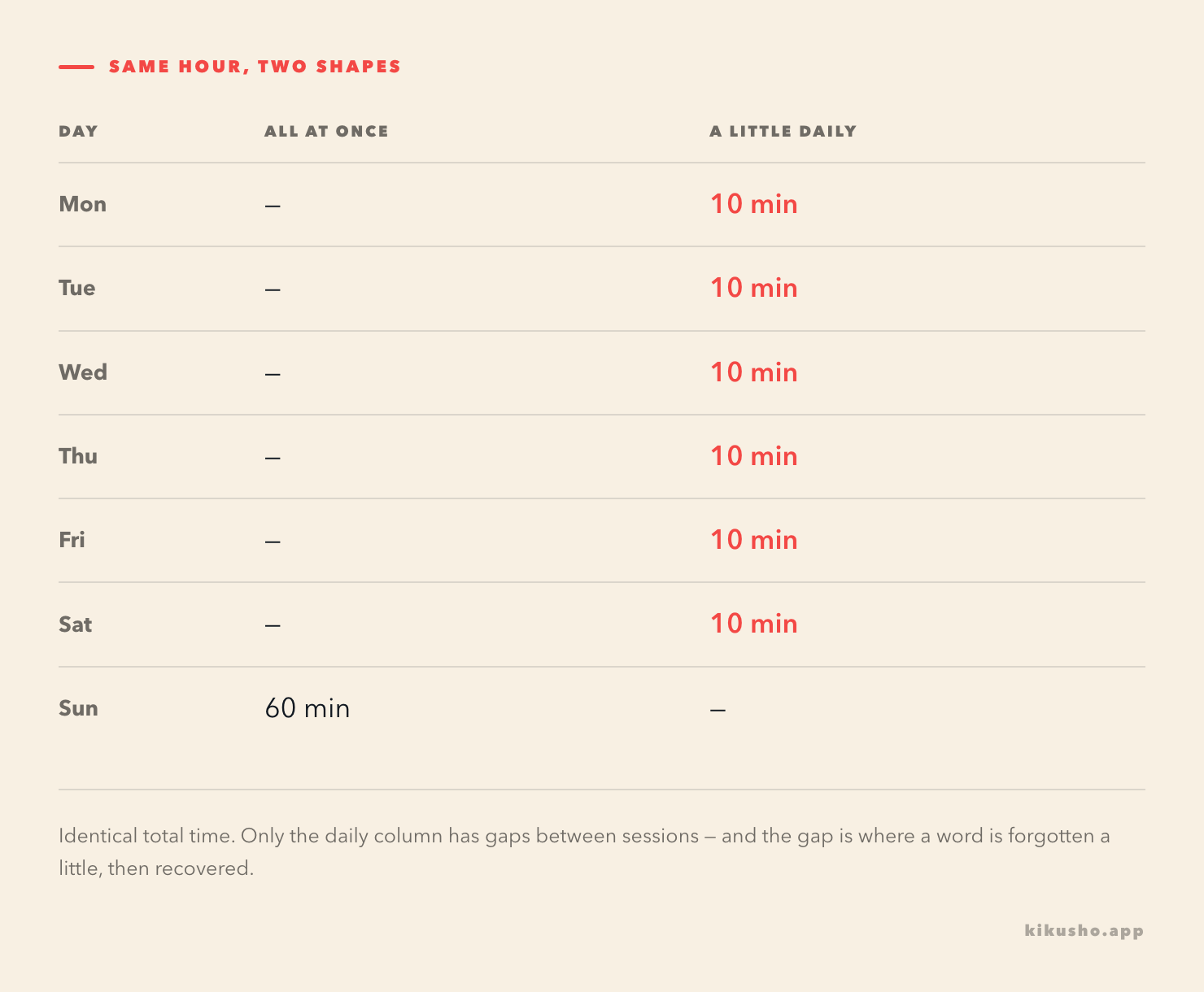
Look at the two columns and notice what is identical: the total time. What differs is the shape. The Sunday block has one enormous gap and then a wall of effort your brain treats as a single event. The daily column has six small gaps, and each gap is a chance for a word to fade just enough that catching it counts. The short session is not a compromise you make because you are busy. It is the better design, and being busy is what makes you accept it.
There is a quieter benefit to the ten-minute version: it survives contact with a real week. An hour is a thing you schedule, defend, and eventually skip. Ten minutes is a thing you do in a queue or before coffee, and a habit that small rarely breaks. The best session length is the one you will still be doing in a month.
The catch: "a little every day" doesn't stay little
Here is the part the cheerful version of this advice skips. Spacing solves how to review what you already have. It does nothing about how much you add, and adding is where a daily habit quietly turns into an unpleasant one.
Every new word you take on is a promise of future reviews. Add ten words today and you have not spent ten minutes — you have signed up for those ten words coming back tomorrow, then in a few days, then next week, on top of everything else already in rotation. The first week hides this, because a young deck has almost nothing coming back yet and the daily session feels breezy. Three weeks in, the reviews those early words generate all start arriving, and the ten-minute session is suddenly twenty-five minutes of pure revision.
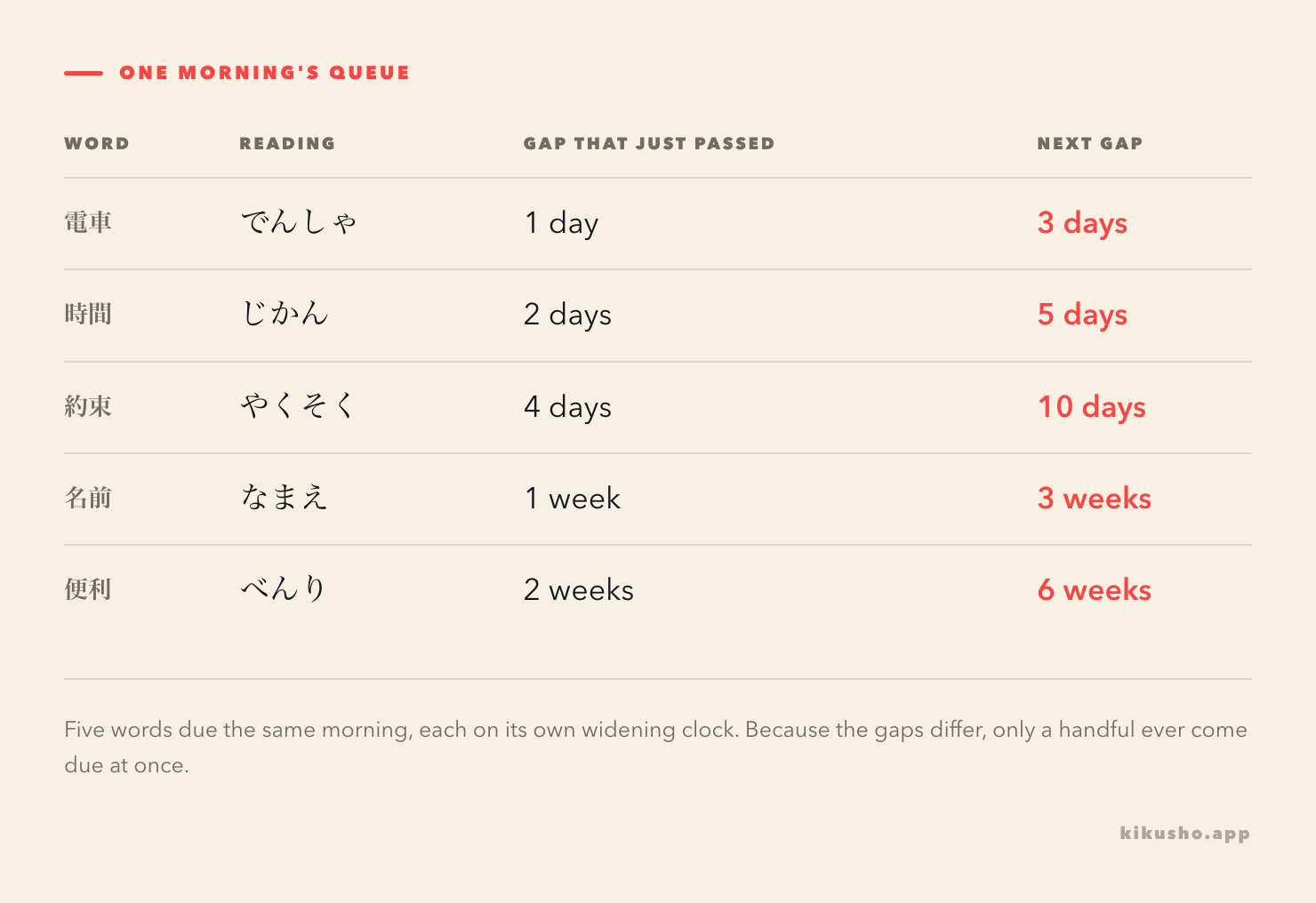
The words in that queue are not all on the same clock. A word you have known for weeks comes back at long intervals; one you met yesterday comes back tomorrow. A healthy deck spreads itself across widening gaps on its own, which is precisely why any single day only surfaces a handful. But that only holds if you keep the inflow modest. The real ceiling on a daily habit is not your attention span — it is how many new words a day you can add before the reviews they generate swamp the ten minutes you promised yourself. Space your reviews, and cap your intake.
What happens on the day you miss
The objection every honest reader has by now: I will not actually study every single day. Good — you do not have to, and the fear of missing is what makes people choose the Sunday block in the first place, reasoning that one guaranteed hour is safer than seven fragile chances at ten minutes.
A missed day is not a broken schedule. It is a slightly longer gap, which is the very thing spacing wants more of, not less. If a word was due Tuesday and you open the deck Wednesday, it has faded a touch further, and recalling it counts for slightly more. A modern scheduler — the FSRS algorithm Kikusho uses — simply serves the overdue cards the next time you show up; nothing is lost, and the intervals adjust around the gap. One skipped day costs you nothing.
What does hurt is turning a run of skipped days into a rescue mission. Skip for two weeks, watch the queue pile up, then try to clear two hundred overdue cards in one grim Sunday session, and you have rebuilt the cram you were trying to escape — with worse morale. The fix for a backlog is never a marathon. It is to stop adding new words, do the daily ten minutes, and let the queue drain over a week. Most of a backlog is words you still know; it clears faster than it looks.
Why "all at once" feels more productive than it is
If daily wins so clearly, why does the long session feel so much better? Because massing produces a sensation that spacing deliberately withholds: fluency. Halfway through a cram, every word is instantly available, and that ease reads as mastery. You are measuring how well you know the words right now, in the session, which is the one moment the measurement is guaranteed to be flattering and useless.
Spacing feels worse for the same reason it works. Each recall is a little effortful, you fail some cards, and you leave the session less certain than you arrived. That discomfort is the signal that the memory is being worked, not confirmed. Trusting the pleasant feeling over the result is the single most common reason capable people keep choosing the shape that teaches them less.
The whole argument reduces to one line: the sitting is what you feel, and the gap is what you keep. Spread the same time out, keep the intake small enough that the daily queue stays short, and let the days you miss be longer gaps rather than emergencies. That is not a harder routine than an hour on Sunday. It is a much easier one that happens to be the one that works.
Common questions
Is it better to study a little every day or all at once?
A little every day, for anything you want to keep. Split the same total time across several days and the gaps between sessions let each word fade a little, so recalling it costs effort — and that effort is what installs the memory. One long session gives your brain no gap to work against, so most of it is gone within a week.
How long should a daily study session be?
Short enough that you never dread it: ten minutes is plenty for reviews once your deck is running. What matters is that it happens most days, not that any one session is long. A missable hour on Sunday teaches less than ten minutes you actually do on Monday, Tuesday and Wednesday.
Does cramming ever work?
Yes, for a deadline. If you need words in your head for a test on Friday, an intense session gets them there. It just does not keep them. Massed study buys short-term recall and pays for it with fast forgetting, which is fine when the deadline is the point and useless when the deadline is the rest of your life.
What if I miss a day — does that break the spacing?
No. A missed day is a slightly longer gap, not a broken schedule, and a scheduler simply serves the overdue words the next time you open it. The thing that breaks spacing is the opposite move: skipping for two weeks and then trying to make it up in one marathon, which recreates the cram you were avoiding.