

On this page
A review session should last exactly as long as it takes to clear the cards that came due today — which, once a deck is running and you show up most days, is usually five to fifteen minutes. The length is not a dial you set. It is a number your schedule hands you, and the way to shorten tomorrow's session is to change what you put into the deck, not how long you are willing to sit.
That is the part most advice skips. "Ten minutes a day beats an hour on Sunday" is true, and the usual explanation is the spacing effect — the gap between sittings is what installs a memory. But there is a second, more mechanical reason the weekly marathon fails, and it has nothing to do with willpower or forgetting curves. A review session can only happen on one day. Your cards come due on many. This article is about that mismatch, and what it means for how you actually run a session.
The length isn't yours to choose — the queue sets it
Reviewing is not studying. When you sit down to review, you are not deciding what to learn or how much of it; you are answering the cards a scheduler has decided are due, and then you are finished. The session ends when the queue empties, not when a timer goes off. So the honest reply to "how long should a review session be" is a question back: how many cards are due? And that count is not something you control in the moment. It was set weeks ago, by how many words you added and how faithfully you turned up.
This is why two people can both "do their reviews" and one spends eight minutes while the other spends forty. Neither of them chose their number. The forty-minute person is not more diligent — they are paying down a larger schedule, usually because they added words faster than they could absorb, or missed enough days that the queue backed up. The length of your session is a readout of decisions already made. Treat it as a symptom, not a setting, and the question stops being "how long should I sit" and becomes "what did I feed this deck".
Ten minutes daily beats an hour on Sunday — and not only for the reason you've heard
Here is the mismatch made concrete. Suppose you review once a week, on Sunday, and you clear the whole deck in one go. It feels thorough. But look at any single card in that pile. A card that came due last Monday has been sitting overdue for six days, decaying well past the moment it should have been caught. A card that will not actually be due until next Wednesday gets reviewed anyway, three days early, while you still remember it perfectly — so the recall is effortless, and an effortless recall teaches almost nothing. One session, on one day, cannot be on time for cards whose due-dates are scattered across a fortnight. It is too late for half of them and too early for the rest.
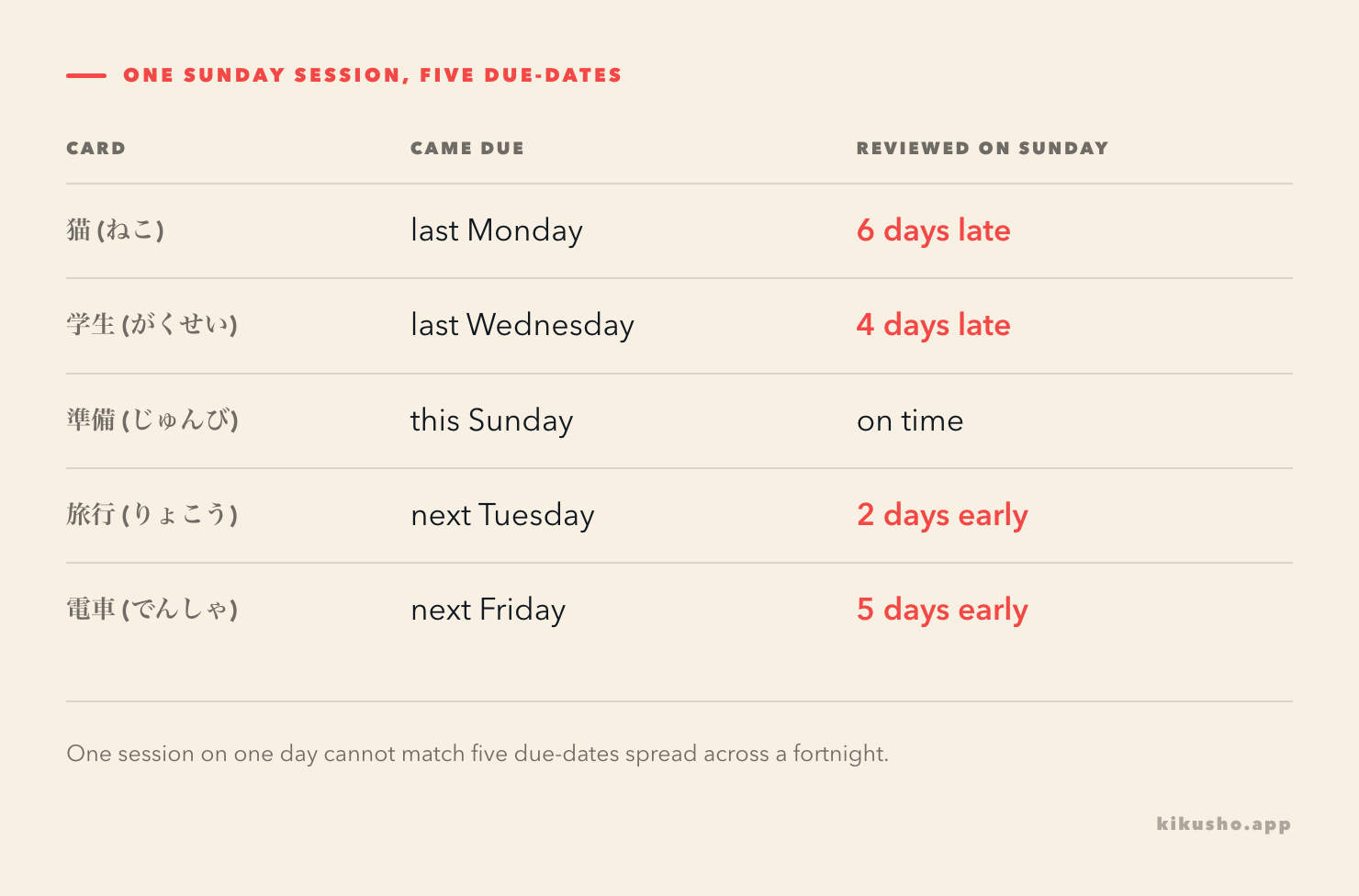
The daily session avoids this not by being longer or more disciplined but by being frequent enough to meet each card near its own due-date. Show up every day and the card due Monday is reviewed Monday, the card due Wednesday waits until Wednesday, and each recall lands when it is meant to — hard enough to count, not so late the word is gone. The ten-minute session wins because it can be on time. The hour on Sunday cannot buy its way out of being on the wrong day.
You can't bank reviews to get ahead
The instinct behind the marathon is that reviewing is work you can get ahead on: do a big batch now and you have covered the week. Reviewing does not behave like that. Each card carries a due-date, and reviewing it early does not push that date meaningfully further out — it mostly spends the repetition for nothing. The value of a review is in the effort of recall, and effort only appears once the memory has had time to fade. Catch a card while it is still fresh and you have paid a repetition to confirm something you already knew.
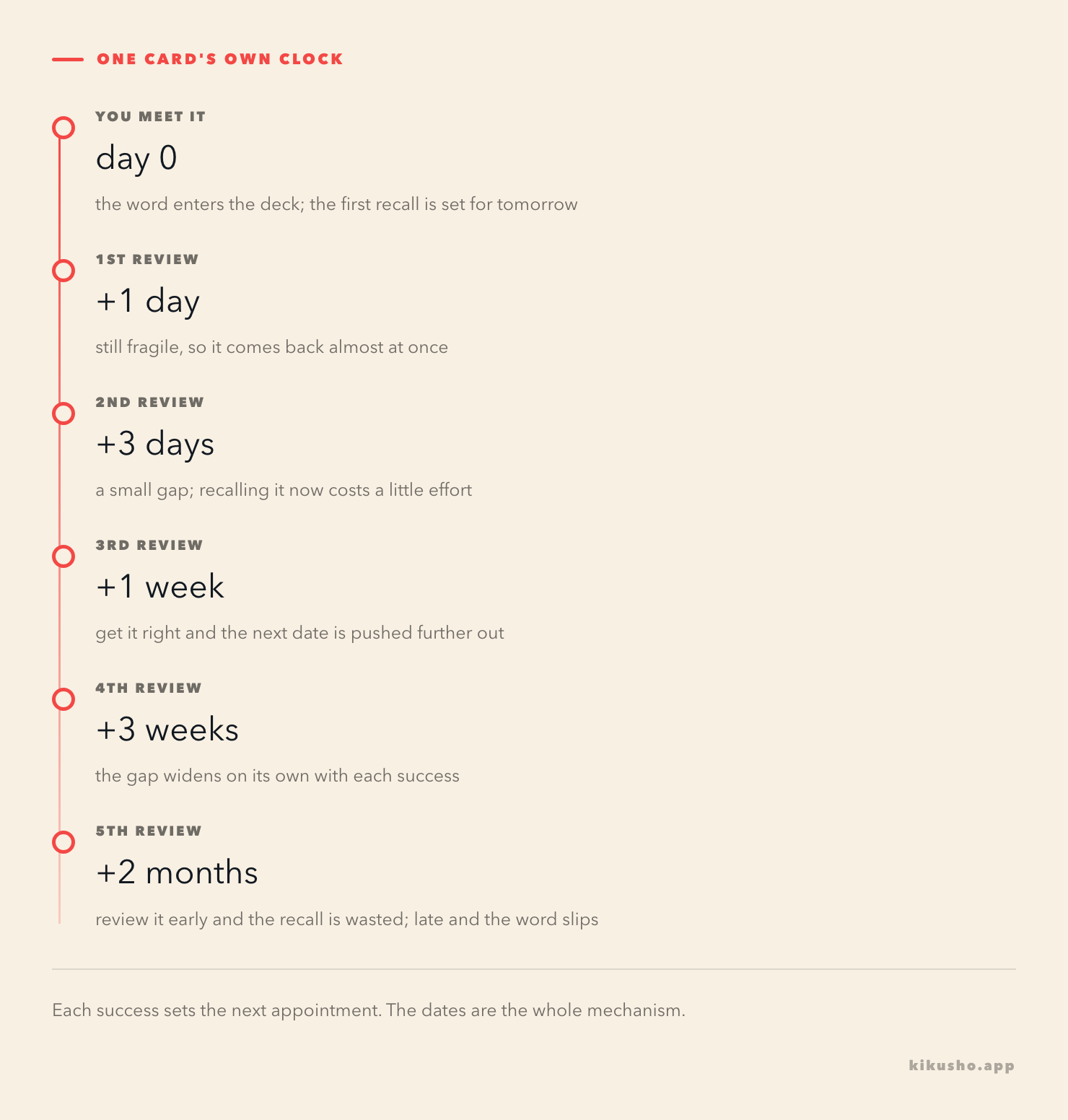
A single card's schedule is a set of appointments, not a standing invitation. You meet the word; the next review is tomorrow; get it right and the one after is a few days out, then a week, then three weeks, then two months, each success pushing the next date further away. Those dates are the whole mechanism. Turning up on the day is the point; turning up early throws the recall away, and turning up late lets the word slip further than the schedule intended. You cannot do next Tuesday's review today any more than you can eat next Tuesday's lunch today and call yourself fed.
This is also why "I'll do extra now so I can skip later" quietly fails. The extra you do now is mostly cards that were not ready, so it buys very little, and the days you skip later are days that real due-cards go unmet. You spend more time for a worse result.
What actually makes a session long is a backlog, not laziness
If your sessions are creeping toward half an hour, the fix is almost never "sit longer." It is upstream, and it is usually one of two things.
The first is intake. Every new word you add is a promise of future reviews, and how many you add is what sets where your daily queue settles. Add five a day and the reviews they generate stay manageable; add thirty and, about three weeks later, the session you promised yourself would be ten minutes is suddenly twenty-five. The words feel free on the day you add them. The bill arrives a fortnight on.
The second is that nothing ever leaves the deck. A card you have known cold for months still resurfaces now and then, and a card you keep failing comes back constantly — a handful of those can generate more daily reviews than a week of new words. A session stays short when the deck is a living thing that both takes cards in and lets them go. When only the inflow works, the session grows until you abandon it.
Missed days are the third, milder cause. Skip enough of them and the overdue cards pile into one queue, which is how a daily ten minutes becomes a dreaded forty on the day you come back. But notice the shape of the cure, because it is the opposite of the instinct: you do not clear a backlog with a marathon. You stop adding new cards, do your normal short session daily, and let the pile drain over a week. Most of a backlog is words you still know, so it clears faster than it looks.
Clear the queue, don't watch the clock
All of this points to a plain rule for running a session: finish the due cards, then stop. Do not set a timer and quit halfway, because the cards you leave behind do not wait politely — they roll into tomorrow and make tomorrow's session the longer one. And do not keep going once the queue is empty, hunting for more to review, because the only cards left are ones that are not due, and reviewing them is the wasted effort from the section above.
If clearing the due cards honestly takes longer than the time you have, that is real information, and the answer is still not a timer. It is to switch off new cards until the queue comes back down, and to spend two minutes retiring or repairing the handful of cards you fail every single time. The session length corrects itself once the deck is healthy again.
There is one part of a session you can cut when time is short, and it is the new cards. Reviews are the appointment; new cards are optional extras you tack on when there is room. On a rushed morning, do the reviews and add nothing. Skipped reviews cost you, because they come back heavier. Skipped new words cost nothing at all — the word will still be there next week. Getting that order backwards, adding new cards on a day you could not even finish yesterday's reviews, is the fastest way to turn a ten-minute habit into an abandoned one.
This is also where reviewing on a phone earns its keep. A session small enough to finish in a queue, on a platform, in the two minutes before a meeting is a session that survives a real week — and because Kikusho keeps its cards and audio on the device, the tunnel and the plane are ordinary review conditions rather than excuses. The best session is the one short enough that you never have to schedule it.
When a longer session is actually the right call
There is one honest exception. If you have a deadline — a test on Friday, a trip next week, a conversation you need particular words for — then a long, massed session is a legitimate tool, and it will get those words into your head for the occasion. Cramming works exactly as well as it feels, and for exactly as long as you need it not to fail. The catch is that it buys short-term recall and pays for it in fast forgetting, so the words are mostly gone the week after. That trade is fine when the deadline is the whole point. For a language you intend to keep, the deadline is the rest of your life, and there is no all-nighter for that. Space the reviews, keep the daily session short, and let its length be whatever a healthy deck hands you.
Common questions
How long should a review session be?
As long as it takes to clear the cards due that day — for most people with a running deck, five to fifteen minutes. You do not set the length; the number of due cards does, and that was decided weeks ago by how many words you added and how often you showed up. If the session is consistently long, the fix is fewer new cards, not a longer sitting.
Should I set a timer for my reviews?
No. Clear the due queue and then stop, rather than reviewing to a clock. Quitting at a timer leaves overdue cards that roll into tomorrow and make the next session longer; carrying on past an empty queue only reviews cards that are not due yet, which wastes the recall. If the due pile is bigger than your time, turn off new cards until it shrinks.
If I have spare time, should I review ahead to get it out of the way?
It does not help. A card reviewed before it is due is recalled while you still remember it easily, and an easy recall teaches almost nothing, so you cannot bank reviews the way you can get ahead on chores. Spare time is better spent fixing the few cards you keep failing than reviewing cards that are not ready.
Does a longer session help before a test?
For a deadline, yes — a long, massed session will get specific words into your head for Friday. It just will not keep them; crammed words fade fast once the deadline passes. Use it when passing the test is the point, and go back to short daily sessions for anything you want to still know next month.