ば and なら: conditions and advice
なら takes up a condition someone already raised; ば supplies its own. The test that tells them apart, and why ば can't carry a request.
14 September 2026 KikushoDownload
 The Kikusho blog
Practical writing on Japanese, memory and spaced repetition — how vocabulary sticks, why decks die, and what to do about the words you meet every day.
なら takes up a condition someone already raised; ば supplies its own. The test that tells them apart, and why ば can't carry a request.
14 September 2026
Japanese counts with two sets of numbers, and you need both from week one. Every reading for 1 to 10,000, why 4, 7 and 9 have two, and how a price is read.
14 September 2026
の links one noun to another, and possession is only its most famous job. How it attaches, the relationships it carries, and the one place it never goes.
14 September 2026
べく and んがため both mean 'in order to' in formal Japanese. Each hangs off a different verb stem, and that stem is how you tell them, and せん, apart.
13 September 2026
N4 degree adverbs hide a grammar rule: 全然 and ちっとも force the verb negative, ほとんど flips its meaning with it, and 最も means most, not extremely.
13 September 2026
Duolingo runs spaced repetition, but only over its own course. Here is the gap it leaves, and whether you need Anki for the words you meet elsewhere.
13 September 2026
Both ~はず and ~べき turn into "should" in English, but one is a prediction and the other a judgement. The one test that tells them apart, with N3 examples.
13 September 2026
At N1 the kanji look easy and the reading is the trap. 玄人, 仲人 and 土産 read nothing like they look. How to recognise them, and why the reading is the test.
13 September 2026
N3 vocabulary turns abstract, and nearly every new noun is two kanji welded together: learn to read the pieces instead of memorizing eight new sounds.
13 September 2026
取材, 発表, 発行 and 報道 look interchangeable in a dictionary. In an actual newsroom they name four different steps, and 世論 carries a spelling reform inside its two readings.
13 September 2026
にあたって marks the run-up to a milestone; に際して marks the moment itself. Same dictionary translation, and a different sentence each time you pick wrong.
13 September 2026
Five N4 words share one mechanism: fuse a verb stem to a second verb, and the second one carries every bit of the conjugating.
12 September 2026
Nineteen N5 verbs that carry one ordinary day: get up, wait, work, eat, sleep, each paired with the object or particle it actually takes, not a-i-u-e-o order.
12 September 2026
Come back to hundreds of overdue Anki cards? A week away doesn't erase your progress. Cap how many you clear a day and the backlog drains fast.
12 September 2026
Both mean the window is open. てある says someone opened it on purpose; ている just reports the state — and you commit to which one word early, at the verb.
12 September 2026
と names a result nobody had to choose; たら names what happened once something became true, including a plan. The test that tells them apart.
12 September 2026
A verb's dictionary form decides how it conjugates. The test that separates the two groups, the exceptions that break it, and how each becomes ます.
12 September 2026
わけ marks a conclusion implied by context: だ affirms it, ではない denies it partly, がない denies it could ever hold. Mixing up the last two changes what you claim.
12 September 2026
〜てしまう marks an action as finished and past undoing. The regret everyone teaches is a consequence of that, not a second meaning to learn.
11 September 2026
A review session is as long as the cards you owe today — usually about ten minutes. Why you don't set that length, and why a weekly marathon backfires.
10 September 2026
Nearly all manga prints furigana over every kanji, so the character count is not what stops you. The real wall is dialogue written the way people talk.
10 September 2026
Handwriting a word feels like it lodges it, but the pen was never the reason it stuck. What actually fixes a word in memory, and why typing does it too.
8 September 2026
Highlighting a word marks it; it doesn't teach it. What builds the memory is recalling the word later from nothing — and a highlight quietly prevents that.
7 September 2026
The same word turns up in kanji one place and kana another. For most words that is a register-and-readability choice, not a right answer — here is how to read it.
6 September 2026
Everyone says learn words in sentences. Here is what the sentence actually carries — the particle, the words it travels with, the register — that a lone word can't.
6 September 2026
Japanese drops the subject because the sentence already encodes who: giving verbs, feeling words and honorifics all point to a person. Here is how to read them.
4 September 2026
You know the word, then it vanishes the moment you need to say it. Understanding and producing are two different skills, and most study trains only one.
3 September 2026
A downloaded deck teaches someone else's words in someone else's order, anchored to nothing you lived. Why that fails — and what to build instead.
2 September 2026
The four review buttons aren't a difficulty score — they tell the scheduler how fast a memory is fading, and that is what really sets when you see the card next.
31 August 2026
Japanese groups digits by four, not three, so a million is 百万 — a hundred ten-thousands. Why big numbers stall you, and the comma trick that fixes it.
30 August 2026
Stroke order matters for handwriting and dictionary lookup, not for reading or typing. How much to learn if you capture and review instead of writing by hand.
30 August 2026
Textbook Japanese sounds stiff because it teaches the one register that's safe to teach: explicit and fully polite. What sounds natural is mostly what natives leave out.
29 August 2026
Japanese has no spaces because it doesn't need them: the switch between kanji, hiragana and katakana marks every word boundary. Why, and how to read it.
28 August 2026
The same study hours split across days beat one long session, because the forgetting between sittings is the mechanism that installs the memory.
25 August 2026
You know every word, yet the sentence blurs past. Spoken Japanese drops the gaps, wears down the vowels and fuses whole phrases — and that is what to train.
24 August 2026
There is no magic number. Seeing a word again barely installs it; the recall you do later, not the sighting, is what makes it stick.
21 August 2026
You can read the katakana perfectly and still not get the word. Japanese rebuilds a loanword's sound, cuts its length, and often moves its meaning.
19 August 2026
Look-alike kanji stop competing the moment you meet them inside a word. Why the pairs confuse, and why studying them side by side makes it worse.
18 August 2026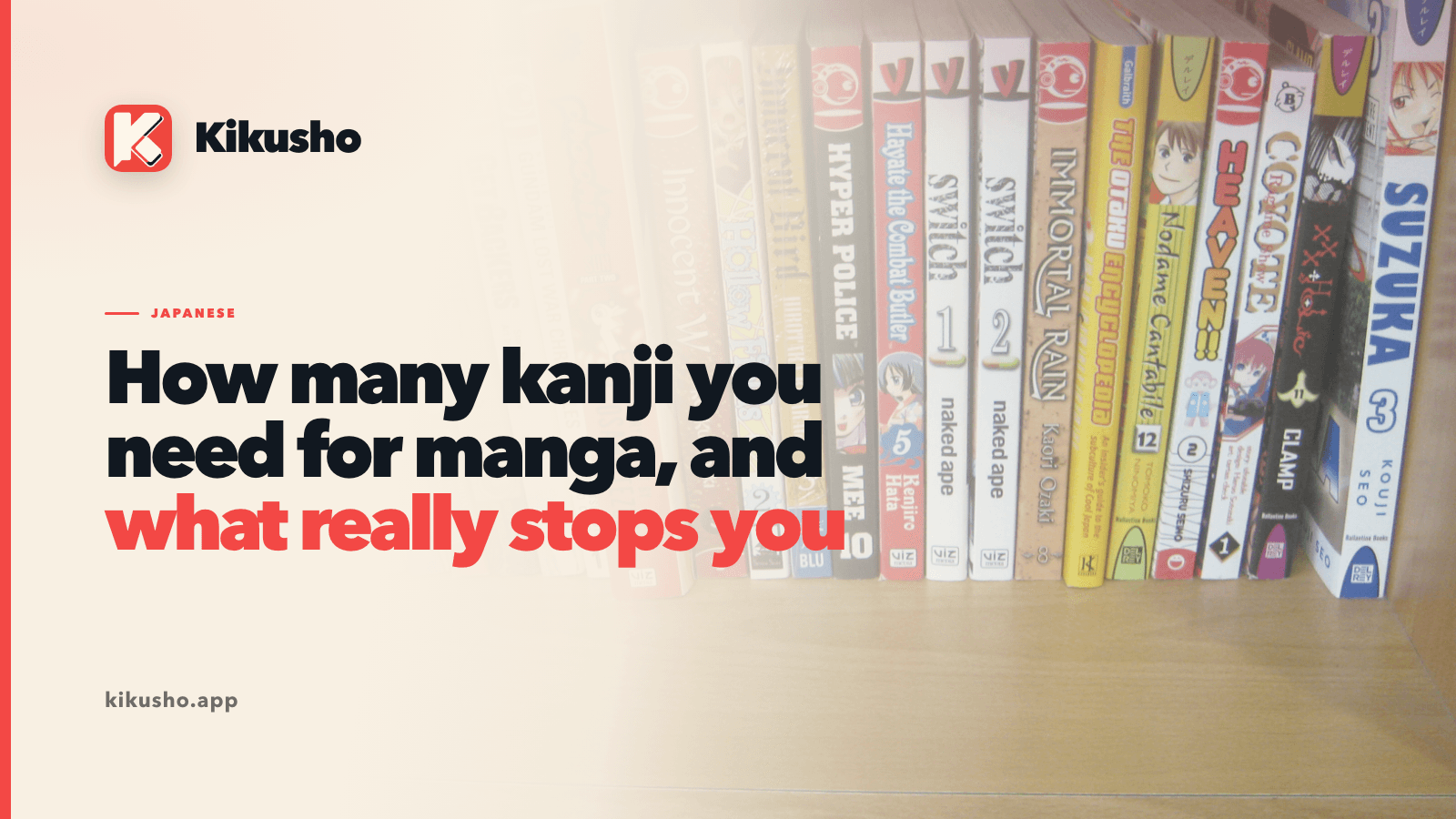
Most shōnen manga prints the reading above every kanji, so the character count is not the wall. What stops you is the spoken register underneath.
17 August 2026
Japanese first-person words are nouns, not pronouns, so each says something about you. The commonest choice of all is to leave the word out.
17 August 2026
A deck becomes a chore when cards only ever arrive. Here is what should be leaving it, when a card is safe to retire, and how to run the pass.
16 August 2026
Japanese has hundreds of counters and you will use about six. Which ones matter, why the numbers reshape them, and what to say when one escapes you.
16 August 2026
Pitch distinguishes fewer words than the famous pairs suggest, and context settles most of them. What it costs, what it buys, and when to start.
14 August 2026
は marks what you and your listener already share; が introduces what they do not yet know. The rule that settles the cases a textbook leaves ambiguous.
13 August 2026
A kanji carries a borrowed Chinese sound and a native Japanese word, sometimes several of each. Where they came from, and how to tell which one applies.
12 August 2026
Five to fifteen a day suits most people, but the ceiling is not attention span: it is the review load today's new cards create three weeks from now.
11 August 2026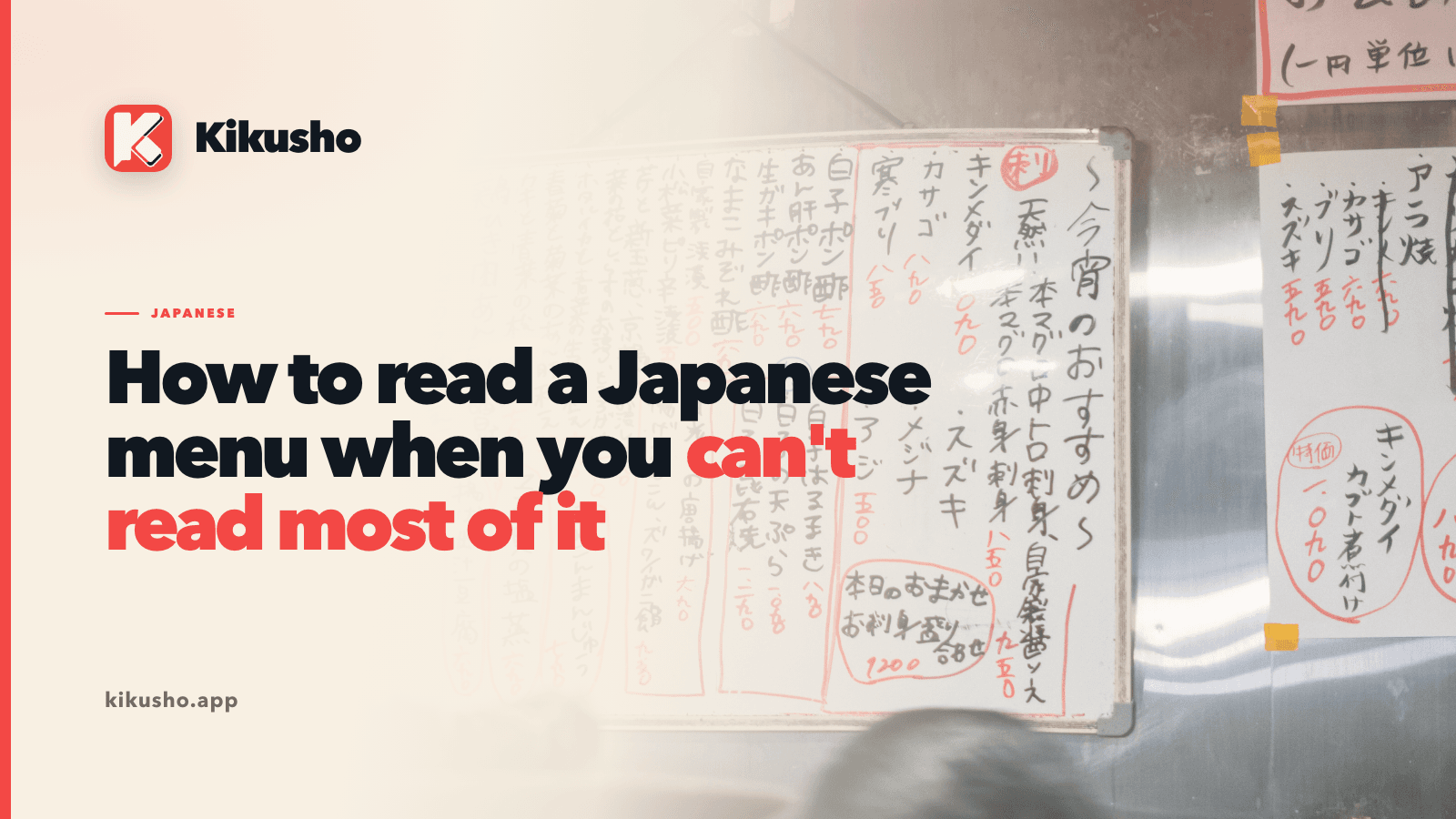
You don't need to read the whole menu: the price, a short list of repeating words, and a way to hold onto the one word that stops you.
11 August 2026
Keigo is not a second vocabulary. It is three levels, two productive patterns and about eight irregular verbs — here is how they fit together.
10 August 2026
The Japanese on signs, menus and in conversation is the vocabulary most worth keeping. Here is how to hold on to it without a study session.
10 August 2026
You forget new words because memory decays on a schedule, and because nothing brought you back at the right moment. Here is what changes that.
10 August 2026Sections
Kanji, readings, politeness levels and the practical mechanics of keeping Japanese vocabulary you meet in the wild.
20 articles →Every level, grammar and vocabulary apart: what each point does, where it stops, and which of two forms the sentence in front of you wants.
17 articles →Spaced repetition, memory, immersion and the habits that decide whether a word survives the week you met it.
13 articles →