On this page
There is no fixed number, and the figures you have seen quoted — seven, seventeen, a hundred and sixty — are answers to a question you did not quite ask. They count how many times you see a word, and seeing a word is close to the least effective thing you can do with it.
What actually moves a word into memory is retrieval: the moment you pull it back out yourself, with the answer hidden. Counted in retrievals rather than sightings, most words take a small handful of tries, provided the tries are spread out and each one costs you a little effort. The number you are looking for is real. It is just measuring the wrong event.
The figures that circulate are real, and they measure the wrong thing
The reason the quoted numbers disagree so wildly is itself the tell. If a word reliably needed some count of exposures, the estimates would converge on it. Instead they run from a handful to well past a hundred, because they mostly measure incidental exposure: meeting a word while reading or listening and doing nothing deliberate about it. That is the slowest way a word ever enters memory, so the counts come out high and unstable.
More to the point, the exposure count is a lever you cannot pull. You cannot decide to see a word a hundred and sixty times on purpose, and waiting for it to come around again is mostly waiting. What you can change is what you do at each encounter, and that changes the number far more than any amount of repetition left to chance.
Seeing a word and remembering it are two different events
When you re-read a word and think, yes, I know that one, you are feeling recognition, not recall. The word is sitting right in front of you, doing most of the work; your memory only has to confirm it. Recognition is real, but it is shallow, and it flatters you into believing the word is learned.
Everyone has met the gap it hides. You follow a subtitled line and understand it completely, then cannot produce a single word of it an hour later. Re-reading your notes, highlighting, playing the same track again, all of it lives on the recognition side. It feels productive because the text gets easier each time. But ease of reading a word is not the ability to summon it, and only the second one is what you were counting toward.
A retrieval is worth more than a sighting, and a hard one worth more than an easy one
The active version costs almost nothing to arrange. Cover the meaning and try to produce the word before you check. Whether you succeed or not, the act of reaching for it does more for the memory than another passive look would. This is retrieval practice, and for the same minutes spent it beats re-reading by a wide margin.
There is a second rule stacked on top, and it is the less obvious one. The harder the retrieval — the closer you came to failing — the more it strengthens the memory. A word you rattle off instantly has little left to gain. A word you dredge up after a pause, almost losing it, gains a great deal. Difficulty you can just barely overcome is not the price of learning here; it is the mechanism. Which is why breezing through easy cards feels good and teaches little.
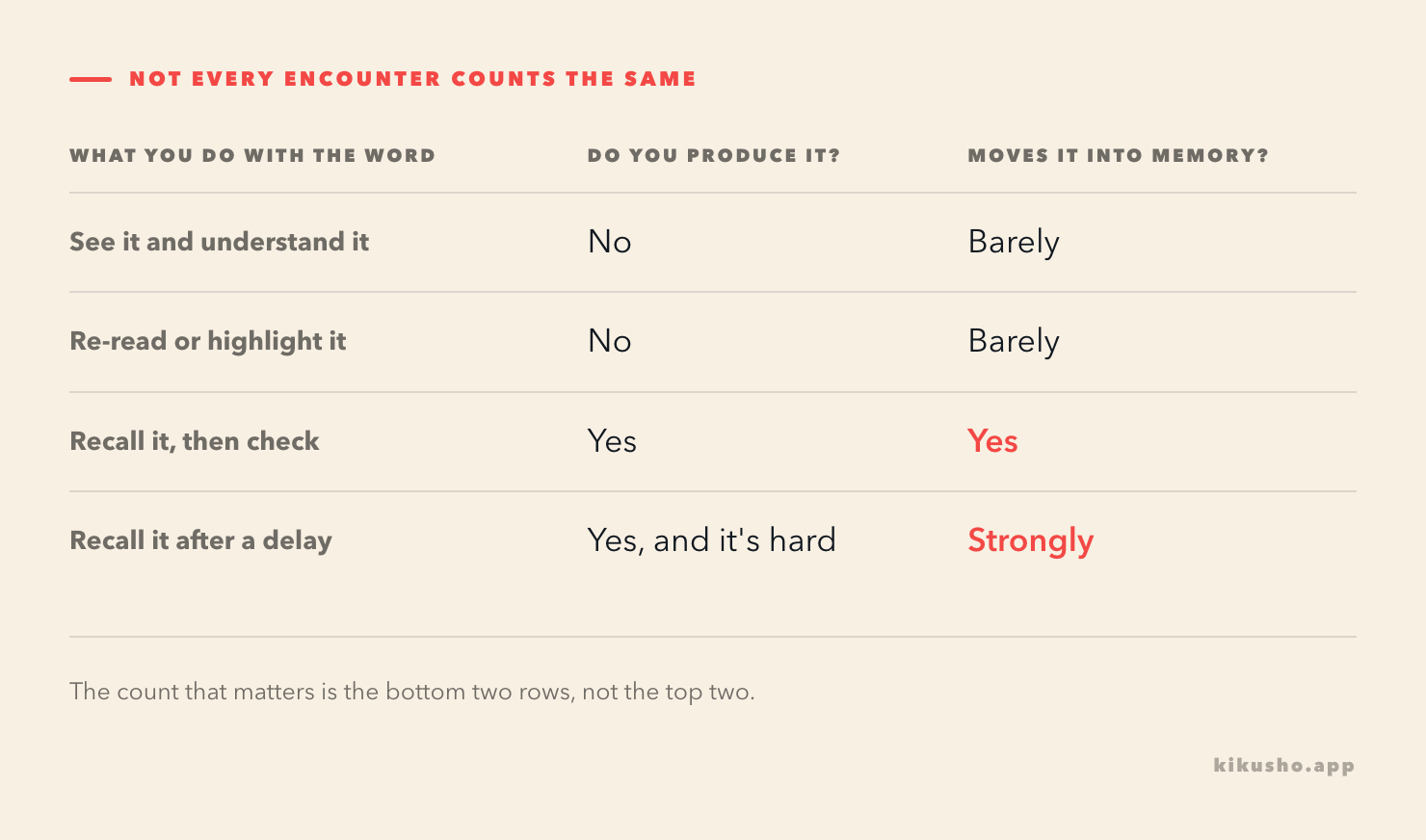
Read down that last column and the counting problem reframes itself. The sightings barely register. The rows that install the word are the ones where you produced it from memory, and the strongest is the one where producing it was hard.
Spacing is what turns a few recalls into a memory
There is a catch built into the difficulty rule. To make a recall hard, you first have to let a little forgetting happen. Test yourself thirty seconds after meeting a word and it is trivial: the word never left your short-term memory, and you gain nothing. Wait until tomorrow, when it has half-faded, and the same recall suddenly counts.
So the recalls have to be spaced, and the gaps should widen as the word gets more secure. This is why a word can slip away no matter how many times you saw it in one afternoon: massed exposure gives your memory nothing to work against. Vocabulary decays on a schedule, and the repair is to arrive back at each word just as it is about to go. Three or four well-timed recalls will hold a word that twenty re-readings in a single sitting will not.
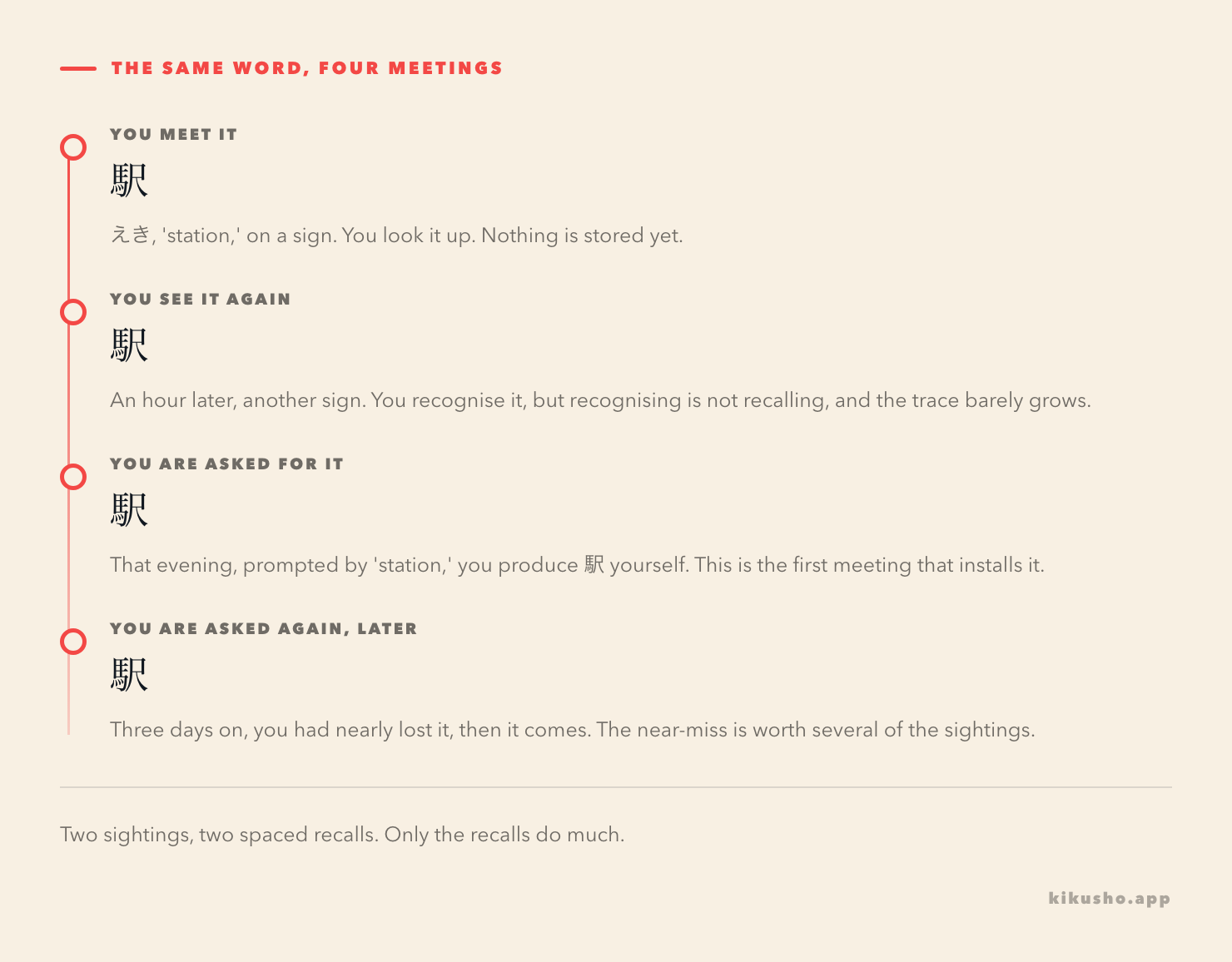
Two of those four encounters were sightings that added almost nothing. And the title's question, how many times, has quietly turned into a different one: how many spaced recalls, each a little hard.
Exposure still matters, as the raw material and not the method
None of this makes seeing a word pointless. You cannot retrieve a word you have never met, and the encounters you get from reading and listening widely do real work: they teach you a word's shades of meaning, the company it keeps, the situations it belongs to. Retrieval sharpens a memory. Broad exposure is what gives it something worth sharpening.
The mistake is treating exposure as the whole method and waiting for repetition alone to finish the job. Think of it as two stages. Meeting a word in the wild is how you find the ones worth keeping and how you flesh them out. Recalling them on a schedule is how you make them yours. Learners who plateau usually have plenty of the first stage and almost none of the second: a great deal of input, and no moment where anything asks them to produce what they took in.
Why one word takes two tries and another takes ten
The count refuses to settle into a single figure because it depends on the word and on you. A concrete word for something you can picture — a station, a bowl, a bridge — lodges faster than an abstract or grammatical one. A word that hooks onto things you already know arrives half-learned: a compound built from kanji you can read, or a loanword whose source you recognise, though katakana disguises that source more often than you would hope.
Interference pushes the number the other way. Two words that look or sound alike compete every time you reach for one, and the competition inflates the count for both. Meeting them together, as a confusable pair, is the surest way to keep them entangled. And plain salience matters: a word you needed in order to be understood, right then, at a counter or in an argument, is often nearly learned on the first encounter, while the same word met on a list needs many more.
So how should you actually study a word?
Stop counting sightings, and start counting successful recalls. The shift is small, and everything downstream changes with it.
The first time you meet a word worth keeping, do not just look it up and move on. That is one exposure, and on its own it evaporates by evening. Turn the word into something that will come back and ask you for it later, which is all a spaced-repetition card really is. A scheduler like FSRS then times those questions to land when the word is nearly forgotten, so each recall falls in the difficult, useful zone instead of the easy, wasted one. Kikusho exists to make that first step take about three seconds: point the camera at the word, or say it aloud, and it comes back as a card on a schedule, with the reviews themselves never counted against you.
From there, aim not for a magic number of repetitions but for a few spaced recalls, each slightly effortful. Let the easy words stretch out on their own, and spend your attention on the ones that fight you. Remember that every new word you take on is a promise of future recalls, which is the real thing that caps how many you can add in a day. Count that way and the answer to the title stops being a number at all. It becomes a shape: meet the word, lose it a little, find it again, and again, at growing distances, until finding it is no longer work.
Common questions
Is there a real number of times you need to see a word to remember it?
No single number holds. The figures that circulate, from a handful of exposures to well over a hundred, mostly measure meeting a word passively while reading, which is the slowest route into memory. Once you switch from re-seeing a word to recalling it from memory, most words need only a few well-spaced tries.
Does re-reading or highlighting a word help at all?
A little, as raw exposure, but far less than it feels. Re-reading builds recognition, the sense that you know a word when it is in front of you, not recall, the ability to produce it when it is not. For the same time spent, covering the meaning and testing yourself does much more.
How far apart should the recalls be?
Far enough that each one is slightly hard. Recall a word the same day you met it, then the next day, then after a few days, then a week or two, letting the gaps grow as it becomes secure. Recalling a word just as you are about to forget it is what makes the encounter count, and a spaced-repetition scheduler picks those moments for you.
Why does one word stick in two tries and another take ten?
Because the count depends on the word and on you. Concrete words you can picture stick fastest, words that connect to things you already know arrive half-learned, and words that look or sound like something else compete with it and take longer for both. A word you genuinely needed at the moment you met it is often nearly learned the first time.