On this page
Google Translate answers a different question than a dictionary does. It tells you what a sentence probably means right now; a dictionary tells you what a word is: how it is read, how formal it sounds, which of its two or three senses is in play. The first answer gets you through the line in front of you. The second is the one you keep, and it is the part a single translated line leaves out.
Translate is built for the sentence, a dictionary for the word
The two tools sort themselves by what you want from them. Translate is a sentence machine: feed it a line and it returns the likeliest meaning of the whole line, smoothing over each word so the sentence reads cleanly. A dictionary is a word machine: ask it about 辛い and it does not decide which 辛い you meant, it lays out both and leaves the choice to you.
So the deciding question is not "which is more accurate," it is "what am I doing." Getting the gist of a notice, a chat reply, a road sign: that is Translate's job, and it is fast and good at it. Learning a word you expect to meet again: that is a dictionary's job, and Translate cannot do it, because the thing that makes a word learnable is the thing it discards to produce a clean sentence.
Where Google Translate is the right tool
None of this makes Translate a bad tool. It is a good tool aimed at a narrow job: turning text you cannot read into a sentence you can act on.
In front of a station sign, a train announcement, a form at the ward office, an email from a landlord, you do not need to learn those words. You need to know what they say in the next ten seconds. Point a camera at them and Translate earns its keep. The same holds for a restaurant menu when you cannot read most of it: if the goal is to order lunch, a rough rendering of the dish names is plenty, and opening a dictionary for each one would be perverse.
The trouble begins only when the sentence you translated contained a word you actually wanted, and you let the translation stand in for knowing it.
What a dictionary entry keeps that a translation drops
Open a dictionary entry for one word and look at its shape. It is not a line. It is a small structured record: the headword, its reading in kana, its part of speech, a numbered list of senses, a register label where one applies, and an example or two of the word in use. Each of those fields is a separate fact, and each is something you might need later.
Look up 結構 and the entry does not hand you one word. It lists it as a な-adjective meaning splendid or fine, as an adverb meaning considerably, and as a set phrase used to decline politely. Three senses, plainly separated, so you can see the word has a range before you ever have to choose inside it. A translation collapses all of that to the single cell your sentence happened to require.
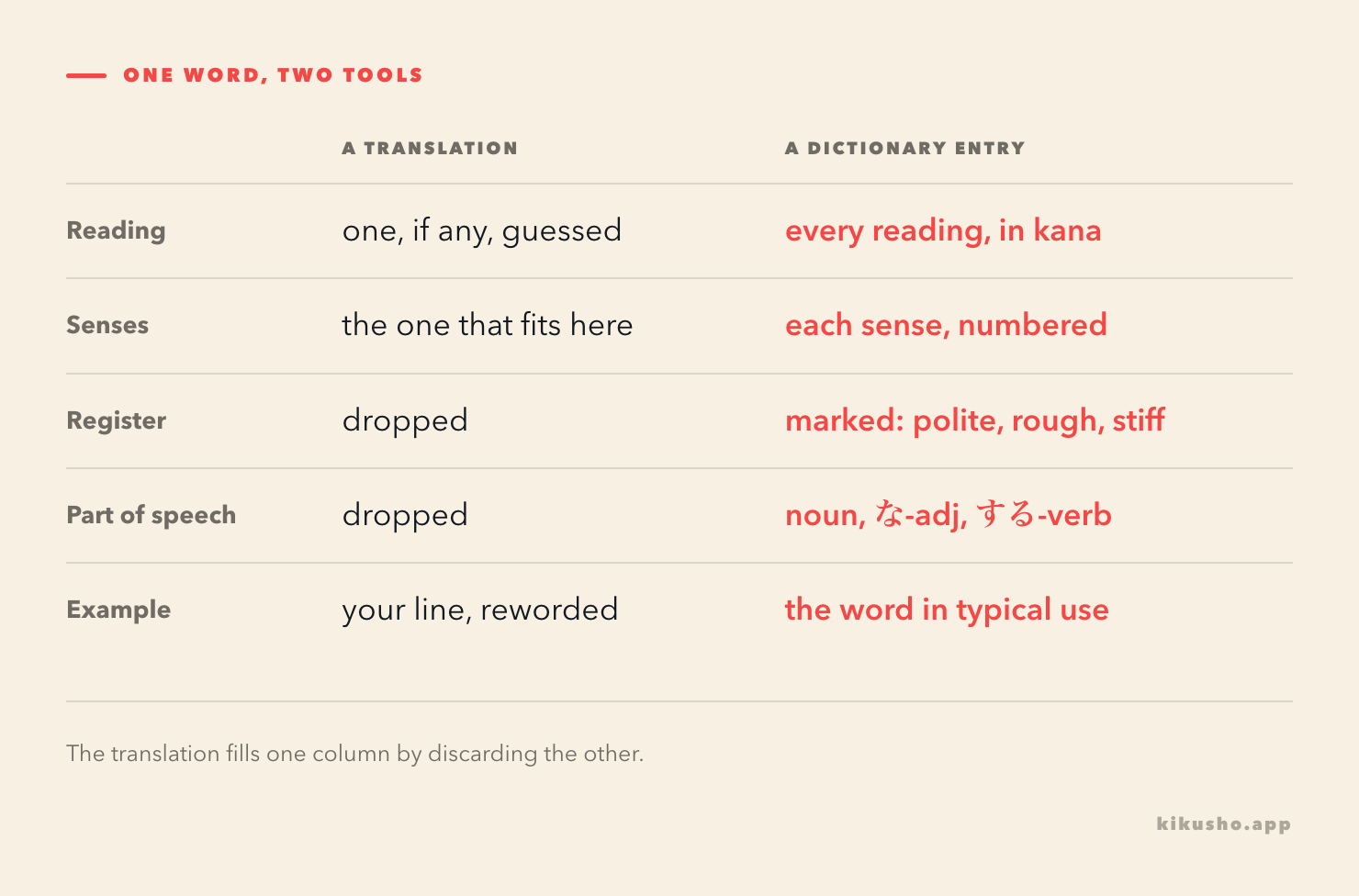
The grid is not saying Translate is wrong. It is saying Translate answers with one cell and hides the rest of the table, and the hidden cells are the ones that turn a word you met into a word you know.
The reading a machine has to guess
The gap shows most clearly in the reading. Japanese writes many words with kanji that carry more than one reading, and the reading is not a detail: it is how you say the word, how you would look it up again, and often which meaning is intended.
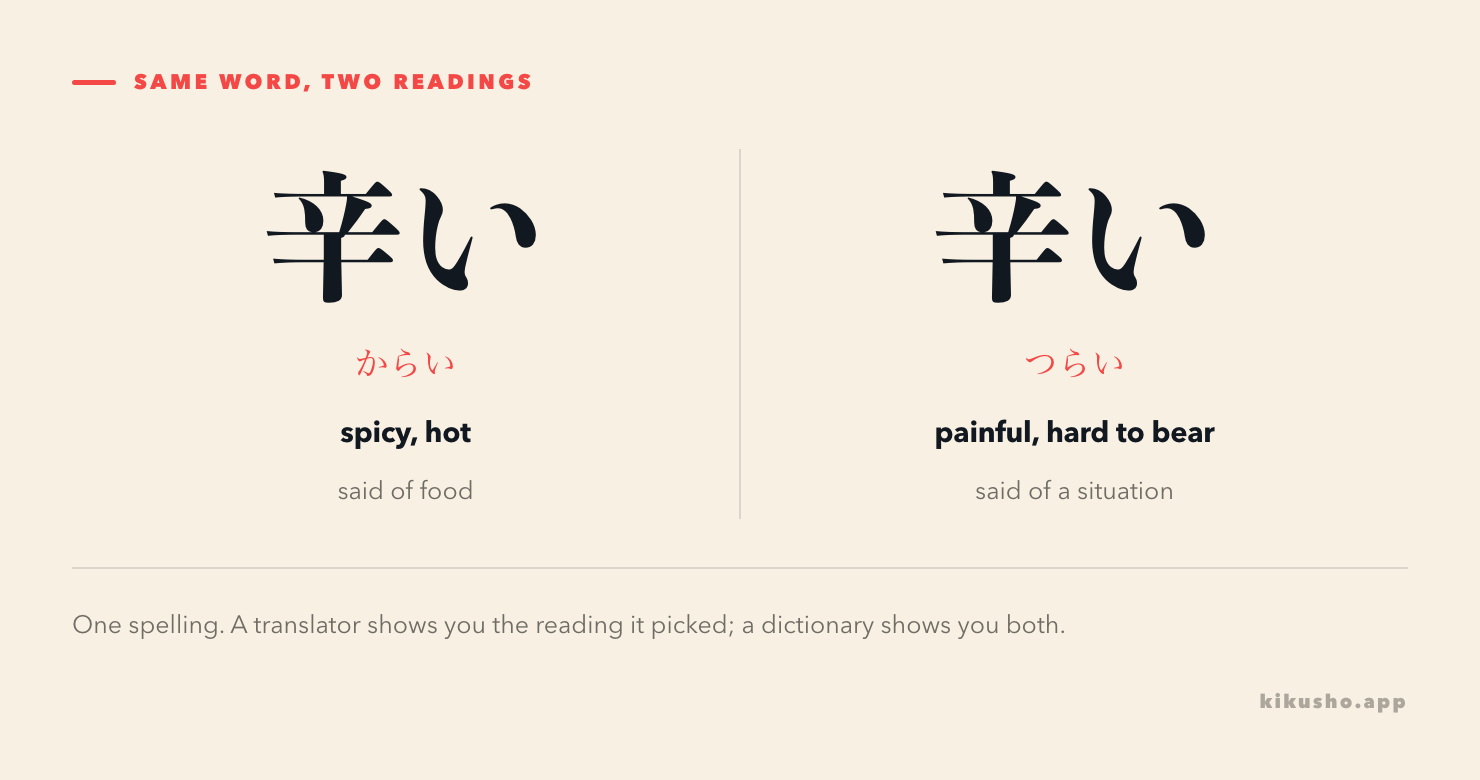
辛い is the standard case. Read as からい it means spicy; read as つらい it means painful, hard to bear. In a full sentence, context usually settles it: この料理は辛い is a spicy dish, 毎日が辛い is a hard life, and a translator handling the whole sentence will often pick right. The failure shows when you do the thing a learner does most: tap the one word you did not know. Out of its sentence, 辛い has no context to lean on, so the tool commits to one reading and shows you only that one. If it guesses からい where the writer meant つらい, there is no warning; you get a clean, wrong answer. A dictionary declines to choose for you, which is the correct response, because a single kanji can carry several unrelated readings. The reading matters for a blunt practical reason too: if you learned the wrong one, you cannot find the word again by ear or type it into a search box, so a single bad guess closes the door on the word.
The register that does not survive translation
Meaning is only half of what a word carries. The other half is register: how formal it is, how warm, who you are allowed to say it to. Register is the first thing a translation flattens, because English often has no single word that preserves it.
貴様 (きさま) comes back as "you." So does あなた, and 君, and お前. A translator gives you "you" for all four and moves on. But 貴様 is hostile, close to a snarl; あなた is neutral to distant; 君 is familiar, often spoken downward in rank; お前 is rough or intimate depending on who says it. The English word is identical and the social charge is opposite. The same flattening hits 結構 again, a word of praise in one sentence and a polite refusal in the next: a translation picks whichever the sentence needed, and you never learn that the word does both. When you are trying to work out how politeness works in Japanese, a tool that deletes register is worse than no tool, because it hands you a confident answer with the load-bearing part removed.
Why the gap is wider for Japanese than for most languages
If you have used Translate happily for a European language, the warning here can sound overblown. The difference is that Japanese loads more onto each word, so a translation has more to throw away.
Three things stack up. A spelling can map to several readings, so the pronunciation itself is in doubt in a way it rarely is in Spanish or French. The politeness system is grammatical rather than optional, so every verb and many nouns carry a register English has no slot for. And the language routinely drops the subject, so a translator is often guessing who is doing what before it even reaches the word you cared about. Each of these is a place the machine has to fill a gap by choosing the likeliest option, and each choice is a fact it then presents as though it were the only one.
The overlap, and the bill that comes later
There is real overlap, and it is worth naming, because it is where the mistake feels reasonable. Ask both tools what 結構 means and both answer with the word "meaning" in them. That is the trap. Translate gives you the meaning here, in this sentence. A dictionary gives you the meaning of the word, which is its whole range. When you only ever need the first, the two look interchangeable, and Translate is faster, so you take it.
This gap is the reason Kikusho drafts a card from a word rather than from a translation. When you hand it something you met, a photographed line, pasted text, a phrase you say out loud, what it files is the dictionary-shaped version: the reading, the sense that fits, a register note, an example sentence and native audio, laid out on a review screen you approve before anything is saved. A flattened gloss is enough to finish reading the sentence. This is the version you can still recall a month later.
The cost of the shortcut is invisible when you pay it and obvious the second time. You meet 結構 again, in a sentence where "fine" makes no sense, and you find you never learned the word: you borrowed one of its faces and handed it back. A translated sentence is spent the instant you understand it. The word inside it was the only part worth keeping, and it is the part a translator was never built to give you.
Common questions
Is Google Translate accurate enough for Japanese?
It is good enough to get the gist of a whole sentence and unreliable for anything that turns on a single word. To produce a clean sentence it commits to one reading and one sense and hides the alternatives, so for understanding a notice it is fine, but for learning a word it drops the reading, register and other senses a dictionary keeps.
Why does Google Translate get Japanese readings wrong?
Because many kanji spellings map to more than one reading. 辛い is からい (spicy) or つらい (painful), and a translator must pick one to build a sentence. It shows you the reading it chose, not the fork, so a wrong guess reads as a confident, clean sentence with no sign anything is off.
Can I trust Google Translate for politeness and formality?
No. Register rarely survives translation. 貴様, 君 and あなた all come back as "you" even though their social weight runs from hostile to neutral to familiar. If tone matters, check the word in a dictionary rather than trusting the translated line.
What should I use instead to learn a Japanese word?
A dictionary for the word itself, so you see its reading, its numbered senses and its register, and a translator only for grasping a whole sentence quickly. The two do different jobs, and the dictionary is the one that gives you something worth keeping.