On this page
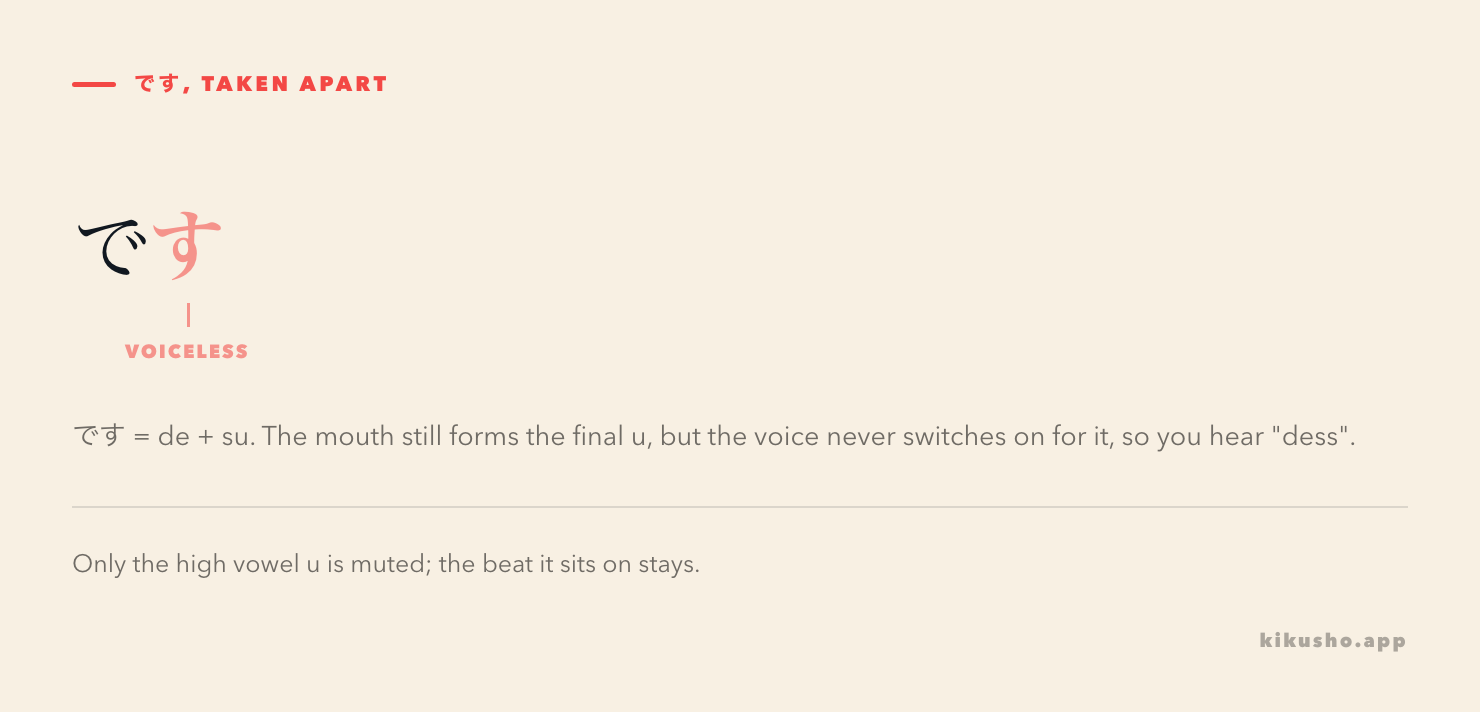
です comes out as "dess" because the u at the end is voiceless: your mouth still shapes the vowel, but your vocal cords never switch on for it, so only the s reaches the ear. This is not a one-off habit of the copula. Japanese mutes its two high vowels, i and u, in two predictable positions, and the same reflex that flattens です into "dess" is the one that turns した into "shta" and 好き into "ski". Once you expect it, those words stop sliding past you unrecognised.
Your mouth still makes the vowel; your voice does not
The name for this is vowel devoicing, and the word is exact: the vowel is devoiced, not deleted. Say です slowly and your tongue and lips move into the u exactly as they would for a full "su". What changes at conversational speed happens upstream, in the throat. The vocal folds that buzz for every ordinary vowel simply stay open and still, so air passes through the u-shaped mouth with no voice behind it. What comes out is a breath in the shape of a u rather than a sounded one.
That is why "dropped" is the wrong picture even though it feels right. Japanese is timed in even beats, or morae, and です is two of them whether or not you voice the second. The beat does not go anywhere; a native です holds that final space as a voiceless puff, not as silence. To a beginner it registers as a sound gone missing. It is really a sound with the volume turned down, and the distinction is the whole point of learning it. A dropped vowel is a mystery you meet word by word. A devoiced one is a rule you can run in your head.
Two places the vowel goes quiet
The rule has two clauses, and です sits in the second. A high vowel, meaning only i or u, goes voiceless when either of these holds:
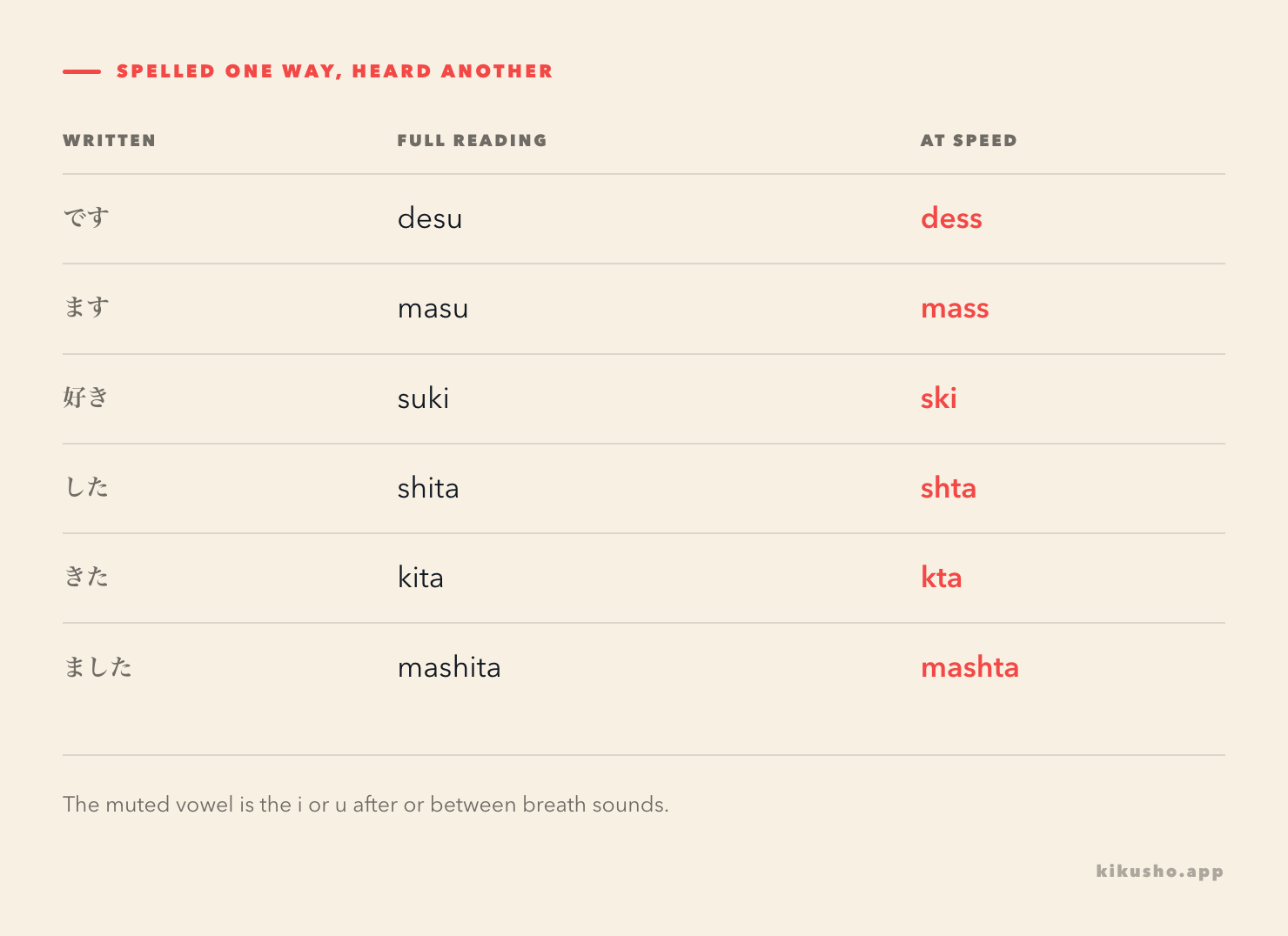
- It is caught between two voiceless consonants. した is shi-ta, and the i sits between sh and t, both of them breath sounds, so it falls out: "shta". 好き is su-ki, the u boxed in by s and k: "ski".
- It ends a phrase after a voiceless consonant. です finishes on s plus u with nothing after it, so the u thins to a breath: "dess". ます does the same: "mass".
です and ます are the famous cases only because they close almost every polite sentence, so a beginner hears them hundreds of times a day and notices the missing vowel there first. But the phrase-final clause is the smaller of the two. The between-consonants clause is the one that reshapes ordinary words in mid-sentence, exactly where you have no time to stop and decode.
You can feel which sounds trigger it
You do not have to memorise a list. Put two fingers on your throat and say "z-z-z", then "s-s-s". The first buzzes under your fingertips; the second does not. That buzz is voicing, and the sounds made without it are the ones that switch off a neighbouring i or u. In Japanese the breath sounds are k, s, sh, t, ch, ts, h, f and p. The buzzing ones, g, z, j, d, b, n, m, r and w, leave the vowel alone.
So the target is narrow. A vowel devoices only when it is one of the two high vowels and it is hemmed in by breath on both sides, or trailing off a breath at the end of a phrase. すぎ keeps its u, because the g behind it buzzes. あさ keeps its a, because a is not a high vowel. The reason it feels unpredictable at first is that the trigger is a property of the sounds around the vowel, not of the vowel itself, and nobody points at the sounds.
Why it is only i and u
The vowels that go quiet are the two high ones, i and u, and that is not an accident of which sounds Japanese happened to pick. Both are made with the tongue raised and the mouth nearly closed, so there is little space for air and little sound to carry a voice. Switching the voice off costs almost nothing you can hear. The open vowels a, e and o are the opposite: the mouth stands wide, the sound rings, and muting one would leave an obvious hole in the word. That is why した loses a vowel and あさ loses none, though both sit against breath sounds.
Japanese u makes it even easier on itself. It is pronounced with the lips relaxed rather than pushed forward, flatter and thinner than the oo in "flute", so it is already close to a breath before any rule touches it. Devoicing just finishes a journey the vowel had mostly made.
です is only the famous one: the rule runs everywhere
Once this is a rule and not a です exception, the same pattern turns up across the language, and this is where it starts paying for itself. Every polite past tense hides it: ました is ma-shi-ta, the i between sh and t, so 食べました lands as "tabemashta". Every question with か carries it, because ですか puts the u between s and k: "des ka". Plenty of everyday words show it standing alone: きた comes out "kta", 好き "ski", した "shta".
Stack the two endings and a whole polite sentence thins out at once. わかりました is wa-ka-ri-ma-shi-ta, and the shi devoices to give "wakarimashta". そうですか runs the です rule and the か together into "sō des ka". None of that is slang or slurring. It is how the careful, textbook-correct forms are said at ordinary speed, by a newsreader as much as by a friend.
The listening cost is the reason to internalise this rather than admire it. Speech runs forward at the speaker's pace and never waits, so if your ear is still holding out for a full "desu" or "suki", the sentence has moved three words on by the time you accept the breathier shape. You are not short of vocabulary in that moment. You are missing words you already know because they arrive in a form you never trained. Devoicing is one of the first forms worth training, because it lands on です and ました, the two endings attached to nearly every sentence anyone says to you.
This is also why a word you only ever met on the page can ambush you the first time it is spoken aloud. Kikusho puts native audio on every card it builds, so when you photograph a sign or paste a line and keep the word, you get です as "dess" and 好き as "ski" in your ear from the start, rather than the kana spelling to rebuild into sound later. Select a word inside an example sentence and it becomes its own card, audio and all, playable with no signal.
When the u comes back
The vowel is not gone for good, and the places it returns are worth knowing, because a sounded u where you braced for a breath is telling you something.
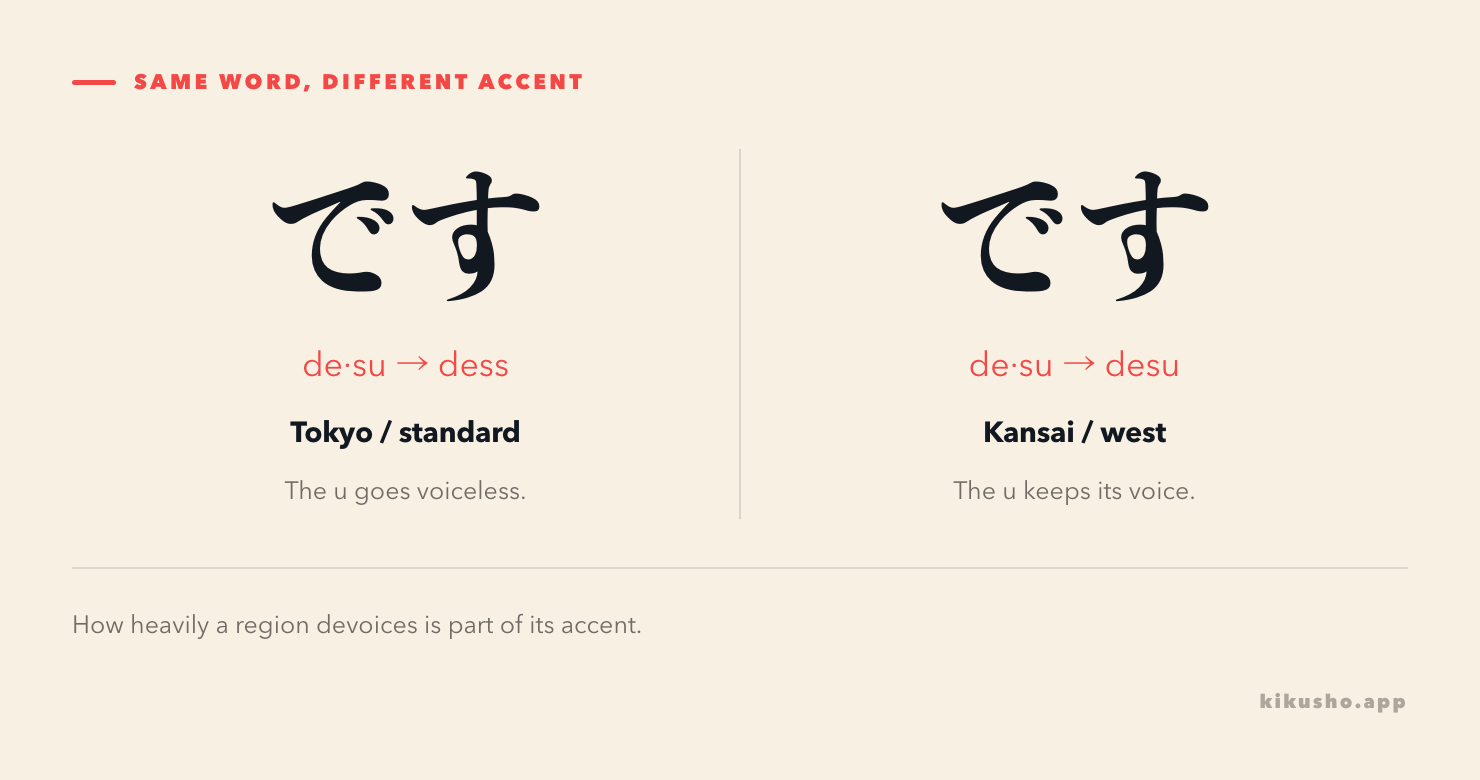
Region is the biggest one. Devoicing is strongest in Tokyo and in the standard broadcast Japanese built on it. In Kansai, meaning Osaka and Kyoto, and in several other areas, it is much weaker, so です there keeps more of its u and sits closer to the spelled "desu". Neither is more correct than the other. They are different accents, and hearing the fuller vowel is often your first sign that you are listening to a western speaker.
Speed and care bring it back as well. Say です slowly, or lean on it for emphasis, and the vowel voices again, which is exactly why a textbook recording enunciated for learners gives you "desu" while a conversation gives you "dess". Two devoiceable vowels in a row also resist collapsing together: in 靴下 (kutsushita) more than one vowel could in principle go quiet, but a speaker keeps at least one voiced rather than let the word dissolve into a run of consonants.
Pitch does its own filtering too. A high vowel that carries the word's pitch accent tends to hold its voice even where the rule would otherwise mute it. So when you hear a clear u sitting precisely where you expected a whisper, it is rarely a mistake. It is a clue: a western accent, a careful register, or the accent landing on that beat. Read it that way and the exception stops being noise and becomes another thing your ear can use.
Common questions
Is the u in です completely silent?
No. Your mouth still shapes the vowel and the beat is still there, so です keeps its two morae. Only the vocal cords go still, so you hear a breathy s instead of a full "su". At speed it lands like a missing sound, but it is a voiceless vowel, not a deleted one.
Does every i and u get devoiced?
Only i and u, and only when they sit between two voiceless consonants (k, s, sh, t, ch, ts, h, f, p) or end a phrase after one. A high vowel next to a voiced sound such as g, z, d, b, n, m or r keeps its voice, and a, e and o are never devoiced this way.
Do all Japanese speakers do this?
It is strongest in Tokyo and the standard broadcast Japanese modelled on it. Kansai and several other regions devoice much less, so です there keeps more of its u and sits closer to the spelled "desu". Careful or emphatic speech also brings the vowel back.
Will I sound wrong if I pronounce the u fully?
You will be understood, but a fully voiced "desu" or "suki" sounds careful or non-native at conversational speed. Matching the devoicing makes you easier to follow, and expecting it makes fast speech easier to catch.