On this page
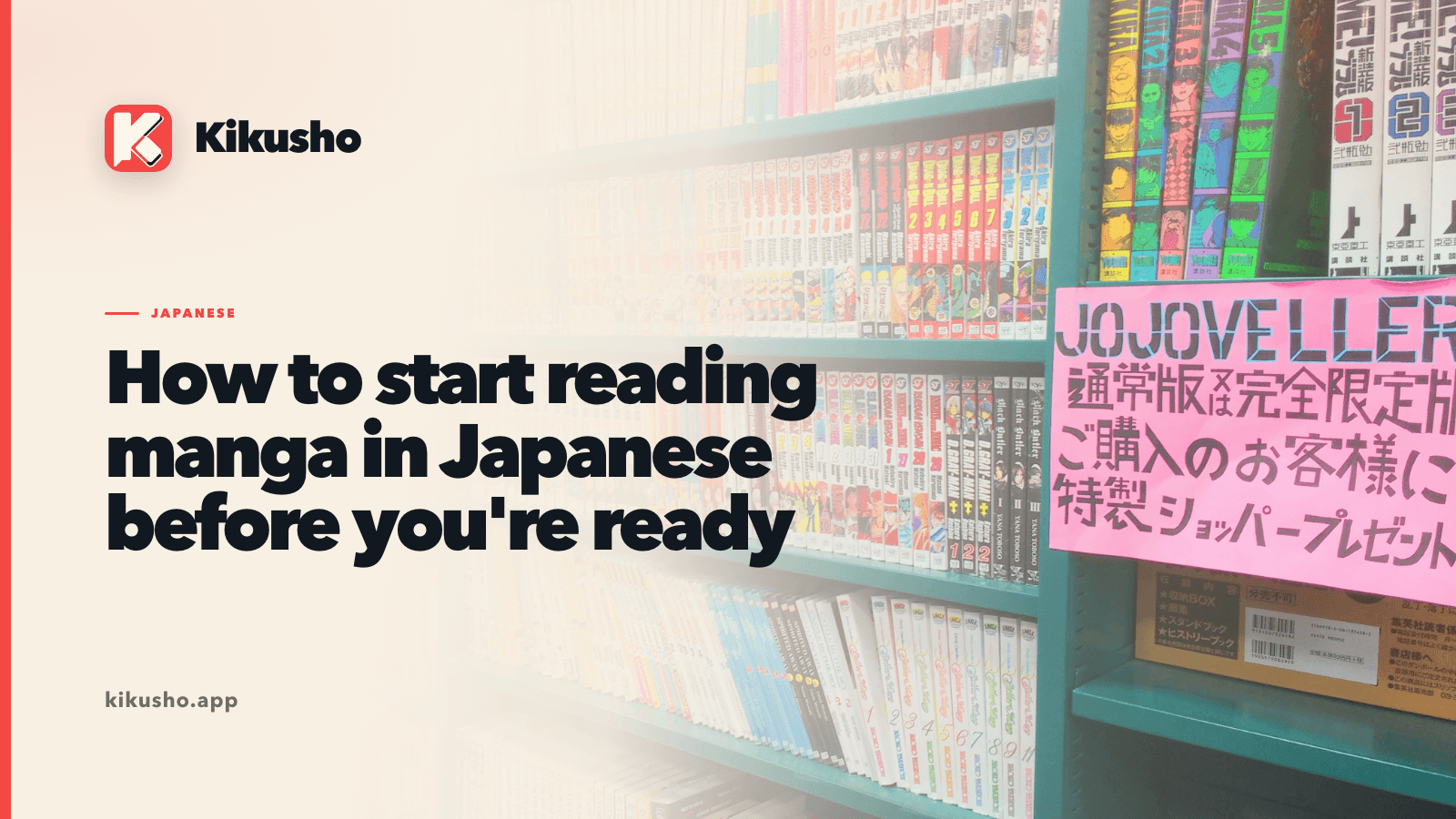
You can start now, and the readiness you are waiting for is mostly the wrong readiness. Nearly all manga aimed at younger readers prints the reading in tiny kana above every kanji, so the character wall you dread is already handled — you can sound out any word and look it up the second you meet it. What actually makes the first volume hard is the opposite of your textbook: manga is written the way people talk, in contractions, dropped particles and sentence-final flourishes that a beginner course teaches late or never. Expect that, pick the right title, and the first chapter stops being an exam you have to pass before you are allowed to read.
The readiness you're waiting for is the wrong one
Most people postpone manga until they have "enough kanji" or "enough grammar." The trap is that the vocabulary you are saving manga for is largely the vocabulary manga would teach you. You do not build a reading level in a vacuum and then spend it on a book; you build it by reading the book, meeting words in a scene concrete enough that they stick. Waiting is the one strategy guaranteed not to work, because the thing you are waiting to acquire only accumulates through the activity you are postponing.
Counting characters is the wrong readiness test in particular, and it is worth understanding why the character count isn't the gate before you let it stop you. A number of kanji tells you nothing about whether you can follow a conversation, and a conversation is what manga mostly is. The honest prerequisite is much smaller than the one you have set yourself: both kana, a beginner's grip on sentence structure, and the willingness to not understand every panel.
Furigana means the kanji count isn't the wall
Furigana are the small kana printed above or beside a kanji that spell out how it is read. Manga for younger audiences — which covers most of what a learner reaches for first — carries them over essentially every character. That single convention changes what an unknown word costs you.
In a novel, a kanji you cannot read is a dead end. You have no reading, so you cannot say the word, look it up by sound, or even hold it in your head; you are reduced to hunting it by radicals and stroke count. In furigana manga, the same character is just a word you happen not to know yet — exactly like an unfamiliar word in a language written with an alphabet. You read the kana above it, you have the sound, and a dictionary or a quick capture gives you the meaning in seconds. The lookup that derails you in a novel is trivial here.
This is why "how many kanji do I need" is the wrong question for manga specifically. The characters are handed to you pre-read. What is not handed to you is everything the next few sections are about.
The real wall is that manga is written the way people talk
Your textbook teaches one register: careful, explicit, fully polite. It is the register that is safe to teach, because it is unambiguous and it will never be rude. Manga dialogue is the other thing entirely — casual spoken Japanese, where forms contract, particles vanish and words get rough. Knowing the reading of every character does not help if the shape of the word has changed from the one you learned.
The contractions are the first shock. A verb form you know from class turns up on the page missing a syllable, and for a moment you don't recognise the word you already know.
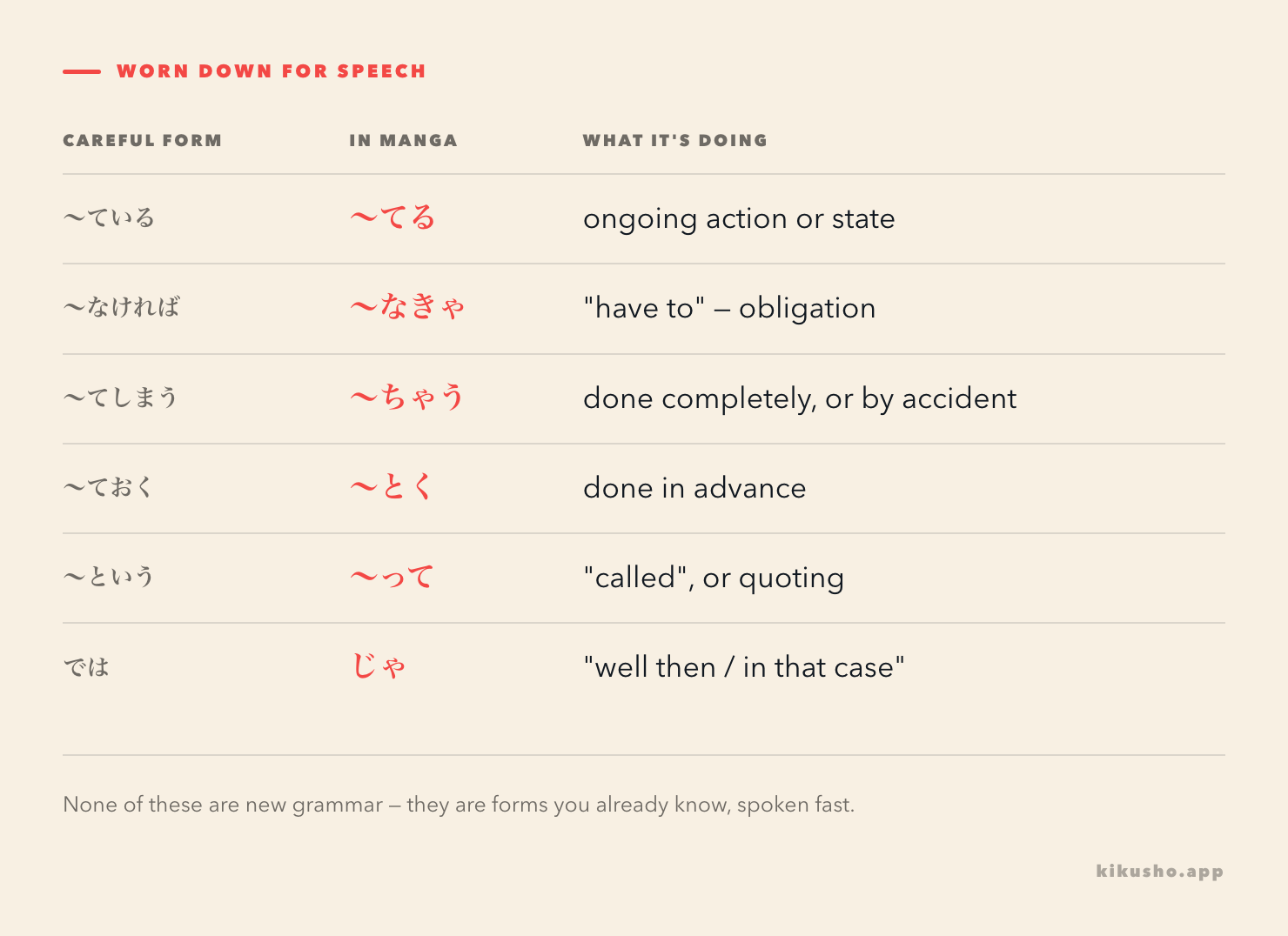
None of these are new grammar. They are the grammar you have, spoken quickly, and manga writes them the way they sound. The same erosion is what makes spoken Japanese outrun the words you know — except that on the page it holds still, so you can stop and work it out instead of having it fly past. Alongside the contractions, the topic and object particles (は, を) simply drop out of casual speech, and the pronouns get blunt: おまえ and あいつ where a textbook would give you あなた and そのひと. It reads as impolite because it is; that is the register.
Sentence-final particles carry the tone a subtitle throws away
The other thing manga is full of, and courses skim, is the small words tacked onto the end of a sentence: ね, よ, さ, ぞ, ぜ, な, わ, かな, っけ. They barely touch the dictionary meaning. What they set is stance — whether the speaker is seeking your agreement, informing you of something, softening a claim, or sounding tough — and a great deal of a character's voice lives here.
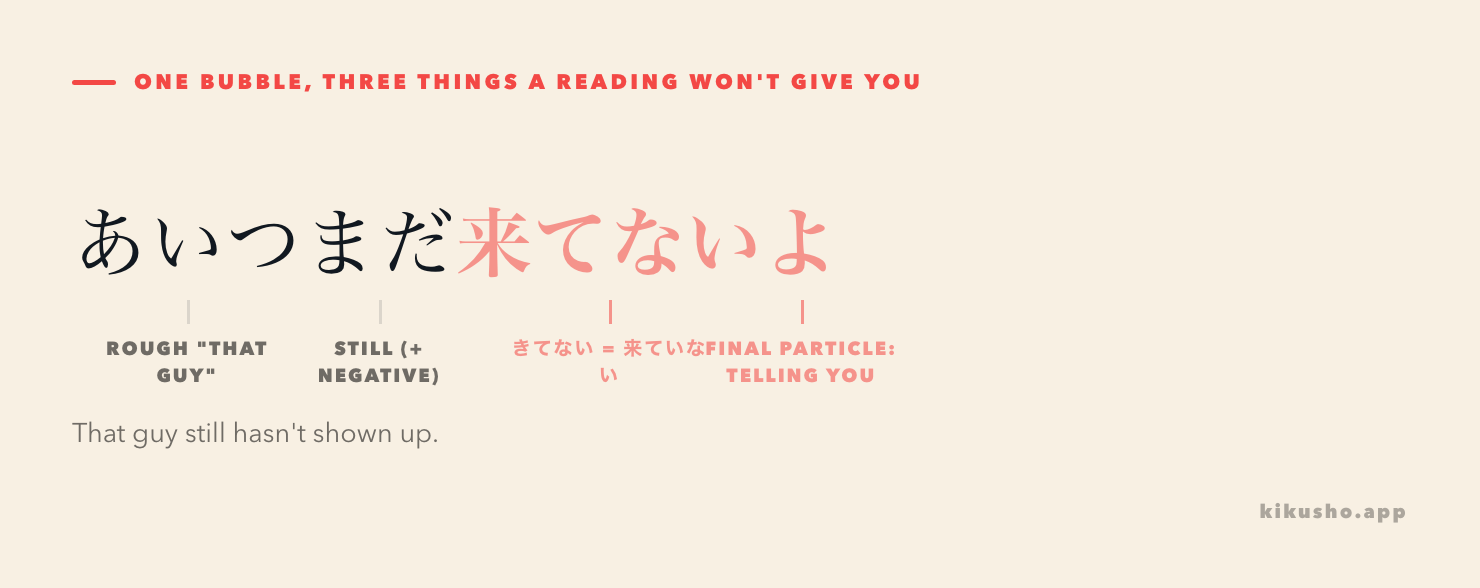
Miss the final particle and every character sounds the same and slightly flat. Read it, and the same four words tell you the speaker is a little impatient and letting you know something you apparently missed. You do not have to master these to start — you have to expect them, and treat the ending of a sentence as information rather than noise.
Pick your first manga by its register, not your level
The single biggest lever on whether you keep reading is what you pick, and the useful axis is register, not how "advanced" the story is.
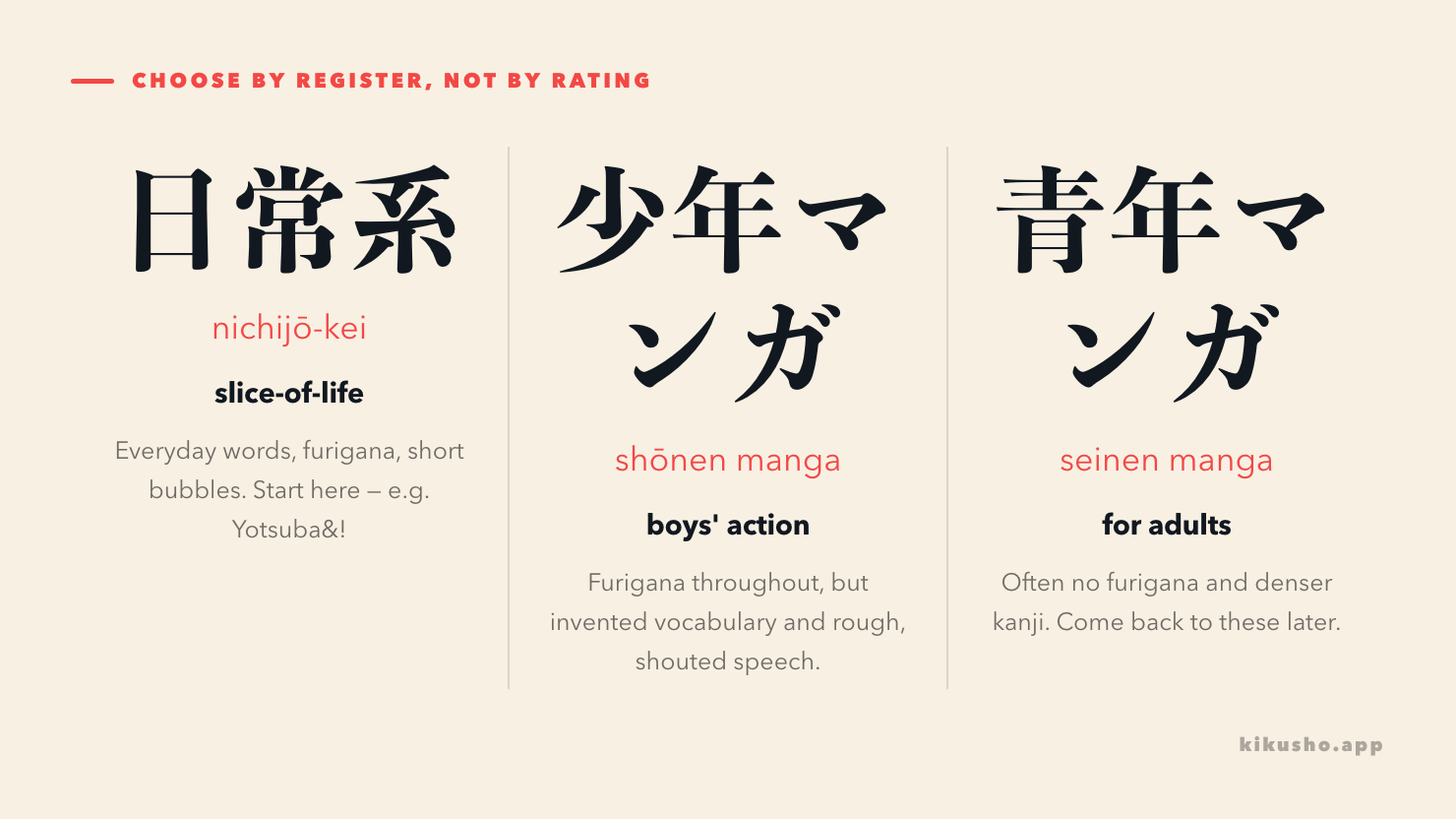
The order in the figure is the order to try them. Slice-of-life is the genuine on-ramp; boys' action manga is the most recommended title and the least beginner-friendly, because invented names and shouted speech are harder than a quiet conversation over lunch, furigana or not. But one filter beats the whole axis: pick something you have already seen animated or read in translation. When you know the plot, you are reading for the language and not for the suspense, so you can afford to slow down on a line instead of racing to find out what happens.
Read for the gist of the bubble, not every word
The habit that drowns beginners is looking up every unknown word. Don't. Read a whole speech bubble, take the gist, and only stop for a word that either blocks the meaning outright or keeps coming back. Everything else you let go, and you will meet it again if it matters.
Manga is unusually forgiving of this because the picture is doing half the work. The panel already tells you who is angry, what is being pointed at, whether this is a threat or a joke. That context resolves ambiguity a wall of plain text never would, which is exactly why a manga page is easier to read than the same dialogue transcribed. Lean on the art; it is not cheating, it is how the medium is meant to be read.
Keep the words that stop you, not the whole page
The words worth keeping are the small set that actually blocked you or recurred — not the whole page, and certainly not a pre-made deck of someone else's manga vocabulary. Capture those in the form you met them, with the reading attached, so the word stays fastened to the scene where you saw it.
This is the part that used to break the flow: pausing to look a word up, format a card and file it is slow enough that you stop doing it, and the words you actually read go unrecorded. Kikusho collapses that into a photo. Point the camera at a panel, highlight up to five words on it, and each one comes back as a card with its reading, its meaning and the register note that a dictionary skips, plus an example sentence you can play. Reviews run offline and are never metered, so the words you pull off a page you read on the train are there to revisit later without breaking your reading to build them. It is the same instinct as holding on to the words you meet every day rather than the ones a syllabus chose for you.
Don't finish the first volume expecting to have understood every panel. Finish it having met the register — the contractions, the dropped particles, the endings that carry the tone. The second volume is noticeably easier, because manga reuses its own vocabulary and every author has verbal tics you learn once and then read on sight.
Common questions
Do I need to know a certain number of kanji before reading manga?
No. Most manga aimed at younger readers prints furigana — the reading in small kana — over every kanji, so you can sound out any word and look it up the moment you meet it. The character count is not the barrier; the casual spoken register of the dialogue is.
What is the easiest manga to start reading in Japanese?
Slice-of-life and children's titles, which use everyday vocabulary, carry furigana throughout and keep speech bubbles short. Boys' action manga is commonly recommended but harder than it looks, and adult (seinen) titles often drop furigana entirely, so leave those for later.
Why can I read the furigana but still not understand the sentence?
Because manga is written in spoken register: contractions like てる and なきゃ, dropped particles, and sentence-final particles that textbooks introduce late or not at all. Knowing how a word is read is not the same as recognising its colloquial, worn-down form.
Should I look up every word I don't know while reading manga?
No. Read the whole speech bubble for the gist and only stop for a word that blocks the meaning or keeps recurring. The artwork resolves most of the ambiguity, and keeping only the words that stopped you holds your review load down.