On this page
You are four lines into a Japanese article and there is a word you have never seen. Skip it. The people who read the most in a second language are the ones who stop for the fewest words, and every extensive-reading guide worth its salt says the same thing: guess from context and keep moving. But "should I skip this word" is two questions folded into one, and the usual advice answers only the first.
Skipping is the right call, and stopping is the expensive one
Stopping to look a word up costs more than it feels like it should. A sentence lives in your working memory only while you are reading it, and it is fragile there. Break off to open a dictionary, wait for the entry, read three senses and choose one, and by the time you look back the first half of the sentence has gone cold. You reread it, lose the thread again on the next unknown word, and a paragraph that should take a minute takes ten. That is not reading. It is decoding, and decoding does not become reading by doing more of it.
Reading is the skill of pulling meaning from a run of text at speed, and you build it only by running through text. This is why a menu you can barely read is still worth reading rather than translating word by word: getting the gist of a page you cannot fully decode is the exact muscle you are training. Stop for every unknown word and you never use that muscle. You use the dictionary instead, and the dictionary is not the thing you are trying to get good at.
The advice answers a reading question, not a memory one
Here is the part the advice leaves out. When you hit an unknown word and ask whether to skip it, you are asking two separate things at once:
- Do I stop reading right now? Almost always, no.
- Do I lose this word? That is a different decision, and skipping does not have to make it for you.
The standard advice answers the first question and lets the second answer itself. Skip, keep reading, meet it again if it matters. But "skip" is a decision about your reading and "lose it" is a decision about your memory, and the trouble starts when you let the first quietly settle the second. You can keep reading and still keep the word. The two only look like one choice because the usual way of keeping a word is to stop for it, which is the thing you correctly refuse to do.
Not every unknown word costs the same
Before you can skip well, you have to know what you are skipping. Words do not weigh the same in a sentence, and the ones worth a moment are the ones the sentence hinges on: usually the main verb, or the noun the sentence is about. The rest are scenery.
There is a test you can run without leaving the sentence. Cover the unknown word and read to the end. If you still know what happened, the word was skippable and you have lost nothing by gliding past it. If the sentence falls into a blank, the word was load-bearing, and it is one of the few worth a two-second capture before you move on.
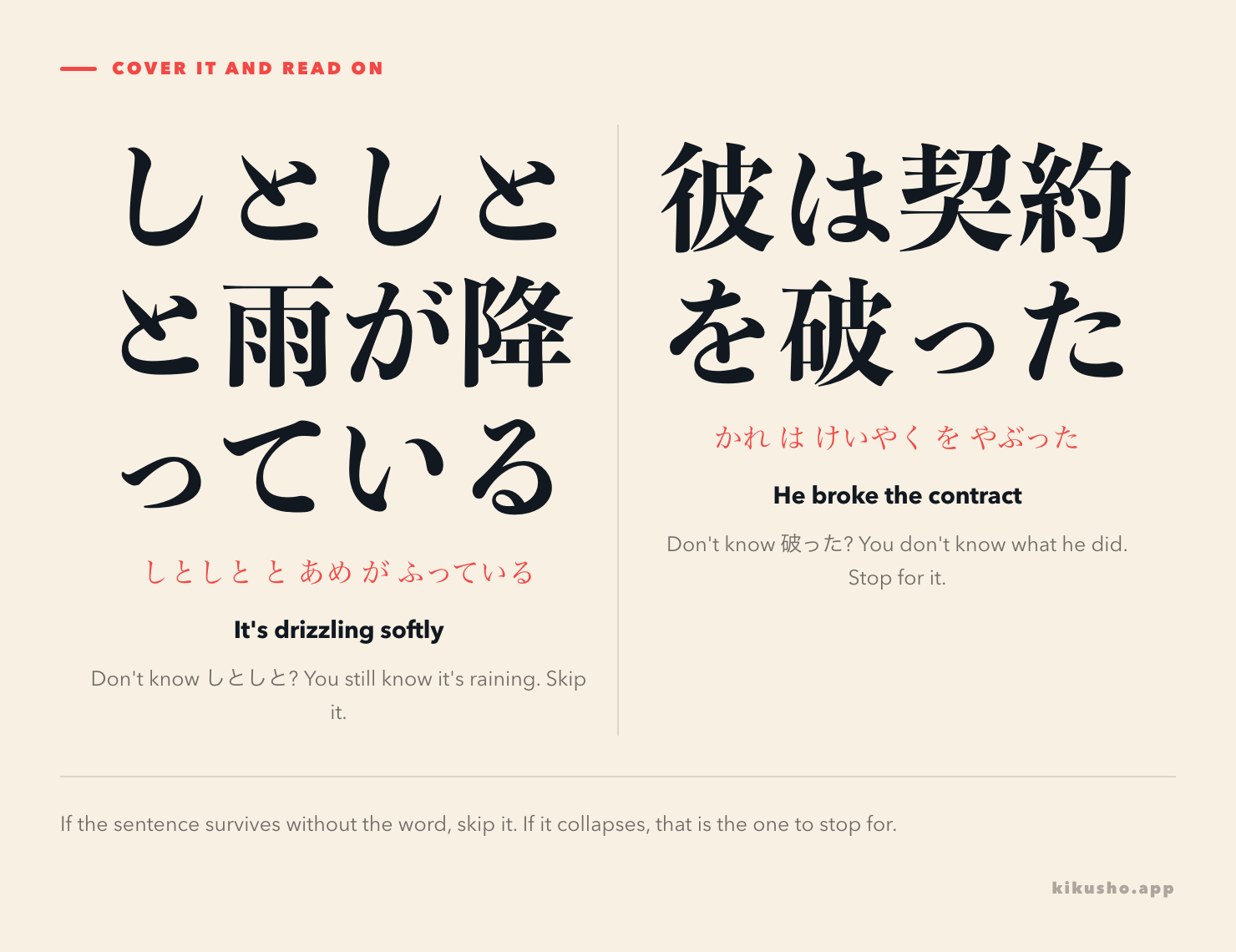
Frequency is the other half of the test. A word that shows up once, a place name or a character's nickname, is rarely worth keeping even when you cannot read it. A word that keeps coming back has already told you it matters, and it earns a stop even if you skated past it the first two times.
You can follow the sentence without the word
Skipping works at all because Japanese grammar carries a lot of the meaning on its own, independent of any single content word. The particles tell you who is doing what to whom, and they keep doing that job even when one of the words they attach to is a blank.
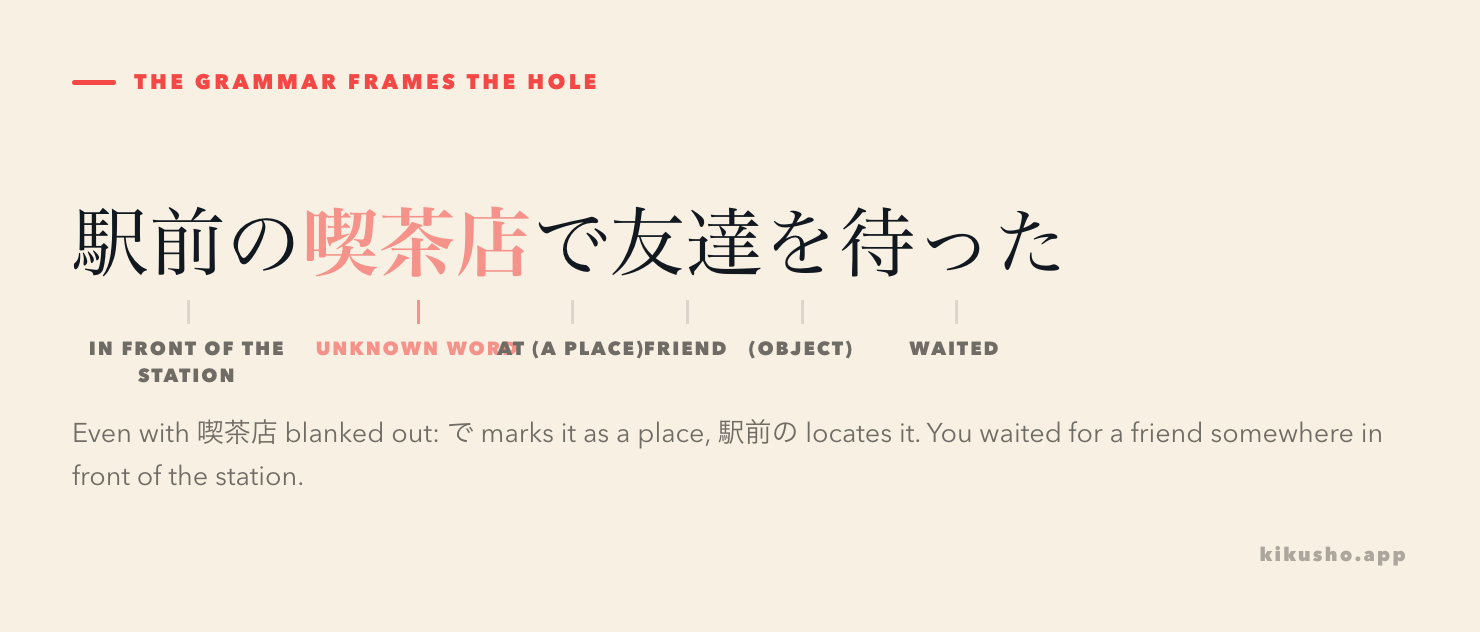
Blank out 喫茶店 and the sentence does not fall apart. で tells you the missing word is a place, 駅前の tells you it is in front of the station, and 待った tells you what you did there. You have lost only the specific kind of place, a café, and kept the rest. That is what a good skip looks like: the grammar frames a hole small enough to read straight past. Manga leans on this even harder, because the picture fills the hole too, which is why you can read for the gist of a panel long before you can read every word in it.
What skipping costs you when that is all you do
So skipping is right, and in the moment it is cheap. The cost is deferred, and it lands somewhere you are not looking: on the word itself.
You did not meet this word on a list. You met it in a sentence you were already following, in something you cared about enough to read, at exactly the level of Japanese you can currently manage. That is the most valuable shape an encounter can take, and it is the one a textbook spends enormous effort trying to fake. Skip the word and read on with no other action, and you spend that encounter and bank nothing. The extensive-reading guides promise you will meet the word again if it matters, and you will. What they do not add is that the second meeting is as cold as the first. "Meet it again" is not "keep it." A word you have glided past five times is a word you have failed to learn five times, in five good contexts, each of them used up and gone.
Split the reading pass from the collecting pass
The way out is to stop treating this as one activity. Reading and collecting are two passes, and they need not run at the same speed or even in the same minute.
The reading pass stays exactly as the advice wants it: fast, unbroken, guessing freely, stopping for almost nothing. The collecting pass happens afterwards, or in the margins. You mark the word the instant you meet it, in a single gesture, and read on. When you put the page down, the words you marked are waiting, and you deal with them then, out of the flow, where looking three of them up costs you nothing.
This only works if marking a word is close to instant. If capturing means a detour into a dictionary and a card editor, you will not do it mid-page, and you are back to choosing between stopping and forgetting. The gesture has to be fast enough to vanish.
That gap is what Kikusho is built to close. Reading on a screen or on paper, capturing a word is a photo or a paste and a tap, not a detour: you can mark up to five words on a single page and read straight on. Each one is drafted for you afterwards into a card carrying its reading, its meaning, the register note a dictionary tends to drop, and a spoken example, and you glance at it before anything is saved. Reviews live on the device and are never metered, so a page read on a train becomes a small stack of words you can work through later, wherever you land. The reading pass keeps its speed, and the words stop escaping it.
The word you skipped is the one worth keeping
Turn the whole thing around and the skipped word stops looking like a loss. The words your own reading hands you beat any frequency list, because they arrive pre-sorted: at your level, in a context you were already inside, in roughly the order your reading needs them. A list gives you the thousand most common words in the abstract. A page you read gives you the words that stopped you on that page, which is a far more useful thing to own.
So skip-and-capture is not a grudging truce between reading fast and remembering. It is the one method that keeps both, and it rebuilds your deck out of exactly the words your reading is demanding, in the order it demands them, instead of the order a syllabus guessed. It is the same reason the words you walk past every day are worth more than the ones a course chose for you.
Read the page at full speed. Skip what the grammar lets you skip, mark what you want to keep, and finish no slower than the reader beside you who skipped and kept nothing. The difference surfaces a week later, when you still have the handful of words that page taught you and they no longer do.
Common questions
Won't I just never learn a word if I keep skipping it?
You won't learn it if skipping is all you do. Skipping protects your reading; it is the capture step, not the reading, that keeps the word. Mark the word and read on, then deal with it once you put the page down, and you get both the flow and the word.
How do I know which words are worth stopping for?
Cover the word and read to the end of the sentence. If you still know what happened, it was skippable; if the sentence collapses, it was load-bearing, usually the main verb or the noun the sentence is about. A word that keeps recurring earns a stop even when it was skippable the first time.
Should I look a word up, or capture it and move on?
Capture it and move on while you are reading. Looking a word up mid-sentence breaks the thread you are holding in your head, whereas marking it for later keeps your reading pass fast and still records what you met, so you can look it up out of the flow.
Does guessing from context count as learning the word?
It is enough to keep reading, which is the whole point in the moment. But a guess fades faster than a checked meaning, so a word you guessed and want to hold on to is exactly the kind to capture now and confirm later.