On this page
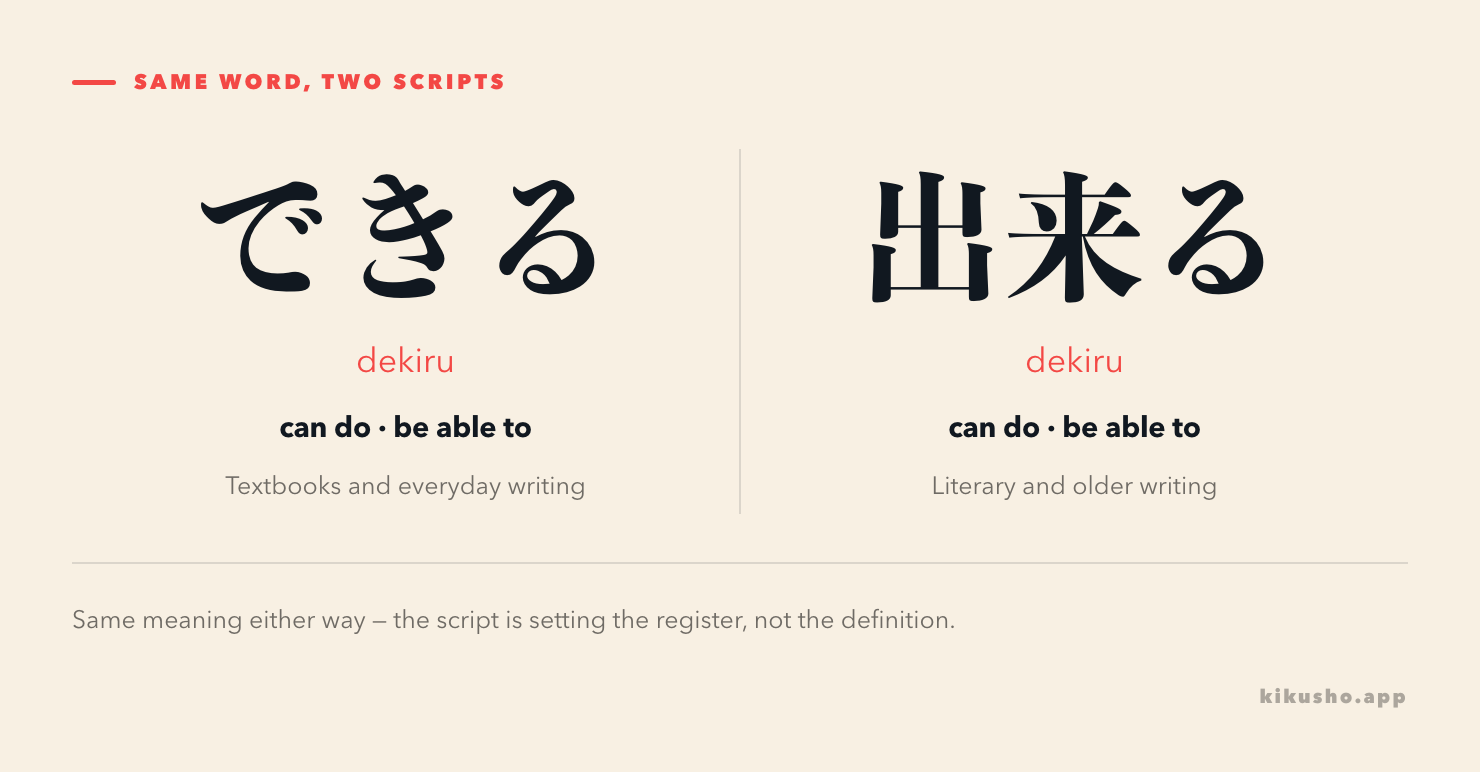
When the same word shows up as 出来る in a novel and できる in your textbook, neither one is wrong. For most words that can be written in either script, choosing kanji or kana is a decision about register and readability — how formal the writing is and how easily the eye moves through it — not about which spelling is correct.
A smaller set of words genuinely leans one way by convention, and a smaller set still flips script depending on the grammatical job the word is doing in the sentence. Once you can tell those three cases apart, the alternation stops looking like inconsistency and starts telling you something.
Only one of the three cases is a free choice
Most words are not actually up for debate. The script is settled, and it helps to know which kind you are looking at before you worry about the choice.
The first kind has no realistic alternative: ordinary content words with a common kanji. 水 (water), 本 (book), 学校 (school), 日本 (Japan). You will only ever see these in kana in a book for small children, or when a writer is deliberately softening the tone. Writing みず for water in normal prose reads as either baby-talk or an affectation, so there is nothing to decide.
The second kind is fixed the other way. The word has a kanji — the dictionary will list it — and almost nobody uses it. ありがとう (thank you) has the kanji 有難う; きれい (pretty) has 綺麗; たくさん (a lot) has 沢山; even the everyday verb ある (to exist) has 有る and 在る that you will rarely see. Reaching for the kanji here looks ornamental, or old-fashioned in a way you probably did not intend.
Only the third kind is a genuine choice: words that adults write both ways depending on the piece. できる and 出来る, とき and 時, わかる and 分かる, ください and 下さい. Here the decision is real, and two forces settle it — one grammatical, one social.
The clearest rule: kana for grammar, kanji for meaning
The most reliable pattern, and the one worth internalising first, is this: a word is written in kanji when it carries its full meaning, and drops to kana when it has been bleached into a grammatical function. The same morpheme, two scripts, and the script tells you which job it is doing.
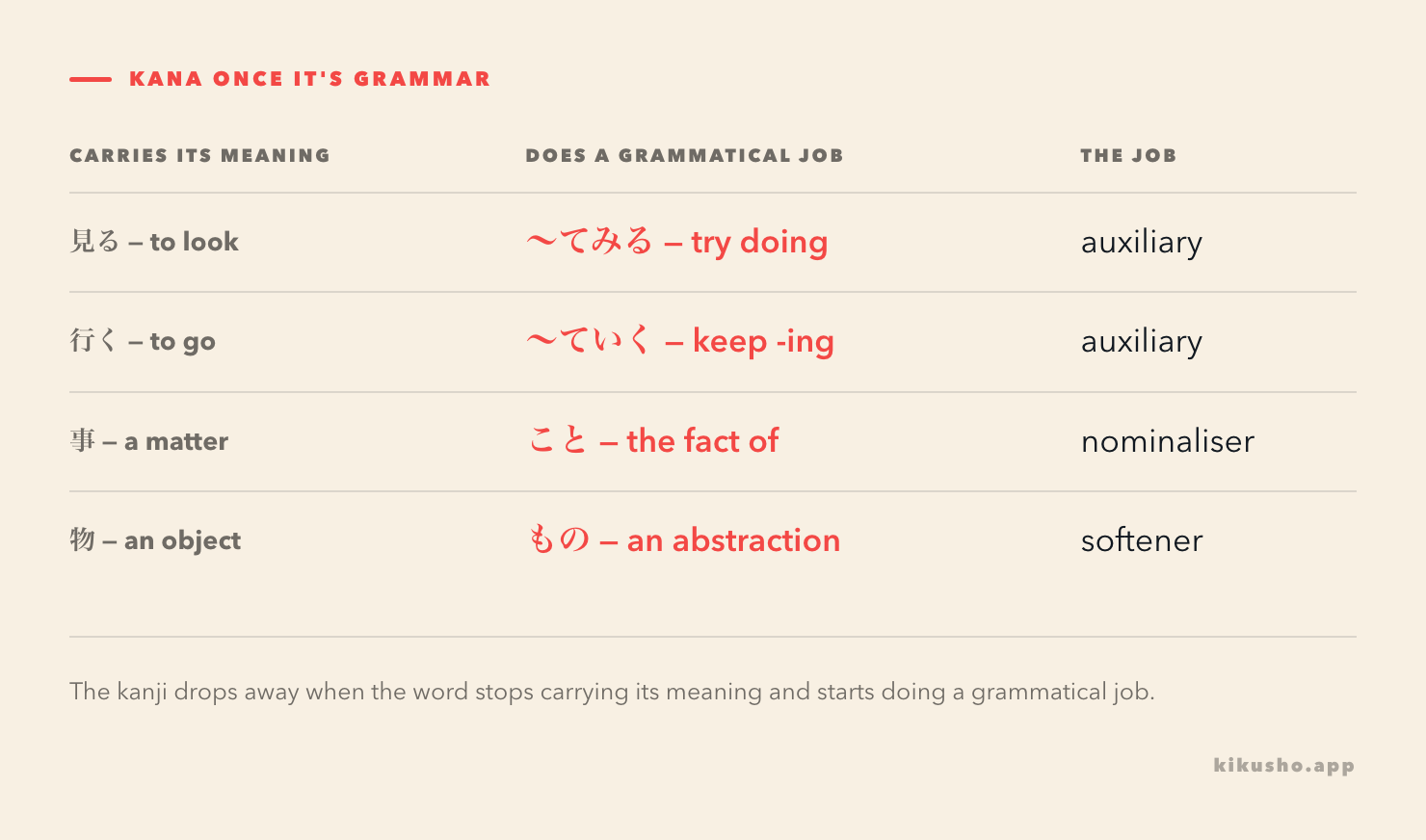
見る means "to look" and keeps its kanji. But 〜てみる, "to try doing something," is that same verb emptied of looking, and it goes to kana: 食べてみる, "try eating." 行く is "to go"; 〜ていく, marking a change that keeps going, drops to kana in 増えていく, "keep increasing." 事 is a concrete matter or an incident; こと as the nominaliser that turns a verb into "the fact of doing it" — 食べることが好き, "I like eating" — goes to kana. Even ください follows the pattern: 待ってください (please wait) is kana because it is a grammatical request, while 下さい keeps the kanji when it means, literally, "give me."
The logic underneath is simple. Kanji exist to carry meaning. When a word stops meaning its thing and starts doing a grammatical job, the kanji has nothing left to represent, so it falls away. This is not only a writing rule — it is a reading aid. A こと in kana is grammar; a 事 in kanji is a thing.
Why your textbook and a manga spell the same word differently
Inside that flexible third group, the choice is mostly about who is reading and what the page is allowed to print.
Beginner textbooks and children's books minimise kanji and add furigana, because the reader cannot yet read the characters. Literary fiction, academic writing and older texts do the opposite: they use more kanji, including for words that most writing leaves in kana, because the audience can read them and the density reads as more formal. So できる in your textbook and 出来る in a novel are the same word dressed for a different room — one written for someone still learning the characters, one for someone who finished years ago.
There is also a rule the novelist can ignore but the newspaper cannot. Newspapers and official documents follow the jōyō list, the 2,136 characters approved for everyday use. A word whose kanji falls outside that list gets written in kana instead, or, in an older style, half in each — 改ざん for 改竄 (tampering). So a kanji that is perfectly normal in a novel can legitimately disappear into kana in a newspaper, not because the paper is being casual, but because it is obeying a limit the novelist writes past.
Kanji is the sentence's skeleton, which is why kana breaks it up
The deeper reason nobody writes everything in one script is readability. Japanese runs its words together with no spaces, so the eye needs some other cue for where one word ends and the next begins — and the switch between scripts is exactly that cue. Content words sit in kanji, the grammar around them in kana, and the alternation itself is what lets you parse the line. It is the same mechanism that lets you read a spaceless sentence at all.
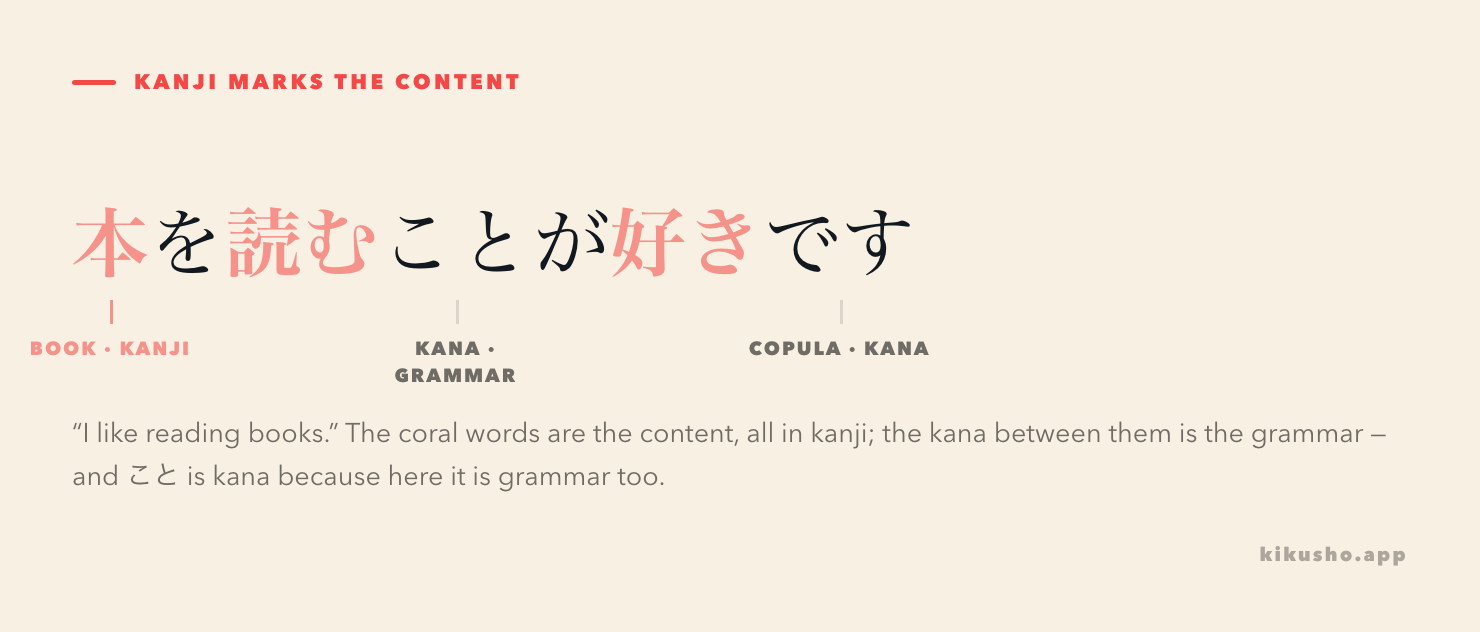
This is why you would not write a whole sentence in kanji even where you could: a run of five characters in a row is a wall, and dropping the functional words to kana gives the eye a rhythm to follow. And it is why you would not write it all in kana either. All-hiragana text is perfectly legible and still slow, because every word boundary has to be guessed rather than seen. The mix is not a compromise between two scripts. It is the thing that makes the writing quick to read.
Sometimes the script is the tone
Within that flexible middle, a writer will also pick the script for feel. A word usually left in kana, set instead in kanji, reads as heavier, more formal, a little old-fashioned — 有難う on a printed card where a text message would just say ありがとう. A word usually written in kanji, softened to kana, reads gentler or more childlike — a café menu writing おいしい rather than 美味しい to sound warm rather than exact.
You do not need to produce these effects to write correct Japanese. What you need is to notice that when a writer breaks the usual script for a word, it is almost always deliberate, and the break is carrying a small amount of meaning. Reading 出来る where you expected できる is a signal about the register of the whole text, the same way an unusually formal word would be in English.
What to actually do about it
For reading, take whichever script appears and do not treat the kana spelling as a lesser version of the "real" word. When you meet こと in kana, read it as grammar; when you meet 事, read it as a thing. The common switchers — こと, もの, できる, とき, わかる — are worth learning with both faces attached, because you will meet both.
For writing, default to the conventional form: kana for the greetings and the auxiliaries, kanji for the content words, kana again for anything doing a grammatical job. Your keyboard offers you both spellings as you type; pick the one that matches what you read most, and you will never look out of place. There is no need to memorise a list of which words go in kana — you absorb that by reading, the same way you learn which counter goes with which noun.
It is also one small reason to keep a word in the exact form you met it. When you capture できる off a subtitle or 出来る off a page, a card that holds the spelling you actually saw, with its reading beside it, keeps both faces of the word attached to the moment you met it rather than to some textbook's house style — and the reading on the card means the kanji version never becomes the one you can't read back.
Common questions
Is it wrong to write a word in hiragana when it has a kanji?
For most words, no. Kanji or kana is usually a choice about formality and readability, not correctness. A few words are fixed one way by convention — ありがとう is almost always kana, 水 almost always kanji — but in the flexible middle both spellings are correct, and adults use both.
Why does こと switch between 事 and こと?
事 is written in kanji when it means a concrete matter or incident. It drops to kana (こと) when it is the grammatical nominaliser that turns a verb into 'the fact of doing it.' The kana form signals that the word has stopped carrying its full meaning and is doing a grammatical job instead.
Should I learn Japanese with more kanji or more kana?
Read whatever appears and learn to recognise both faces of a word. When you write, follow the conventional spelling — kana for greetings and auxiliaries, kanji for content words — and you will never look wrong. You absorb the conventions by reading, not by memorising lists of which word takes which script.