On this page
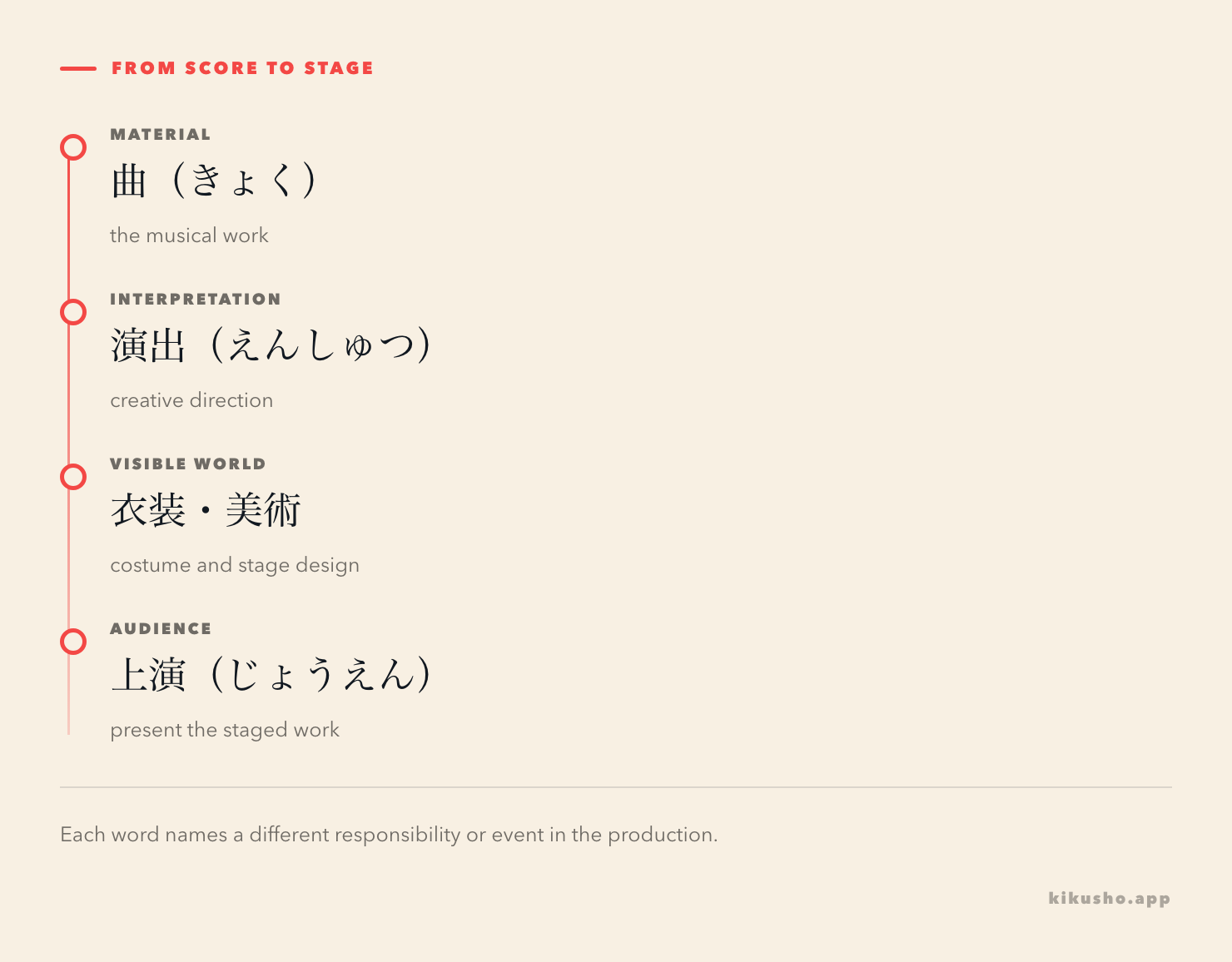
These five words follow a work from idea to audience: a 曲 supplies music, 演出 gives the production its interpretation, 衣装 and 美術 build the visible world, and 上演 puts the finished stage work before spectators. Their English glosses overlap around “production” and “performance,” so the useful question is which part of the process each word names.
Five words from score to stage
| Stage | Word | Reading | Core sense | Anchor phrase |
|---|---|---|---|---|
| Musical material | 曲 | きょく | tune; piece or work of music | 曲を作る, compose a piece |
| Creative direction | 演出 | えんしゅつ | direction; staging; designed effect | 舞台を演出する, direct a stage production |
| What performers wear | 衣装 | いしょう | clothing; costume; outfit | 衣装を身につける, put on a costume |
| Visual field | 美術 | びじゅつ | fine art; production design | 舞台美術, stage design |
| Public presentation | 上演 | じょうえん | staging or performance of a dramatic work | 劇を上演する, stage a play |
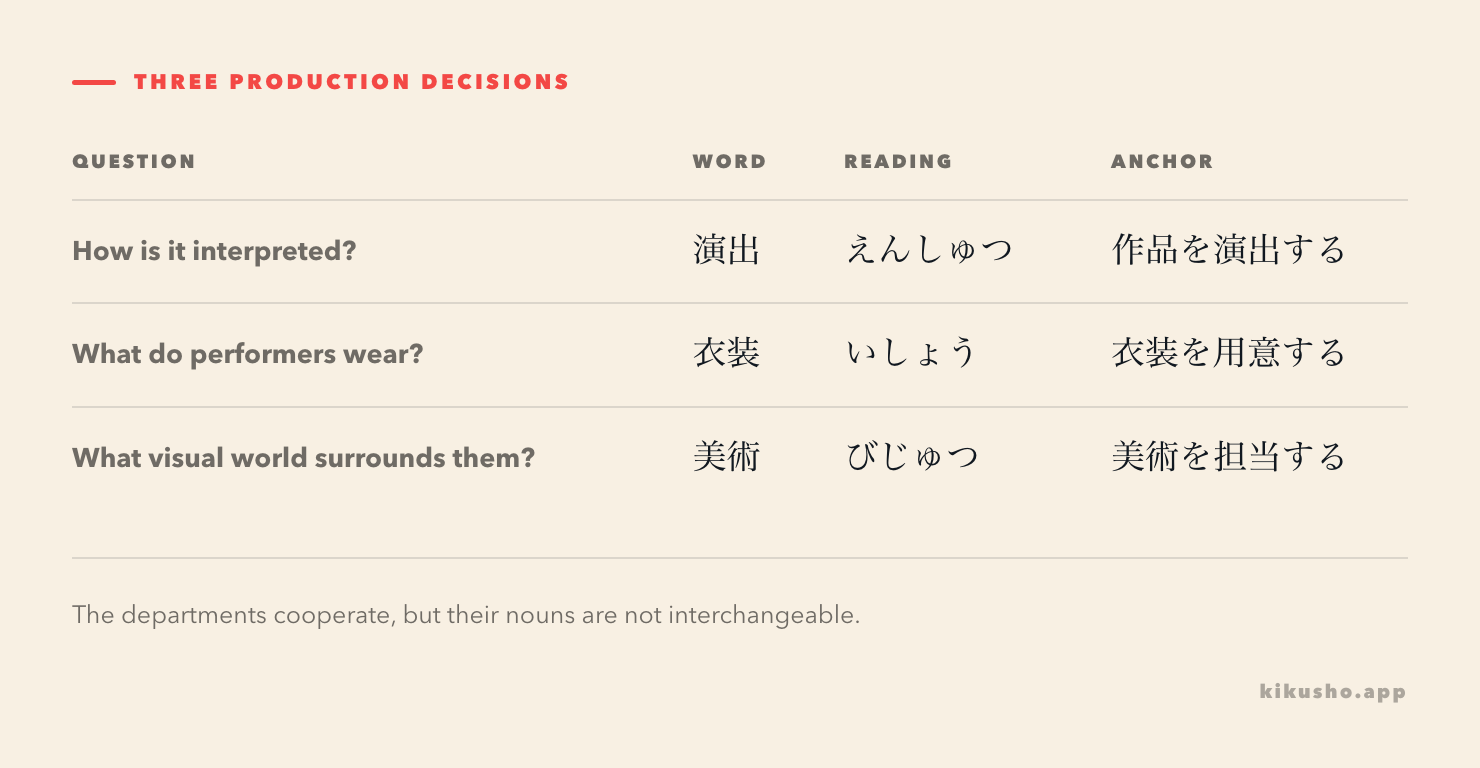
All five are nouns. 演出 and 上演 also combine directly with する. The visual nouns prefer other verbs: 衣装を着る, 衣装を用意する, 美術を担当する.
曲 is one musical work, not music as a whole
曲(きょく) can mean a tune, composition or piece of music.
アンコールでは、作曲家の初期の曲が演奏されました。
アンコールでは、さっきょくかの しょきの きょくが えんそうされました。
For the encore, a piece from the composer's early period was performed.
The counter is also 曲: 三曲(さんきょく), three pieces. Common compounds show its place in music vocabulary: 作曲 is composition, 編曲 arrangement, 新曲 a new song or piece, and 楽曲 a musical composition. Kotobank's 曲 entry separates the musical reading きょく from the character's “bend” and “distortion” family of meanings.
Do not replace 音楽, music as an art or activity, with 曲 in every sentence. 音楽を勉強する means study music; この曲を練習する means practise this piece. The N5 music and creative-hobbies lesson teaches the earlier activity words that this production vocabulary assumes.
演出 shapes how the audience receives the work
演出(えんしゅつ) is the creative work of coordinating acting, space, lighting, sound, costume and movement into an interpretation. It can name the act, the direction itself, or the designed effect.
今回の演出は、舞台をほとんど空のまま使います。
こんかいの えんしゅつは、ぶたいを ほとんど からのまま つかいます。
This production's direction uses an almost empty stage.
若手の演出家が古典作品を現代風に演出しました。
わかての えんしゅつかが こてんさくひんを げんだいふうに えんしゅつしました。
A young director staged the classic work in a contemporary style.
An 演出家 is a director. The Kotobank theatre account of 演出 describes coordinating script, acting, set, lighting, costume, music and effects under one artistic intention.
The word extends beyond theatre. News and criticism may call a ceremony, advertisement or political appearance an 演出 when its effect has been deliberately staged. 感動的に演出する therefore concerns presentation, not merely performing a role.
衣装 and 美術 create the visible world
衣装(いしょう) broadly means clothing or an outfit, but an arts context often narrows it to costume.
時代に合う衣装を作るため、古い写真を調べました。
じだいに あう いしょうを つくるため、ふるい しゃしんを しらべました。
We studied old photographs to make costumes appropriate to the period.
舞台衣装 makes the stage sense explicit. Kotobank defines 衣装 both as clothing generally and as clothing used for a stage role. Its 舞台衣装 overview places costume beside script, music, direction, performers and stage art.
美術(びじゅつ) usually means fine art, including painting and sculpture, or art as a school subject. In production credits, it can identify the department responsible for the designed visual environment.
この作品では、美術と照明を同じデザイナーが担当しました。
この さくひんでは、びじゅつと しょうめいを おなじ デザイナーが たんとうしました。
In this production, the same designer handled the art direction and lighting.
舞台美術 includes the set and, in a broad account, the visual composition involving scenery, costume and lighting. Kotobank's 舞台美術 entry explicitly connects it with the world created for a performance. Outside production, 美術館 is an art museum and 美術を専攻する means major in fine art.
上演 is the event of putting a stage work before an audience
上演(じょうえん) means presenting a play, dance work, opera or comparable dramatic work on stage.
この歌劇は来年、三つの都市で上演されます。
この かげきは らいねん、みっつの としで じょうえんされます。
This opera will be staged in three cities next year.
劇団は新作を一か月間上演しました。
げきだんは しんさくを いっかげつかん じょうえんしました。
The theatre company performed its new work for one month.
The work takes を in the active sentence: 劇を上演する. Publicity often uses the passive: 上演される, be staged. The Kotobank entry for 上演 centers dramatic and performing-arts presentation.
The boundary with 演奏 matters. A pianist 曲を演奏する; a theatre company オペラを上演する. An opera includes music but is also a staged dramatic work. Calling any instrumental performance 上演 would stretch the word past its ordinary centre.
One work can have several 演出 and many 上演
Consider a classic opera revived by a new company:
有名な曲はそのまま使い、新しい演出と舞台美術を加えた。衣装は現代風に変え、秋に初めて上演する。
ゆうめいな きょくは そのまま つかい、あたらしい えんしゅつと ぶたいびじゅつを くわえた。いしょうは げんだいふうに かえ、あきに はじめて じょうえんする。
They kept the famous music, added new direction and stage design, changed the costumes to a contemporary style, and will stage it for the first time in autumn.
The 曲 can remain unchanged while the 演出 changes. 衣装 and 美術 realize that interpretation. Each night the work is 上演される again. “Production” cannot translate all four relationships without losing the structure.
The Agency for Cultural Affairs uses this same professional network in its guidance for performing-arts contracts, listing script, direction, stage art and costume as distinct responsibilities around a performance.
A note about the N1 placement
Kikusho's dated reference inventory places all five exact spelling-reading records in N1 and records no internal disagreement. Its two snapshots descend from the same Waller source family, so their agreement counts as one placement tradition rather than two independent confirmations.
The JLPT publishes broad ability descriptions, not an exhaustive official vocabulary list. Dictionaries and cultural-agency material verify meaning and professional usage; they do not certify an exam level. N1 here names the lesson's position in Kikusho's study sequence.
When capturing a review card in Kikusho, keep the production relationship: 曲を演奏する, 作品を演出する, 衣装を用意する, 美術を担当する, 劇を上演する. The verb prevents five arts nouns from collapsing into one vague “performance” category.
Practice: plan the production before opening the notes
Production 1 · read the staging
How do you read 上演 in 来月から上演される?
A. じょうえん B. しょうえん C. じょうで D. うええん
Production 2 · write the costume
Which spelling is いしょう, “costume or outfit”?
A. 意匠 B. 衣裳 C. 衣装 D. 医装
For this lesson, choose the assigned modern form; 衣裳 is a documented variant.
Production 3 · choose the department
Which word completes 舞台__は装置や空間の視覚的な世界を作る?
A. 曲 B. 美術 C. 上演 D. 衣装
Production 4 · direction or performance
A director gives a classic play a new interpretation, and a company presents it for two weeks. Which pair fits?
A. 新しい上演 / 二週間演出する B. 新しい曲 / 二週間美術する C. 新しい演出 / 二週間上演する D. 新しい衣装 / 二週間曲する
Production 5 · piece or art form
Which sentence means “I practised this piece,” rather than “I studied music”?
A. この曲を練習した。 B. この音楽を専攻した。 C. この上演を着た。 D. この美術を演奏した。
Production 6 · staged work or concert piece
Which pairing is most natural?
A. ピアノ曲を上演する / オペラを演奏する B. ピアノ曲を演奏する / オペラを上演する C. ピアノ曲を衣装する / オペラを美術する D. ピアノ曲を演出家する / オペラを曲する
Production 7 · interpret the credit
In a theatre programme, 美術:山田花子 most likely identifies what responsibility?
A. Ticket sales B. Musical composition only C. The production's visual or stage design D. The dates of every performance
Answers and explanations
1 · Staging reading: A, じょうえん. 上演 is read じょうえん. The distractors alter the voicing or substitute the ordinary standalone reading of 上.
2 · Costume spelling: C, 衣装. 衣装 is the assigned form. 衣裳 is a real variant, which is why the prompt narrows the task to this lesson's recorded spelling; 意匠 means design or device, and 医装 is not this word.
3 · Visual department: B, 美術. 舞台美術 creates the visual world of the stage. 衣装 covers what performers wear, while 曲 and 上演 name musical material and the performance event.
4 · Two stages: C. 新しい演出 is a new interpretation or direction; 二週間上演する presents the work in performance for two weeks. Reversing the words confuses creative shaping with the public run.
5 · One piece: A. 曲 names a particular tune or composition, so この曲を練習した is “I practised this piece.” 音楽 is the broader art and the remaining sentences attach incompatible verbs.
6 · Performance verbs: B. A pianist 演奏する a piece. A company 上演する an opera as a staged dramatic work. Music inside an opera does not make the two verbs interchangeable.
7 · Production credit: C. In theatre credits, 美術 commonly identifies responsibility for the designed visual environment or stage art. The programme context narrows the general fine-art word.
The production chain is now precise: choose or compose a 曲, decide the 演出, realize it through 衣装 and 美術, then bring the work to an audience through 上演.
Common questions
What is the difference between 演出 and 上演?
演出(えんしゅつ)is the creative direction or staging that shapes how a work reaches an audience. 上演(じょうえん)is presenting a play, opera, dance work or similar stage work in performance. One work can be 上演される under a new 演出.
Does 上演 mean any musical performance?
上演 is natural for staged works such as opera and musical theatre. A concert or instrumental piece is ordinarily 演奏(えんそう)される. The inherited gloss "performance, for example music" is therefore too broad without a stage context.
What does 美術 mean in theatre credits?
美術(びじゅつ)generally means fine art. In stage or screen production it can name the visual-design department or art direction, including sets and the designed visual world. 舞台美術 makes the theatrical sense explicit.
Are all five words officially N1 vocabulary?
No exhaustive official JLPT vocabulary list exists. Kikusho's reference inventory places these five records in this N1 lesson and records no internal disagreement, but N1 remains a study placement rather than an official boundary.