On this page
Across an education system, these five words trace a path from subject area to qualification: 教科 organises a curriculum, 演習 applies knowledge, 試みる marks an attempt, 修士 names a degree, and 修了 closes a defined course. The English glosses are easy; the useful distinction is what each word names and which noun or particle it takes.
The N2 study-word lesson introduces 大学院, the institution. This N1 set moves inside academic documents, where a course catalogue, research plan and graduation record choose more exact terms.
Five words across an academic path
| Stage | Word | Reading | Word class and sense | Anchor phrase |
|---|---|---|---|---|
| Curriculum | 教科 | きょうか | noun; organised school subject area | 教科を担当する, teach a subject |
| Applied class | 演習 | えんしゅう | noun / する-verb; seminar, exercises, drill | 演習で発表する, present in a seminar |
| Research action | 試みる | こころみる | transitive ichidan verb; attempt | 新しい方法を試みる, attempt a new method |
| Degree | 修士 | しゅうし | noun; master's academic degree | 修士の学位, master's degree |
| Completion | 修了 | しゅうりょう | noun / する-verb; completion of a set course | 課程を修了する, complete a programme |
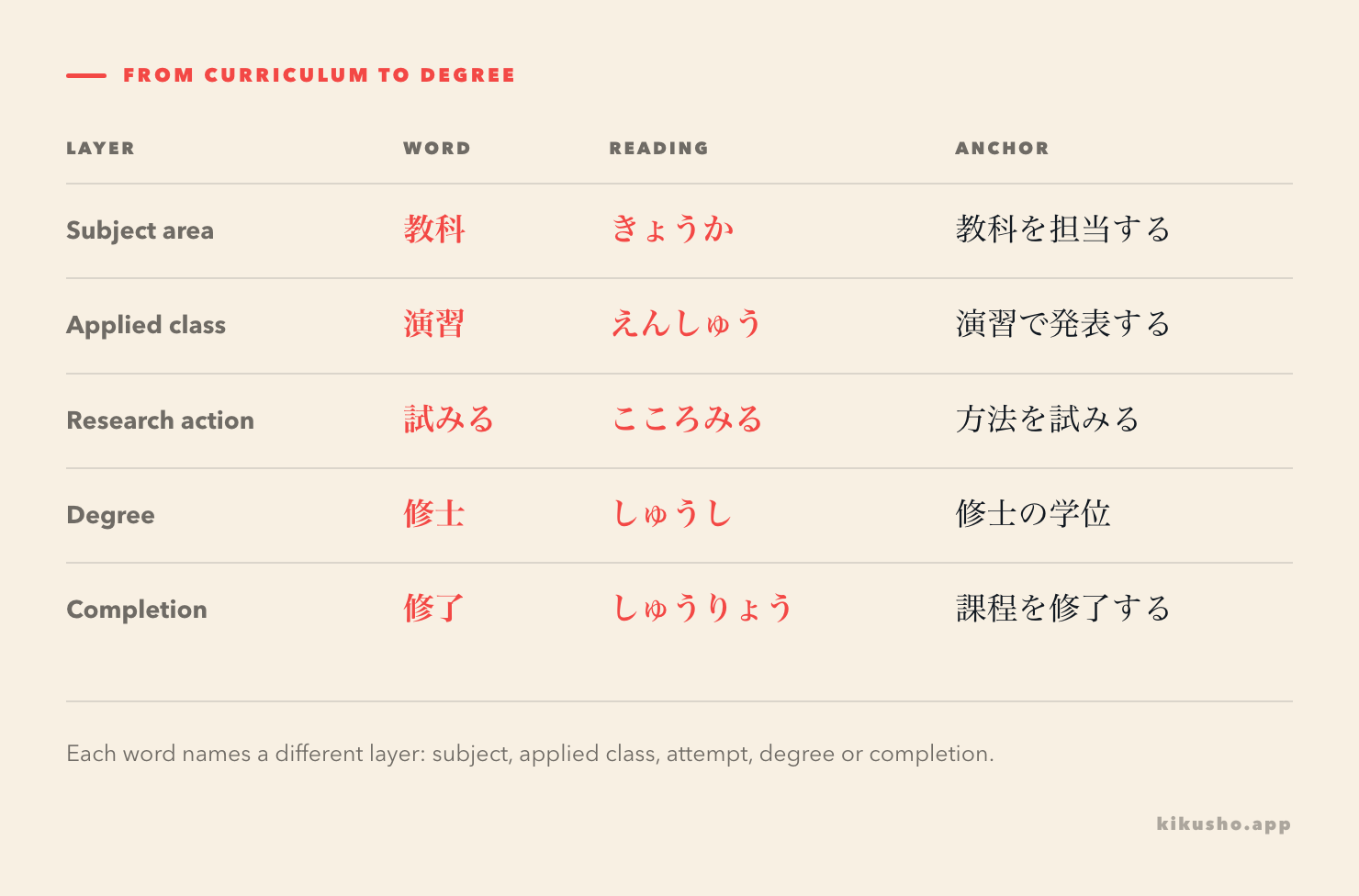
The two words beginning with 修 are especially easy to blur. 修士 names a degree; 修了 names the act or state of completing a defined course. The final characters, 士 and 了, carry that difference.
教科 is the curriculum area; 科目 can be one component
教科 is an organised area of knowledge or skills taught in school. Kotobank's 教科 entry gives 国語, 社会, 算数 and 理科 as familiar examples. It also explains a useful institutional hierarchy: at high school, a broad 教科 may be divided into narrower 科目(かもく).
高校の理科という教科には、物理や化学などの科目があります。
こうこうの りかという きょうかには、ぶつりや かがくなどの かもくが あります。
The high-school subject area of science includes courses such as physics and chemistry.
That distinction is not a universal ban on calling mathematics a 科目 or a 教科. A pupil can answer 好きな教科は数学です, while an enrolment form may ask which 科目 a student selected. Ask whether the document is naming the curriculum's larger category or one countable course, exam component or requirement.
The familiar 教科書(きょうかしょ), textbook, literally contains 教科. A textbook serves a subject area; it does not make 教科 mean the physical book.
演習 puts learned material into use
In education, 演習 can name practice exercises or a class built around application, presentations and discussion. It often stands beside a lecture in a syllabus:
来週の演習では、各自が研究計画を発表します。
らいしゅうの えんしゅうでは、かくじが けんきゅうけいかくを はっぴょうします。
In next week's seminar, each person will present a research plan.
講義の後で、統計の演習問題に取り組みました。
こうぎの あとで、とうけいの えんしゅうもんだいに とりくみました。
After the lecture, I worked on statistics practice problems.
Kotobank records three main senses of 演習: repeated practice, a military or emergency exercise, and a small university class centred on research, presentation and discussion. A Ministry of Health teaching document makes the educational contrast concrete: 演習 uses discussion, presentation and simulations under guidance, while 実習(じっしゅう) centres on practical or hands-on work.
| Word | Ask what the learner is doing | Typical example |
|---|---|---|
| 練習 | repeating a skill to improve it | 発音を練習する |
| 演習 | applying knowledge in problems, discussion or a drill | 演習問題を解く |
| 実習 | gaining supervised practical experience | 病院で実習する |
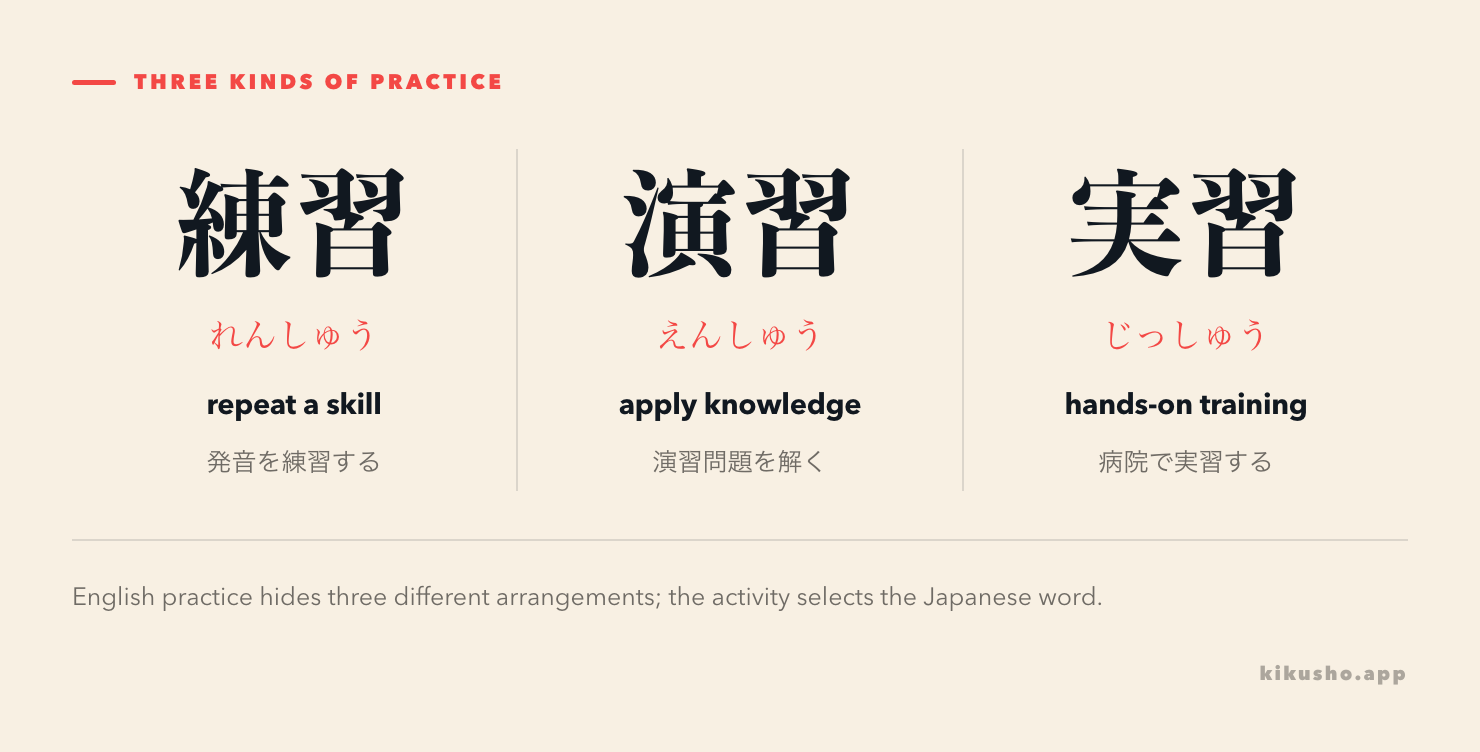
The non-academic sense can change the scene completely: 防災演習 is a disaster-prevention drill, and 軍事演習 is a military exercise. A bare translation of “seminar” would fail in both.
試みる presents an action as an attempt
試みる is read こころみる, not ためみる. It is a transitive ichidan verb: 試みます, 試みた, 試みない. The object with を is the action or change being attempted.
研究チームは新しい分析方法を試みました。
けんきゅうチームは あたらしい ぶんせきほうほうを こころみました。
The research team attempted a new method of analysis.
誤解を解くため、本人との対話を試みたが、返事はなかった。
ごかいを とくため、ほんにんとの たいわを こころみたが、へんじは なかった。
I attempted a dialogue with the person concerned to clear up the misunderstanding, but there was no reply.
The second sentence keeps the result open until the final clause. That uncertainty is characteristic. Goo's usage note says 試みる focuses on going ahead with something despite not knowing the outcome. 試す(ためす) more strongly tests a target to discover its ability, quality or truth:
- 新しい解決法を試みる: attempt a new solution.
- 装置の性能を試す: test the device's performance.
- 脱出を試みる: attempt an escape.
- 自分の実力を試す: test one's ability.
The overlap is real when trying an action also tests whether it works. The object reveals the centre of attention: 試みる looks toward carrying out the attempt; 試す looks toward evaluating the target.
修士 is the degree, 修士課程 is the programme
修士 names the master's degree in the modern academic sense. Kotobank's 修士 entry places it between a bachelor's and a doctorate and describes the Japanese graduate-course setting in which it is awarded.
彼女は工学の修士号を取得しました。
かのじょは こうがくの しゅうしごうを しゅとくしました。
She obtained a master's degree in engineering.
The source inventory gloss “master's degree program” is too broad for the headword alone. Add 課程(かてい) for the programme:
| Japanese | What it names |
|---|---|
| 修士 | the master's degree |
| 修士号 / 修士の学位 | the degree or degree title |
| 修士課程 | the master's programme |
| 修士論文 | a master's thesis |
In Japanese universities, you can also see 博士前期課程(はくしぜんきかてい) for the first stage of a doctoral programme that corresponds to the master's level. It is an institutional name, not a different reading of 修士.
修了 closes a defined course, not just an event
修了 means completing a prescribed course of study or training. The course normally takes を:
二年間の修士課程を修了しました。
にねんかんの しゅうしかていを しゅうりょうしました。
I completed the two-year master's programme.
Goo defines 修了 as finishing a fixed academic course. Its comparison with 卒業 gives the practical boundary: 卒業 treats finishing school and leaving it as the event, while 修了 treats a particular course or stage as complete. This is why 大学を卒業する and 修士課程を修了する are the stable pair.
Do not replace 修了 with the homophone 終了(しゅうりょう). 終了 means an event, service or process ends: 試験が終了した, “the exam ended.” 修了 contains 修, the same character that appears in study-related words such as 修士 and 修学.
彼は修士課程を修了し、修士の学位を取得しました。
かれは しゅうしかていを しゅうりょうし、しゅうしの がくいを しゅとくしました。
He completed the master's programme and obtained a master's degree.
That sentence keeps completion and qualification separate. Finishing the course is 修了; the degree received is 修士.
The level labels disagree more than the meanings
Kikusho's dated inventory assigns all five records to this N1 lesson. Its two lists are related descendants of the same Waller source, so agreement between them is one source-family observation. Bunpro places 演習 at N1 and 試みる at N1, but places 修士 and 修了 at N2. No independent level placement was found for 教科 in the sources used here.
Those differences affect study order, not the readings or core meanings. The JLPT describes N1 through broad reading and listening ability and does not publish an exhaustive vocabulary list. This page therefore records its source placements without presenting them as an official boundary.
If a syllabus or research notice gives you one of these terms, save the smallest phrase that fixes its role in Kikusho: 演習で発表する, 方法を試みる, 修士課程, or 課程を修了する. The editable card can keep the reading and surrounding noun together, which matters when one English gloss such as “course,” “practice” or “try” covers several Japanese choices.
Practice: complete all questions before checking the answers
Question 1
Which reading matches 修了 when it means completing a course?
- A. しゅりょう
- B. しゅうりょ
- C. しゅうりょう
- D. しゅうりゅう
Question 2
A research report uses こころみる for an attempted method. Select its kanji spelling.
- A. 試みる
- B. 試しる
- C. 調みる
- D. 験みる
Question 3
A high-school curriculum groups physics, chemistry and biology under the broader area of science. Which word best names that broader area?
- A. 修士
- B. 教科
- C. 修了
- D. 演習
Question 4
Which paraphrase best preserves 研究者は新しい方法を試みた?
- A. The researcher proved that the new method was effective.
- B. The researcher completed a course in the new method.
- C. The researcher attempted a new method.
- D. The researcher tested another person's ability.
Question 5
Which sentence uses 演習 naturally in an academic setting?
- A. 大学院の演習で研究計画を発表した。
- B. 演習を卒業して修士を終了した。
- C. 教科を演習から取得した。
- D. 演習が学生を試みた。
Question 6
Choose the pair that completes the sentence: 二年間の( )を( )、修士の学位を取得した。
- A. 修了 / 修士し
- B. 修士課程 / 修了し
- C. 教科 / 演習し
- D. 演習問題 / 卒業し
Question 7
You want to say that engineers checked a device to discover how well it performs. Which sentence best fits?
- A. 技術者が装置の性能を試した。
- B. 技術者が装置の性能を修了した。
- C. 技術者が装置の性能を卒業した。
- D. 技術者が装置の性能を教科した。
Question 8
Which sentence correctly distinguishes 修了 from the homophone 終了?
- A. 会議を修了し、研修課程が終了した。
- B. 修士を修了し、大学院を終了した。
- C. 研修課程を修了し、午後五時に式が終了した。
- D. 修了 means a master's degree, while 終了 means a master's programme.
Answers and explanations
Answer 1
C. しゅうりょう. Both しゅう and りょう contain long vowels. The same pronunciation belongs to 終了, so context and the first kanji distinguish the words.
Answer 2
A. 試みる. The reading こころみる belongs to the complete verb 試みる. 試す is a separate verb read ためす.
Answer 3
B. 教科. 教科 names the organised curriculum area. Physics, chemistry and biology can then be treated as more specific 科目 within the broad area of science.
Answer 4
C. The researcher attempted a new method. 試みる reports making the attempt; it does not itself say that the method succeeded or proved effective.
Answer 5
A. 大学院の演習で研究計画を発表した. A presentation and discussion inside a graduate seminar fit the academic 演習 sense. The other choices assign the words grammatical or semantic roles they do not have.
Answer 6
B. 修士課程 / 修了し. 修士課程 is the master's programme, and a defined programme is something you 課程を修了する. The resulting qualification is 修士の学位.
Answer 7
A. 技術者が装置の性能を試した. 試す focuses on evaluating the performance of a target. 試みる would need an attempted action or method as its object, such as 改良を試みた.
Answer 8
C. 研修課程を修了し、午後五時に式が終了した. 修了 completes a course of study or training; 終了 says an event or process ends. The identical reading does not make the nouns interchangeable.
Common questions
What does 演習 mean in a university syllabus?
演習(えんしゅう)is a seminar or exercise-based class in which students apply material through problems, research, presentations or discussion. The same word can also mean practice exercises or a drill, including a military or emergency exercise, so the surrounding noun matters.
What is the difference between 教科 and 科目?
教科(きょうか)is a structured subject area in a school curriculum, such as science. 科目(かもく)can name a more specific component or course, such as physics within science, especially in upper-secondary and higher education. Everyday usage overlaps, so the institutional context decides.
What is the difference between 試みる and 試す?
試みる(こころみる)presents an action as an attempt whose result is not guaranteed. 試す(ためす)often means testing a person, object, method or ability to find out how it performs. Both can translate as try, but they focus on different questions.
Does 修士 mean a master's programme?
修士(しゅうし)is the master's academic degree. The programme is 修士課程(しゅうしかてい). You 修士課程を修了する, complete the master's programme, and 修士の学位を取得する, obtain the master's degree.