On this page
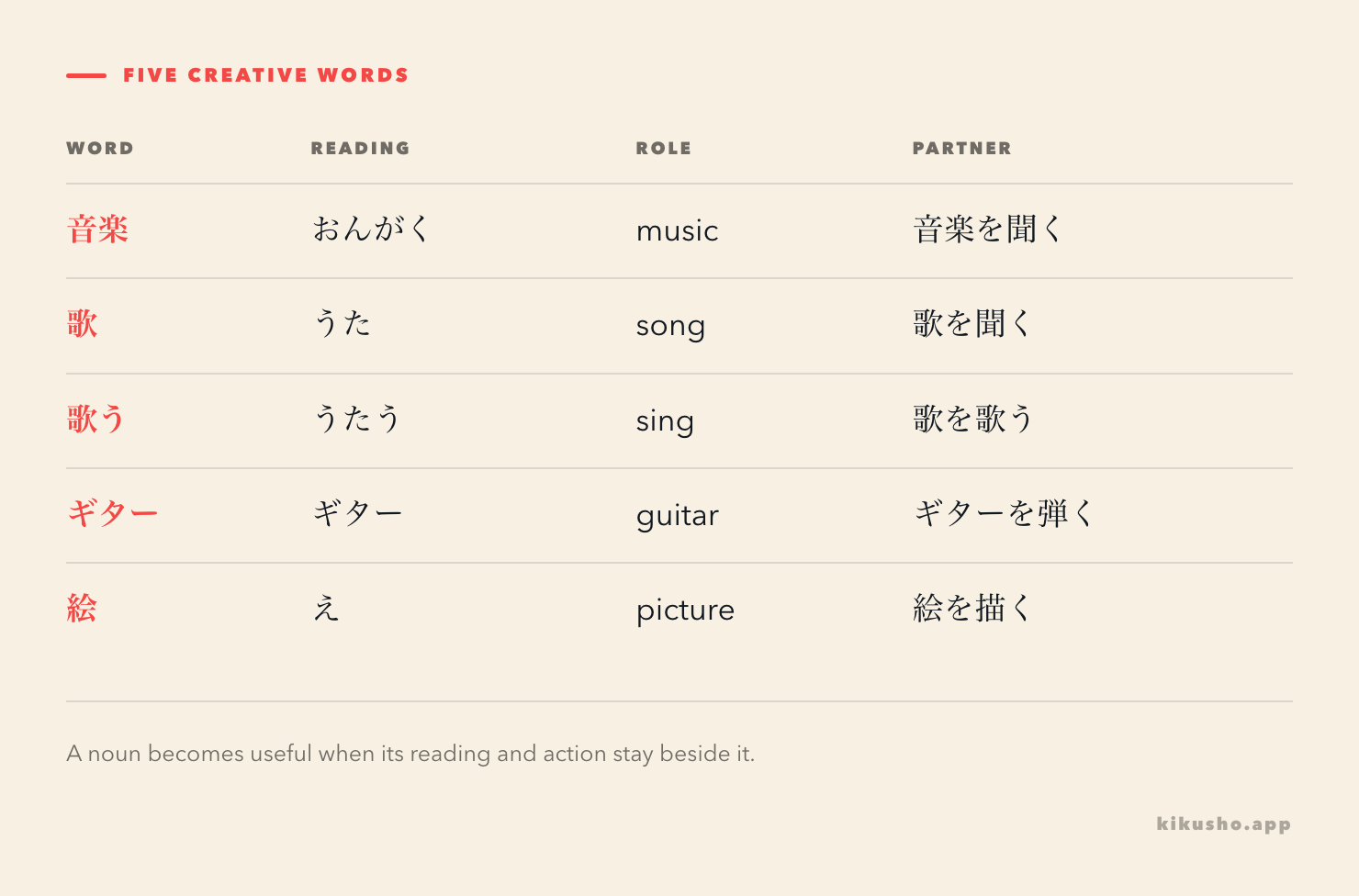
Five short words let you describe a small creative scene in Japanese: 音楽 is music, 歌 is a song, 歌う is to sing, ギター is a guitar, and 絵 is a picture. The most useful way to learn them is with the action each one invites: 音楽を聞く, 歌を歌う, ギターを弾く, and 絵を描く.
Why these five belong together
These words begin with things you can see or hear, then move to what someone does with them. Four are nouns. One, 歌う, is a verb built from the same visible kanji as the noun 歌. That noun and verb pair makes the whole set easier to organize.
| Role | Word | Reading | Part of speech and meaning | Natural partner |
|---|---|---|---|---|
| Broad medium | 音楽 | おんがく | noun: music | 音楽を聞く, listen to music |
| One vocal work | 歌 | うた | noun: song; singing | 歌を聞く, listen to a song |
| Vocal action | 歌う | うたう | godan verb: sing | 歌を歌う, sing a song |
| Instrument | ギター | ギター | noun: guitar | ギターを弾く, play the guitar |
| Visual work | 絵 | え | noun: picture, drawing or painting | 絵を描く, draw a picture |
The Japan Foundation's Marugoto Starter wordbook groups 音楽, 歌, 歌う and ギター in its free-time vocabulary, gives ギターを弾く, and follows them with 絵を描く. Japanese dictionary entries independently verify 音楽, 歌, 歌う and 絵. The goo dictionary entry for ギター identifies it as a plucked string instrument.
Current search results often put these words inside much larger hobby lists. Studination's N5 hobbies page, for example, ranges across music, film, sport, reading, drawing, travel and games. This lesson stays with the assigned five and teaches the short phrases needed to use them.
歌 is the song; 歌う is the action
The extra う changes both the word class and the reading. 歌(うた) is a noun. 歌う(うたう) is a godan verb whose final う conjugates.
この歌が好きです。
この うたが すきです。
I like this song.
妹は毎日歌います。
いもうとは まいにち うたいます。
My younger sister sings every day.
They can appear together without repetition being a mistake:
みんなで日本の歌を歌いました。
みんなで にほんの うたを うたいました。
We sang a Japanese song together.
The noun 歌 is the object marked by を. The verb 歌いました reports the action in polite past form. English usually avoids “sing a song” only when the object is already obvious; Japanese comfortably keeps both words when naming what was sung.
Do not shorten 歌う to 歌 when the sentence needs a verb. 私は歌です would identify the speaker as a song. 私は歌います says “I sing.” The final kana is carrying grammar, not merely extending the noun.
音楽 is the broad category
音楽(おんがく) covers music as an art or activity. A 歌 can be one work within that larger category, especially one made to be sung. The sentence decides whether you mean the medium or an individual song.
電車で音楽を聞きます。
でんしゃで おんがくを ききます。
I listen to music on the train.
この歌をもう一度聞きます。
この うたを もういちど ききます。
I will listen to this song once more.
Both nouns can take 聞く, listen. 音楽を聞く leaves the music general; この歌を聞く selects one song. When a device supplies background music, 音楽をかける means to put music on:
家で静かな音楽をかけました。
いえで しずかな おんがくを かけました。
I put on quiet music at home.
The kanji reading needs attention. Read the whole word as おんがく, with ん before が. Reading the two characters as isolated beginner words will not reliably produce this compound, so keep its reading attached to the complete noun.
ギター takes 弾く
ギター is written in katakana because it entered Japanese as a loanword. Its long vowel mark matters: ター holds the final vowel longer than タ.
Japanese chooses a verb according to how an instrument is played. For a guitar, use 弾く(ひく):
兄はギターを弾きます。
あには ギターを ひきます。
My older brother plays the guitar.
The polite form is 弾きます. The spelling 弾く is useful even if that kanji is beyond the five assigned items, because it prevents the English verb “play” from pulling you toward 遊ぶ, which means play or have fun rather than perform on a guitar.
You may also hear ギターを練習する, practise guitar, or ギターが弾ける, can play guitar. Those expressions make different claims. The basic phrase ギターを弾く simply names the performance action.
The direct-object lesson explains why the instrument is marked with を here. Learn the noun and verb as one phrase first; the particle pattern will then feel familiar in other actions.
絵 is a picture you view or make
絵(え) can name a drawing, painting or picture. It does not by itself tell you which materials were used.
子どもが犬の絵を描きました。
こどもが いぬの えを かきました。
The child drew a picture of a dog.
The usual written distinction is 絵を描く, draw or paint a picture, and 名前を書く, write a name. Both verbs are pronounced かく, so speech alone may not reveal which kanji is intended. The object does: a picture invites 描く, while letters and words invite 書く.
美術館で有名な絵を見ました。
びじゅつかんで ゆうめいな えを みました。
I saw a famous painting at the art museum.
Do not treat 絵 and 写真(しゃしん) as automatic synonyms. A photograph is normally 写真, paired with 写真を撮る, take a photograph. A hand-drawn or painted image is naturally 絵, paired with 絵を描く.
One room, four different actions
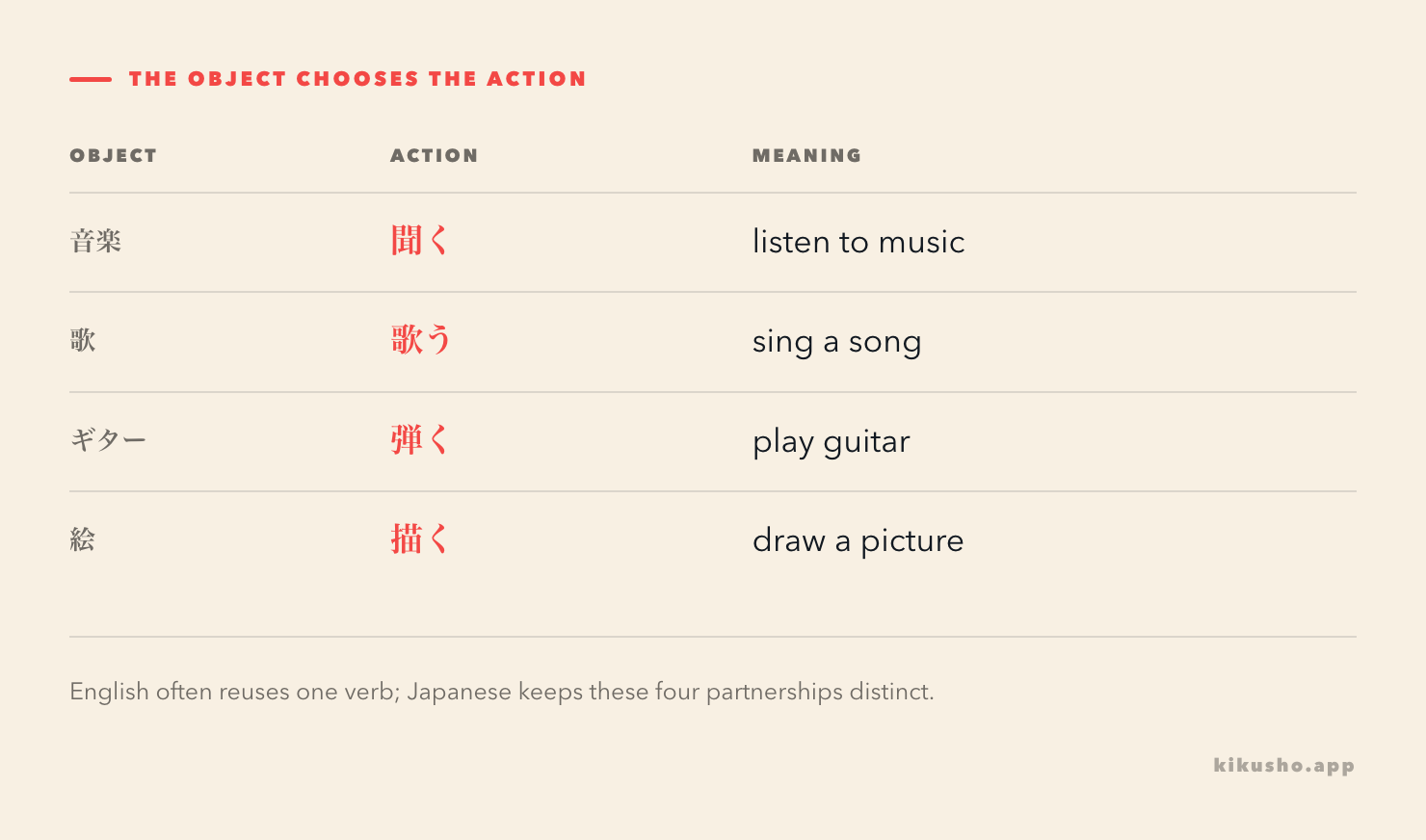
Picture a school club after class. One student puts on music, another sings a song, someone plays guitar, and a friend draws a picture:
音楽を聞きます。歌を歌います。ギターを弾きます。絵を描きます。
おんがくを ききます。うたを うたいます。ギターを ひきます。えを かきます。
We listen to music, sing a song, play guitar and draw a picture.
The four clauses repeat the same noun + を + verb frame. What changes is the natural partnership. English uses “play” for music, an instrument and a game, but Japanese does not choose one universal verb for all three. The object gives you a strong clue: 聞く for what you listen to, 歌う for a song you sing, 弾く for a guitar you play, and 描く for a picture you create.
If you hear one of these phrases at a rehearsal or see it in a hobby notice, keep the whole phrase when making a card. Kikusho can draft a card from the captured line, and you can check the reading and example before saving it. Preserving ギターを弾く is more useful than storing ギター beside the broad English verb “play.”
The five items come from Kikusho's dated N5 reference inventory. The two compared list families agree on their placement, but the JLPT FAQ says the former Test Content Specifications have not been published for the revised exam. Treat N5 as a documented study estimate and practise reading and listening separately.
Test the five-word scene
Question 1: read the music word
How is 音楽 read?
- ア. おんらく
- イ. おとがく
- ウ. おんがく
- エ. おんかく
Question 2: separate the song from the action
Which word is the verb “to sing”?
- ア. 歌
- イ. 歌う
- ウ. 音楽
- エ. 絵
Question 3: choose the listening scene
You want to say “I listen to music on the train.” Which sentence fits?
- ア. 電車で音楽を聞きます。
- イ. 電車で音楽を描きます。
- ウ. 電車で音楽を弾きます。
- エ. 電車で音楽を歌です。
Question 4: choose the instrument phrase
Which phrase naturally means “play the guitar”?
- ア. ギターを聞く
- イ. ギターを描く
- ウ. ギターを歌う
- エ. ギターを弾く
Question 5: find the picture noun
Which word means a picture, drawing or painting?
- ア. 画う
- イ. 歌
- ウ. 絵
- エ. 音楽
Question 6: understand the group activity
What does みんなで日本の歌を歌いました mean?
- ア. We drew a Japanese picture together.
- イ. We listened to Japanese music alone.
- ウ. We played a Japanese guitar together.
- エ. We sang a Japanese song together.
Answers and explanations
Answer 1
ウ. おんがく. 音楽 is read おんがく. The ん remains before が, and 楽 is がく in this compound.
Answer 2
イ. 歌う. The final う makes 歌う the verb “to sing.” 歌 is the noun “song,” while 音楽 and 絵 are also nouns.
Answer 3
ア. 電車で音楽を聞きます. 音楽を聞く means listen to music. 描く belongs with a picture, 弾く with a stringed or keyboard instrument, and エ does not form a grammatical predicate.
Answer 4
エ. ギターを弾く. 弾く is the natural verb for playing a guitar. 聞く would listen to it, while 描く and 歌う describe different creative actions.
Answer 5
ウ. 絵. 絵(え)names a picture, drawing or painting. 歌 is a song and 音楽 is music; 画う is not the assigned word or a valid spelling for “to sing.”
Answer 6
エ. We sang a Japanese song together. みんなで means together as a group, 日本の歌 is a Japanese song, and 歌いました is the polite past of 歌う.
Common questions
What is the difference between 歌 and 歌う?
歌(うた)is a noun meaning a song or singing. 歌う(うたう)is the godan verb meaning to sing. They can appear together in 歌を歌う, sing a song, because the first word names the thing and the second names the action.
How do you say play the guitar in Japanese?
Say ギターを弾く(ギターをひく). 弾く is the usual verb for playing a stringed or keyboard instrument. In polite speech, use ギターを弾きます.
Does 絵 mean a photograph?
絵(え)usually means a picture, drawing or painting. A photograph is 写真 (しゃしん). Use 絵を描く for drawing or painting a picture and 写真を撮る for taking a photograph.
Are these five words officially assigned to JLPT N5?
Kikusho's dated reference inventory places all five at N5, and its two compared list families agree. The JLPT publishes no exhaustive official vocabulary list, so N5 is a source-based study estimate.