On this page
When 予想が当たった, the prediction proved right; when ボールが壁に当たった, a ball hit the wall. Learn a Japanese verb's sense together with its partner words, because one English gloss cannot explain both encounters.
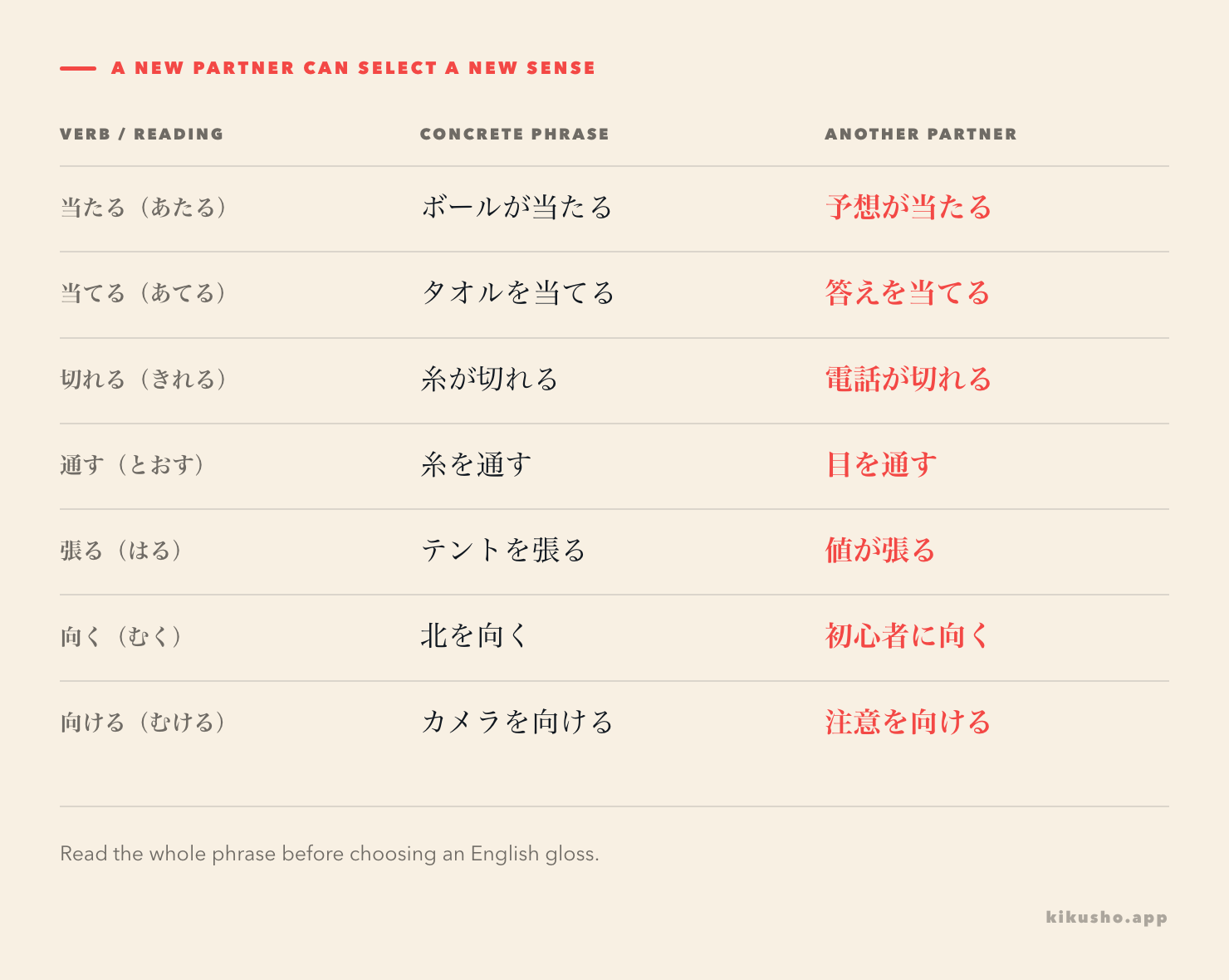
This N3 vocabulary set teaches 当たる、当てる、切れる、通す、張る、向く、向ける. You will compare concrete actions with predictions, suitability and conventional expressions, then check the conjugation needed to put each phrase into a sentence.
Seven verbs, with two starting phrases each
An accompanying noun can change the interpretation while the verb stays the same. Some words also form pairs: 当たる describes contact occurring, while 当てる presents something brought into contact. Other senses need their own phrase checks.
Godan and ichidan are conjugation classes. Transitive and intransitive describe how an action is constructed; they do not tell you whether it was intentional. 張る has both transitive and intransitive uses.
| Headword | Reading | Class and uses here | Two phrases to retrieve |
|---|---|---|---|
| 当たる | あたる, ataru | Godan; intransitive | ボールが当たる: a ball hits; 予想が当たる: a prediction proves correct |
| 当てる | あてる, ateru | Ichidan; transitive | タオルを当てる: apply a towel; 答えを当てる: guess the answer correctly |
| 切れる | きれる, kireru | Ichidan; lexical intransitive verb here | 糸が切れる: a thread breaks; 電話が切れる: a call is disconnected |
| 通す | とおす, toosu | Godan; transitive | 糸を通す: thread something; 目を通す: look through / read over |
| 張る | はる, haru | Godan; transitive or intransitive | テントを張る: put up a tent; 値が張る: be expensive |
| 向く | むく, muku | Godan; intransitive | 北を向く: face north; 初心者に向く: suit beginners |
| 向ける | むける, mukeru | Ichidan; transitive in the directed-object examples | カメラを向ける: point a camera; 注意を向ける: direct attention |
Keep the particles along with the nouns. 予想が, 答えを, 初心者に and 目を give you different kinds of clue. The lesson on effort and endurance makes a related distinction between a verb, a する noun, an adjective and a noun used with 出す.
当たる reports contact or a prediction that proves right
当たる does not need a person receiving a blow. The thing making contact can be the subject:
庭で遊んでいたら、ボールが窓に当たった。
にわで あそんで いたら、ボールが まどに あたった。
While we were playing in the garden, a ball hit the window.
The sentence reports contact. It does not identify who threw the ball or say the window broke. The same verb supports an abstract result:
雨になるという私の予想が当たった。
あめに なるという わたしの よそうが あたった。
My prediction that it would rain proved correct.
予想(よそう) means a prediction or expectation. Here 当たった evaluates it against what happened. Daijisen's 当(た)る entry and Kanjipedia both distinguish contact from a prediction being on target. Translate the entire relationship: “my prediction was hit” would import the physical sense into this scene.
A lottery win and an undertaking that succeeds are further dictionary senses. They do not make 当たる a general substitute for “succeed at anything.” This lesson uses the prediction and contact phrases as its starting points.
当てる brings something into contact or guesses correctly
In XをYに当てる, X is what someone brings against Y. A gentle application can fit; force is not required.
暑かったので、冷たいタオルを額に当てた。
あつかったので、つめたい タオルを ひたいに あてた。
It was hot, so I put a cold towel against my forehead.
額(ひたい) is the forehead. Compare the guessing sense:
妹はクイズの答えを全部当てた。
いもうとは クイズの こたえを ぜんぶ あてた。
My younger sister got all the quiz answers right.
答えを当てる includes correctness. “She guessed every answer” leaves that result uncertain in English. Daijisen and NINJAL's usage dictionary independently record contact and correct guessing.
The sound あてる also appears with 充てる, allocate to a purpose, and 宛てる, address something to a recipient. Those spelling choices matter in other sentences. The contact and guessing examples use 当てる; the あてる spellings are not all interchangeable.
切れる describes a break, an interruption or sharp cutting
A continuous thing may separate without the sentence naming an actor who cut it:
糸が切れたので、もう一度針に通した。
いとが きれたので、もう いちど はりに とおした。
The thread broke, so I threaded it through the needle again.
糸(いと) is thread and 針(はり) is a needle. 切れた is ichidan past, with one ordinary れ and no small っ. An interrupted connection uses the same headword:
話している途中で電話が切れた。
はなして いる とちゅうで でんわが きれた。
The call was disconnected while we were talking.
Daijisen and Kanjipedia also record depletion and sharp cutting. よく切れる包丁(よくきれるほうちょう) is a kitchen knife that cuts well, rather than one that often snaps in half.
One complication deserves a separate check. Godan 切る(きる), cut something, forms the potential 切れる, “can cut.” That surface can match this lexical verb. The passive of 切る is 切られる. A thread breaking, an implement cutting well and a person's ability to cut a material need their own sentence contexts; 切れる is not universally “is cut by someone.”
通す moves something through; 目を通す means looking over
The physical construction is 糸を針に通す, put a thread through a needle. 通す is godan, read とおす, with two お vowels. Do not replace the kana with とうす.
The partner in 目を通す(めをとおす) selects a conventional reading expression. The document takes に:
会議の前に、短い資料に目を通した。
かいぎの まえに、みじかい しりょうに めを とおした。
Before the meeting, I looked through the short document.
The Daijisen phrase entry describes looking through something; Imidas's idiom dictionary clarifies the quick overview rather than attention to every detail. It does not assert that the reader memorized, approved or carefully proofread the document.
Daijisen's main entry and NINJAL also describe admitting a visitor, getting something accepted and carrying something through. Those senses exceed “let pass.” This page does not survey every stem-attached compound ending in 通す.
張る changes meaning between a tent and its price
With a tent, 張る describes setting it up or spreading it out:
川の近くに小さなテントを張った。
かわの ちかくに ちいさな テントを はった。
We put up a small tent near the river.
It is godan: 張る → 張った. With a price, the construction changes:
このテントは少し値が張る。
この テントは すこし ねが はる。
This tent is a little expensive.
値(ね) names the price. The second sentence does not say someone is stretching a price tag. Daijisen and Kanjipedia support spreading or stretching and a price being high. 肩が張る(かたがはる), have tense or stiff shoulders, is another sense; 張る is not transitive in every use.
The gloss “stick / paste” is too small for this headword. For an adhesive action, 貼る(はる) is a useful spelling to recognize. Daijisen also records 張る in that sticking sense, so “張る can never mean stick” would overcorrect. Learn テントを張る for pitching a tent, keeping that action distinct from pasting a poster onto a surface.
向く faces a direction or suits a person; 向ける directs something
For a direction faced, 向く can take を:
写真を撮るとき、北を向いた。
しゃしんを とる とき、きたを むいた。
When taking the photo, I faced north.
Here 北を marks the direction, not an object made to face something. 向く is godan: 向く → 向いた. The suitability sense instead fits に:
この説明は初心者に向いている。
この せつめいは しょしんしゃに むいて いる。
This explanation is suitable for beginners.
初心者(しょしんしゃ) means a beginner. The explanation is not physically facing a row of beginners. Both Daijisen and Kanjipedia distinguish direction from suitability.
With 向ける, you can name the object directed:
カメラを北に向けた。
カメラを きたに むけた。
I pointed the camera north.
説明の大事な部分に注意を向けた。
せつめいの だいじな ぶぶんに ちゅういを むけた。
I directed my attention to the important part of the explanation.
The camera is concrete; 注意(ちゅうい), attention, is abstract. Daijisen and NINJAL support directing an object or attention. 向ける is ichidan in these uses: 向ける → 向けた. The spelling also matches a possible potential form of 向く, so one surface alone does not identify the construction in every context.
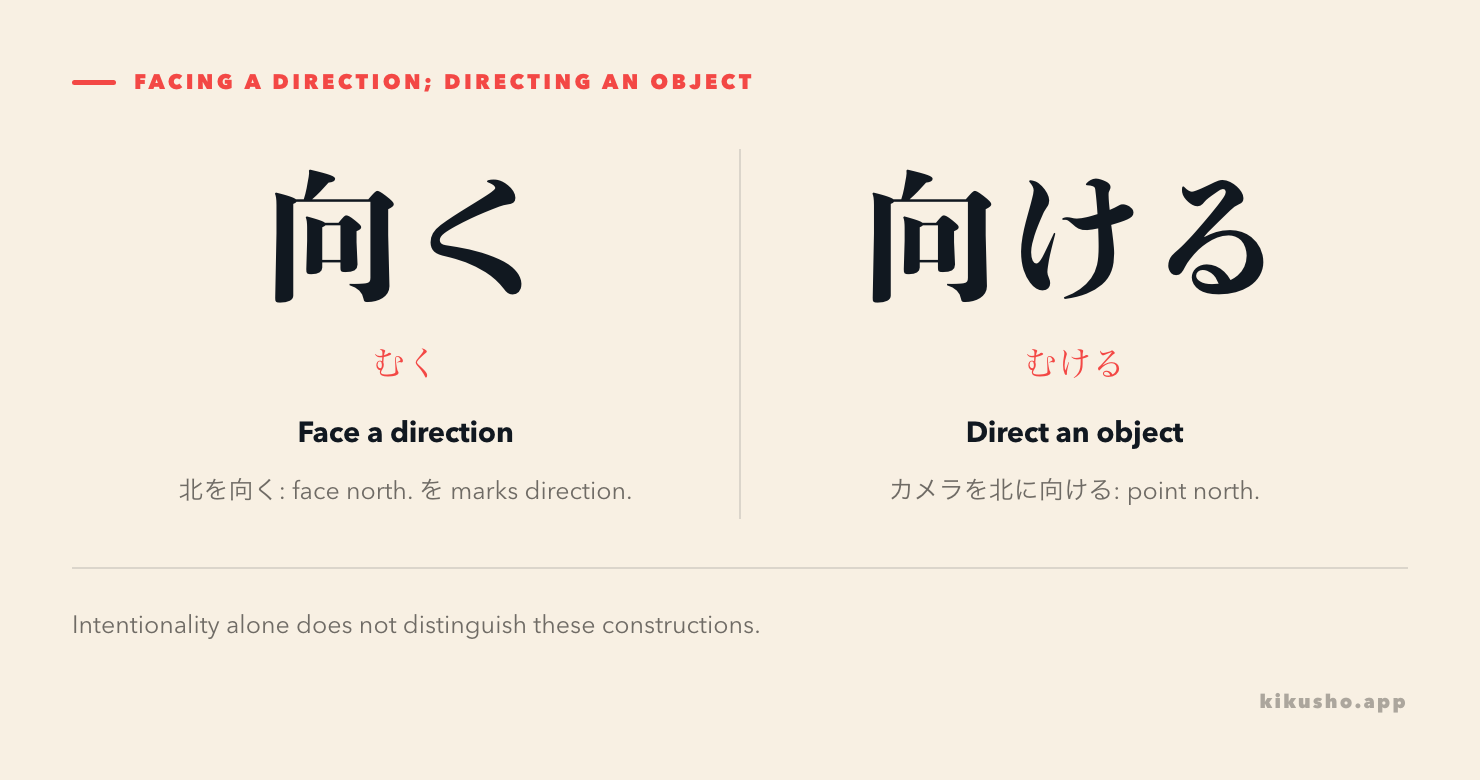
| Construction | Reading | What the phrase names |
|---|---|---|
| 北を向く | きたをむく | The direction faced |
| 初心者に向く | しょしんしゃにむく | The people something suits |
| カメラを北に向ける | カメラをきたにむける | The object directed and its direction |
| 注意を向ける | ちゅういをむける | Attention directed toward something |
The N4 verb-family reference supplies earlier pairs and particles. These examples add a reason to keep を's actual role visible rather than equating it with transitivity.
Conjugation follows the verb, even when the sense shifts
The prediction sense does not change 当たる into an ichidan verb. Nor does a concrete object change 当てる into godan. Keep these forms available:
| Dictionary form | Polite form | Plain past | て-form |
|---|---|---|---|
| 当たる | 当たります | 当たった | 当たって |
| 当てる | 当てます | 当てた | 当てて |
| 切れる | 切れます | 切れた | 切れて |
| 通す | 通します | 通した | 通して |
| 張る | 張ります | 張った | 張って |
| 向く | 向きます | 向いた | 向いて |
| 向ける | 向けます | 向けた | 向けて |
The N5 verb-group lesson explains those classes. The table gives ordinary forms, not a rule that every ending in る conjugates alike.
Save the encounter that changes your first translation
A camera subtitle with 向ける and a paragraph with 注意を向ける can give you different retrieval cues. In Kikusho, paste the latter clause and inspect the proposed editable card. Keep the attention sense and the part of the sentence identifying its target; check the example before accepting a physical-camera gloss. You can later compare that encounter with the camera sentence.
The N3 placements used here come from the dated Kikusho inventory and its Waller-derived study lists. Those two adaptations share one ancestry. The freshly inspected JapaneseTest4You 当たる page also labels that headword N3; it does not establish independent current grades for the other six or every sense. The dictionaries check readings and usage without assigning official JLPT levels. No exhaustive official JLPT word list makes these exclusive level boundaries. Treat the placements as a study sequence, with basic particles and verb groups as prerequisites.
The language checks use Shogakukan's dictionaries, the association-owned 漢検 漢字辞典 described by Kanjipedia, and the separately compiled NINJAL usage dictionary. This bounded set does not cover every dictionary sense, historical use or compound built from the seven verbs.
Try eight vocabulary questions
Work through the readings, spellings and situations before checking the final block. These original questions use the N3 vocabulary formats; they are not copied exam items.
Question 1: read the verb. Read the bold word in the sentence about a brief document check.
資料に目を通しました。
A. とおしました
B. とうしました
C. つうしました
D. とおりました
Question 2: choose the spelling. Select the written form of むいた in the account 写真を撮るとき、北をむいた.
A. 向けた
B. 向った
C. 向いた
D. 通いた
Question 3: complete the report. The connection stopped while the speakers were still talking. Choose the verb describing that event.
話している途中で電話が( )。
A. 張った
B. 切れた
C. 当てた
D. 向いた
Question 4: write the verb for the camping task. Choose the spelling of はった meaning “put up” in 川の近くにテントをはった.
A. 張た
B. 貼った
C. 張いた
D. 張った
Question 5: preserve the result. Choose the statement with the same meaning as 雨になるという予想が当たった.
A. 雨になると予想していたが、雨は降らなかった。
B. 予想していたとおり、雨が降った。
C. 雨の中でボールを投げた。
D. くじで傘が当たった。
Question 6: check 当てる in a sentence. Find the use that expresses correctly identifying an answer.
A. 妹はクイズの答えを当てた。
B. 電話が途中で当てた。
C. この説明は初心者に当てた。
D. テントの値が当てた。
Question 7: keep the document action. Find the sentence using 目を通す to describe an overview of written material.
A. 会議の前に、資料を目に通した。
B. 会議の前に、資料に目が通した。
C. 会議の前に、資料に目を通した。
D. 会議の前に、資料に目を張った。
Question 8: finish the direction change. The photographer pointed the camera toward the mountains. Select the form that preserves the object and the action.
撮影する前に、カメラを山に( )。
A. 切れた
B. 向いた
C. 当たった
D. 向けた
Put your eight selections on paper or in a note. Stop here until you have decided how each sentence connects the verb with its partner.
Answers and explanations
Answer 1: A. 通す is とおす, giving 通しました・とおしました: “I looked through the document.” B changes とお to とう; C substitutes the kanji's つう reading. D instead reads 通りました, the polite past of 通る, changing the verb and written ending.
Answer 2: C. 向いた・むいた is the godan past: “When taking the photo, I faced north.” A reads むけた. B applies a small-っ pattern where く becomes いた; D substitutes 通 for 向 and does not spell this direction-facing verb.
Answer 3: B. 電話が切れた reports disconnection during the conversation. 張った does not state the interruption; 当てた lacks the object for a contact or guessing action. 向いた concerns a facing direction. The stated event selects 切れる's connection sense.
Answer 4: D. テントを張った describes pitching the tent. A omits godan 張る's small っ; C has the wrong past ending. B selects adhesive 貼る for a task explicitly described as putting up a tent.
Answer 5: B. “It rained, as predicted” preserves the correct prediction. A reverses its success. C introduces throwing a ball; D introduces winning a lottery umbrella. The latter is another possible 当たる sense, but it describes a different event.
Answer 6: A. クイズの答えを当てた means getting the answer right. B and D attach transitive 当てた to a call or price without the required object for the intended action. C does not express suitability for beginners. None of those choices identifies an answer correctly.
Answer 7: C. 資料に目を通した reports a document overview. A reverses 資料に and 目を; B substitutes 目が; D replaces the reading expression with 張る. Looking through does not establish detailed proofreading or approval.
Answer 8: D. カメラを山に向けた points the camera toward the mountains: ichidan 向けた, object カメラを, direction 山に. B could describe someone facing a direction with a different construction, but cannot take this directed-camera object. A's interruption and C's contact change the event. 撮影(さつえい)means photographing or filming.
Common questions
Does 当たる always mean being hit?
No. ボールが当たる describes a ball hitting something, while 予想が当たる means a prediction proves correct. The accompanying noun and the rest of the sentence select the sense. 当たる is read あたる and is godan.
Is 切れる the passive of 切る?
No. 糸が切れる uses the lexical ichidan verb 切れる, describing a thread breaking. 切れる can also have the same surface as the potential of godan 切る, can cut; the passive form of 切る is 切られる. Context distinguishes the lexical verb from the potential form.
Should I write 張る or 貼る?
Start with 張る for stretching, putting up a tent or a price being high. 貼る is useful for sticking something on with adhesive. Dictionaries also record 張る in the sticking sense, so this is a useful spelling distinction rather than a claim that those two spellings never overlap.
Does を always identify the object of a transitive verb?
No. In 北を向く, を marks the direction faced with intransitive 向く. In カメラを北に向ける, カメラ is the object being directed with transitive 向ける, and 北に names its direction. Learn the whole construction rather than classifying a verb from を alone.