On this page
Some N1 vocabulary is difficult for a reason that has nothing to do with meaning. You know every character in 玄人, 仲人 and 土産, and you still cannot say them: くろうと, なこうど, どさん. Nothing in the characters points to those sounds, and the rules you would use to guess land nowhere near.
These words sit on N1 vocabulary lists not because the kanji are rare. You met all of them years ago. They are hard because the reading is a separate fact you have to learn on its own. Here are the four readings, why three of them behave alike, and why 土産 does not.
You already know the characters, and still cannot read the word
A word at N5 is hard because you have never seen it. A word like these is hard the opposite way: it is transparent and unreadable at the same time. You know 玄 from 玄関 (げんかん) and 玄米 (げんまい). You know 仲 from 仲間 (なかま). 土 and 産 are among the first kanji anyone learns. Assemble them and the sound refuses to follow.
That is because the reading of a word is a property of the word, not a total of its characters. One kanji carries several readings for historical reasons, and one result is 熟字訓: a native reading laid across a whole compound, impossible to hand out to the individual characters. 今日 is きょう, and no part of it is きょ or う. くろうと and なこうど are built the same way. The characters give you the meaning; the sound is a separate word resting on top of them.
So the meaning of these words is nearly free. An expert, a matchmaker, the produce of a region: none of that is the obstacle. The obstacle is that you cannot pronounce what you already understand.
The set, and the reading you would have guessed
Here are the four readings, each beside what it means.
| Written | Read | What it means |
|---|---|---|
| 玄人 | くろうと | an expert, a professional |
| 仲人 | なこうど | a matchmaker, at a wedding |
| 仲人 | ちゅうにん | a go-between or mediator, more generally |
| 土産 | どさん | the produce of a region |
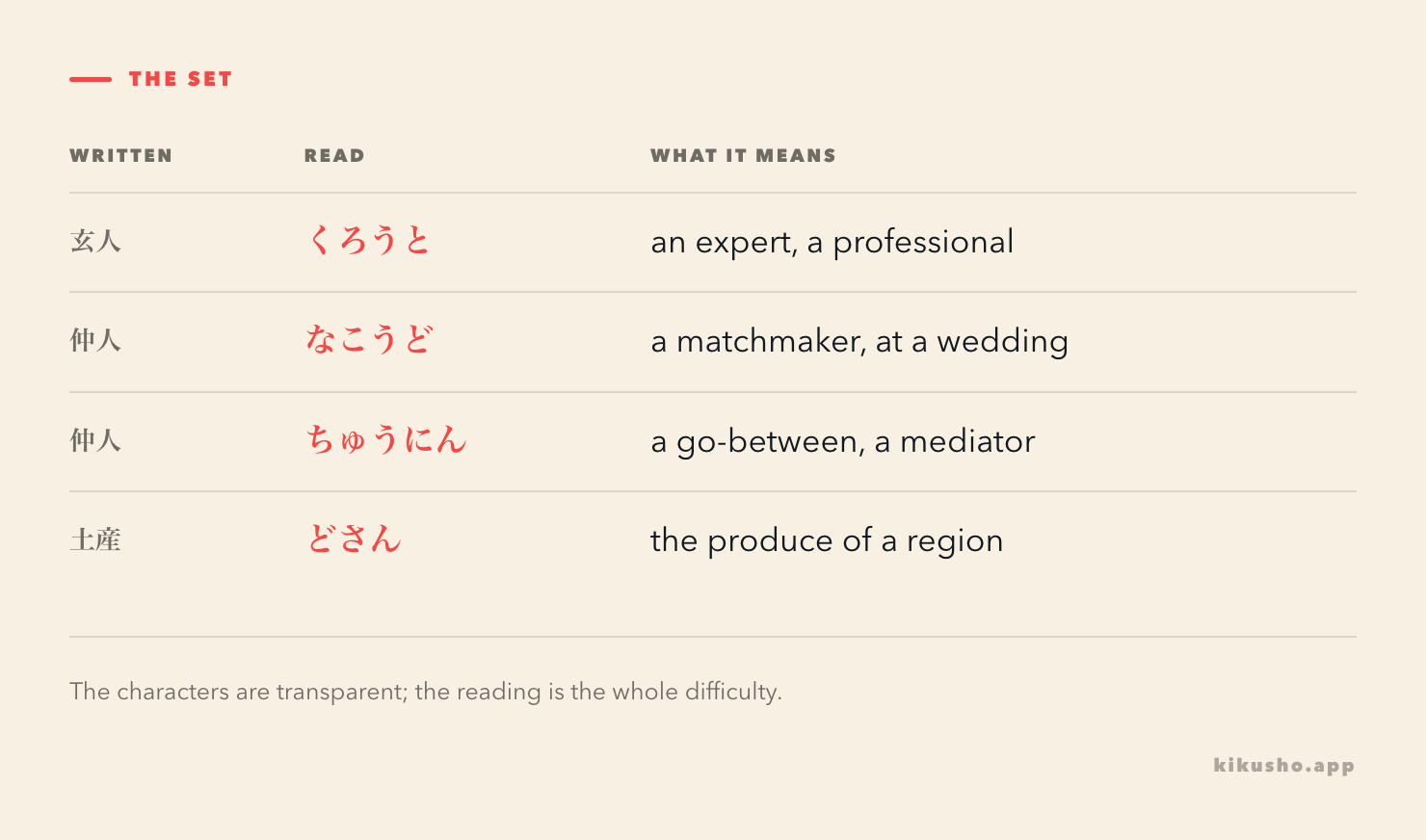
The reading a learner reaches for first is almost never the answer. Faced with 玄人 you try the on'yomi げんじん, and it does not exist for this word. Faced with 土産 the problem is worse, because you already know a reading — みやげ, the souvenir on every station kiosk — and どさん looks like a mistake even though it is correct. The set has one word, 仲人, that carries two readings at once, and that is a clue to the shape of the whole group rather than an exception to it.
Three of them end in a worn-down 人
Look at くろうと and なこうど and the same shape sits at the end of both: うと, うど. That tail is 人. Not the ひと you know, but an old, contracted form of it that survives only as a suffix. Attach it to a native stem and you get a person-word whose reading you could never assemble from the on'yomi.
素人 (しろうと), the amateur who stands opposite the 玄人, is the most common member, and the pair is neater than it looks: 玄 carries a sense of dark or deep and 素 of plain and undyed, so the two read almost as the dark one against the plain one, くろ against しろ. Three more words fill out the family.
| Written | Read | The person |
|---|---|---|
| 素人 | しろうと | an amateur |
| 玄人 | くろうと | an expert |
| 仲人 | なこうど | a matchmaker |
| 若人 | わこうど | a young person |
| 狩人 | かりゅうど | a hunter |
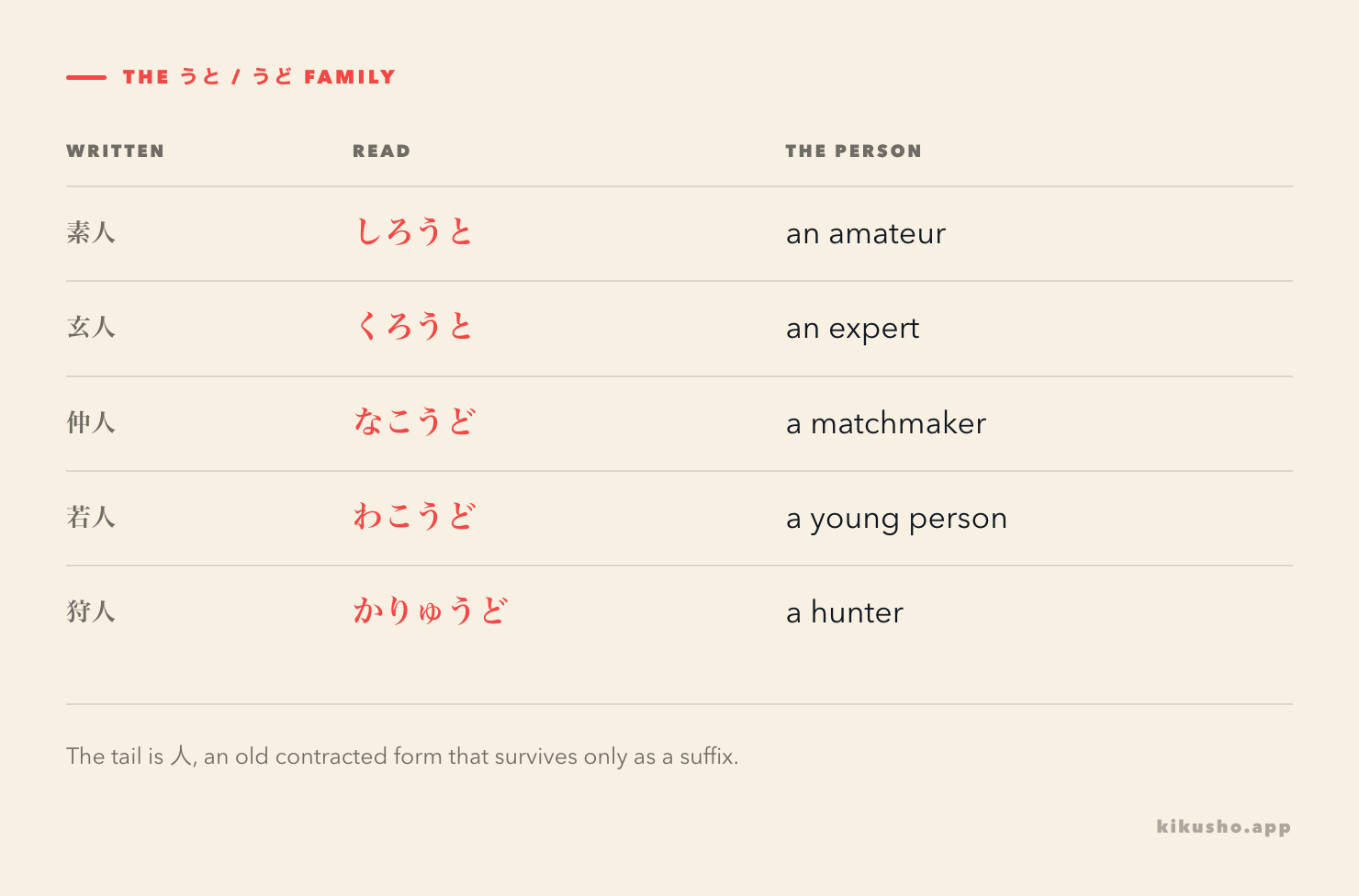
Once the うと and うど tail is a thing you watch for, the family starts to read itself, and a new member is a smaller surprise. 玄人 and 仲人 read なこうど are two entries in a group that is closed and worth learning together, which is the whole reason to meet them on one page instead of one at a time.
土産 is the one that breaks the pattern
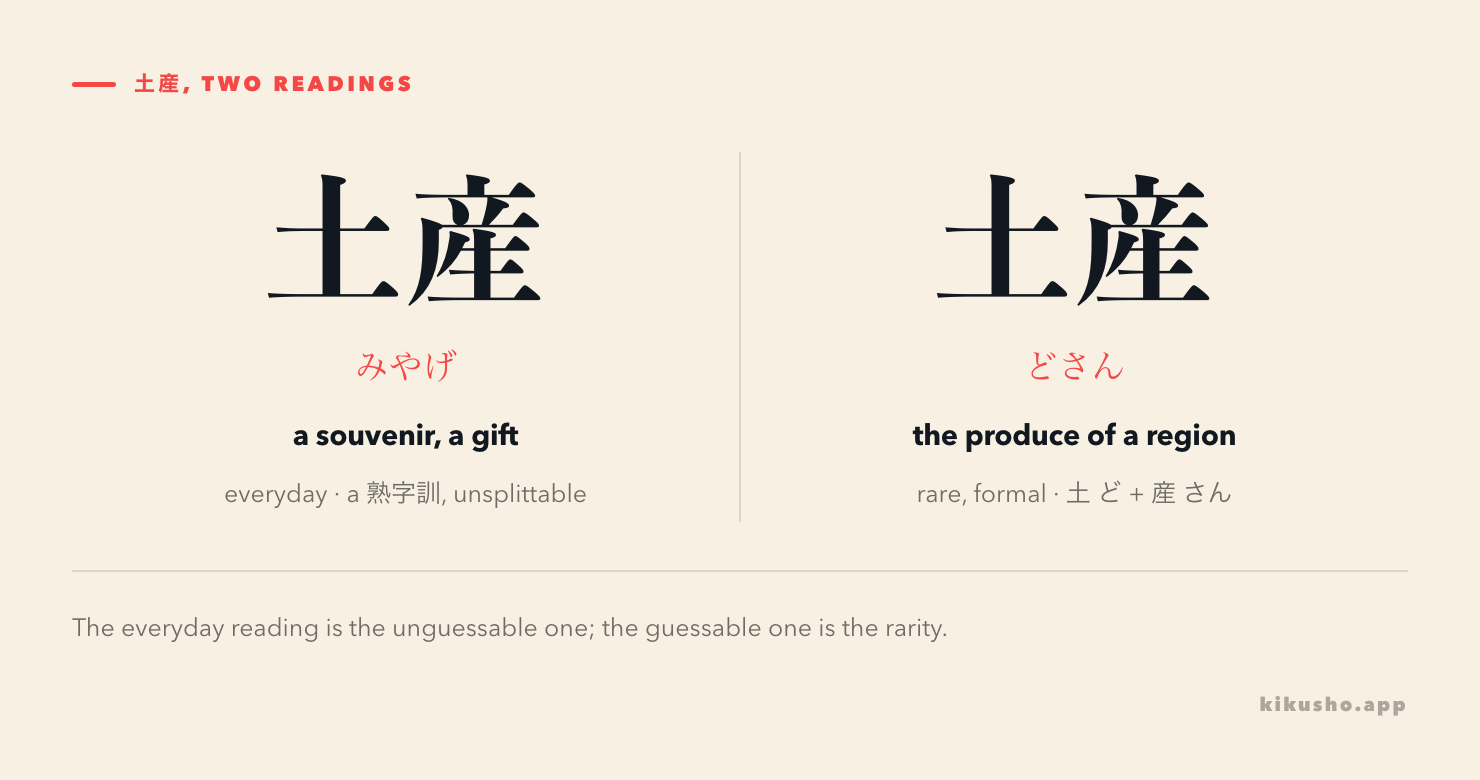
土産 read どさん is in the set for the reading it does not share. There is no person in it and no うど. どさん is the plain on'yomi, 土 (ど) plus 産 (さん), and it means the produce of a region. That reading, not the everyday one, is what put 土産 on an N1 list.
The trap is also inverted here, and this is the part worth slowing down for. With 玄人 you guess wrong and there is a correct reading waiting to be learned. With 土産 the reading you already carry, みやげ, is itself the irregular one — a 熟字訓 for a souvenir or a gift — while the "logical" on'yomi どさん is the rare, formal word that almost no one says. The everyday reading is the one you could never have derived, and the derivable one is the rarity.
仲人 breaks the surface a second way. One written form, two readings, and the reading you pick tells the reader which sense you mean: なこうど is the matchmaker at a wedding, ちゅうにん the more general go-between or mediator. This is the ordinary case of one written word holding several readings, sharpened to the point where the choice is not cosmetic but a fork in the meaning.
Test yourself
Five questions, then the answers with the reasoning. The point each time is the reading and the sense, not the meaning of the characters.
- Reading. その分野で彼はもう素人ではなく、___の域だ。The word written 玄人 is read: (a) げんじん (b) くろうと (c) げんにん (d) しろうと
- Reading. 披露宴で仲人があいさつをした。In this sentence the word 仲人 is most naturally read: (a) ちゅうじん (b) なこうど (c) なかにん (d) ちゅうにん
- Meaning in context. この地方の土産(どさん)として名高い焼き物だ。Here 土産 is closest in meaning to: (a) 旅行の記念に買う品 (b) その土地でとれる産物 (c) 訪問先へ持参する贈り物 (d) 名産品を売る店
- Usage. Which sentence uses 玄人 correctly? (a) 入社一年目の彼はこの道の玄人だ。 (b) 長年やってきた彼はこの道の玄人だ。 (c) 玄人の私にはこの機械は難しすぎる。 (d) 初心者向けの玄人コースに申し込んだ。
- Paraphrase. 彼女はその世界では玄人だ。The sentence closest in meaning is: (a) 彼女はその世界に詳しくない。 (b) 彼女はその世界の専門家だ。 (c) 彼女はその世界に入ったばかりだ。 (d) 彼女はその世界を嫌っている。
Answer 1: (b) くろうと. 玄人 is the expert who stands opposite the 素人, and it takes the irregular reading くろうと. げんじん and げんにん are the on'yomi guesses that never occur for this word, and (d) しろうと is the reading of 素人, the amateur, so it is the antonym rather than a variant.
Answer 2: (b) なこうど. At a wedding the 仲人 is the matchmaker, read なこうど. (d) ちゅうにん is a real reading, but it names a general mediator or go-between and is not the wedding term; ちゅうじん and なかにん are not readings of this word at all.
Answer 3: (b) その土地でとれる産物. Read どさん, 土産 means the produce of a region. (a) and (c) describe the みやげ senses — a souvenir and a visitor's gift — which belong to the other reading, and (d) invents a "shop" meaning the word does not have.
Answer 4: (b). 玄人 means an expert, the opposite of a beginner, so a veteran of long standing fits. (a) calls a first-year newcomer an expert and contradicts itself; (c) uses 玄人 where the sense is clearly a novice, which would be 素人; (d) pairs "for beginners" with "expert course" and cancels out.
Answer 5: (b) 彼女はその世界の専門家だ。 玄人 is a specialist or professional. (a) and (c) describe a 素人 or a newcomer, the opposite, and (d) reads a dislike into a word that carries none.
Which of these you will actually meet
Frequency sorts the set for you. くろうと and しろうと are alive in ordinary speech and writing: 玄人はだし describes an amateur so good a professional would run, and 素人目にも means "even to an untrained eye". You will meet these, and they repay learning now. なこうど survives around weddings and fades with the custom, but it still appears on invitations and in speeches; ちゅうにん is rarer and leans formal or legal. 土産 you will see constantly, and it will nearly always be みやげ or おみやげ. どさん you may never meet outside a dictionary or a label on regional produce, so recognise it and move on rather than drilling it.
What ties all four together is that the reading is information the characters withhold. A card that shows you 玄人 and asks for the meaning is testing the half you already had; the half you failed is くろうと, and a card with no reading on it never asks the question. When one of these turns up on a shop sign, a wedding invitation or a subtitle, the thing worth keeping is the pairing: the word you saw and the sound you did not expect. Kikusho writes the reading, the meaning and an example sentence onto the card at the moment you capture it, so 玄人 arrives already carrying くろうと, and you can select any word inside that example to keep it too. The word you met and the reading you could not guess stay attached, which is the only form in which either is worth remembering.
After a while the surprise becomes the signal. A short, common-looking compound whose reading you cannot immediately produce is often one of these, and the move is not to guess harder but to check once and file the sound with the word. The characters were never going to tell you.
Common questions
Why is 土産 read みやげ and not どさん?
みやげ is a 熟字訓 — a native word for a souvenir or gift, written with characters chosen for their meaning rather than their sound, so it cannot be split across 土 and 産. どさん is the literal on'yomi reading and a real word meaning the produce of a region, but it is rare and formal. In everyday Japanese 土産 is みやげ.
What is the difference between 仲人 read なこうど and 仲人 read ちゅうにん?
They are the same characters. なこうど is the matchmaker at a wedding; ちゅうにん is a more general go-between or mediator and uses the on'yomi. The reading you choose signals which sense you mean, and the wedding role is almost always なこうど.
Is 玄人 related to 素人?
They are opposites. 玄人 (くろうと) is the expert and 素人 (しろうと) the amateur, and both end in the same suffix うと, a worn-down form of 人. 玄 carries a sense of dark or deep and 素 of plain and undyed, so the pair reads almost as "the dark one" against "the plain one".
How should I study words whose reading is irregular?
As whole words with the reading attached, not as characters to decode. The meaning is usually transparent; the reading is the part that fails, so a flashcard that hides the reading is testing the half you already had.