On this page
Eight N1 words here name how you treat the people around you, from the care you extend to the rudeness that withholds it. Three of them carry a small puzzle worth clearing up first: 尊い and 貴い are one adjective written two ways, and each spelling reads two ways, とうとい or たっとい, with 尊ぶ the verb beside them sharing the same split. Most learners spend their energy choosing between the readings. That is the wrong worry. The reading is close to free; the kanji is the choice that changes the meaning.
Why these eight sit together
Courtesy at N1 is less about the phrases you say to a person's face than about the stance behind them, and these eight name that stance. Two are the care you offer: いたわる, to be gentle with someone, and 配慮, the forethought that arranges things so others are not put out. Three are esteem: 尊い and 貴い, precious or noble, and 尊ぶ, to hold something in that regard. One marks an occasion, 祝賀, celebration in its formal dress. The last two are what you need when things go wrong: 無礼, a breach of manners, and 詫び, the apology that answers it. Several are old native words that live mostly in written and ceremonial Japanese, which is part of why they wait until N1.
The eight words, and how each behaves
Here they are with their readings and grammatical class. The cluster of 尊い, 貴い and 尊ぶ shares readings and sense, so it takes one row; the rest stand alone.
| Word | Reading | Class | What it does |
|---|---|---|---|
| いたわる | いたわる | godan verb | to care for, to be kind to, to console |
| 祝賀 | しゅくが | noun, する-verb | formal celebration, congratulation |
| 尊い / 貴い | とうとい・たっとい | い-adjective | precious; noble, sacred |
| 尊ぶ | とうとぶ・たっとぶ | godan verb | to value, to esteem, to revere |
| 配慮 | はいりょ | noun, する-verb | consideration, thoughtfulness |
| 無礼 | ぶれい | noun, な-adjective | rudeness, discourtesy |
| 詫び | わび | noun | apology |
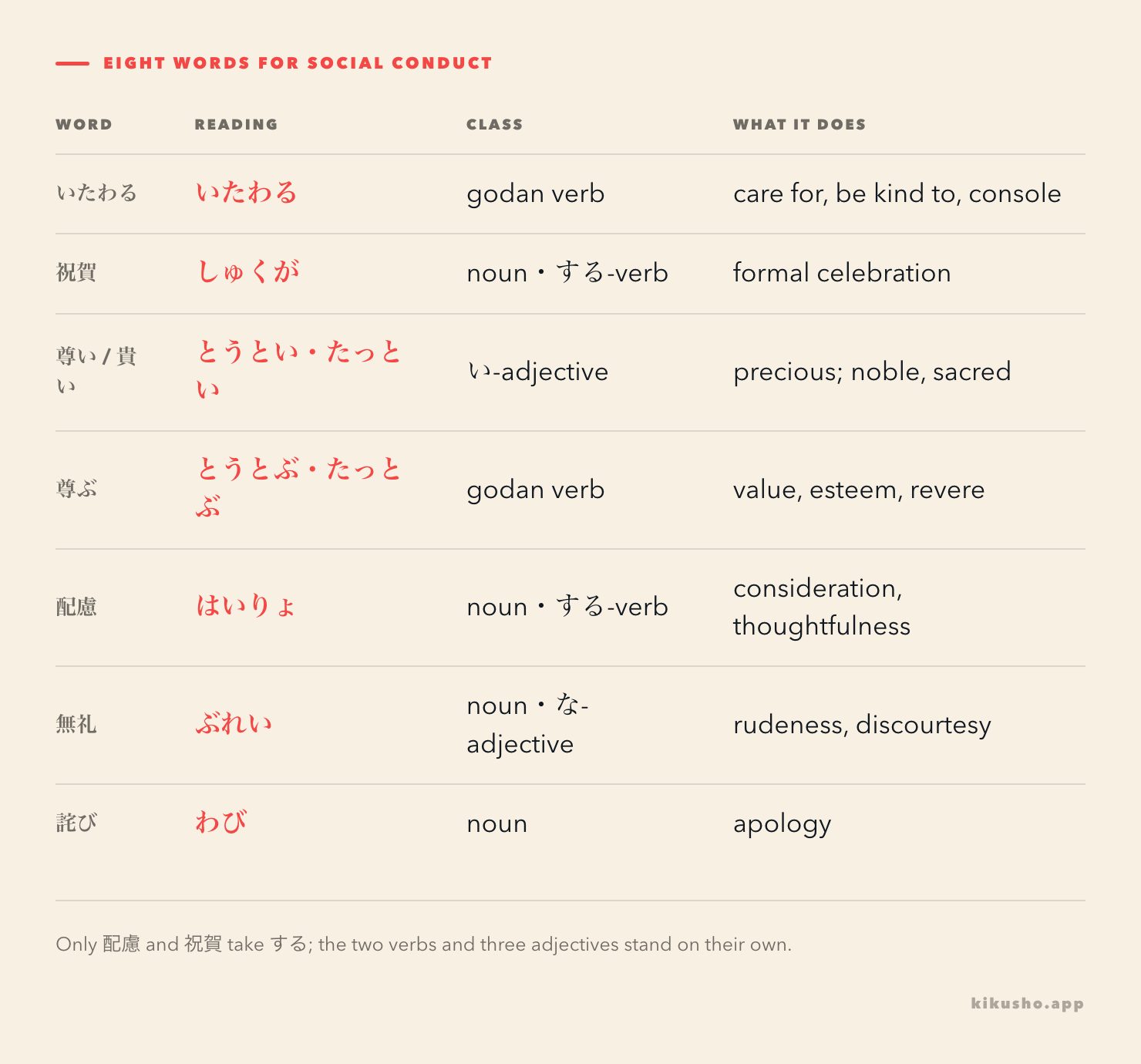
Only 配慮 and 祝賀 take する. The two verbs いたわる and 尊ぶ conjugate on their own, and 尊い, 貴い and 無礼 are adjectives, い for the first pair and な for 無礼.
尊い or 貴い: reverence, or value
This is the pair to slow down for, and the relief is that the readings are not the decision. Both spellings accept both とうとい and たっとい, and dictionaries list the two as interchangeable. とうとい is the older base form and the one you will hear most; たっとい is a later variant with a slightly more formal or old-fashioned ring. Pick either. The kanji is where the meaning turns.
尊い is reverence. It marks what you look up to, honour or hold sacred: 尊い命, a life to be revered, 尊い犠牲, a noble sacrifice, 尊い教え, a precious teaching. 貴い is value. It marks what is rare or high in worth: 貴い経験, a valuable experience, 貴い資料, a precious document. Japanese usage guides draw the line as a subjective feeling of reverence set against an objective judgement of worth. When you mean you revere something, reach for 尊い; when you mean it is precious or hard to come by, reach for 貴い.
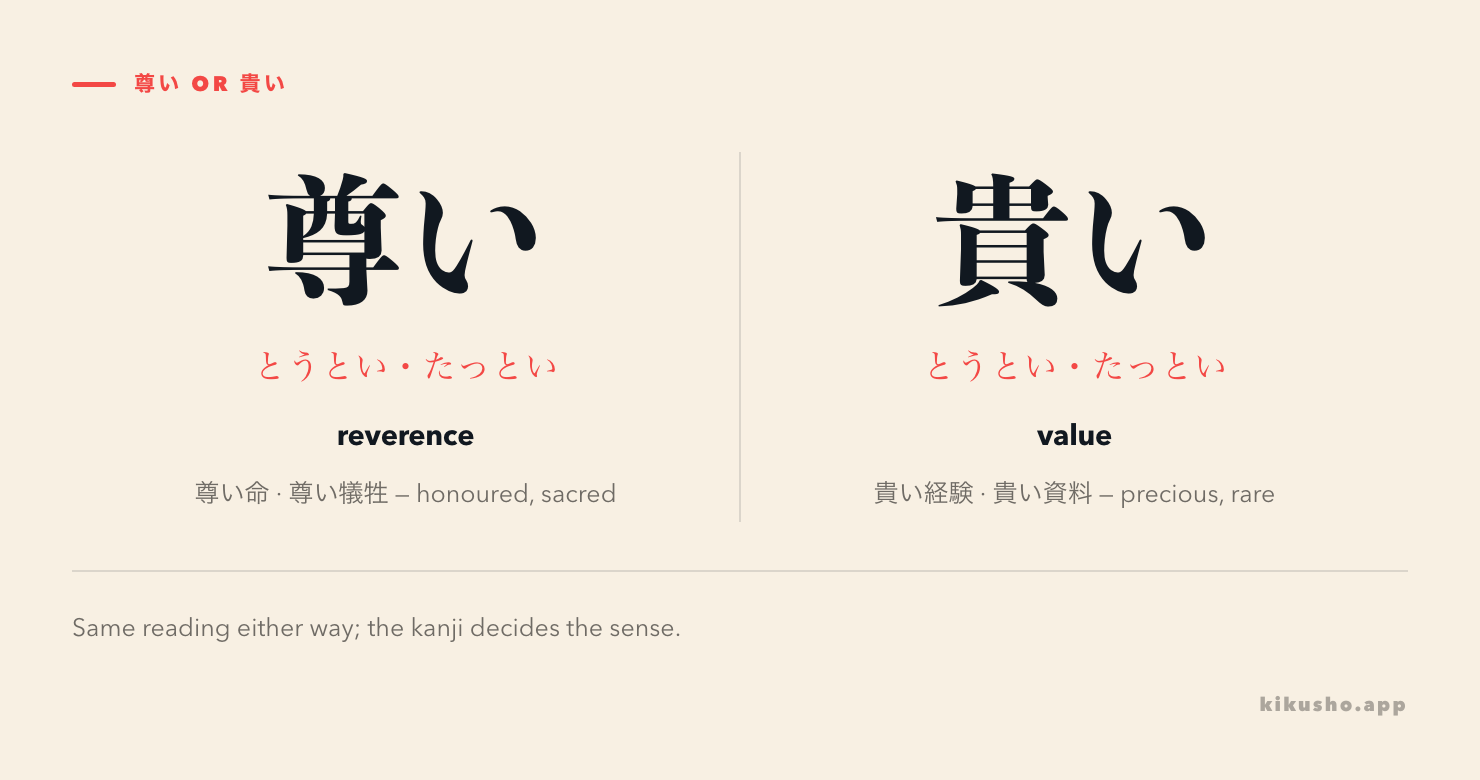
尊ぶ carries the same two readings, とうとぶ and たっとぶ, and the same divide. 命を尊ぶ is to hold life sacred, 平和を尊ぶ is to prize peace, 伝統を貴ぶ is to esteem tradition for its worth. In running text 尊ぶ is the spelling you will meet for either sense, with 貴ぶ kept rare.
いたわる, 配慮 and 無礼: care given, care planned, care refused
いたわる is the warm act. It means to treat someone gently: to look after, to be kind to, to console, and by extension to appreciate the effort a person has spent. 疲れた体をいたわる is to go easy on a tired body, 部下をいたわる is to look after the people under you. It is a native godan verb usually written in kana, so you meet it as いたわって and いたわった far more often than as 労る.
配慮 is that same regard turned into planning. It is the consideration you put in ahead of time so nobody is troubled: 相手の立場に配慮する, to take account of the other person's position, 健康に配慮した食事, a meal made with health in mind. As a noun it heads ご配慮ありがとうございます, thank you for your consideration, and 配慮に欠ける, to be short on it. Where いたわる is felt in the moment, 配慮 is decided in advance.
無礼 is the refusal of both. It is rudeness, discourtesy, insolence, and it works as a な-adjective and a noun: 無礼な態度, a rude manner, 無礼を働く, to commit a rudeness. It also hides inside one cheerful compound, 無礼講, the name for a gathering where rank is suspended and everyone may drink and speak freely, discourtesy licensed for the evening.
祝賀 and 詫び: the formal high note, and the formal apology
祝賀 is celebration in its ceremonial register, the word printed on an invitation rather than said over a cake. 祝賀会 is a celebratory reception, 祝賀パレード a victory parade, 優勝を祝賀する to mark a championship. It is the dressed-up cousin of the plain 祝う you met in the N3 courtesy set.
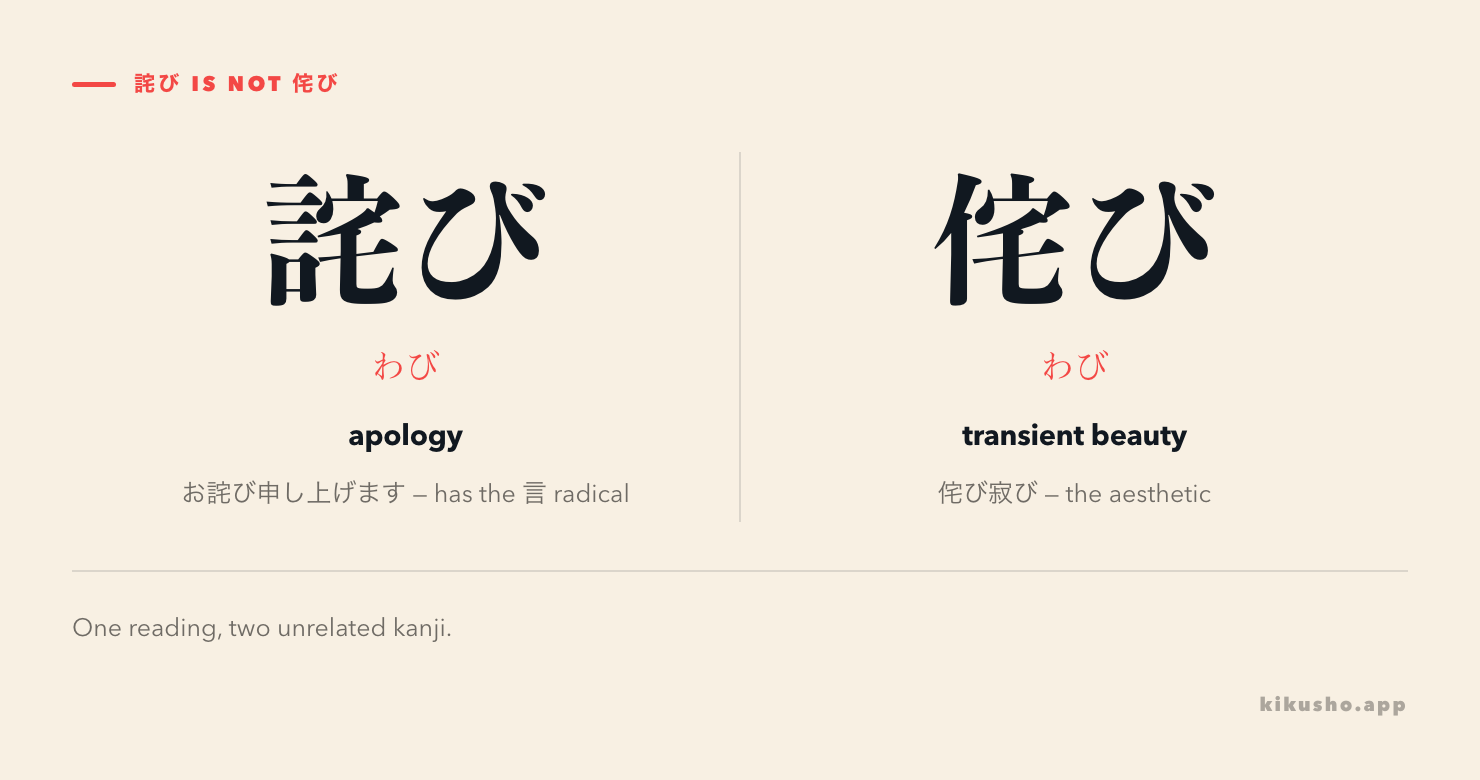
詫び is apology as a noun, and it travels almost always as お詫び: お詫び申し上げます, I offer my apologies, 詫びを入れる, to make an apology, お詫びの品, a gift sent to say sorry. The verb underneath it, 詫びる, is where the N2 courtesy set takes the thread up.
One warning, because it catches people. 詫び is not 侘び. 侘び is the わび of 侘び寂び, the aesthetic of quiet, imperfect, passing beauty, a different world from saying sorry. If a sentence is about apology, the character you want has the 言 word-radical on its left.
Which of the eight you will meet first
None of these arrives on a schedule you set. お詫び and ご配慮 reach you the first time you read a formal notice or a service message, where both are near-fixed furniture. 無礼 turns up the moment someone names a breach, or in the friendly 無礼講 at a work party. 尊い you may meet online before anywhere else, in the fan-speech sense of gloriously precious. 祝賀 waits on a printed invitation, いたわる in someone telling you to take care of yourself, and 尊ぶ in a speech or essay arguing what a society should hold dear.
That scatter is the argument for catching each word where it lands rather than drilling the list. Out in real text the hard part is already solved: the writer has picked 尊い or 貴い, the notice prints the reading in furigana, the setting fixes the register. What is left is to keep the word before it slips past. Kikusho is built for that keeping. Aim the camera at the 祝賀会 line on an invitation, or paste the お詫び sentence from an email, and it drafts the entry for you, reading and meaning and a note on how formal the word is, ready to glance over and save. The review that follows works with no connection, which suits a ceremonial word you meet once and want back only months later.
Practice: readings, meaning in context, paraphrase and use
Attempt all six first; the answer key sits folded at the end.
1 · Read the courtesy word. How is the bold word read? 相手の立場に配慮する。
- ① はいりょ
- ② はいれい
- ③ はいろ
- ④ はいりょう
2 · The words of apology. Choose the word that fits: 深く反省し、お( )の言葉を述べた。
- ① 詫び
- ② 祝賀
- ③ 配慮
- ④ 無礼
3 · Using いたわる. In which sentence is いたわる used naturally?
- ① 病気の父の体をいたわる。
- ② 難しい仕事をいたわる。
- ③ 新しい情報をいたわる。
- ④ 予定を細かくいたわる。
4 · A rude remark. Which word is closest in meaning to the bold one? 彼の無礼な発言に驚いた。
- ① 失礼な
- ② 立派な
- ③ 親切な
- ④ 正直な
5 · Marking the occasion. Choose the word that fits: 創立百周年を( )する式典が開かれた。
- ① 祝賀
- ② 配慮
- ③ 詫び
- ④ 無礼
6 · Which kanji for value. Which spelling suits the blank? 二度と手に入らない(とうと)い資料だ。
- ① 貴い
- ② 尊い
- ③ 尚い
- ④ 遠い
Answers and explanations
①, はいりょ. 配 gives はい and 慮 gives りょ, which run together as はいりょ. ② はいれい points at 拝礼 (a worshipful bow); ③ はいろ drops the small ょ and lands on nothing; ④ はいりょう adds a long vowel the word does not have.
①, 詫び. お詫びの言葉 is the set phrase for words of apology, and 反省 (reflection, remorse) sets it up. ② 祝賀 is celebration, the opposite mood; ③ 配慮 is consideration, not something you put into 言葉 this way; ④ 無礼 is the rudeness you would be apologising for, not the apology.
①, 病気の父の体をいたわる。 いたわる takes a person, or their body or feelings, and means to treat them gently. ② a job is not something you いたわる; you tackle it; ③ information cannot be cared for like a person; ④ a schedule is arranged, not consoled.
①, 失礼な. 無礼な means rude, so 失礼な, the everyday word for the same failing, is closest. ② 立派な (admirable), ③ 親切な (kind) and ④ 正直な (honest) each name a different quality, and two of them are the opposite of rude.
①, 祝賀. A ceremony for a hundredth anniversary is a formal celebration, so 祝賀する fits, as would 祝賀式典. ② 配慮する (to be considerate) does not celebrate an occasion; ③ 詫び is apology; ④ 無礼 is rudeness, neither of which a 式典 marks.
①, 貴い. 二度と手に入らない frames the document as rare and precious, the worth sense that 貴い carries. ② 尊い would call the document revered or sacred, which does not fit a research source; ③ 尚い is not a standard adjective; ④ 遠い (とおい) is "far", a different word that only looks close.
Read as a group, the eight stop being a vocabulary column and become a map of social distance: the esteem you raise something to with 尊ぶ, the gentleness you lower toward someone tired with いたわる, the forethought you spend so no one is troubled with 配慮, and the two moves for when the distance is misjudged, the 無礼 that opens a gap and the 詫び that closes it. Lower levels taught you to perform courtesy. N1 is where Japanese asks you to name its exact shape, and the grammar of politeness is where that naming turns back into something you say aloud.
Common questions
Is 尊い read とうとい or たっとい?
Both, and for 貴い too. とうとい is the older base reading and the one you will hear most; たっとい is a later variant that sounds a little more formal or dated. Dictionaries treat them as interchangeable, so the reading is not the decision. The kanji is: 尊い for reverence, 貴い for value.
What is the difference between 尊い and 貴い?
尊い marks reverence, what you honour or hold sacred, as in 尊い命 or 尊い犠牲. 貴い marks value, what is precious or rare, as in 貴い経験 or 貴い資料. Japanese usage guides put it as a subjective feeling of reverence against an objective judgement of worth. In practice 尊い and 尊ぶ are the spellings you will meet for both senses.
Is 詫び the same word as 侘び?
No. 詫び (わび) is apology, almost always お詫び, and comes from the verb 詫びる. 侘び (わび) is the aesthetic term in 侘び寂び, about transient, imperfect beauty. Same reading, different kanji. The apology character carries the 言 word-radical on its left.
Which of these take する?
配慮 and 祝賀 do: 相手に配慮する, 優勝を祝賀する. 無礼 is a な-adjective and noun, 無礼な態度, and does not. いたわる is already a verb, so it needs no する at all. 尊ぶ is likewise a verb; 尊い and 貴い are い-adjectives.