On this page
English gives you three verbs for everything this set does — write it down, say it, read it out — and a learner reaches for 書く, 言う and 読む every time. At N1 the exam expects the word that names which kind of record you are making: 記載(きさい)for an entry on a form, 断言(だんげん)for a claim made without hedging, 朗読(ろうどく)for a text read aloud with feeling. These thirteen words are the formal register of putting language on the record, and they sort cleanly into three channels: down on paper, out loud, and read back to a room.
English uses three verbs where N1 wants thirteen
Every word here has a plainer twin you already own. 書く becomes 記す when the writing is formal; 書類 becomes 文書 when the document is official; 言う splits into 発言, 宣言 and 断言 depending on how public and how firm the statement is; 読む becomes 読み上げる or 朗読 once the reading is done aloud for others. Choosing the N1 word is choosing two things at once: the channel the language travels through, and the formality of the record it leaves behind.
The kanji carry the channel, which is why the set is worth learning as a set rather than one flashcard at a time. 記 and 書 are the writing radicals; 言 is a word said aloud; 口 is the mouth itself; 読 is reading. Once you see the group by radical, a word you have never met still tells you which channel it belongs to.
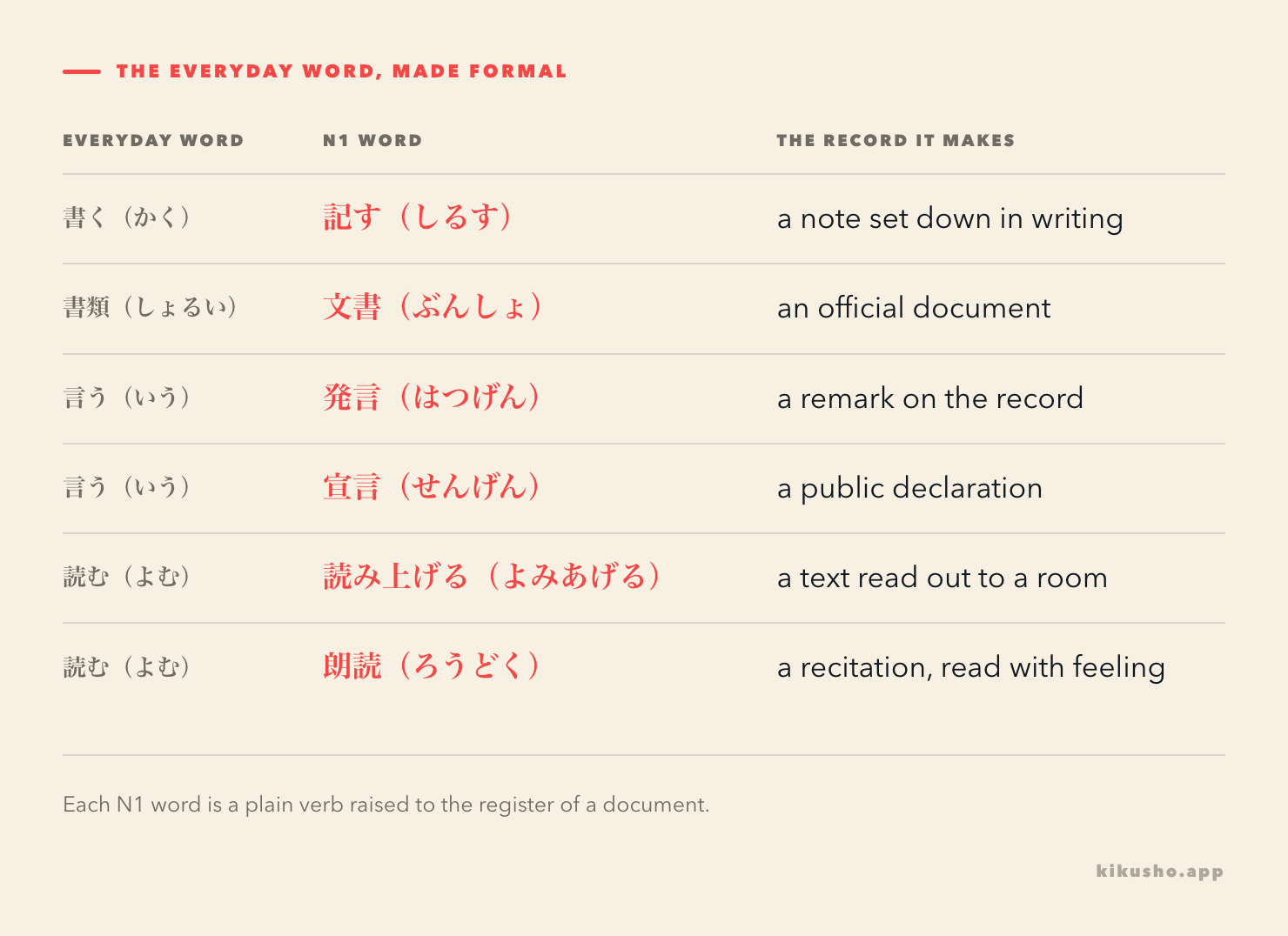
The thirteen, sorted by the record they make
The tables below are the reference; the sections after them explain the pattern and the traps. Readings and senses were checked against monolingual dictionaries, and the set phrase in the last column is the company each word usually keeps.
On paper: five ways to get it in writing
| Word | Part | What it does | Keeps company with |
|---|---|---|---|
| 書き取る(かきとる) | 五段・他動詞 | write down what you hear; take dictation | 話を書き取る |
| 記す(しるす) | 五段・他動詞 | note down; set in writing (formal, literary) | 日記に記す |
| 記載(きさい) | サ変名詞 | enter an item or fact into a document | 記載事項 |
| 記述(きじゅつ) | サ変名詞 | describe or set out in connected prose | 記述式 |
| 文書(ぶんしょ) | 名詞 | an official written document | 公文書 |
Out loud: five ways to put it on the spoken record
| Word | Part | What it does | Keeps company with |
|---|---|---|---|
| 発言(はつげん) | サ変名詞 | a remark, usually in a meeting | 会議で発言する |
| 宣言(せんげん) | サ変名詞 | a formal, public declaration | 独立宣言 |
| 断言(だんげん) | サ変名詞 | assert with conviction, without hedging | …と断言する |
| 口述(こうじゅつ) | サ変名詞 | state or dictate orally | 口述筆記 |
| 口頭(こうとう) | 名詞(副詞的) | orally, rather than in writing | 口頭で伝える |
Read back: three ways to bring it before a room
| Word | Part | What it does | Keeps company with |
|---|---|---|---|
| 読み上げる(よみあげる) | 一段・他動詞 | read out; call out (a list, a result) | 名前を読み上げる |
| 朗読(ろうどく) | サ変名詞 | recite aloud with feeling | 詩を朗読する |
| 提示(ていじ) | サ変名詞 | present, produce or put forward | 条件を提示する |
The pattern is register: an everyday word, raised to the level of a document
Read the middle column of all three tables together and one rule emerges. None of these words means something the plain verb cannot; each means the same act performed on the record, in the register a document, a meeting or a ceremony uses. 記す is 書く with a formal collar on. 発言 is 言う once a minute-taker is present. 朗読 is 読む when someone is listening and the reading is meant to move them.
That is also why a dictionary gloss strands you. Look up 宣言, 断言 and 発言 and you get "declaration" three times over, because English collapses the register that Japanese keeps. The three sit apart on one axis: how public the words are, and how firmly they are meant.
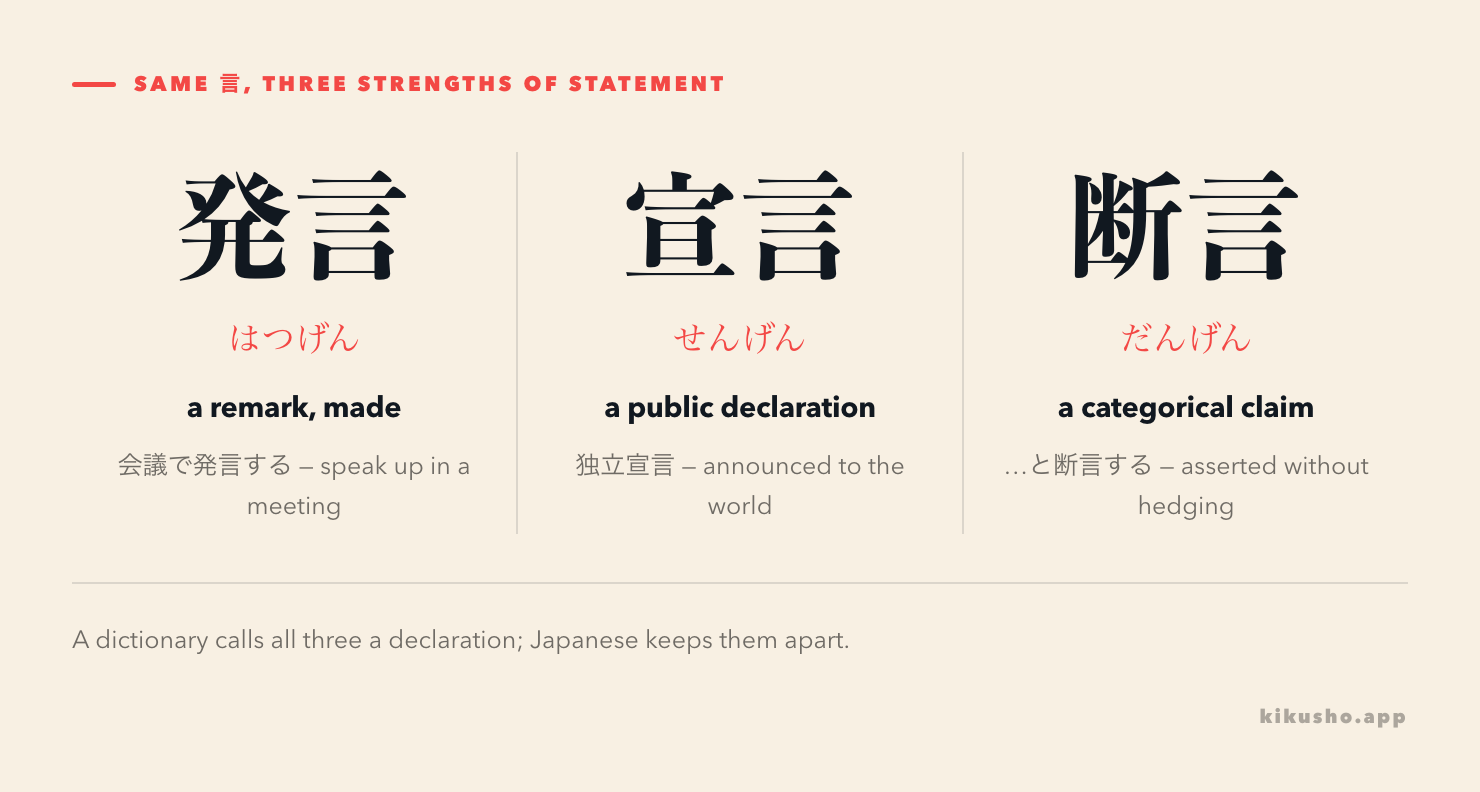
宣言 faces outward: a country, a company or a person announces a position to the world, as in 独立宣言 or 非常事態宣言. 断言 faces inward on the speaker's certainty: 彼は自分は潔白だと断言した, he asserted his innocence and left no room in it. 発言 is the neutral one, the act of speaking up itself, which is why it takes 発言権 and 発言力 and is the word a news report reaches for when a politician says something it would rather quote than characterise.
The pairs the plain word cannot separate
Where two words share a twin, the collocation decides, not the gloss.
記載 and 記述 are both "write in a document," and both are サ変 nouns, so the twin 書く settles nothing. 記載 is the entry: a name, a date, a clause put into a fixed field, as in 記載事項 or 詳細は説明書に記載されている. 記述 is the account: describing something in connected prose, which is exactly why an exam's essay questions are 記述式 and not 選択式. Fill in a form and you are doing 記載; explain your reasoning at length and you are doing 記述.
読み上げる and 朗読 both read aloud, but one is functional and one is a performance. 読み上げる calls out a text as information: 司会者が名前を読み上げる, a court that reads out a verdict, an app that reads out a number. 朗読 reads it as art: 詩を朗読する, a story read with understanding and feeling, the word behind 朗読会 and audiobooks. The monolingual entry for 朗読 makes the split explicit by contrast: 読み上げる is the mechanical act, 朗読 the interpretive one. Reading aloud is its own skill, separate from reading silently for sense, which five N1 words for reading Japanese prose takes up.
口頭 and 文書 name the two channels themselves, and they are the pair the JLPT most likes to test as opposites. 口頭で説明する is to explain orally; 文書で通知する is to notify in writing. 口頭 is a noun that lives adverbially with で, and it carries the set phrases 口頭試問 (an oral exam) and 口頭弁論 (oral argument in court).
That leaves 提示, the word with no plain twin. It is not "say" and not "write" but "produce": you hold something up for another party to see or consider. 証明書を提示する is to present your ID; 条件を提示する is to put terms on the table. When a sentence is about bringing a document or a proposal into view, 提示 is the word the other twelve leave a gap for.
Which of these you will meet before the exam does
Several of these are not rare at all. 発言, 宣言, 提示 and 文書 run through the news and the office long before you formally sit N1: a politician's 問題発言, a 非常事態宣言, 資料を提示する in a meeting, a 公文書 leak. "N1 vocabulary" here means the list they were placed on, not a promise that they are obscure. One level earlier, the same theme collects the N3 words for reading, writing and verbal expression — 表す, 示す, 署名 — the everyday end of this channel. 記載 waits on every application form you fill in; 口頭 turns up the day you take an oral test; 朗読 lives in classrooms and audiobooks; 書き取る is the verb for the dictation drill itself.
Two readings are worth pinning before they trip you. 文書 is ぶんしょ, not もんじょ: that older reading survives mainly in 古文書(こもんじょ). And 記す is しるす, the formal cousin of 書く, not the on-reading きす.
The catch with words like these is that you meet each one exactly once in a place worth remembering: 記載 on the form in your hand, 発言 in a subtitle, 文書 at the top of an official letter. By the evening it is gone. That evaporation is the problem Kikusho was built for. You photograph the line on the form, or paste the sentence under the video, and it returns a finished card carrying the reading, the meaning and a playable example, then files it into a spaced-repetition schedule you can run offline. Making cards is capped at five a day on the free plan; reviewing the ones you have already kept is not. And because each card is shown to you, editable, before it is saved, a draft that renders 記載 as a flat "write" takes a second to correct.
Practice questions
Attempt all six, then open the answers together at the end.
1. 重要な文書を保管する。下線部「文書」の読み方はどれか。 ① ぶんしょ ② もんじょ ③ ぶんしょう ④ もんしょ
2. 規則を書面に記す。下線部「記す」の読み方はどれか。 ① きす ② しるす ③ のこす ④ かくす
3. 申込書に生年月日が正しく( )されているか確認してください。空欄に最も適切な語はどれか。 ① 記載 ② 朗読 ③ 発言 ④ 提示
4. 「その件は口頭で伝えました」。下線部「口頭で」に最も近い意味はどれか。 ① 文書で ② 言葉で直接 ③ 大声で ④ 後で
5. 「断言」の使い方が最も適切な文はどれか。 ① 彼は「絶対に成功する」と断言した。 ② 政府は独立を断言した。 ③ 会議では自由に断言してください。 ④ 申込書に住所を断言する。
6. 「司会者が受賞者の名前を( )」。空欄に最も適切な語はどれか。 ① 朗読した ② 読み上げた ③ 記述した ④ 提示した
Answers and explanations
Answer 1. ①ぶんしょ. In modern use 文書 is ぶんしょ, a document. ②もんじょ is the archival reading, alive mainly in 古文書(こもんじょ); ③ぶんしょう is 文章, a different word meaning a piece of prose; ④ is not a real reading.
Answer 2. ②しるす. The verb 記す reads しるす and is the formal, literary twin of 書く (氏名を記す, 日記に記す). ①きす mistakes it for an on-reading; ③のこす is 残す and ④かくす is 隠す, both different verbs.
Answer 3. ①記載. 記載 is entering a fact into a fixed field of a document, the act behind 記載事項. ②朗読 is reciting aloud, ③発言 is a spoken remark, and ④提示 is producing or showing a document rather than filling in its fields.
Answer 4. ②言葉で直接. 口頭で means orally, in spoken words rather than in writing, so it is the opposite of ①文書で. It says nothing about volume (③大声で) or timing (④後で).
Answer 5. The correct sentence is ①. 断言 is asserting something with conviction and no hedging. Proclaiming independence to the world is 宣言, so ② should read 独立を宣言した; speaking up freely in a meeting is 発言, so ③ wants 発言してください; writing an address into a form is 記載, so ④ wants 住所を記載する.
Answer 6. ②読み上げた. 読み上げる reads a text out functionally: a name list, a verdict, a result. ①朗読した recites with feeling and suits literature, not a roll call; ③記述した describes in writing; ④提示した presents or shows something rather than reading it out.
Common questions
Is 記載 or 記述 the word for filling in a form?
記載(きさい). It means entering a specific item into a document (a name, a date, a clause), and its set phrase is 記載事項. 記述(きじゅつ)is describing something in connected prose, as in a 記述式 exam question, so it is the account rather than the entry.
What is the difference between 発言, 宣言 and 断言?
All three put words on the record. 発言(はつげん)is a remark, typically in a meeting. 宣言(せんげん)is a formal declaration made to the outside world, like 独立宣言. 断言(だんげん)is asserting something with conviction and no hedging.
Is 文書 read ぶんしょ or もんじょ?
In modern use it is ぶんしょ, a document. The reading もんじょ survives mainly in 古文書(こもんじょ), historical archives, so a contract or an official letter is ぶんしょ.