On this page
In Japanese prose, 趣 gives a scene its character, 赴く sends someone toward a destination, 懐く describes growing attachment, and 空しい and 憂鬱 distinguish futility from gloom. These five N1 study words let you read what a passage says about an experience, beyond the bare sequence of events.
Why these five belong in a reading set
A story may tell you where someone went, what a place felt like, whom an animal trusted and how the day ended. The words below cover those different jobs. Learning them together is useful for interpreting a scene; it does not make them synonyms or give them one shared level of formality.
Their N1 vocabulary placement comes from the Waller/Tanos family of study lists used by this curriculum. Those lists are related sources, not independent votes. The dictionary checks below establish readings and uses; they do not certify an official exam boundary. You will need ordinary verb conjugation, noun modification and the particles が and に to use the examples.
The practical distinction is between recognising a word in writing and deciding where you would say it. 赴く carries deliberate formality. 懐く, especially about a child or pet, can belong to everyday conversation. Calling the whole set “classical vocabulary” would obscure that difference.
The set: readings, meanings and useful companions
| Word and reading | Word class | Meaning taught here | A phrase to keep with it |
|---|---|---|---|
| 趣(おもむき) | Noun | Atmosphere or charm; character; substance of a message | 趣がある; 趣が違う |
| 赴く(おもむく) | Intransitive godan verb | Go or proceed toward a place; move toward a state | 現場に赴く(げんばにおもむく) |
| 懐く(なつく) | Intransitive godan verb | Become familiar with and attached to someone | 人に懐く(ひとになつく) |
| 空しい(むなしい) | I-adjective | Empty of substance or fulfilment; futile | 空しい努力(むなしいどりょく) |
| 憂鬱(ゆううつ) | Noun / na-adjective | Gloom or a downcast mood | 憂鬱な気分(ゆううつなきぶん) |
These are the senses developed in this lesson. A historical dictionary may record others. Treat those as separate reading problems when they arise, rather than applying every English gloss to every sentence.
趣: the character of a place or a message
この喫茶店には、古い映画のような趣がある。
この きっさてんには、ふるい えいがのような おもむきがある。
This café has the atmosphere of an old film.
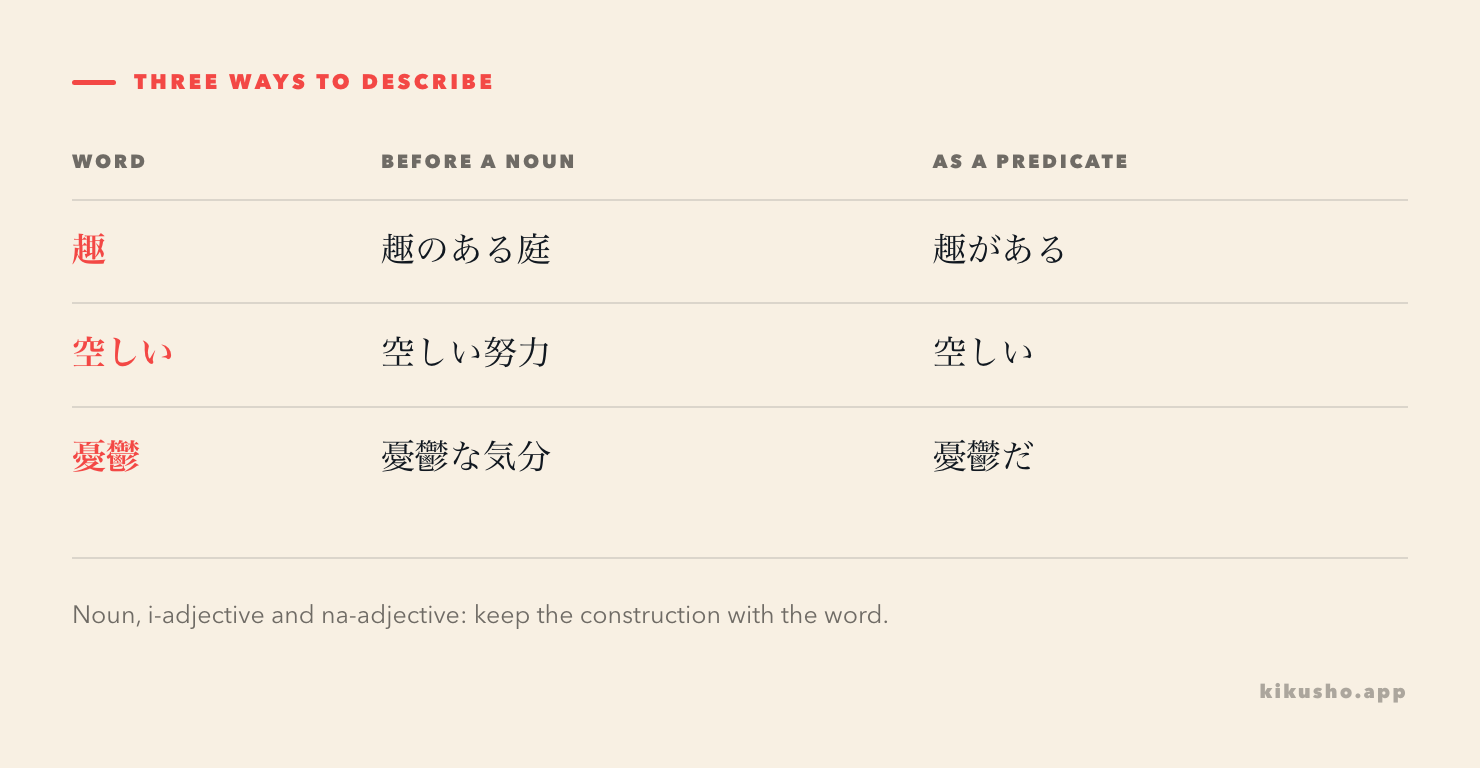
Before another noun, 趣のある庭(おもむきのあるにわ)means “a garden with atmosphere or charm.” Here 趣 names the impression created by the place. It is more specific than simply saying that the café exists or that it is old. You can admire a room's atmosphere without claiming that it is luxurious, expensive or historically important.
In 昼と夜では趣が違う, “it has a different character by day and by night,” the word identifies a difference of impression. The comparison does not rank the two. More formal prose can use 趣を異にする(おもむきを ことにする)for “differ in character.”
There is also a message sense: 手紙の趣, “the substance or intent of a letter.” Shogakukan's entry separates atmosphere, overall character and intended content; Kanjipedia independently makes the same broad distinctions. Translating every occurrence as “charm” would make a business letter sound unexpectedly decorative.
赴く: follow the destination
調査のため、担当者が島に赴いた。
ちょうさのため、たんとうしゃが しまに おもむいた。
The person in charge went to the island to investigate.
The traveller is marked with が; the destination here takes に. 赴く → 赴いた is the ordinary godan past form. You also get 赴きます and 赴かない. There is no special classical conjugation to learn for these modern sentences.
NINJAL's IPAL verb dictionary labels the movement sense literary and records the pattern of a person or group proceeding to a destination. In everyday retelling, 島に行った conveys the trip more simply. 赴く does not by itself confer respect on the traveller: formality and honorific grammar are different matters.
Its destination can also be a state. 快方に赴く(かいほうにおもむく)means to move toward recovery, rather than travel to a place called 快方. NINJAL and Shogakukan both distinguish that change-of-state use from physical movement. The noun before に tells you which kind of destination you are reading.
懐く: someone becomes attached
毎日世話をするうちに、子猫が私に懐いた。
まいにち せわをするうちに、こねこが わたしに なついた。
As I cared for the kitten each day, it became attached to me.
The kitten develops the attachment. 私に identifies the person it warms to. Reversing the two roles changes the statement: this is not simply a decorative way to say that I like the kitten.
The forms follow the same godan pattern as 赴く: 懐く → 懐いた → 懐いている. The last can describe an existing attachment. Shogakukan describes familiarity and attachment, while Jitenon's definition highlights becoming comfortable enough to approach the other party.
The reading taught here is なつく. Do not choose a reading from the character 懐 alone. The complete word and its sentence are the unit to recognise, just as in the lesson on unusual readings in familiar words. A pet becoming attached to its carer is a current, ordinary situation, even when the printed verb looks difficult.
空しい: effort without a satisfying return
何度説明しても聞いてもらえず、空しい気持ちになった。
なんど せつめいしても きいてもらえず、むなしい きもちになった。
No matter how often I explained, nobody would listen, and I felt it was all pointless.
The feeling comes from the gap between effort and response. 空しい努力 describes effort judged fruitless; 空しい言葉 can describe words lacking substance. The word does more than report sadness: it can evaluate what an action or statement amounts to.
It is an i-adjective: 空しかった for the past and 空しく when it modifies what happens. In a passage about failure, the phrase 努力も空しく(どりょくもむなしく)can mean “despite the effort” or “with the effort coming to nothing.” Read the outcome before choosing the English wording.
You may also see 虚しい or kana むなしい. Kanjipedia and Shogakukan record the alternative kanji spelling. This lesson keeps 空しい as its headword and concentrates on futility and lack of substance, rather than treating every historical use as interchangeable.
憂鬱: a mood that will not clear
明日の面談を考えると、憂鬱になる。
あしたの めんだんを かんがえると、ゆううつになる。
Thinking about tomorrow's interview makes me feel gloomy.
The interview has not happened yet. The sentence describes the speaker's mood, without asserting that the interview will be useless or unsuccessful. That is the distinction from 空しい worth retaining.
As a na-adjective it gives 憂鬱な気分; as a predicate, 憂鬱だ. To express a change, use 憂鬱になる. The kana are ゆ・う・う・つ: do not lose the middle う when reading or typing. Kanjipedia explains the downcast feeling, and Shogakukan records both noun and adjectival use. The sense here is an everyday description of mood.
The pattern: preserve the relationship around the word
The two verbs below both take に in these examples, but the noun marked by に has a different role. The adjectives then separate the speaker's evaluation of an effort from the speaker's mood.
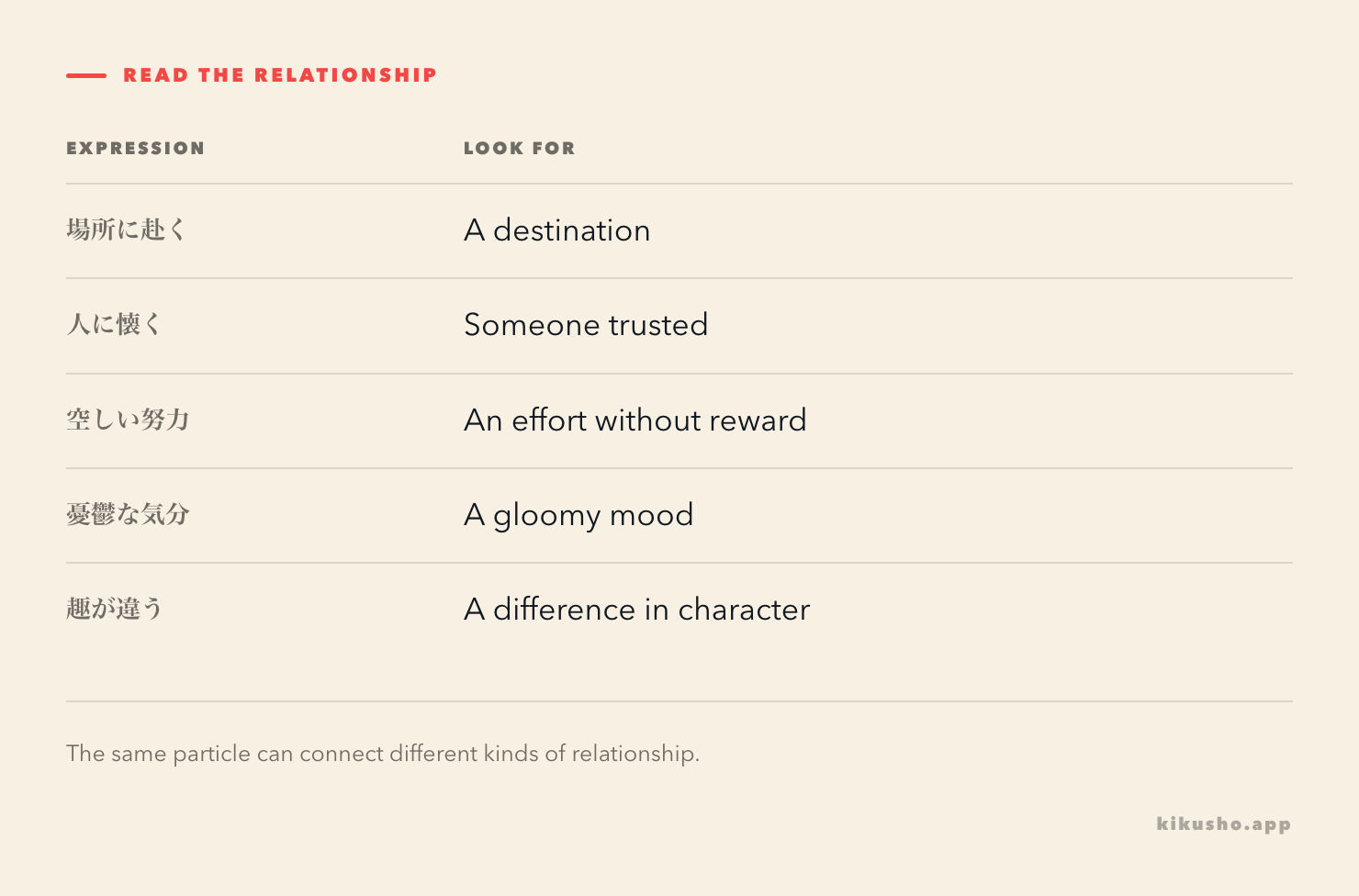
| Frame | What the surrounding words settle |
|---|---|
| 場所に赴く | Where someone goes |
| 人に懐く | Whom someone becomes attached to |
| 空しい努力 | Whether the effort achieves anything worthwhile |
| 憂鬱な気分 | What the mood feels like |
| 趣が違う | How one impression differs from another |
The dictionary meaning gets you started; the relationship determines the reading of the sentence. Two words can share an English translation such as “empty” or “sad” in one context and still fail to substitute for each other in the next.
Where a single label breaks down
Literary does not mean obsolete. 赴く can make a report sound more formal while using entirely modern grammar. If an unfamiliar passage also contains old endings, identify those separately: the lesson on まじき and ずして shows two constructions whose forms need their own explanation.
Difficult kanji do not determine the situation. 憂鬱 has a visually dense second character, but the example concerns an upcoming interview. 懐く can occur in talk about a family cat. The difficulty of the spelling is no measure of the distance from daily life.
Mood and evaluation can overlap without becoming identical. Someone whose efforts achieved nothing might feel both 空しい and 憂鬱. The first can focus on the lack of fulfilment; the second on the gloomy feeling. Do not turn that useful contrast into a claim that only one adjective could ever describe the person.
What to look for in your next reading session
For travel writing, look for what carries 趣: a street, a building, a season, or a comparison with another place. In reports, identify the destination of 赴く. In scenes involving relationships or feelings, mark who becomes attached and whose mood changes. These are useful search targets, not predictions that every text will contain all five words.
When you save one in Kikusho, edit the example so that this relationship remains visible. 子猫が私に懐いた keeps both participants; 明日の面談を考えると、憂鬱になる keeps the cause of the mood. The reading and example audio then help you revisit a specific use instead of only the shape of a difficult character.
The practice below changes the settings. Try all six questions before moving to the answer block.
Practice questions
Question 1: read the word
Choose the reading of 趣 in this sentence.
この庭には独特の趣がある。
- A. おもむく
- B. おもむき
- C. しゅみ
- D. しゅい
Question 2: read the adjective
Choose the reading of 憂鬱.
今日は朝から憂鬱だ。
- A. ゆうとつ
- B. ゆういつ
- C. ゆうくつ
- D. ゆううつ
Question 3: follow the result
Choose the word that best fits the writer's judgment of the effort.
一晩かけて作った資料は、一度も使われなかった。誰の役にも立たず、( )努力に終わった。
- A. 空しい
- B. 新しい
- C. 細かい
- D. 明るい
Question 4: follow the journey
Choose the verb that completes the report of a trip.
調査のため、担当者は本社から電車に乗り、遠方の現場に( )。
- A. 懐いた
- B. 飽きた
- C. 赴いた
- D. 驚いた
Question 5: keep the participants
Which paraphrase best preserves the meaning of the second sentence?
私が毎日餌をやった。やがて、その犬は私に懐いた。
- A. その犬を見ると、昔のことを思い出すようになった。
- B. その犬は私に親しみを持ち、そばに来るようになった。
- C. 私はその犬を怖がり、近づけなくなった。
- D. その犬は私を見ても、全く反応しなくなった。
Question 6: choose the use
Which sentence uses 懐く to describe becoming attached to someone?
- A. 私は明日の予定を手帳に懐いた。
- B. 新しい机を窓のそばに懐いた。
- C. 子どもはよく遊んでくれる叔父に懐いた。
- D. 鍋のスープが熱く懐いた。
Answers and explanations
The explanations identify the participant, destination or feeling that makes each choice fit its sentence.
Answer 1
B: おもむき. The garden has a distinctive atmosphere or character. おもむく is the verb reading in 赴く; しゅみ and しゅい do not read this standalone noun. 独特 is どくとく, “distinctive.” The phrase 趣がある supports the atmosphere sense.
Answer 2
D: ゆううつ. Keep all four kana: ゆ・う・う・つ. The sentence says the speaker has felt gloomy since morning. The final だ works with the noun/na-adjective; the alternative readings are not readings of 憂鬱.
Answer 3
A: 空しい. The material was never used and helped nobody, so the writer judges the effort fruitless. Newness, small detail and brightness do not express that stated result. 空しい directly modifies 努力; 資料 is しりょう, “materials” or “documents.”
Answer 4
C: 赴いた. Taking a train from the head office to a distant site supplies a physical destination for the movement verb. 懐いた concerns attachment, 飽きた means becoming tired of something, and 驚いた describes surprise. None of those reports the journey asked for here. 遠方 is えんぽう, “a distant place.”
Answer 5
B. The dog becomes comfortable with and attached to the speaker. In 私に懐いた, 私 is the target of the attachment, not the subject experiencing nostalgia or fear. A and C change the person whose experience is described; D replaces growing attachment with no reaction. 餌 is えさ, animal food.
Answer 6
C. The child grows attached to an uncle who plays with them. 叔父 is おじ. The child is the one developing attachment, and the uncle is marked with に. The other sentences misuse the verb for recording a schedule, positioning furniture or heating soup; none describes familiarity with a person or animal.
Common questions
Are all five words exclusively literary Japanese?
No. 赴く has a more formal or literary feel than everyday 行く, but 懐く can describe a pet becoming attached to someone in ordinary conversation. A word appearing in an N1 study list does not make it archaic.
Is 趣 always praise for something beautiful?
No. 趣がある can describe atmosphere or charm, but 趣 can also mean the character of something or the substance of a message. 趣が違う says the character differs; it does not necessarily say one thing is better.
How is 憂鬱 read, and what form comes before a noun?
It is ゆううつ, with the kana sequence ゆ・う・う・つ. It functions as a noun and a na-adjective: 憂鬱な気分 means a gloomy mood, and 憂鬱になる means to become gloomy. The everyday feeling sense is the focus here.