On this page
An あらすじ tells you what a story is about; 撮影 and 編集 turn material into a film; 名作 and 傑作 evaluate the result. These ten N2 words let you follow a book or film from its creator's choices to the language of a review.
The complete set
| Stage | Entry | Reading | Part of speech | Core sense | Phrase to keep |
|---|---|---|---|---|---|
| Overview | あらすじ | あらすじ | noun | synopsis; outline of a story | あらすじをまとめる |
| Creation | 創作 | そうさく | noun; する-verb | artistic creation; a creative work | 物語を創作する |
| Writer | 筆者 | ひっしゃ | noun | writer of the text being discussed | 筆者の意見 |
| Expression | 文体 | ぶんたい | noun | writing or literary style | 文体が硬い |
| Production | 撮影 | さつえい | noun; する-verb | photography; filming | 映画を撮影する |
| Appearance | 登場 | とうじょう | noun; する-verb | appearance; entrance | 登場人物 |
| Performer | 役者 | やくしゃ | noun | actor; performer | 役者が演じる |
| Assembly | 編集 | へんしゅう | noun; する-verb | editing; compilation | 映像を編集する |
| Evaluation | 傑作 | けっさく | noun; na-adjectival use | exceptionally fine work | 最高傑作 |
| Reputation | 名作 | めいさく | noun | celebrated excellent work | 不朽の名作 |
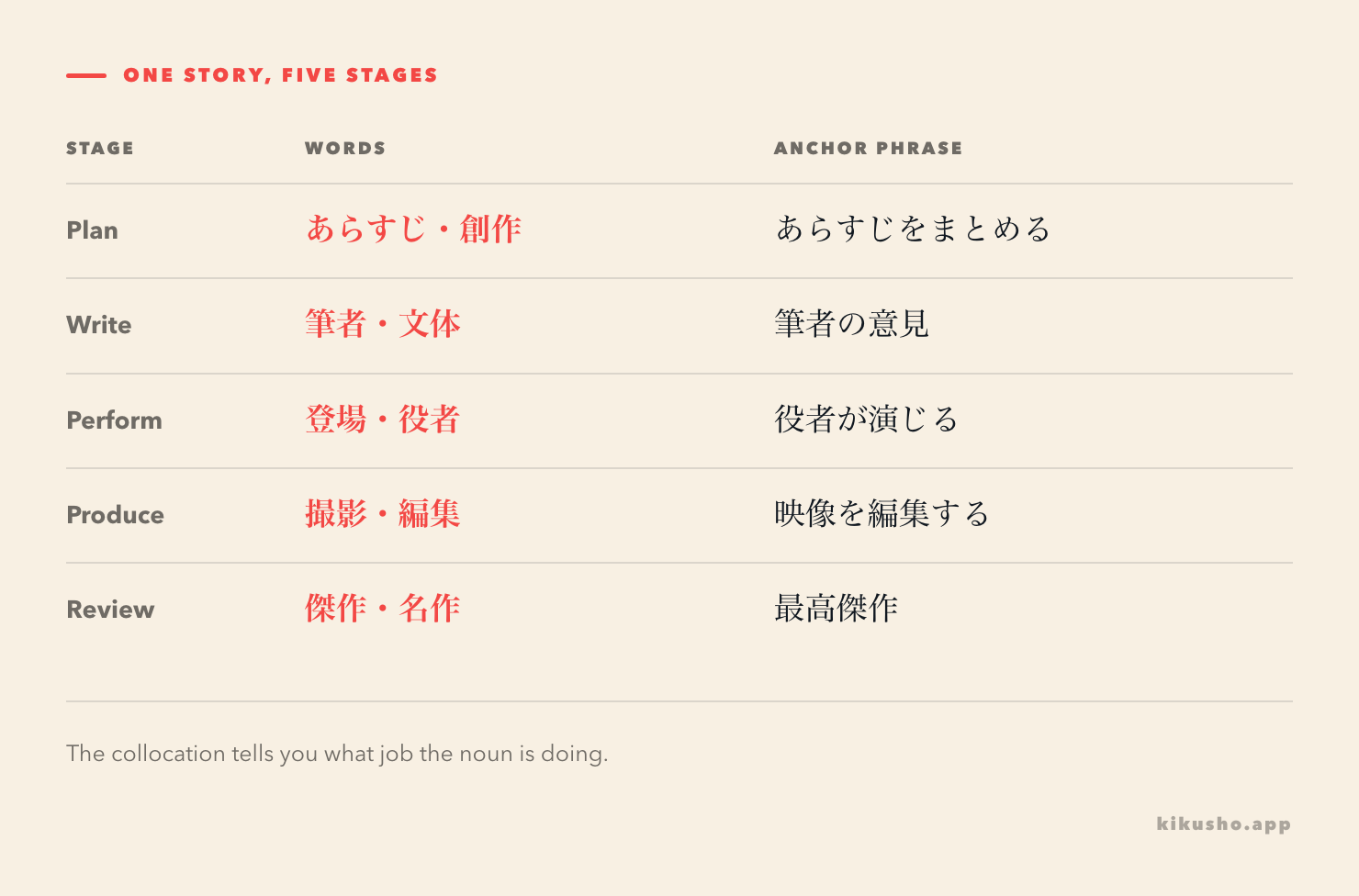
The table follows a useful production route. A 筆者 chooses a 文体 while creating a story. Its あらすじ introduces what happens. A screen version needs 役者, 撮影 and 編集, and a review may call the finished work a 名作 or 傑作.
あらすじ gives the story's main line
あらすじ is the broad outline or synopsis of a novel, play or film. Kotobank's 粗筋 entry defines it as the approximate content of a story. It leaves out most details and reveals only the main sequence.
- あらすじを読む: read the synopsis
- あらすじを説明する: explain the plot outline
- あらすじをまとめる: summarize the story
- 前回までのあらすじ: the story so far
映画を見る前に、公式サイトであらすじを読んだ。
Before watching the film, I read the synopsis on the official site.
小説のあらすじを百字以内でまとめてください。
Please summarize the novel's plot in no more than one hundred characters.
The N3 word 筋(すじ) can mean a plot or narrative line. あらすじ is the condensed account that someone reads or writes about that plot. The N3 storytelling lesson teaches 筋 along with 物語 and 場面.
筆者 and 文体 keep the focus on the text
筆者(ひっしゃ) is the person who wrote the article, passage or other piece of writing under discussion. Kotobank gives “the person who wrote that text or calligraphy.” Reading questions therefore use phrases such as 筆者の意見, 筆者の主張 and 筆者が最も伝えたいこと.
筆者は、便利さだけで制度を評価すべきではないと述べている。
The writer says that the system should not be judged by convenience alone.
著者(ちょしゃ) identifies the author responsible for a written publication, while 作者(さくしゃ) identifies the creator of a work. These labels overlap. A novelist discussing an essay they wrote may be its 作者, 著者 and 筆者, but 筆者 is especially natural when your attention is on the words in front of you.
文体(ぶんたい) is the characteristic way language is arranged in writing. The Kotobank overview of 文体 describes style through word choice, sentence construction and the individual or conventional features of expression.
- 文体が硬い: the writing style is formal or stiff
- 簡潔な文体: a concise style
- 独特の文体: a distinctive style
- 文体を変える: change one's writing style
この筆者は、難しい問題を簡潔な文体で説明している。
This writer explains difficult issues in a concise style.
創作 is the act and sometimes the result
創作(そうさく) means creating something new, especially a literary or artistic work. It is both a noun and a する-verb. The same word can also name the fictional or artistic piece that results. Kotobank's 創作 entry records both the creative act and the work itself.
- 物語を創作する: create a story
- 創作活動: creative activity
- 創作意欲: desire to create
- 創作料理: original or inventive cuisine
彼女は実際の体験をもとに短編小説を創作した。
She created a short story based on a real experience.
The word does not guarantee that a work is good. 創作 describes its making; 名作 and 傑作 evaluate what was made.
撮影, 登場 and 役者 put the story on screen
撮影(さつえい) means taking photographs or recording film and video. Kotobank explicitly covers photographs, films and video. The medium normally appears nearby: 写真撮影, 映画の撮影, 動画を撮影する.
この場面は夜明け前に海岸で撮影された。
This scene was filmed on the coast before dawn.
撮影現場では、携帯電話の電源を切ってください。
Please turn off your mobile phone at the filming location.
登場(とうじょう) means appearing or entering. On stage it can describe an entrance; in a novel or film it describes a character appearing in the story. It also extends to a new product, technology or public figure appearing. The compound 登場人物 means a story character.
主人公は最初の場面には登場しない。
The protagonist does not appear in the first scene.
役者(やくしゃ) is an actor or performer, especially someone who plays a role on stage. Kotobank's 役者 entry also records figurative senses for someone skilled at handling people or presenting themselves. 俳優(はいゆう) is the broad standard occupational label for a stage or screen actor. In an ordinary film credit, 俳優 will often sound more neutral; in theatre talk, 役者 remains familiar and natural.
若い役者が老人の役を自然に演じた。
A young actor played the role of an elderly person naturally.
編集 shapes the recorded material
編集(へんしゅう) means selecting, arranging and preparing material according to a plan. It applies to books, magazines, newspapers, audio and video. Kotobank includes both assembling publications and turning recorded footage into a film.
- 雑誌を編集する: edit a magazine
- 映像を編集する: edit footage
- 編集者: editor
- 編集部: editorial department
撮影した映像を編集して、十分の短編映画にした。
We edited the footage we had filmed into a ten-minute short film.
筆者と編集者は、説明が伝わりやすくなるように文体を整えた。
The writer and editor refined the style so the explanation would be easier to understand.
The first sentence separates the two production stages clearly: 撮影 records the material, then 編集 selects and arranges it.
名作 and 傑作 both praise a work
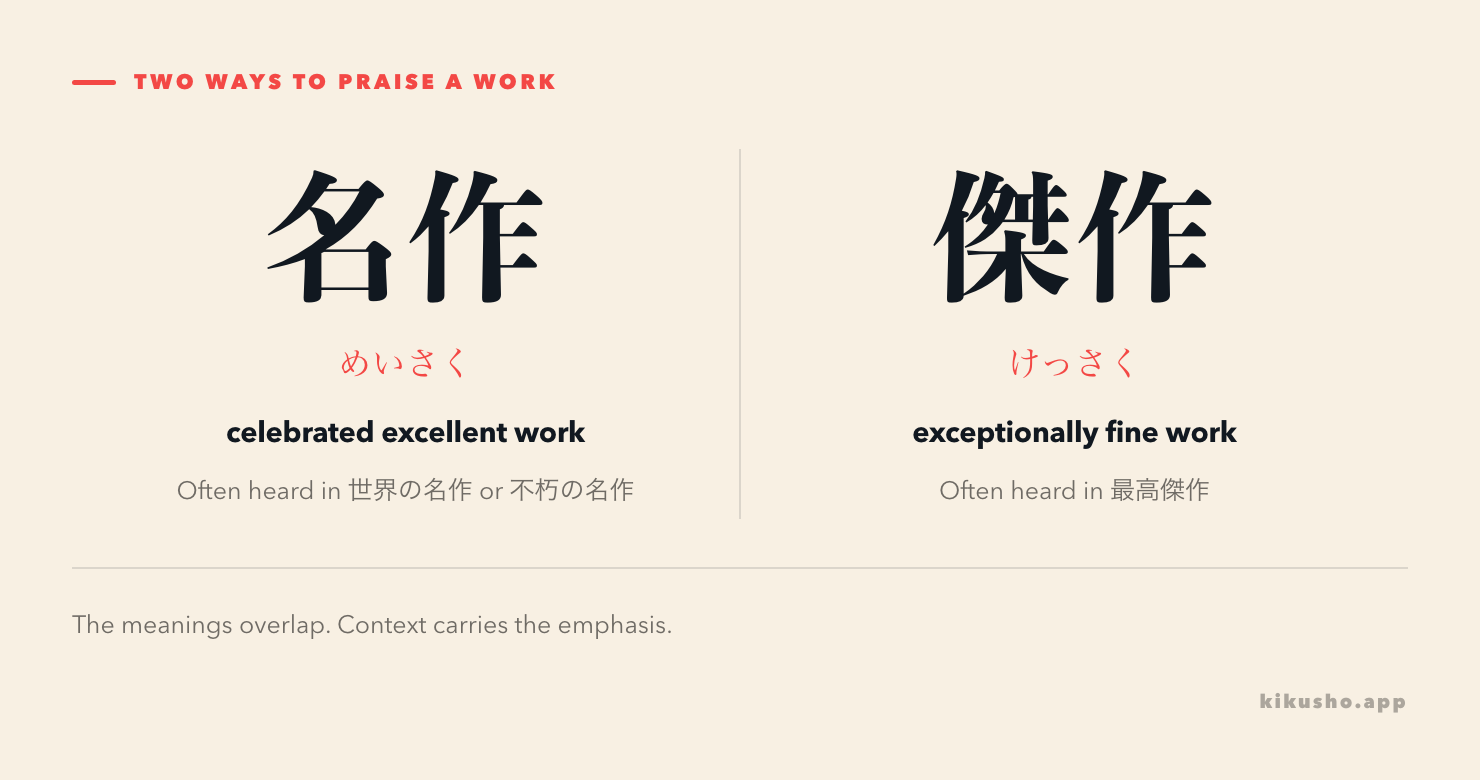
名作(めいさく) and 傑作(けっさく) both refer to an excellent work, so no single English contrast separates them every time. The Goo thesaurus groups them among words for outstanding works.
傑作 directly stresses exceptional quality or accomplishment. Kotobank defines it as a work of extremely fine quality. It appears naturally in 最高傑作, “greatest masterpiece,” or when a reviewer judges one work against others.
名作 often presents a work as celebrated, established or worthy of lasting recognition. Phrases such as 世界の名作, 古典の名作 and 不朽の名作 are common. This is a tendency, not a hard rule: speakers may call the same film either a 名作 or a 傑作.
批評家はこの作品を監督の最高傑作だと評価した。
Critics judged this work to be the director's greatest masterpiece.
この小説は世代を超えて読まれる名作だ。
This novel is a classic read across generations.
There is one extra sense to notice. 傑作だ can react to something absurdly funny: その話は傑作だ can mean “That story is hilarious.” Context decides whether the speaker praises a work or laughs at an incident.
Build one complete review
The words become easier to retrieve when they form a chain:
あらすじは単純だが、筆者の独特な文体が魅力的だ。映画版では、新人の役者が登場人物を演じ、海辺の場面が美しく撮影されている。編集のテンポもよく、原作を生かした傑作だと思う。
The plot outline is simple, but the writer's distinctive style is compelling. In the film version, a new actor plays the character, and the seaside scenes are beautifully filmed. The editing also has a good pace, and I think it is a masterpiece that preserves the strengths of the original.
In Kikusho, save the headword with the phrase that identifies its job. あらすじをまとめる, 映画を撮影する and 映像を編集する are stronger review prompts than isolated translations. The N1 storytelling lesson continues into adaptation analysis with 原作, 描写, 映像 and 主人公.
Japanese study lists are useful guides, but there is no official checklist that guarantees every word on a future JLPT. These ten records form Kikusho's N2 review set. The official JLPT FAQ explains why the revised test no longer releases the former Test Content Specifications.
Test the production route
Question 1
Write the reading of 筆者 in hiragana.
Question 2
Which spelling means “editing”?
- A. 編週
- B. 偏集
- C. 編集
- D. 変修
Question 3
Choose the most natural phrase for a short account of a film's main events.
- A. あらすじをまとめる
- B. 役者をまとめる
- C. 文体を撮影する
- D. 登場を編集者する
Question 4
Which word best completes the sentence?
この写真集の写真は、三年間かけて全国の祭りで__された。
- A. 撮影
- B. 登場
- C. 名作
- D. 文体
Question 5
Which word best completes the sentence?
難しい内容だが、__が簡潔なので読みやすい。
- A. 役者
- B. 文体
- C. 撮影
- D. あらすじ
Question 6
Put these two actions in production order, then join them as one Japanese sentence:
- 必要な映像を選んで編集する
- 場面を撮影する
Question 7
Which statement best reflects the lesson's comparison of 名作 and 傑作?
- A. 名作 is only for books, while 傑作 is only for films.
- B. 名作 is N2, while 傑作 cannot describe art.
- C. Both praise excellent works; their emphasis may differ, but their uses overlap.
- D. They are exact opposites.
Question 8
Use the passage to select the supported claim:
この映画の脚本は有名な短編小説をもとに創作された。あらすじは原作とほぼ同じだが、新しい登場人物が加わっている。役者の演技だけでなく、夜の撮影と速い編集も高く評価された。
- A. The film abandons the source story and contains no actors.
- B. The film keeps roughly the same outline, adds a character and received praise for acting, night filming and fast editing.
- C. The writer removed every character during the editing of a magazine.
- D. The passage says only that the original story has a formal writing style.
Answers and explanations
1 · Reading
ひっしゃ. 筆者 identifies the person who wrote the text under discussion. 筆 is ひつ in compounds, with consonant doubling before しゃ.
2 · Orthography
C, 編集. 編 carries the idea of compiling or arranging, and 集 means gathering. The other choices are lookalike combinations rather than this word.
3 · Synopsis
A, あらすじをまとめる. This means “summarize the plot outline.” The other combinations either assign the wrong object to a verb or are grammatically ill formed.
4 · Photography
A, 撮影. The camera context and the phrase カメラに収めた point to photography. The sentence says the photography for the collection took three years.
5 · Writing style
B, 文体. A concise writing style can make difficult content easier to read. The other nouns do not naturally take 簡潔 here with that meaning.
6 · Production order
場面を撮影し、必要な映像を選んで編集する。 A team records the scene through 撮影, then selects and arranges the resulting footage through 編集.
7 · Overlapping praise
C. Both words can praise the same excellent work. 傑作 often stresses exceptional quality, while 名作 can suggest established reputation, but the boundary is not absolute.
8 · Connected review
B. The passage says the film retains roughly the same あらすじ, adds a 登場人物 and is praised for the 役者's performance, night 撮影 and fast 編集.
Let the verb identify the production stage
These nouns become precise when their partner is visible. A writer 創作する, a character 登場する, a crew 撮影する, and an editor 編集する. A critic then 評価する the finished work as a 名作 or 傑作. Following those verbs lets you reconstruct the whole route even when several media words appear in one dense N2 passage.
Common questions
What is the difference between 名作 and 傑作?
Both praise an excellent work and often overlap. 傑作(けっさく)directly stresses exceptionally fine quality, while 名作(めいさく)often presents a work as celebrated or established. Context matters more than a rigid rule.
What is the difference between 筆者, 著者 and 作者?
筆者(ひっしゃ)is the person who wrote the text currently being discussed. 著者 identifies the author of a written publication, while 作者 is the creator of a work and can extend beyond prose. One person may fit all three.
Can 撮影 mean both photography and filming?
Yes. 撮影(さつえい)means recording photographs, film or video. The object or setting clarifies the medium, as in 写真撮影, 映画の撮影 and 撮影現場.
Is 役者 the same as 俳優?
Both can mean an actor. 俳優 is the standard occupational term across stage and screen. 役者 is common for a person performing a role, especially in theatre, and also has figurative senses for a shrewd or impressive person.