On this page
原作 becomes 映像, a 主人公 anchors the story, and 描写 plus 語彙 give you the language to analyse how the result works. The sixth assigned record breaks that media chain on purpose: 役(えき) means a historical war or campaign, whereas an actor's role is 役(やく).
Five words form an adaptation chain; one tests the reading
| Job in the lesson | Word | Reading | Class and sense | Phrase to retain |
|---|---|---|---|---|
| What appears on screen | 映像 | えいぞう | noun: visual image; footage; screen imagery | 鮮明な映像, vivid footage |
| The source work | 原作 | げんさく | noun: original work behind an adaptation or translation | 原作に忠実だ, be faithful to the source |
| The word stock | 語彙 | ごい | noun: vocabulary as a set of words | 語彙が豊富だ, have a rich vocabulary |
| The central character | 主人公 | しゅじんこう | noun: protagonist; main character | 主人公を演じる, play the protagonist |
| The portrayal | 描写 | びょうしゃ | noun and する verb: depiction; description; portrayal | 心理を描写する, portray a mental state |
| The historical outlier | 役 | えき | noun: war; military campaign; imposed labour | 前九年の役, the Former Nine Years' War |
The first five let you discuss what happens when a written work reaches the screen. The last record belongs to historical prose, not film production. Keeping it here exposes exactly why spelling alone cannot choose a reading.
The earlier N4 storytelling lesson supplies 小説, 漫画 and 翻訳. This page assumes those basics and moves from naming a format to analysing the relation between a source, its adaptation and its language.
原作 is the source; 映像 is what the screen presents
原作(げんさく) names the work that existed before a translation, dramatisation or adaptation. It may be a novel, manga, game or another kind of source:
この映画は同名の小説を原作としている。
この えいがは どうめいの しょうせつを げんさくと している。
This film is based on a novel of the same title.
The pattern Nを原作とする means “use N as the original work.” You will also see 原作に忠実な映画, a film faithful to the source, and 原作とは異なる結末, an ending different from the original. Kotobank defines 原作 as the work that precedes translation, adaptation or dramatisation.
映像(えいぞう) is an image formed by light, an image on a film or television screen, or screen imagery and footage more broadly. It does not automatically mean a complete movie:
冒頭の映像は美しいが、原作にはない場面だ。
ぼうとうの えいぞうは うつくしいが、げんさくには ない ばめんだ。
The opening imagery is beautiful, but the scene is not in the original work.
That sentence can praise the visual material without calling the whole film a masterpiece. Kotobank's 映像 entry distinguishes a reflected optical image, an image shown on a film or television screen, and a mental image.
The useful adaptation verb is 映像化する, “adapt for a visual medium”:
長編小説を二時間の映画として映像化するのは難しい。
ちょうへんしょうせつを にじかんの えいがとして えいぞうかするのは むずかしい。
It is difficult to adapt a full-length novel into a two-hour film.
Here 映像化 describes the transformation. 映画 names the finished film. 原作 remains the source.
主人公 and 描写 let you discuss what the adaptation changes
主人公(しゅじんこう) is the central figure in an event, novel, play or film. The English “hero” can suggest moral courage, but 主人公 need not be admirable. It identifies narrative centrality:
映画版では、主人公の年齢が原作より高く設定されている。
えいがばんでは、しゅじんこうの ねんれいが げんさくより たかく せっていされている。
In the film version, the protagonist is older than in the original.
Kotobank defines 主人公 as the central person in an event, novel or play and extends the category across film and drama. An actor can 主人公を演じる, play the protagonist; inside the story, 主人公が成長する, the protagonist develops.
描写(びょうしゃ) names the act or result of representing a shape, condition, scene or feeling through words, pictures or music. It also takes する:
原作は主人公の不安を細かく描写している。
げんさくは しゅじんこうの ふあんを こまかく びょうしゃしている。
The original work portrays the protagonist's anxiety in detail.
映画では心理描写が減り、映像だけで感情を伝えている。
えいがでは しんりびょうしゃが へり、えいぞうだけで かんじょうを つたえている。
In the film, there is less psychological portrayal, and the emotion is conveyed through the images alone.
Kotobank's 描写 entry covers representation through language, writing, painting or music. The object determines what is portrayed: 情景描写 presents a scene, 心理描写 presents inner states, and 人物描写 presents a person. 描写 is broader than drawing with a pen.
語彙 is a collection, not one isolated word
語彙(ごい) is the set of words used within a language, region, field, person or work. The character 彙 carries the sense of gathering, which helps explain why careful Japanese treats 語彙 as a collective noun:
この小説は日常的な語彙で複雑な感情を描写している。
この しょうせつは にちじょうてきな ごいで ふくざつな かんじょうを びょうしゃしている。
This novel portrays complex emotions with everyday vocabulary.
作者は作品ごとに語彙を使い分けている。
さくしゃは さくひんごとに ごいを つかいわけている。
The author varies the vocabulary from one work to another.
Kotobank defines 語彙 as the total set of words used by a language, field, person or work. It explicitly notes that an individual item is a 単語 or 語. Learners do sometimes use 語彙 loosely for one vocabulary item, but that should not erase the central collective sense.
This distinction sharpens analysis. 難しい単語が三つある means there are three difficult words. 語彙が難しい judges the word stock of the passage more broadly. The first counts items; the second characterises a set.
The media chain keeps each noun in its own role
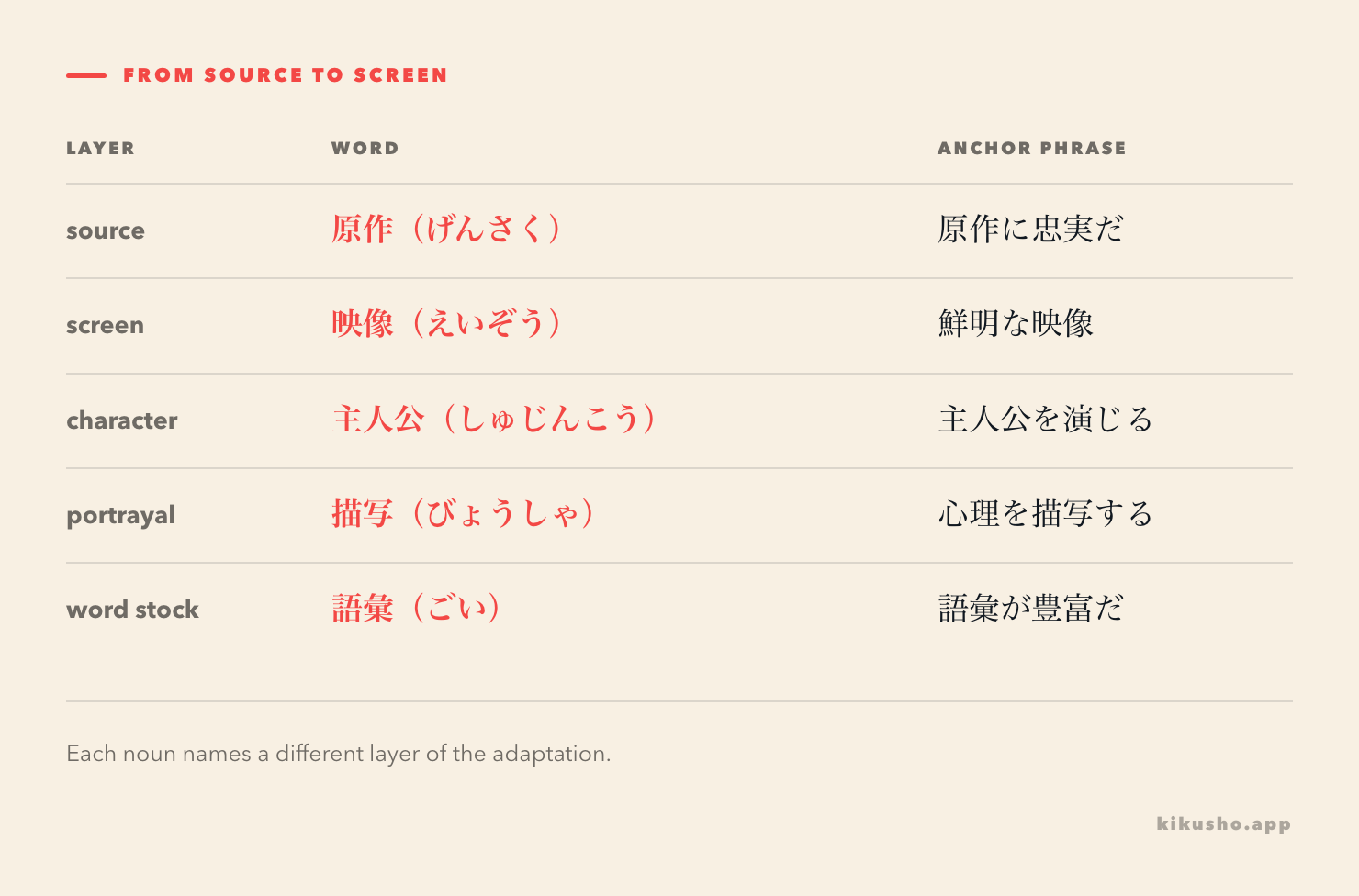
Read the five media words as a sequence rather than five synonyms:
- A novel is the 原作.
- The adaptation turns it into 映像.
- The 主人公 remains central, even if details change.
- The director replaces some verbal 描写 with visual choices.
- A comparison can examine the 語彙 retained in dialogue or narration.
One compact review can use the whole chain:
この映画は原作の主人公を変えず、心理描写の一部を映像で表現している。台詞の語彙も原作に近い。
この えいがは げんさくの しゅじんこうを かえず、しんりびょうしゃの いちぶを えいぞうで ひょうげんしている。せりふの ごいも げんさくに ちかい。
The film keeps the original work's protagonist, expresses some psychological description visually, and uses vocabulary in the dialogue that is also close to the source.
The words describe different layers. 原作 and 映像 name source and presentation; 主人公 names a character; 描写 names representational treatment; 語彙 names the selected word stock.
役(えき) belongs to history, not the cast list
The assigned entry is 役(えき), an old or historical word for war, a military campaign or imposed public labour. It survives most visibly in names of conflicts:
授業で前九年の役について調べた。
じゅぎょうで ぜんくねんの えきについて しらべた。
We researched the Former Nine Years' War in class.
The same kanji read やく has several current senses, including a duty and an acting role:
彼は映画で主人公の役を演じた。
かれは えいがで しゅじんこうの やくを えんじた。
He played the protagonist in the film.
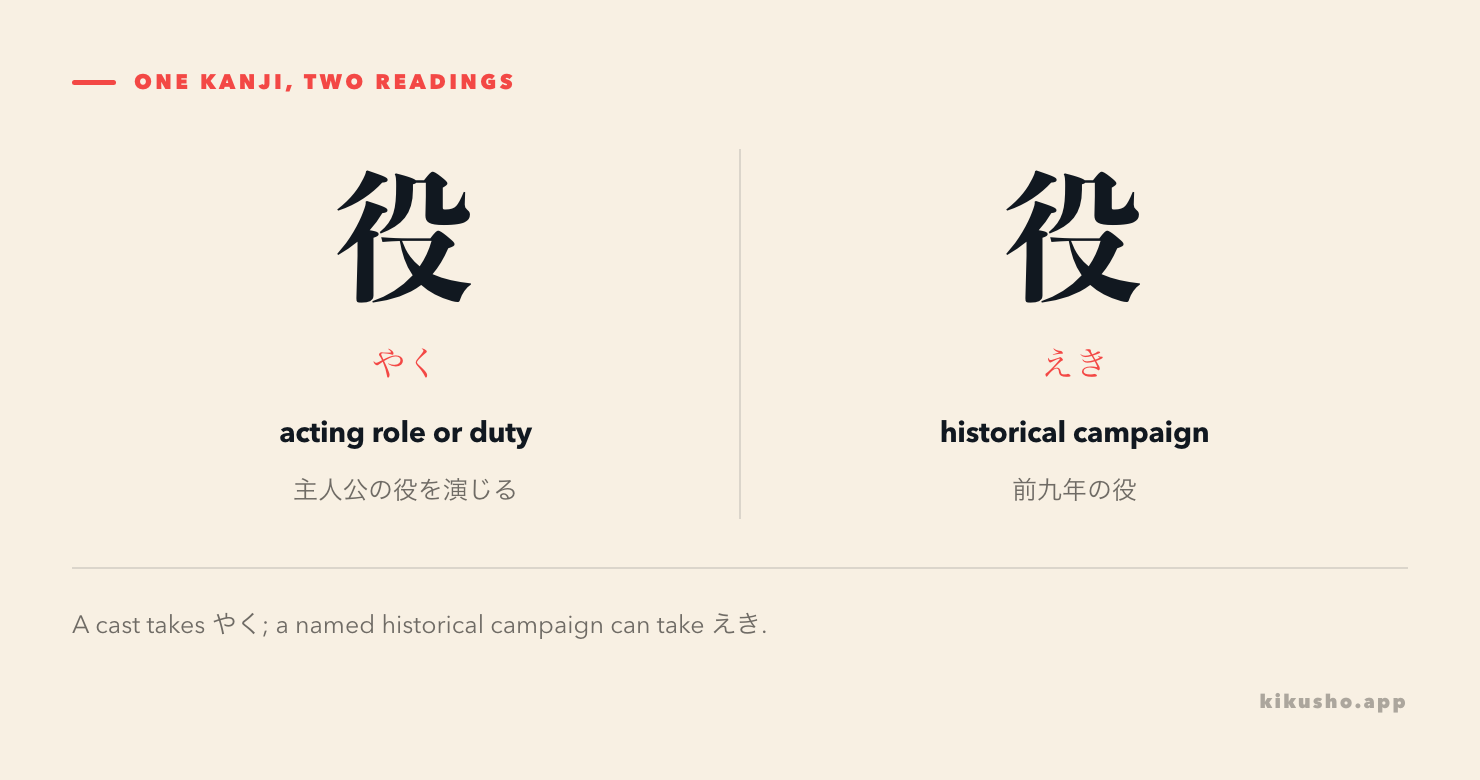
Kotobank's 役 entry separates えき, war or imposed labour, from やく, duty, office or a role in theatre and film. Bunpro independently records 役(えき) as N1 vocabulary meaning war, campaign, battle or unpaid work and illustrates it in a historical name.
Do not create the sentence 主人公の役(えき). The narrative context demands やく. Conversely, a history title such as 弘安の役(こうあんのえき) does not describe anyone's performance. This is a reading-and-sense distinction, not a difference that translation can safely hide.
N1 is a placement here, not an official border
Kikusho's dated inventory assigns all six exact spelling-reading records to N1 and records no internal disagreement. Five appear in both Waller-derived baseline snapshots, while 役(えき) appears in one; those snapshots share a source family and do not count as independent confirmations. A separately published study page also places 映像 at N1, and Bunpro places the exact 役(えき) record at N1.
The official JLPT FAQ states that the revised test does not publish the old exhaustive vocabulary and kanji specifications. Dictionaries establish the readings and senses used here. They do not draw an official N1 line. Treat the label as an order for study, especially for the rare historical reading えき.
For Kikusho cards, capture enough context to preserve the layer being tested. 原作に忠実, 心理描写が細かい, 語彙が豊富, and 前九年の役 produce four distinct retrieval cues. A bare 役 card would force you to guess between readings before memory has any sentence to work with.
Practice: analyse the whole excerpt before opening the key
Question 1 · read the screen word
Which reading belongs to 映像 in this lesson?
- A. えいしょう
- B. えいぞう
- C. えぞう
- D. うつしぞう
Question 2 · identify the source
Which word completes この映画は人気小説を__としている?
- A. 映像
- B. 語彙
- C. 原作
- D. 描写
Question 3 · choose the collective noun
Which sentence uses 語彙 in its central collective sense?
- A. この評論は専門的な語彙が多い。
- B. 分からない語彙を一個だけ丸で囲んだ。
- C. 語彙が一人、部屋に入ってきた。
- D. 昨日、語彙を一本見た。
Question 4 · name the central figure
The character around whom the story is organised is its:
- A. 主人公
- B. 原作
- C. 映像
- D. 語彙
Question 5 · paraphrase the portrayal
Which sentence best preserves 原作は町の様子を詳しく描写している?
- A. The original work describes the town in detail.
- B. The protagonist translates the name of the town.
- C. The film removes the town from the original work.
- D. The town contains many difficult words.
Question 6 · choose the historical reading
How is 役 read in 前九年の役, the name of a historical conflict?
- A. やく
- B. えき
- C. えだち
- D. つとめ
Question 7 · follow the adaptation review
Read the passage:
この映画は小説を原作としている。主人公は同じだが、長い心理描写は短い映像に置き換えられた。台詞の語彙も簡単になっている。
Which summary is accurate?
- A. The film changes the source, protagonist, images and dialogue completely.
- B. The film keeps the same protagonist but replaces long psychological description with brief imagery and simplifies the dialogue's vocabulary.
- C. The novel is based on a film about a historical campaign.
- D. The protagonist studies the meaning of 役(えき).
The questions have now tested reading, context, collective meaning, paraphrase and a connected review.
Answers and explanations
1 · Screen imagery: B, えいぞう. 映像 is read えいぞう. It can refer to an image, footage or screen imagery; none of the other options is the reading of this compound.
2 · The adaptation source: C, 原作. 小説を原作とする means to use a novel as the original work behind an adaptation. The other words name imagery, vocabulary or portrayal and cannot fill this construction.
3 · Vocabulary as a set: A. 専門的な語彙 describes the specialised word stock used by the review. B counts one individual item, where 単語 or 語 is the careful choice. C and D assign 語彙 impossible human and film-counter roles.
4 · Narrative centre: A, 主人公. 主人公 is the protagonist or main character. 原作 is a source work, 映像 is visual material and 語彙 is a set of words.
5 · Describing the town: A. 描写する means to depict, describe or portray. The Japanese sentence says the source work presents the town's appearance in detail; it mentions neither translation nor removal.
6 · A historical campaign: B, えき. In names of wars such as 前九年の役, 役 is read えき. An actor's 役 is read やく, which is precisely the tempting but wrong answer in this historical context.
7 · Reading the full comparison: B. The source is a novel and the protagonist remains the same. Long psychological description becomes short visual material, while the dialogue uses simpler vocabulary. The passage says nothing about a military campaign.
The sentence surrounding a word now supplies the decision: 原作 anchors an adaptation, 映像 occupies the screen, 描写 portrays, 語彙 gathers words, 主人公 centres the story, and a historical title turns 役 into えき.
Common questions
What is the difference between 映像 and 映画?
映像(えいぞう)is a visual image, footage or screen imagery. 映画(えいが)is a film as a complete work or the medium of cinema. A film contains 映像, and a novel can be 映像化された when adapted for a visual medium.
What does 原作 mean in Japanese?
原作(げんさく)is the original work on which a translation, adaptation or dramatisation is based. 原作に忠実 means faithful to the source, while 小説を原作とする映画 is a film based on a novel.
Does 語彙 mean one vocabulary word?
In careful use, 語彙(ごい)means the vocabulary or whole set of words used by a language, person, field or work. Use 単語 or 語 for one individual word.
Is 役 read えき when it means an acting role?
No. An acting role is 役(やく). The assigned N1 record 役(えき)means a war, military campaign or historically imposed labour and appears in names such as 前九年の役. The reading changes the sense completely.