On this page
A cultural programme can move from 稽古 to 演劇, from memorising a 台詞 to hearing a 太鼓, and from looking at a 彫刻 to joining a seasonal 催し. This N2 lesson teaches eight words that describe making, presenting and appreciating culture—and the phrases that keep their meanings apart.
The complete set
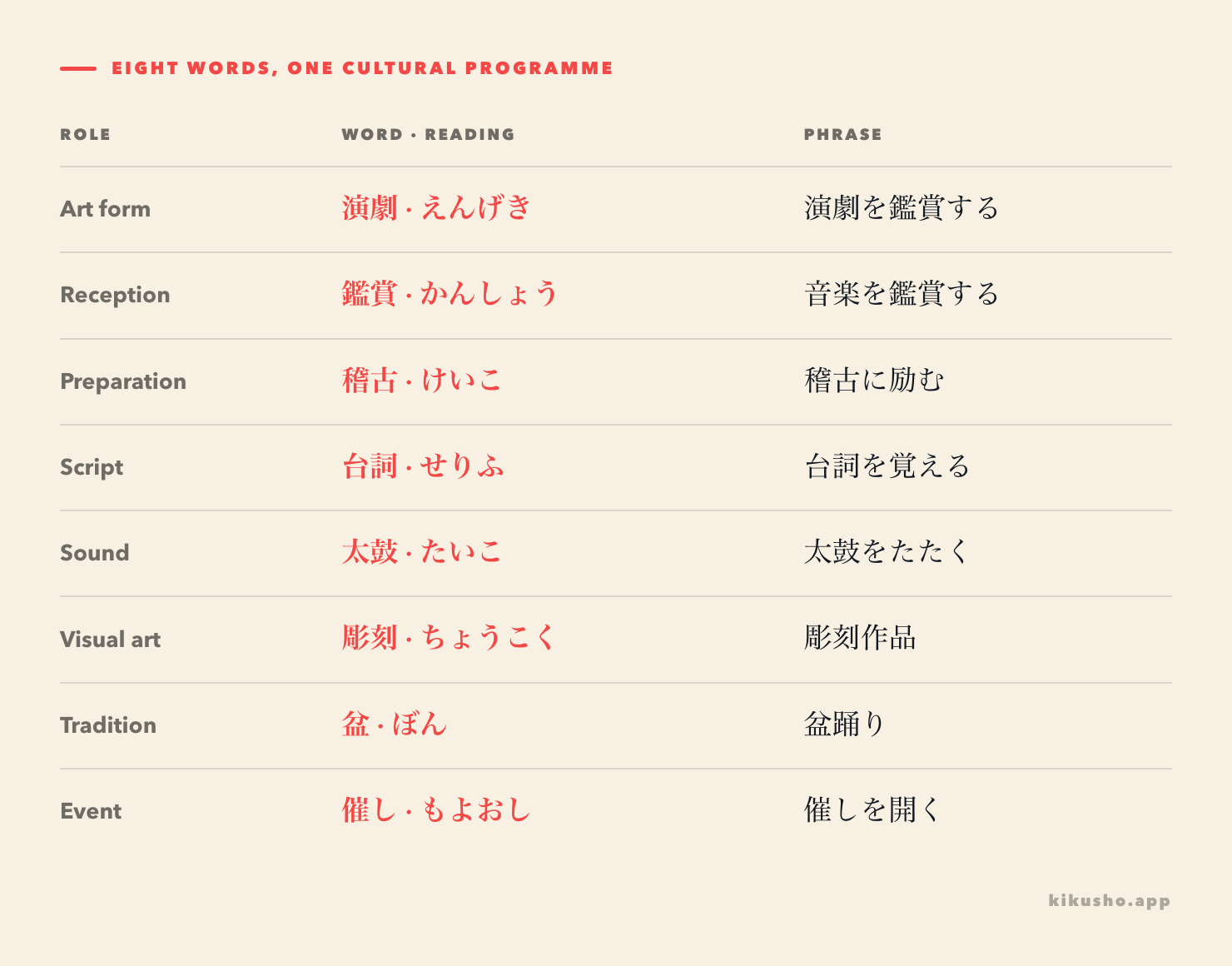
| Role | Entry | Spoken form | Core meaning | Phrase to keep |
|---|---|---|---|---|
| Art form | 演劇 | えんげき | theatre; drama; a play | 演劇を鑑賞する |
| Reception | 鑑賞 | かんしょう | appreciation of art by seeing, hearing or reading | 音楽を鑑賞する |
| Preparation | 稽古 | けいこ | practice; training; study | 稽古に励む |
| Script | 台詞 | せりふ | a line of dialogue; words or remarks | 台詞を覚える |
| Sound | 太鼓 | たいこ | drum | 太鼓をたたく |
| Visual art | 彫刻 | ちょうこく | sculpture; carving | 彫刻作品 |
| Tradition | 盆 | ぼん | tray; Obon period or festival | 盆踊り |
| Event | 催し | もよおし | organized event; function | 催しを開く |
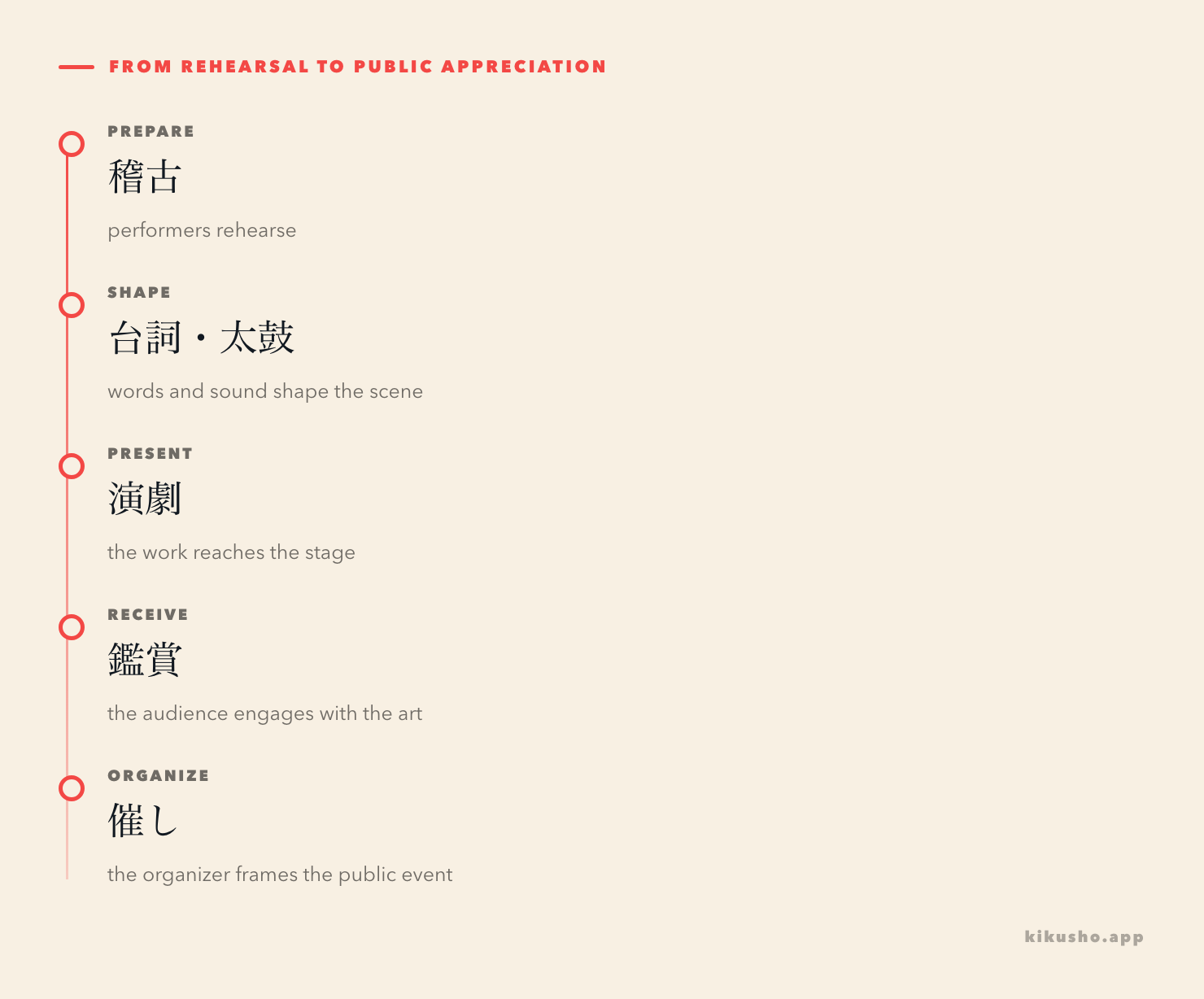
The set becomes easier when you arrange it as a route. Performers begin with 稽古, learn each 台詞, and present an 演劇. Visitors 鑑賞 a play or a 彫刻, hear a 太鼓, and attend a 催し during 盆.
演劇 is the art; 公演 is the presentation
演劇(えんげき) refers to theatre or drama as an art form, and it can also identify a theatrical work or play. Kotobank's dictionary entry describes actors using movement and spoken lines on a stage before an audience, with visual and auditory elements.
大学では日本の現代演劇を研究している。
I study contemporary Japanese theatre at university.
来週、市民会館で新しい演劇を鑑賞する予定だ。
Next week, I plan to see and appreciate a new play at the civic hall.
Do not treat 演劇 and 公演(こうえん) as interchangeable. The earlier N3 performance lesson teaches 公演 as a scheduled public presentation. An 演劇 can be the work or art form presented in that 公演. Music and dance can also be 公演, but they are not normally called 演劇.
The Japan Foundation's performing-arts programme likewise groups theatre with music and dance as forms of 舞台芸術. That real institutional use helps place 演劇 inside the broader world of public performance.
鑑賞 means attentive appreciation
鑑賞(かんしょう) is a noun and する-verb. It means engaging with an artistic work—by seeing, hearing or reading it—and appreciating what it expresses. Kotobank explicitly gives seeing, hearing and reading as possible routes, so 鑑賞 is wider than English “viewing.”
- 演劇を鑑賞する: appreciate or watch theatre
- 音楽を鑑賞する: listen to and appreciate music
- 映画を鑑賞する: watch and appreciate a film
- 美術鑑賞: art appreciation
作品を鑑賞した後、演出について意見を交換した。
After viewing the work, we exchanged opinions about its direction.
The homophone 観賞(かんしょう) uses 観, “look.” It commonly focuses on looking at plants, scenery or animals for enjoyment: 花を観賞する. The boundary can vary with what the writer wants to emphasize, but art, music, theatre and film normally select 鑑賞. The kanji 鑑 points toward evaluation and appreciation, which is a useful exam clue.
稽古 prepares a performance
稽古(けいこ) means practice, training or study. It is especially common in theatre, traditional performing arts, tea ceremony and martial arts. Useful patterns include 稽古をする, 稽古に励む, 稽古をつける (“give someone training”) and 稽古場 (“rehearsal or training room”).
俳優たちは本番に向けて毎日稽古に励んでいる。
The actors are practising hard every day for the actual performance.
稽古の前に、全員で台本を読み合わせた。
Before rehearsal, everyone read through the script together.
練習(れんしゅう) is the broader everyday word for repeated practice: language practice, piano practice or football practice. The two overlap, and 演技の練習 is perfectly possible. In a rehearsal room or a traditional discipline, however, 稽古 often sounds more established and idiomatic.
台詞 gives the actor words
台詞(せりふ), also commonly written セリフ, first means the words spoken by an actor in a play, film or programme. Kotobank's 台詞 entry also records extended senses such as a person's remark, way of putting something or stock phrase.
- 台詞を覚える: memorize one's lines
- 台詞を言う: deliver or say a line
- 台詞を忘れる: forget one's line
- 決まり台詞: a stock phrase or signature line
主役は長い台詞を一度も間違えずに言った。
The lead delivered the long speech without making a single mistake.
「忙しい」は断るときの彼の決まり台詞だ。
“I'm busy” is his stock phrase when he refuses something.
The first example belongs directly to theatre. The second shows why a sentence mentioning 台詞 need not contain a stage: everyday speech can be called a 台詞 when the wording itself attracts attention.
太鼓 is played with たたく
太鼓(たいこ) is a drum. The natural basic phrase is 太鼓をたたく, using the verb for striking. 和太鼓(わだいこ) can refer specifically to Japanese drums or Japanese drumming, while 太鼓 is the general headword.
盆踊りが始まると、広場に太鼓の音が響いた。
When the Bon dance began, the sound of drums echoed through the square.
子どもたちは祭りのために太鼓の稽古を続けている。
The children are continuing their drum practice for the festival.
This adds a useful instrument-action pair to the N3 lesson's バイオリンを弾く and 笛を吹く. Japanese often chooses a verb according to how an instrument produces sound: strike a drum, blow a flute, or play a violin with 弾く.
彫刻 can be the process or the work
彫刻(ちょうこく) covers sculpture and carving. Depending on context, it can name the act or technique, the art form, or the resulting work. This is why both 彫刻を学ぶ and 彫刻を展示する are natural: the first concerns the discipline, while the second concerns a sculpture.
- 木に模様を彫刻する: carve a pattern into wood
- 彫刻作品: a sculptural work
- 彫刻家: sculptor
- 石の彫刻: a stone sculpture
美術館の入口には、大きな石の彫刻が置かれている。
A large stone sculpture stands at the entrance to the art museum.
The N3 word 絵画(かいが) names painting, while 彫刻 names a different visual-art medium. Both can be 芸術作品, and both can be 鑑賞する objects.
盆 has two everyday senses
盆(ぼん) creates a classic context question because one spelling connects two distinct scenes. An お盆 can be a tray used to carry food or drinks. 盆 or お盆 can also refer to the summer Obon period, when families remember ancestors and many communities hold seasonal events.
店員がお盆にお茶を載せて運んできた。
The server brought the tea on a tray.
盆休みに故郷へ帰り、近所の盆踊りに参加した。
During the Obon holiday, I returned to my hometown and joined the local Bon dance.
Compounds remove the ambiguity. 盆休み, 盆踊り and 盆祭り point to the seasonal sense. お盆に載せる or お盆を運ぶ points to the physical tray. Kotobank's 盆 entry documents both the utensil and the annual observance.
催し is an organized event
催し(もよおし) is an event, function or organized attraction. It derives from 催す(もよおす), “hold” or “organize,” and often appears in announcements for museums, community centres, shops and local festivals.
- 催しを開く: hold an event
- 催しを行う: conduct an event
- 文化的な催し: a cultural event
- 催し物: entertainment, attraction or programme item
市の広報には、今月の催しが日付順に紹介されている。
The city's newsletter introduces this month's events in date order.
美術館は子ども向けの催しを開き、彫刻の作り方を紹介した。
The art museum held an event for children and introduced how sculptures are made.
祭り(まつり) often names a festival rooted in a community, season or tradition. 公演 is a public performance. 催し is the broader organizer's word: a talk, workshop, exhibition activity or performance can all be one 催し.
Read the event as a connected scene
Imagine a community centre preparing an Obon programme. Actors rehearse an 演劇, memorize their 台詞, and practise 太鼓. Organizers place a 彫刻 near the entrance and publish the day's 催し. Visitors arrive to 鑑賞 the performance, while volunteers carry drinks on an お盆. One scene now supplies a distinct job for every word.
The N4 arts-and-festivals lesson supplies 美術館, 展覧会 and お祭り. The N3 lesson supplies 公演, 舞台 and 観客. The N1 arts-production lesson continues with 演出, 衣装, 美術 and 上演. Keep those levels connected, but keep each word's function precise.
Test the whole route
Question 1
How do you read 鑑賞?
- かんしょう
- けんしょう
- かんじょう
- けんじょう
Question 2
Which spelling means an actor's line of dialogue?
- 対詞
- 台紙
- 台詞
- 題詞
Question 3
Which phrase is the most natural for actors working repeatedly before opening night?
- 稽古に励む
- 鑑賞に励む
- 台詞を催す
- 演劇をたたく
Question 4
Choose the best word.
この美術館では、入口の石の__も重要な作品として紹介されている。
- 演劇
- 彫刻
- 太鼓
- 台詞
Question 5
What does 盆 mean in this sentence?
盆に飲み物を載せて、客席まで運んだ。
- the Obon holiday
- a stage
- a tray
- a rehearsal
Question 6
Which sentence uses 鑑賞 most naturally?
- 庭の花を鑑賞して、水をやった。
- 劇場で現代演劇を鑑賞した。
- 太鼓を鑑賞して音を出した。
- 台詞を鑑賞して暗記した。
Question 7
Choose the best word for the broad organizer's term “event.”
市民会館では、子ども向けの文化的な__が毎月開かれる。
- 催し
- 稽古
- 盆
- 台詞
Question 8
Which paraphrase best preserves the meaning?
俳優たちは太鼓の音に合わせて台詞を言う場面を何度も稽古した。
- The audience appreciated a drum exhibition several times.
- The actors repeatedly rehearsed the scene in which they deliver lines with the drumbeat.
- The sculptors organized a play during the Obon holiday.
- The actors carried a drum on a tray while reading silently.
Answers and explanations
1 · The reading
かんしょう. 鑑賞 uses 鑑, and means appreciating an artistic work by seeing, hearing or reading it.
2 · The written line
台詞. It is read せりふ and is also frequently written セリフ.
3 · Rehearsal
稽古に励む. The expression means to devote oneself diligently to practice or rehearsal.
4 · Three-dimensional art
彫刻. A stone sculpture at a museum entrance is a 彫刻作品.
5 · The tray sense
A tray. Loading drinks onto it and carrying them selects the physical-object sense. 盆休み or 盆踊り would select Obon.
6 · Artistic appreciation
劇場で現代演劇を鑑賞した. Theatre is an artistic work that one watches and appreciates. The other options confuse appreciation with growing flowers, playing an instrument or memorizing lines.
7 · The organized event
催し. It is a broad event or function arranged by an organizer; 催しを開く is a natural combination.
8 · The connected scene
The actors repeatedly rehearsed the scene in which they deliver lines with the drumbeat. 俳優たち are the actors, 台詞を言う is “deliver lines,” and 何度も稽古した means they rehearsed repeatedly.
Sources and level note
The eight spelling-and-reading records come from Kikusho's pinned N2 inventory, whose two retained baseline snapshots descend from the same older list family and therefore count as one source family. Independent dictionary checks support the readings and senses: Kotobank for 演劇, 鑑賞, 台詞 and 盆, plus the Japan Foundation's current performing-arts programme for authentic institutional use around theatre and public performance.
The official JLPT FAQ notes that the former detailed content specifications are not published for the revised test. “N2” here is therefore Kikusho's transparent study placement, not a claim that each word belongs exclusively to an official list. None of these eight records has an internal level disagreement in the pinned inventory.
Common questions
What is the difference between 演劇 and 公演?
演劇(えんげき)is theatre or drama as an art form, and can also mean a play. 公演(こうえん)is a scheduled public presentation, which may be theatre, music or dance. An 演劇 can therefore be presented as a 公演.
What is the difference between 鑑賞 and 観賞?
鑑賞(かんしょう)means appreciating an artistic work by seeing, hearing or reading it. 観賞(かんしょう)focuses on looking at something such as plants or scenery for enjoyment. Music, theatre, film and sculpture normally take 鑑賞.
Does 盆 mean a tray or the Obon festival?
It can mean either. お盆を運ぶ means to carry a tray, while 盆休み and 盆踊り refer to the Obon period and its customs. The surrounding phrase identifies the sense.
What is the difference between 稽古 and 練習?
Both can mean practice. 稽古(けいこ)is especially common for theatre, traditional arts and martial arts, while 練習 is the broader everyday word for repeated practice. Their uses overlap.