On this page
A 作家 creates a 作品, a publisher handles its 出版, and a reader follows its 人物, 筋 and 場面. These 15 N3 words let you describe the people who make stories, the parts that hold a 物語 together, and the 訳 that carries it into another language.
The complete set
| Job | Entry | Reading | Core sense | Phrase to keep |
|---|---|---|---|---|
| Representation | 描く | えがく | depict; describe; imagine; draw | 心情を描く |
| Drawing | 描く | かく | draw; paint; sketch | 絵を描く |
| Created work | 作品 | さくひん | artistic or creative work | 作品を発表する |
| Creator | 作家 | さっか | artist; writer, especially novelist | 人気作家 |
| Poetic form | 詩 | し | poem; poetry | 詩を書く |
| Creator | 詩人 | しじん | poet | 現代詩人 |
| Release | 出版 | しゅっぱん | publication; publishing | 本を出版する |
| Person in a story | 人物 | じんぶつ | person; figure; character | 登場人物 |
| Narrative line | 筋 | すじ | plot; outline; thread | 話の筋 |
| Named author | 著者 | ちょしゃ | author of a written work | 本の著者 |
| Local scene | 場面 | ばめん | scene; situation | 印象的な場面 |
| Whole story | 物語 | ものがたり | story; tale; narrative | 物語が進む |
| Performed function | 役 | やく | role; duty; function | 主人公の役 |
| Translated version | 訳 | やく | translation; rendering | 日本語訳 |
| Translation action | 訳す | やくす | translate | 英語に訳す |
The repeated spellings and readings are the point. 描く has two assigned readings, while 役 and 訳 share やく but name completely different things.
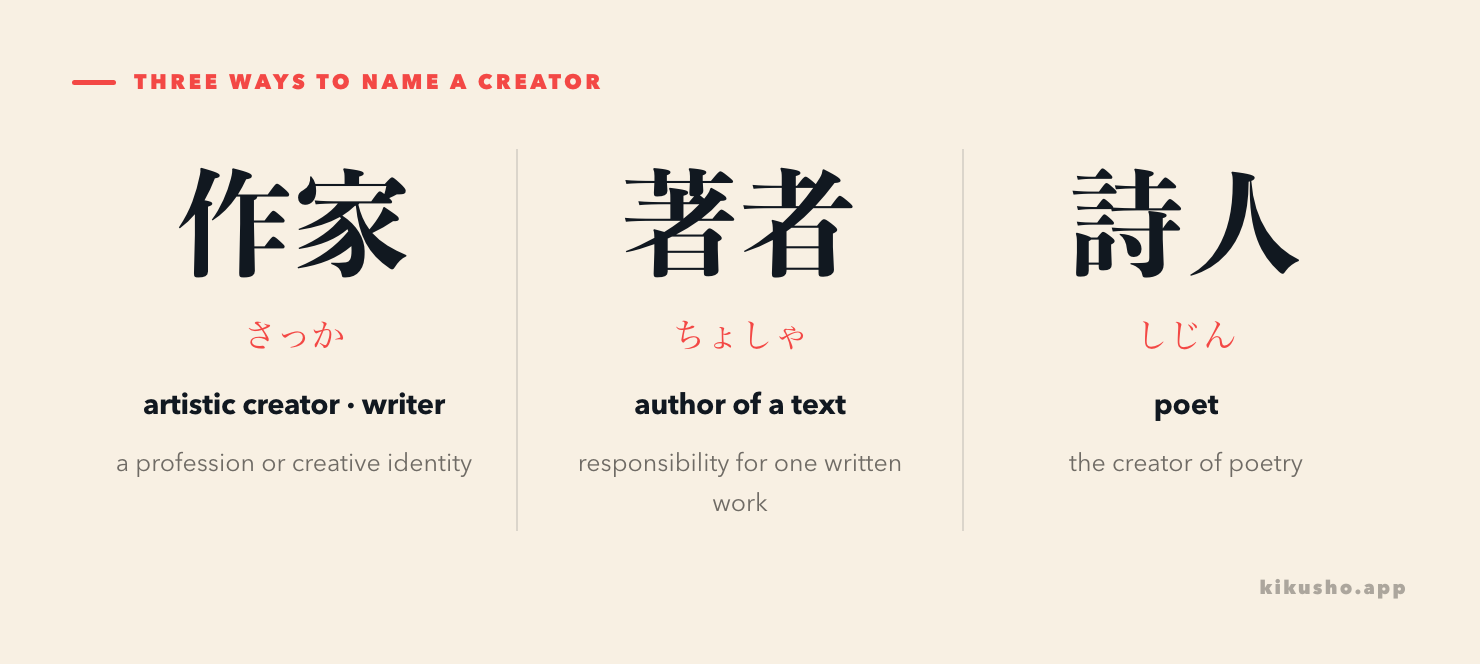
作家, 著者 and 詩人 identify creators differently
作家(さっか) is a creator of artistic works and very often a professional writer or novelist. Kotobank's 作家 entry includes creators of poetry, fiction and visual art, while noting the especially common novelist sense.
著者(ちょしゃ) identifies the person who wrote a particular book or text. On a catalogue page, 著者名 answers “who authored this publication?” A novelist can be both a 作家 and the 著者 of one named novel. The author of a technical manual is naturally its 著者, even if people would not usually introduce that person as a 作家.
詩人(しじん) is narrower: a poet. The word 詩(し) names a poem or poetry as a literary form.
この作家は若いころから詩を書いていた。
This writer had written poetry since youth.
本の最後に著者と詩人の対談が載っている。
A conversation between the author and the poet appears at the end of the book.
The National Diet Library's guide to finding foreign literary works uses 作品, 作者, 物語 and 登場人物 in authentic catalogue guidance. Its wording shows how institutions separate a work, its creator, its story and its characters.
作品 is made; 出版 makes it public
作品(さくひん) is a work created in literature, art, music, film or another creative field. It names the result, not necessarily a physical book.
これはその作家が二十代に書いた作品です。
This is a work that the writer wrote in their twenties.
出版(しゅっぱん) means publication or publishing and takes する. A company can 本を出版する, publish a book; a work can 出版される, be published. 出版社(しゅっぱんしゃ) is a publishing company, while 出版物(しゅっぱんぶつ) is a publication.
受賞した作品は来年、三か国で出版される。
The prize-winning work will be published in three countries next year.
Do not use 出版 for every kind of release. It is at home with books and other published matter. A film normally uses 公開する, release or show publicly, although a book about the film can of course be 出版される.
描く has two readings and a wide field
The inventory assigns both 描く(かく) and 描く(えがく). They are not two completely separate verbs. Both can refer to making an image, and dictionaries show overlap.
かく is common when the immediate act of drawing is central:
子どもが紙に人物の顔を描いている。
A child is drawing a character's face on paper.
えがく readily extends from drawing to representation in words, imagination and movement:
この物語は都会で暮らす家族を描いている。
This story depicts a family living in the city.
将来の姿を心に描いた。
I pictured my future self in my mind.
Kotobank records えがく for representing a form in a picture, depicting a state through writing or music, imagining something, and tracing a shape through movement. Its 描く entry in the Japanese-Portuguese dictionary also lists both readings. Treat the tendency as a memory aid, not a rigid ban on 絵をえがく or a promise that kanji alone reveals the pronunciation.
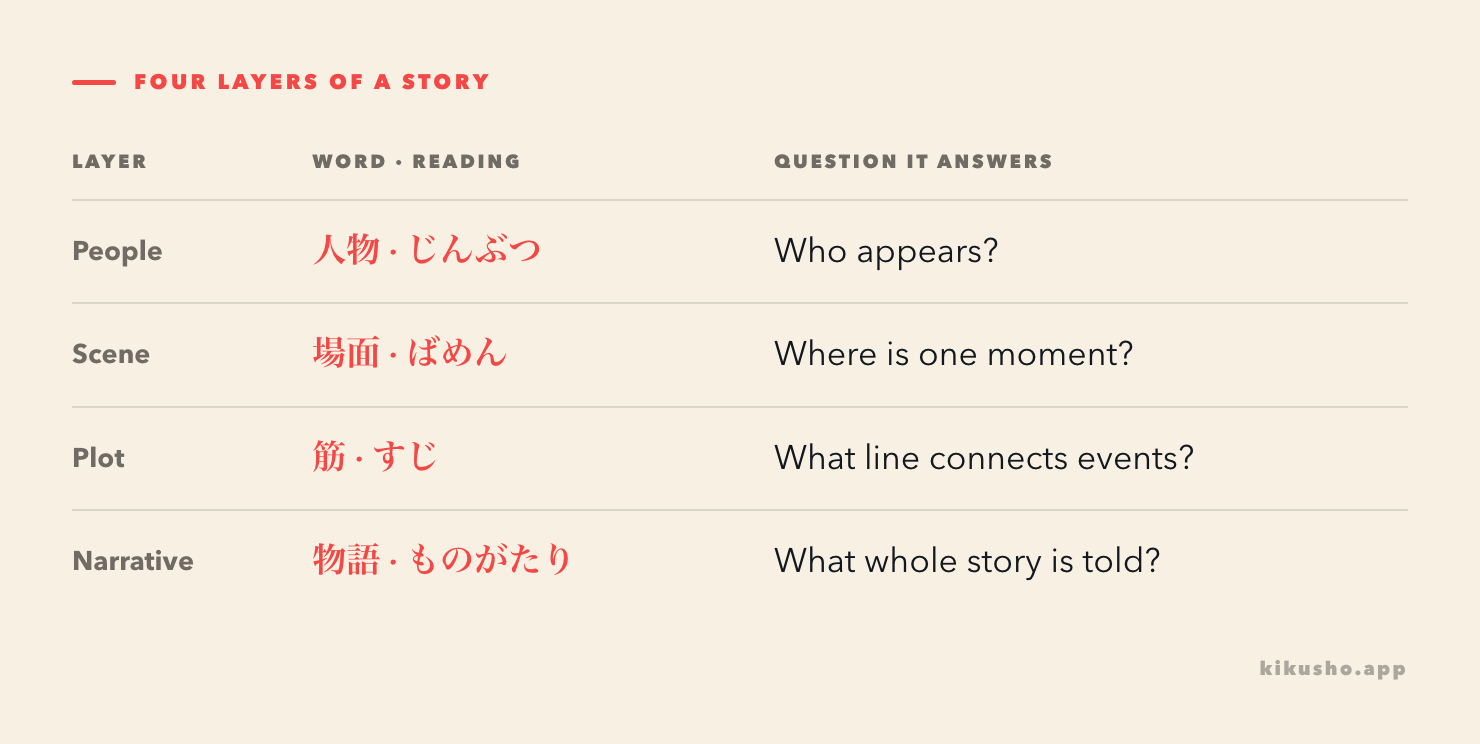
人物, 筋 and 場面 locate different layers
人物(じんぶつ) can mean a person or notable figure. In narrative language, 登場人物(とうじょうじんぶつ) is a character who appears in the work.
筋(すじ) has many concrete and abstract senses: muscle, tendon, fibre, line, logic and plot. In a book or film discussion, 話の筋 is the line of the story. Kotobank's 筋 entry specifically includes the broad content or plot of a novel or play.
場面(ばめん) is one scene or situation within the unfolding work. A story has a 筋 across time; one decisive encounter is a 場面.
登場人物が多くて、最初は話の筋が分かりにくかった。
There were many characters, so the plot was hard to follow at first.
最後に二人が再会する場面が最も印象に残った。
The scene where the two meet again at the end stayed with me most.
物語 is the whole telling
物語(ものがたり) is a story, tale or narrative. It can name the content being told or a work that tells it. 物語が進む says the story advances; 物語を語る says someone tells a story.
物語が進むにつれて、人物どうしの関係が明らかになる。
As the story progresses, the relationships among the characters become clear.
This is broader than 筋. The 筋 is the connected sequence or outline you could summarize. The 物語 includes the fuller act and world of telling: characters, scenes, tone and detail.
The earlier N4 books-and-storytelling lesson supplies 小説, 漫画 and 翻訳. The later N1 adaptation lesson adds 原作, 映像, 主人公 and 描写 for analysing what changes when a story reaches the screen.
役 and 訳 sound alike but do different work
役(やく) can mean a role, duty, position or function. In film and theatre, it is the part played by an actor.
彼女は映画で医者の役を演じた。
She played the role of a doctor in the film.
Kotobank's 役 entry records the theatrical sense as the person represented by an actor. The phrase is 役を演じる, play a role.
訳(やく) means a translation or rendering. It is distinct from 訳(わけ), the N4 noun for a reason or set of circumstances. A language name can attach directly:
- 日本語訳: Japanese translation
- 英訳: English translation
- 新しい訳: a new translation
訳す(やくす) is the verb “translate.” Mark the text with を and the target language with に:
その詩を日本語に訳してください。
Please translate that poem into Japanese.
この作品は著者自身が英語に訳した。
The author translated this work into English personally.
Kotobank's 訳す entry verifies the reading やくす, and its bilingual entry supplies the source-and-target translation use. One sentence can contain both homophones: 主人公の役を別の言語ではどう訳すか, “how to translate the protagonist's role in another language.”
One review can carry the whole set
この作品は有名な詩人が書いた物語で、昨年初めて出版された。著者は三人の登場人物を丁寧に描き、短い場面だけで話の筋を伝えている。映画では若い作家が主人公の役を演じ、英語訳も本人が監修した。
This work is a story written by a famous poet and was first published last year. The author carefully portrays three characters and conveys the plot through only a few short scenes. In the film, a young writer plays the protagonist, and that person also supervised the English translation.
The sentence keeps each noun in its own place. 作品 is the created work, 詩人 and 著者 identify the creator from different angles, 出版 describes release as a book, 人物 inhabit the story, 場面 are local units, 筋 is the connected plot, 役 is performed, and 訳 is the translated version.
Test every layer before opening the key
Question 1
How do you read 出版?
- しゅつばん
- しゅっぱん
- しゅうはん
- しゅっぽん
Question 2
Which pair is written correctly?
- 詩(し)and 詩人(しじん)
- 詞(し)and 詞人(しにん)
- 詩(うた)and 詩人(しょうじん)
- 史(し)and 史人(しじん)
Question 3
Choose the more precise word for the blank.
この研究書の__は大学教授だが、小説家ではない。
- 作家
- 著者
- 詩人
- 人物
Question 4
Match the description to the word: “one moment in a film, rather than its full plot.”
- 物語
- 筋
- 場面
- 作品
Question 5
Which sentence contains “translation,” not “role”?
- 主人公の役を演じる。
- 新しい日本語訳が出版された。
- 受付の役を任された。
- この道具は何の役にも立たない。
Question 6
Which sentence correctly means “translate the poem into English”?
- 詩が英語を訳す。
- 詩を英語に訳す。
- 英語を詩に訳す。
- 詩に英語を訳す。
Question 7
Which sentence uses 描く in the extended sense “depict,” for which えがく is the intended reading here?
- 紙に丸を描く。
- 小説が家族の対立を描く。
- 名前を漢字で書く。
- 本を棚に置く。
Question 8
Read the passage.
この作品には五人の登場人物がいる。話の筋は単純だが、別れの場面が美しい。作家は同じ物語を短い詩にもした。
Which summary is accurate?
- The work has five characters; its plot is simple, its farewell scene is beautiful, and the writer also turned the story into a short poem.
- Five poets translated a complicated film role.
- The author published five different works about drawing.
- The scene has no characters, plot or story.
Answers and explanations
1 · Publication
しゅっぱん. The small っ marks the consonant change in 出版. 本を出版する means publish a book.
2 · Poem and poet
詩(し)and 詩人(しじん). 詩 is a poem or poetry; adding 人 produces the person who writes poetry.
3 · The named author
著者. The professor is responsible for this particular research book, so 著者 is precise. 作家 would present the person as an artistic creator or professional literary writer.
4 · One scene
場面. A 場面 is one scene or situation. 筋 is the plot line, 物語 the story, and 作品 the created work.
5 · The translated version
新しい日本語訳が出版された. 訳(やく) is the translation. The other three sentences use 役(やく) for an acting role, assigned duty or useful function.
6 · Translation direction
詩を英語に訳す. The text takes を and the target language takes に. 訳す is transitive.
7 · Representation in words
小説が家族の対立を描く. Here 描く means depict through writing, and the intended reading is えがく. The circle-drawing sentence can naturally use かく; the remaining choices use different verbs.
8 · The connected review
The work has five characters; its plot is simple, its farewell scene is beautiful, and the writer also turned the story into a short poem. 作品, 登場人物, 筋, 場面, 作家, 物語 and 詩 each occupy a separate layer of the description.
Sources and level note
The 15 spelling-and-reading records come from Kikusho's pinned N3 inventory. Its two baseline snapshots descend from the same older list family, so their agreement is one placement tradition rather than independent confirmation. Dictionary checks support the language facts through Kotobank's entries for 描く, 作家, 筋, 役 and 訳す. The National Diet Library independently supplies real institutional use of 作品, 作者, 物語 and 登場人物.
Four separately published JapaneseTest4You pages match the headwords 描く, 出版, 人物 and 物語 at N3, but headword matching does not by itself verify every reading or sense. The two assigned 描く readings are therefore taught with their overlap visible. The source gloss attached to 訳(やく) conflicts across the two baseline snapshots because one appears to describe 訳(わけ); the exact やく reading is taught here only in its dictionary-verified translation sense. 訳す appears at N3 in one baseline and N2 in another, so its placement is explicitly disputed.
The official JLPT FAQ confirms that no exhaustive vocabulary list is published for the revised test. N3 is Kikusho's study placement for this set, not an exclusive boundary fixed by the exam maker.
Common questions
What is the difference between 作家 and 著者?
作家(さっか)is a creator of artistic works and especially a professional writer or novelist. 著者(ちょしゃ)identifies the author responsible for a particular written work. A novelist can be both, but an academic book has a 著者 who may not normally be called a 作家.
How are 描く(かく)and 描く(えがく)different?
Both readings can describe drawing. かく is common for the physical act of drawing a picture or line; えがく readily extends to depicting a person, describing a world in words, imagining a future or tracing a shape. The boundary overlaps, so context and supplied kana remain decisive.
What does 筋 mean in a book or film review?
筋(すじ)can mean the plot or broad line of a story. あらすじ is a synopsis, while 筋が通っている can say that an argument or story is coherent. 筋 also has unrelated senses such as muscle, tendon, fibre and line.
What is the difference between 役 and 訳 when both are read やく?
役(やく)is a role, duty or function; in film it can be an acting role. 訳(やく)is a translation or translated version. The verb 訳す(やくす) means to translate.