On this page
These nine Japanese words follow a learner from university organization to an exam result: 学年, 学部, 学力, 学科, 講師, 実習, 受験, 採点 and 点数. Learn them as three connected groups—where study happens, how learning happens, and what happens before and after an exam—so that near-neighbours such as 学力 and 点数 stay distinct.
The nine words at a glance
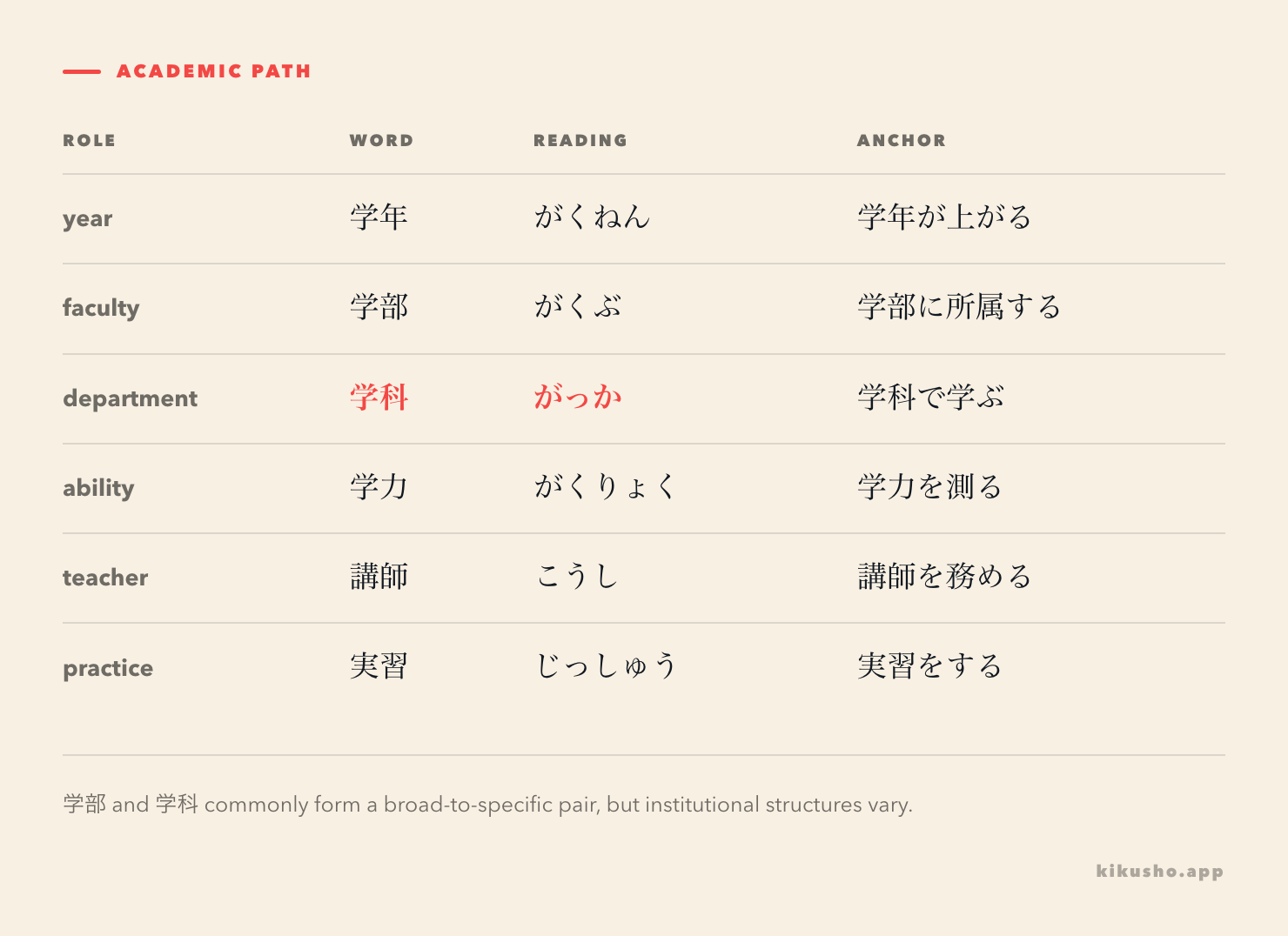
| Role | Word | Reading | Core sense | Phrase to keep |
|---|---|---|---|---|
| Position in school | 学年 | がくねん | school year; grade level | 学年が上がる, move up a year |
| University division | 学部 | がくぶ | faculty; school; undergraduate division | 文学部に所属する, belong to the faculty of letters |
| Academic ability | 学力 | がくりょく | scholastic ability; academic attainment | 学力を測る, assess academic ability |
| Academic unit | 学科 | がっか | department; course of study; subject division | 経済学科で学ぶ, study in the economics department |
| Teacher | 講師 | こうし | lecturer; instructor | 講師を務める, serve as an instructor |
| Applied learning | 実習 | じっしゅう | practical training | 病院で実習する, train at a hospital |
| Exam entry | 受験 | じゅけん | taking or sitting an examination | 大学を受験する, apply to and sit an entrance exam for a university |
| Marking process | 採点 | さいてん | marking; grading | 答案を採点する, mark answer sheets |
| Numerical result | 点数 | てんすう | points; numerical score | 高い点数を取る, get a high score |
The readings carry two useful sound changes. 学科 is がっか, with a small っ, rather than がくか. 学力 keeps the full がく in がくりょく. Treating every 学 compound as though it began identically is an easy way to learn the spelling while missing the word.
学年, 学部 and 学科 locate the learner
学年(がくねん) places a student in a year or grade of school. It can refer to the stage itself or collectively to the students in that stage.
妹は来月、中学校の二学年になります。
いもうとは らいげつ、ちゅうがっこうの にがくねんに なります。
My younger sister will enter the second year of junior high next month.
私たちは同じ学年ですが、クラスは違います。
わたしたちは おなじ がくねんですが、クラスは ちがいます。
We are in the same year, but in different classes.
同じ学年 does not mean the students share a classroom or take every course together. It puts them at the same grade level. Kotobank's dictionary entry for 学年 records both the year of study and the group of students belonging to it.
At a university, 学部(がくぶ) commonly names a broad faculty, school or undergraduate division. 学科(がっか) commonly names a more focused department, programme or subject division.
彼女は文学部に所属し、日本文学科で近代小説を研究しています。
かのじょは ぶんがくぶに しょぞくし、にほんぶんがっかで きんだいしょうせつを けんきゅうして います。
She belongs to the faculty of letters and studies modern fiction in the Japanese literature department.
The sentence shows the common large-to-small relation: 文学部 → 日本文学科. It is a useful model, but it is not a universal organization chart. Some universities use 研究科, 専攻, コース or other labels, and the English translation printed by the institution may be faculty, school, college, department or programme. The Kotobank entries for 学部 and 学科 establish the broad meanings; the university's own site tells you how its units actually nest.
学科 also appears in 学科試験, the written or knowledge-based portion of some licensing tests, in contrast with a practical component. Context therefore decides whether 学科 names an academic department or the academic part of an examination.
If you need the neighbouring words 科目 for a curriculum subject and 専攻 for a chosen field or major, continue with the N3 university study and qualifications lesson. They belong to the same setting but are separate learning items.
学力, 講師 and 実習 describe learning
学力(がくりょく) is the academic ability or knowledge a learner has built. It can be developed, maintained, measured or assessed.
このテストは、入学に必要な学力を測るためのものです。
この テストは、にゅうがくに ひつような がくりょくを はかる ための ものです。
This test is designed to assess the academic ability needed for admission.
The word is broader than one result. A learner might receive a low score on one difficult test without lacking 学力 in every relevant area. Kotobank defines 学力 through knowledge and ability acquired by learning; the Tokyo Foundation for Multicultural Society also uses it naturally in its guide to Japanese words connected with entrance exams.
講師(こうし) names the person who gives a lecture or provides instruction. At a university, it can also be a formal staff title; elsewhere it can describe a part-time teacher, course instructor or invited seminar speaker.
大学の講師が、受験生向けの説明会で話しました。
だいがくの こうしが、じゅけんせいむけの せつめいかいで はなしました。
A university lecturer spoke at an information session for prospective examinees.
Do not replace every 先生 with 講師. 先生 is a broad address and title used directly for teachers, doctors and other respected professionals. 講師 identifies an instructional role or post. Kotobank's 講師 entry covers both the person giving instruction and the institutional title.
実習(じっしゅう) is practical training in which a learner applies knowledge or techniques. It is common in teacher training, medicine, nursing, laboratories, workshops and vocational programmes.
来週から三週間、小学校で教育実習をします。
らいしゅうから さんしゅうかん、しょうがっこうで きょういくじっしゅうを します。
Starting next week, I will do three weeks of teaching practice at an elementary school.
午前は講義を受け、午後は研究室で実習しました。
ごぜんは こうぎを うけ、ごごは けんきゅうしつで じっしゅうしました。
In the morning I attended a lecture, and in the afternoon I did practical training in the laboratory.
The contrast is between explanation and application, not between serious and casual study. 講義 delivers organized instruction; 実習 puts methods into practice. Kotobank's 実習 entry makes that applied component central.
受験, 採点 and 点数 form an exam sequence
The last three words belong on a timeline.
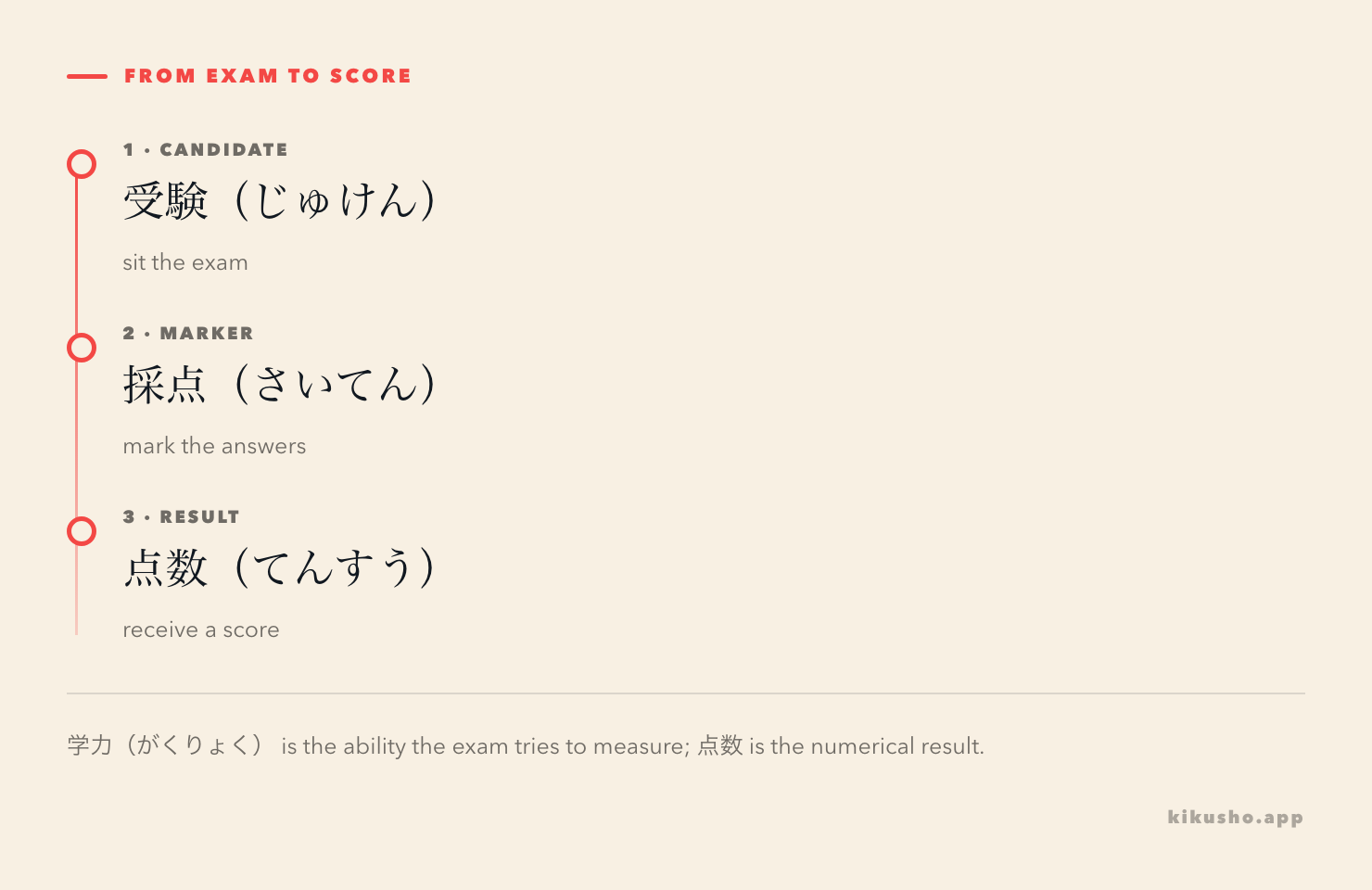
First, the candidate 受験する. Next, an examiner 採点する the responses. Finally, the candidate receives a 点数.
受験: the candidate takes the exam
受験(じゅけん) is taking or sitting an examination, especially a consequential entrance, recruitment or qualification exam. It works as a noun and with する.
姉は来年、看護師の国家試験を受験します。
あねは らいねん、かんごしの こっかしけんを じゅけんします。
My older sister will sit the national nursing examination next year.
三つの大学を受験する予定です。
みっつの だいがくを じゅけんする よていです。
I plan to apply to and sit entrance examinations for three universities.
The second pattern is idiomatic: a school can stand as the object of 受験する because its entrance examination is understood. 試験を受ける is the transparent general phrase “take a test”; 受験する packages the event as a formal exam attempt. Kotobank's 受験 entry emphasizes entrance and qualification examinations, and JASSO's official EJU subject page uses the related language of examinees, subjects and assessment in a real admissions-testing context.
採点: someone assigns marks
採点(さいてん) is the act of checking responses and assigning marks. The object is commonly an answer sheet, test, composition or response.
講師は週末に答案を採点しました。
こうしは しゅうまつに とうあんを さいてんしました。
The instructor marked the answer sheets over the weekend.
採点基準を確認してから、作文を採点します。
さいてんきじゅんを かくにんしてから、さくぶんを さいてんします。
I will check the marking criteria before grading the compositions.
採点する describes the process performed by a marker. It does not mean that a candidate sits the test, and it does not name the number that results.
点数: the result is a number
点数(てんすう) is a number of points or a numerical score.
前回より高い点数を取りました。
ぜんかいより たかい てんすうを とりました。
I got a higher score than last time.
合格に必要な点数は試験によって違います。
ごうかくに ひつような てんすうは しけんによって ちがいます。
The score needed to pass differs by exam.
Keep the collocations as complete units: 点数を取る, 点数が高い and 点数が低い. English “grade” can refer either to a numeric mark or a broader academic record; Japanese keeps 点数 narrower. For a record or evaluation across courses, 成績 is often the better word.
That distinction also separates 点数 from 学力. The test is used to 学力を測る; the answers are 採点される; the learner receives a 点数. The number may be evidence about the ability, but it is not the ability itself.
Where qualifications enter the picture
This lesson's assigned words stop at the formal examination process. A person may 資格試験を受験する, have the answers 採点される, and receive a 点数. The credential words themselves—資格 for a qualification or eligibility, 免許 for an official licence, and 合格 for passing—are taught in the N3 university and qualifications lesson.
That boundary prevents one title from turning into two competing lists. It also preserves the most useful chain:
資格試験を受験し、採点の結果、合格に必要な点数を取った。
しかくしけんを じゅけんし、さいてんの けっか、ごうかくに ひつような てんすうを とった。
I took the qualification exam and, after it was marked, earned the score needed to pass.
A note about the N2 label
Kikusho's reference inventory assigns all nine spelling-and-reading records here to N2 and records no internal placement disagreement. That is a study placement, not an official declaration that each word belongs exclusively to N2. The JLPT's official level summary describes what successful candidates can understand, while its N2 test-item guide explains task purposes; neither supplies an exhaustive official word list.
Save each word in Kikusho with the verb or particle that makes its job visible: 文学部に所属する, 学科で学ぶ, 学力を測る, 実習をする, 試験を受験する, 答案を採点する, 点数を取る. That small piece of context separates the nine roles during review.
Practice: answer all eight before opening the explanations
Question 1 · reading
How do you read 学科 in 日本文学科で学ぶ?
A. がくか B. がっか C. がくけ D. がっけ
Question 2 · spelling
Which spelling means さいてん, “marking or grading answers”?
A. 再点 B. 採典 C. 採点 D. 才点
Question 3 · word formation
Which 学 compound completes the phrase 入学に必要な__を測る, “assess the academic ability needed for admission”?
A. 学年 B. 学部 C. 学科 D. 学力
Question 4 · academic structure
A university notice says 工学部の情報工学科. Which interpretation best fits the usual relationship?
A. 工学部 is the broader faculty and 情報工学科 is a more focused department. B. 情報工学科 is a school year and 工学部 is an examination score. C. The two expressions always name identical units in every university. D. 工学部 is a lecturer and 情報工学科 is practical training.
Question 5 · paraphrase
Which sentence best preserves the meaning of 来月から病院で実習します?
A. I will grade hospital entrance tests next month. B. I will begin practical training at a hospital next month. C. I will enter a higher school year at the hospital next month. D. I will teach a hospital lecture next month.
Question 6 · exam sequence
Put the three events in their natural order: 点数が出る / 答案を採点する / 試験を受験する.
A. 点数が出る → 受験する → 採点する B. 採点する → 点数が出る → 受験する C. 受験する → 採点する → 点数が出る D. 受験する → 点数が出る → 採点する
Question 7 · ability or result
Complete both blanks: この試験で学生の( A )を測り、答案を採点して( B )を出す。
A. A 学力 / B 点数 B. A 点数 / B 学力 C. A 学科 / B 学部 D. A 講師 / B 学年
Question 8 · usage
Which sentence uses 講師 naturally?
A. 試験の講師が百点だった。 B. 来週、専門家を講師として招きます。 C. 私は大学を講師しました。 D. 答案に講師を書いてください。
Answers and explanations
Answer 1: B, がっか. The compound has a small っ: 学科(がっか). がくか incorrectly carries the separate reading of 学 into the compound without the sound change; the other two endings do not read 科 here.
Answer 2: C, 採点. 採 carries the idea of selecting or assigning and 点 is a point or mark. The distractors substitute a similar-sounding or visually related character but do not spell the assigned word.
Answer 3: D, 学力. 学力 is scholastic ability, so 学力を測る means to assess it. 学年 is a year level, 学部 a university division and 学科 a department or subject division.
Answer 4: A. In a common university organization, 学部 is the broader faculty or school and 学科 is a more focused department or programme. The exact hierarchy can vary, which is why choice C's “always” is too strong.
Answer 5: B. 実習 is practical training that applies techniques in a real or simulated setting. It does not mean grading, advancing a school year or delivering a lecture.
Answer 6: C. The candidate first 受験する, a marker then 採点する the answers, and a 点数 results. A score cannot normally result from that exam before its responses are marked.
Answer 7: A, 学力 / 点数. The exam tries to measure an underlying academic ability, 学力. Marking produces a numeric score, 点数; the two remain related but distinct.
Answer 8: B. 講師として招く means to invite someone as an instructor or speaker. The other choices wrongly treat 講師 as a score, a verb meaning to sit an exam, or something written on an answer sheet.
The whole set can now be reconstructed as a path: a learner belongs to a 学年, 学部 and 学科, builds 学力 with a 講師 and through 実習, then completes 受験, waits for 採点, and receives a 点数.
Common questions
What is the difference between 学部 and 学科?
学部(がくぶ)usually names a broad university faculty, school or undergraduate division, while 学科(がっか)usually names a more specific department or course within that structure. The exact hierarchy and English translation vary by institution, so check the university's own organization.
What is the difference between 学力 and 点数?
学力(がくりょく)is academic or scholastic ability. 点数(てんすう)is the numerical score produced by a test or assignment. A score can be evidence about ability, but the two words do not name the same thing.
What is the difference between 受験 and 試験を受ける?
Both can describe taking an exam. 受験(じゅけん)is a compact noun and する-verb used especially for formal entrance, employment and qualification exams; 試験を受ける is the transparent general phrase "take a test."
Does this lesson contain every official N2 education word?
No. The JLPT publishes broad ability descriptions rather than an exhaustive official vocabulary list. These nine records form Kikusho's assigned N2 lesson scope, and other study lists may place individual words differently.