On this page
These five Japanese words let you describe an independent study session: write a term in 仮名, work through it during 自習, draw or measure with a 定規, study at 大学院, and consult a 百科事典 when a normal dictionary is not enough. The crucial details are the readings and the words that naturally accompany each noun.
This is the N2 continuation of the N3 school-and-study lesson, which covers 学習, 暗記 and 記憶. Here the focus moves from the general process of learning to independent work, advanced education and reference tools.
Five words for one research session
The group is broader than a list of stationery. It covers five layers of a study task: the writing system, the mode of work, a physical tool, the institution and a reference source.
| Role | Word | Reading | Practical meaning | Phrase to keep |
|---|---|---|---|---|
| Writing | 仮名 | かな | kana; hiragana and katakana | 仮名で書く, write in kana |
| Study mode | 自習 | じしゅう | self-study; noun / する-verb | 図書館で自習する, study independently at the library |
| Tool | 定規 | じょうぎ | ruler, straightedge | 定規で線を引く, draw a line with a ruler |
| Institution | 大学院 | だいがくいん | graduate school | 大学院に進む, continue to graduate school |
| Reference | 百科事典 | ひゃっかじてん | encyclopedia | 百科事典で調べる, look something up in an encyclopedia |
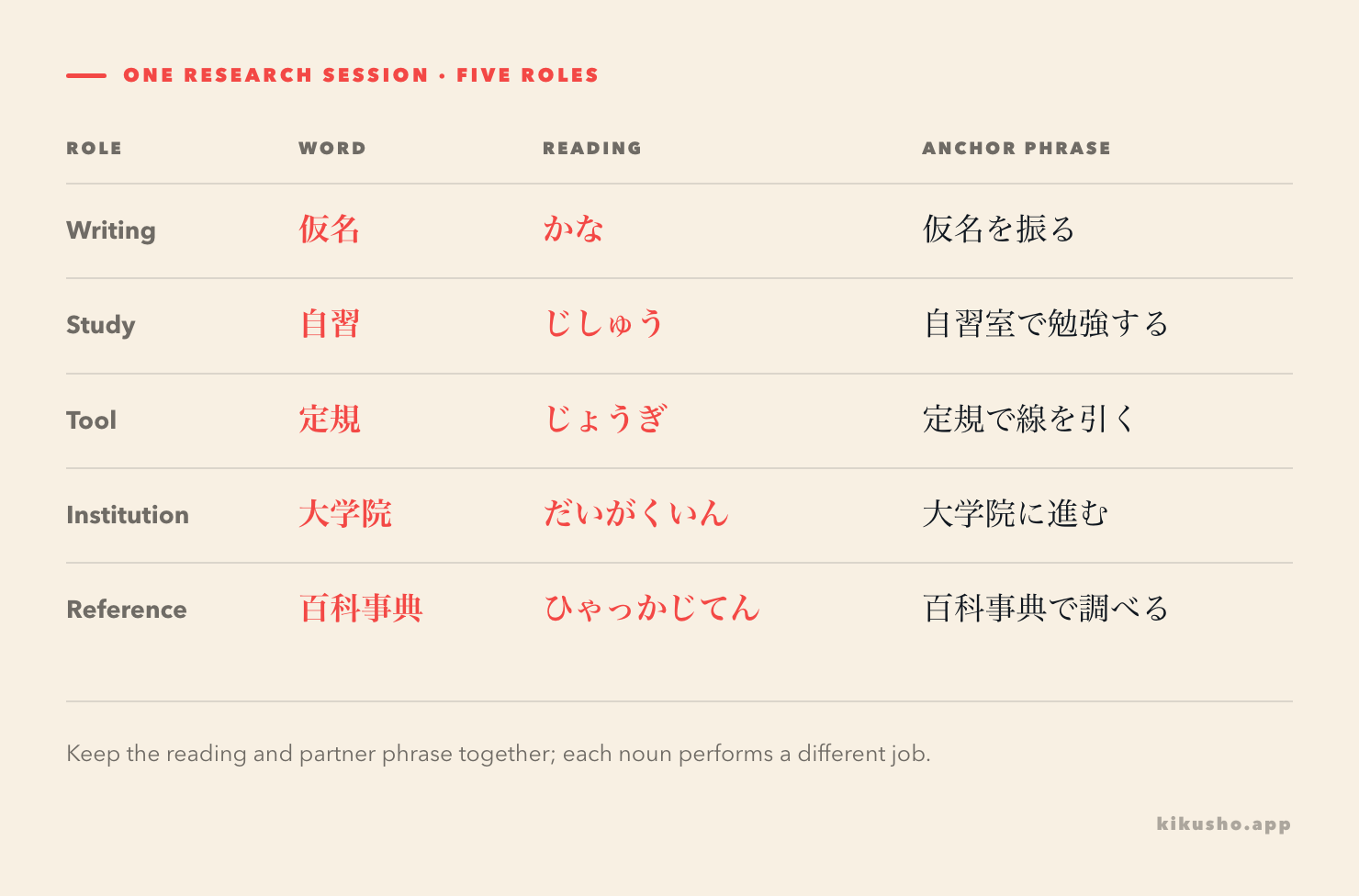
The particles in the last column do useful work. で marks either the form in 仮名で, the place in 図書館で, or the instrument in 定規で and 百科事典で. に in 大学院に進む marks the destination of that progression.
仮名 needs its reading before it has a meaning
Read 仮名 as かな when it means kana, the collective name for hiragana and katakana. It appears in instructions about scripts and readings:
読み方がわからなければ、仮名で書いてください。
よみかたが わからなければ、かなで かいてください。
If you do not know the reading, please write it in kana.
難しい漢字に仮名を振りました。
むずかしい かんじに かなを ふりました。
I added kana readings to the difficult kanji.
The spelling has another word hidden inside it: 仮名(かめい), an assumed name or alias. Kanjipedia separates 仮名(かな) from the かめい reading, and Kotobank's entry records the historical senses and readings. A source gloss that pairs かな with “alias” has crossed those two records. For this lesson, the assigned item is かな = kana.
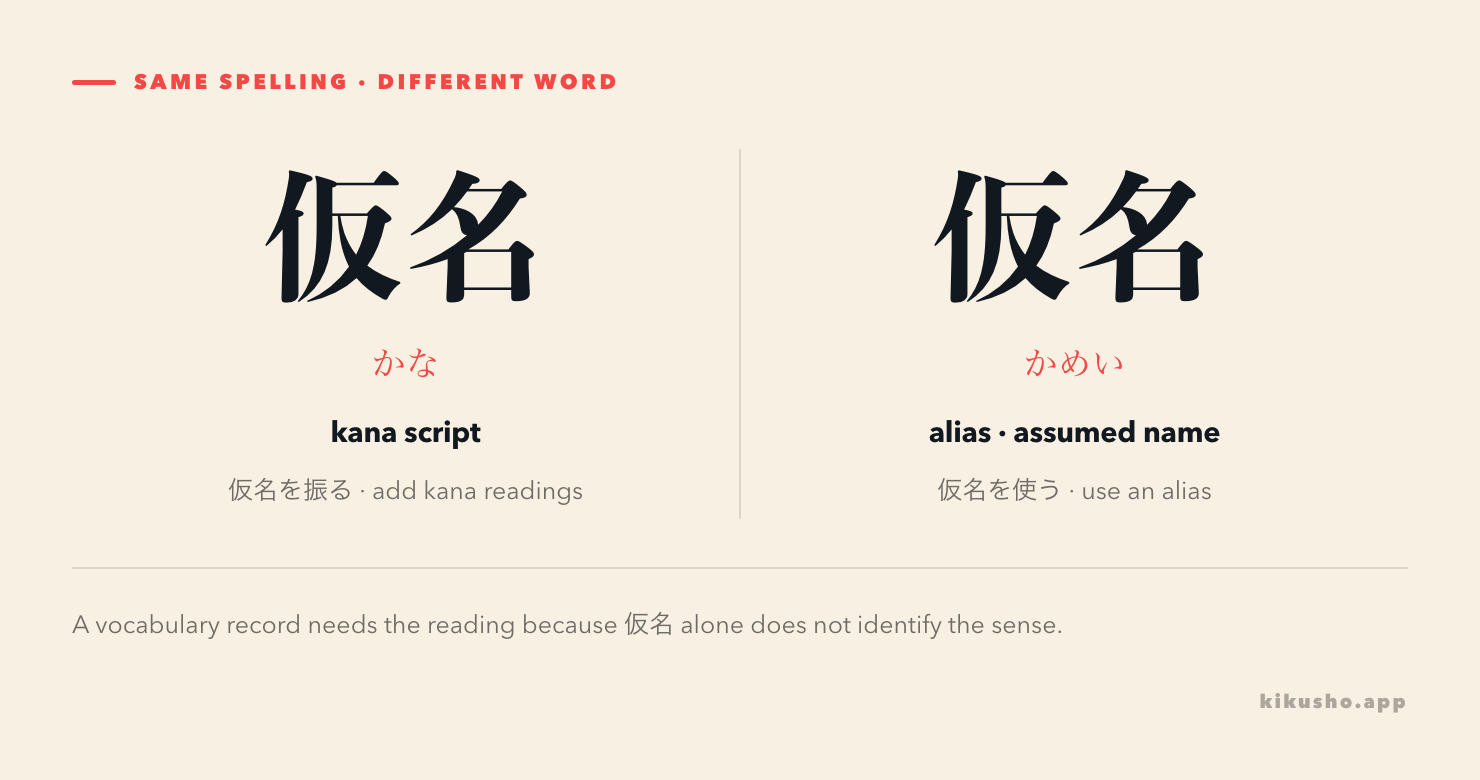
This is why a vocabulary card needs both spelling and reading. If it stores only 仮名, it has not yet told you which word to recall.
自習 is a session you direct yourself
自習 is study or practice done by yourself rather than through a teacher's immediate explanation. It works as a noun and with する:
授業が始まるまで、自習室で復習します。
じゅぎょうが はじまるまで、じしゅうしつで ふくしゅうします。
I will review in the self-study room until class starts.
午後の授業は自習になりました。
ごごの じゅぎょうは じしゅうに なりました。
The afternoon class became a self-study period.
Kotobank defines 自習 as studying or practising without receiving direct instruction from a teacher. Common compounds make the bounded-session sense visible: 自習時間 is a self-study period and 自習室 is a room intended for individual study.
独学(どくがく) overlaps, but it often describes the larger way someone learned a field without formal teaching: プログラミングを独学で学んだ, “I learned programming on my own.” A university student can attend lectures and still 図書館で自習する that evening. That person is not necessarily an entirely self-taught learner.
大学院 is graduate school, not an undergraduate faculty
大学院 is the graduate division or graduate school entered after an undergraduate degree. The person studying there is a 大学院生(だいがくいんせい).
| Pattern | Meaning |
|---|---|
| 大学院に進む / 進学する | go on to graduate school |
| 大学院に入る | enter graduate school |
| 大学院で研究する | conduct research in graduate school |
| 大学院を修了する | complete a graduate programme |
大学を卒業した後、大学院に進んで言語学を研究しました。
だいがくを そつぎょうした あと、だいがくいんに すすんで げんごがくを けんきゅうしました。
After graduating from university, I went on to graduate school and researched linguistics.
Kotobank defines 大学院 as the institution established at a university for advanced academic study and research. Its level label is less stable than its meaning: Bunpro places 大学院 in N4, while Kikusho's assigned inventory puts this record in the N2 set. That is a disagreement between study lists, not a difference in how the word is used.
定規 is the instrument in a で phrase
定規 is a ruler or straightedge used to draw lines, check an angle or measure length. The reading is じょうぎ, with a long じょう.
定規で表の下に線を引いてください。
じょうぎで ひょうの したに せんを ひいてください。
Please draw a line below the table with a ruler.
この定規で紙の幅を測りました。
この じょうぎで かみの はばを はかりました。
I measured the width of the paper with this ruler.
The ruler is the instrument, so it takes で. The line is the object of 引く, while length takes 測る. Kotobank's 定規 entry also records specialised forms such as 三角定規, a set square, and tools for checking straightness and angles.
Do not let the English word rule pull you toward 規則(きそく), a regulation. In a stationery or drawing context, the physical ruler is 定規.
百科事典 explains subjects rather than just words
百科事典 is an encyclopedia: a reference work with articles covering knowledge across many fields. Its reading is ひゃっかじてん.
その人物について百科事典で調べました。
その じんぶつについて ひゃっかじてんで しらべました。
I looked up that person in an encyclopedia.
百科事典の項目には、発見の歴史も書かれています。
ひゃっかじてんの こうもくには、はっけんの れきしも かかれています。
The encyclopedia entry also describes the history of the discovery.
A 辞書 or 辞典 primarily helps when the question is about a word: its reading, meaning or usage. A 百科事典 helps when the question is about a subject, person, place, event or concept. The National Diet Library's reference guidance similarly directs readers to dictionaries for unknown words and readings, and to encyclopedias for matters and events.
Kotobank's 百科事典 entry uses 事典, whose first character points toward matters or subjects. 百科辞典 is nevertheless a documented variant, so the difference is a useful tendency rather than a spelling police rule. This lesson teaches 百科事典 because that is the assigned written form.
The inventory's two related source snapshots also disagree about its test level: one places 百科事典 at N2 and the other at N1. They derive from the same source family, so the repetition is not independent proof. As with 大学院, learn the word and treat the level as a study estimate.
Put the five words into one workflow
大学院の自習室で資料を読んでいます。知らない漢字には仮名を振り、図を写す時は定規を使います。用語の意味は辞書で確認し、その背景は百科事典で調べます。
だいがくいんの じしゅうしつで しりょうを よんでいます。しらない かんじには かなを ふり、ずを うつす ときは じょうぎを つかいます。ようごの いみは じしょで かくにんし、その はいけいは ひゃっかじてんで しらべます。
I am reading material in a graduate-school study room. I add kana to unfamiliar kanji and use a ruler when copying diagrams. I check term meanings in a dictionary and research their background in an encyclopedia.
The paragraph assigns each noun a different job. 仮名 records a reading, 自習室 names the setting, 定規 is a physical instrument, and 大学院 and 百科事典 supply the institutional and research context.
When you capture one of these words in Kikusho, keep the phrase that fixes its role: 仮名を振る, 自習室で勉強する, 定規で線を引く, 大学院に進む, or 百科事典で調べる. A reading plus a short collocation prevents the English translations from collapsing into one vague “study” theme.
Practice: answer every question before opening the explanations
Question 1
In 漢字の上に仮名を振る, which reading and meaning fit 仮名?
- A. かめい, alias
- B. かな, kana
- C. かりな, temporary name
- D. けみょう, posthumous name
Question 2
Which written form is the assigned word ひゃっかじてん, “encyclopedia”?
- A. 百科時点
- B. 百貨事典
- C. 百科事典
- D. 百化事典
Question 3
The teacher is away, and the students quietly work through exercises by themselves during that class period. What is the most precise word for the period?
- A. 自習
- B. 大学院
- C. 仮名
- D. 定規
Question 4
Which paraphrase preserves the meaning of 来年、大学院に進む予定です?
- A. I plan to leave university study next year.
- B. I plan to look up a university next year.
- C. I plan to go on to graduate school next year.
- D. I plan to teach myself every subject next year.
Question 5
Complete the sentence naturally: グラフを書くために、定規( )まっすぐな線を引いた。
- A. が
- B. に
- C. を
- D. で
Question 6
You know how to read a term but want a short article about the person, event or concept behind it. Which action best fits?
- A. 百科事典で調べる
- B. 定規に進む
- C. 仮名で測る
- D. 大学院を振る
Question 7
Which statement correctly distinguishes the two words written 仮名?
- A. かな means an alias, while かめい means hiragana and katakana.
- B. かな and かめい are interchangeable readings with the same meaning.
- C. かな means kana script, while かめい can mean an assumed name.
- D. Only かめい is a modern reading.
Answers and explanations
Answer 1
B. かな, kana. The phrase 仮名を振る means adding kana readings to kanji. The alias sense belongs to the separate reading かめい.
Answer 2
C. 百科事典. 百科 supplies “many fields of knowledge,” and 事典 is the assigned spelling for a reference work organised around subjects. 百科辞典 also exists, but none of the other options here is that documented variant.
Answer 3
A. 自習. A self-directed period inside an existing class routine is a central use of 自習. The students need not be 独学 learners who study the whole subject without instruction.
Answer 4
C. I plan to go on to graduate school next year. 大学院 is graduate school, and に進む expresses progression to the next institution or stage.
Answer 5
D. で. 定規 is the instrument used to draw the line, so it takes the instrumental particle で: 定規で線を引く.
Answer 6
A. 百科事典で調べる. An encyclopedia explains the subject behind a term. The other choices combine a real noun with an action that does not fit its role.
Answer 7
C. かな means kana script, while かめい can mean an assumed name. The written form alone is insufficient; the reading selects the intended lexical item and sense.
Common questions
What does 仮名 mean when it is read かな?
仮名(かな)means kana, the Japanese syllabic scripts hiragana and katakana. The same spelling can mean an alias or assumed name when read かめい. The reading is therefore part of the word, not an optional pronunciation.
What is the difference between 自習 and 独学?
自習(じしゅう)is a self-directed study session and is common inside an existing school or course routine, as in 自習時間 and 自習室. 独学(どくがく) more strongly suggests learning a subject without a teacher or formal instruction. The boundary depends on context rather than a rigid rule.
What is the difference between a 辞書 and a 百科事典?
A 辞書 or 辞典 primarily explains words, readings and usage. A 百科事典(ひゃっかじてん)explains subjects, people, places, events and concepts. 百科辞典 is also a documented spelling, so it should not be treated as an error, although this lesson's assigned form is 百科事典.
Are all five words officially assigned to JLPT N2?
No exhaustive official JLPT vocabulary list exists. Kikusho's assigned inventory places these records in the N2 lesson, but one source snapshot places 百科事典 at N1 and Bunpro places 大学院 at N4. Use N2 as the scope of this lesson rather than as a claim that every word is exclusive to N2.