On this page
These fourteen Japanese words let you follow an academic path from choosing a 科目 and 専攻 to checking 成績, applying for an 奨学金, passing an examination and gaining a 資格 or 免許. The useful distinctions sit between the English glosses: a subject is not a major, a qualification is not always a licence, and the two readings of 博士 do different work.
The earlier school and work vocabulary lesson teaches the prerequisite phrase 試験を受ける, “to take an exam”. This lesson begins with the university record around that exam and the result that follows it.
The fourteen words
The nouns below appear with the verb or particle that most often reveals their role. 試す is the one verb in the set. 留学 can become 留学する, and 合格 commonly becomes 合格する.
| Word | Reading | Part of speech | Core sense | Anchor phrase |
|---|---|---|---|---|
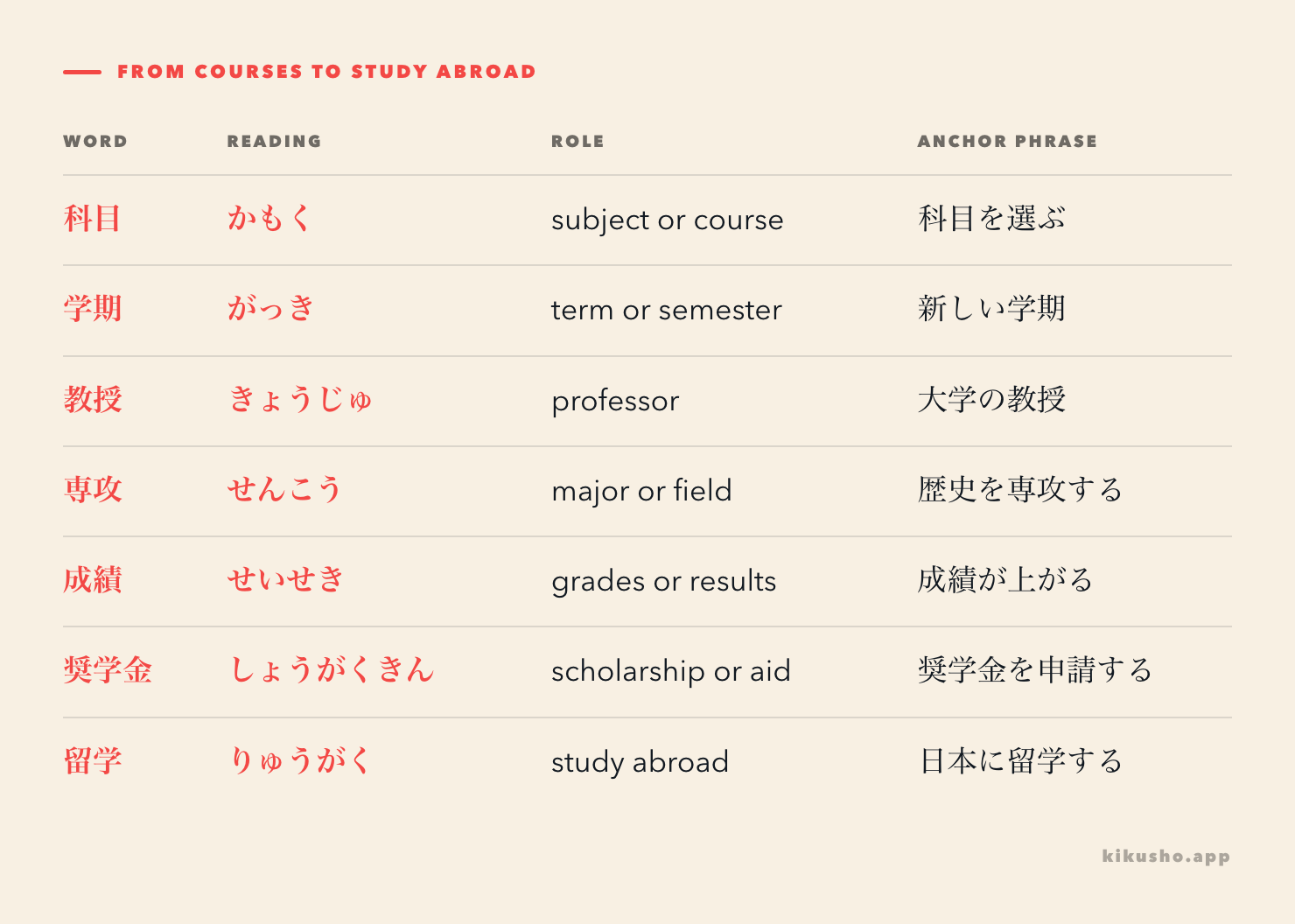
| 科目 | かもく | noun | subject; course | 科目を選ぶ |
| 学期 | がっき | noun | school term; semester | 新しい学期 |
| 教授 | きょうじゅ | noun | professor; formal instruction | 大学の教授 |
| 専攻 | せんこう | noun; する-verb | major; special field of study | 歴史を専攻する |
| 成績 | せいせき | noun | results; grades; performance record | 成績が上がる |
| 奨学金 | しょうがくきん | noun | scholarship; student aid | 奨学金を申請する |
| 留学 | りゅうがく | noun; する-verb | study abroad | 日本に留学する |
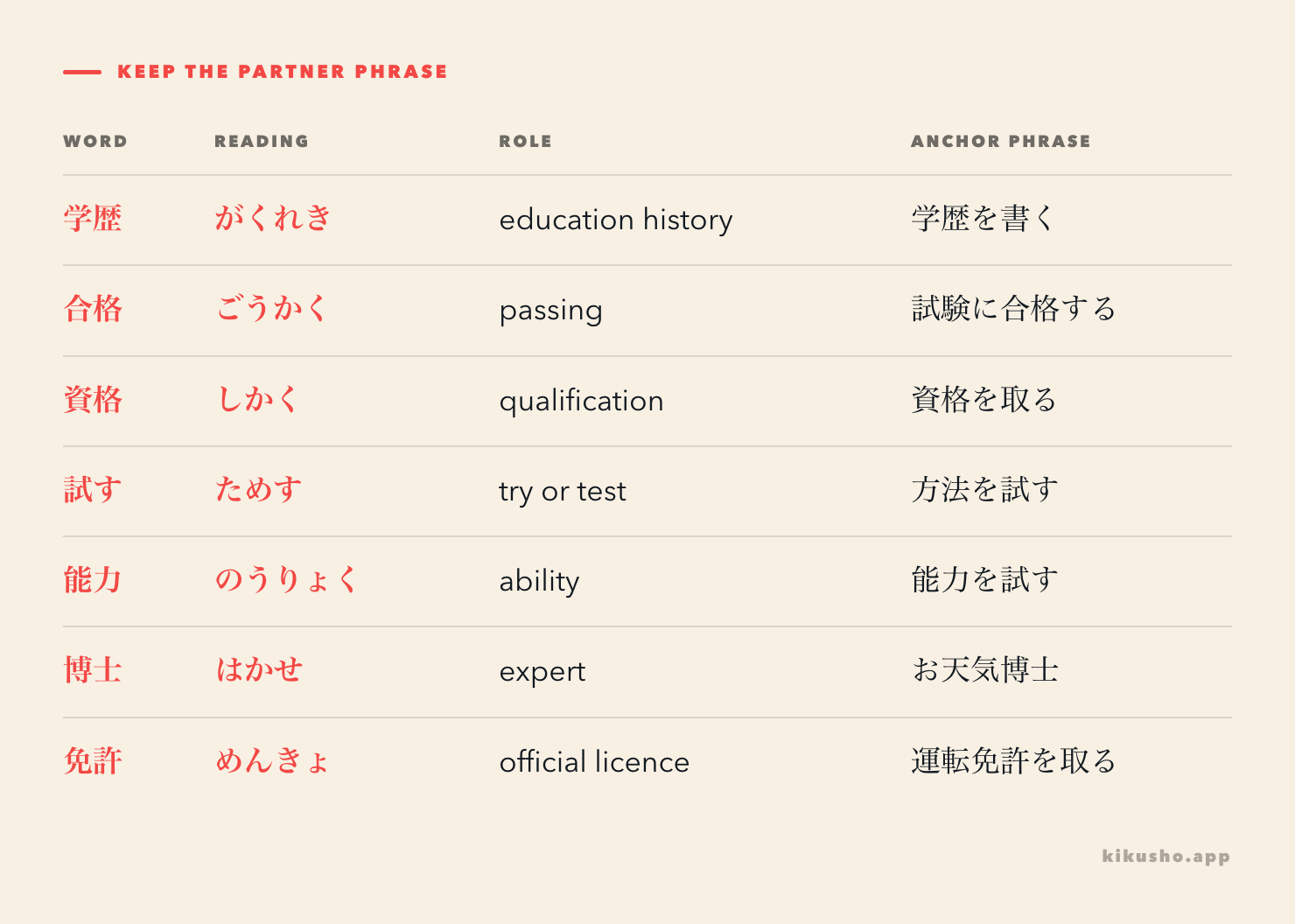
| 学歴 | がくれき | noun | educational background | 学歴を書く |
| 合格 | ごうかく | noun; する-verb | passing; success in selection | 試験に合格する |
| 資格 | しかく | noun | qualification; eligibility | 資格を取る |
| 試す | ためす | transitive godan verb | to try; to test | 新しい方法を試す |
| 能力 | のうりょく | noun | ability; capacity | 能力を試す |
| 博士 | はかせ | noun; suffix | learned person; expert | お天気博士 |
| 免許 | めんきょ | noun | licence; official permission | 運転免許を取る |
The assigned rows are specific spelling-reading pairs. That matters most for 博士(はかせ): the degree reading はくし is a necessary contrast, but it is not a second assigned inventory item.
科目 is one subject; 専攻 is the field you choose
A 科目 is one unit in a curriculum. A timetable may contain 日本史, 経済学 and 英語 as separate 科目. A 専攻 is the student's chosen field or major, wide enough to contain several courses.
私の専攻は経済学ですが、今学期は日本史の科目も取っています。 わたしの せんこうは けいざいがくですが、こんがっきは にほんしの かもくも とっています。 My major is economics, but this term I am also taking a Japanese history course.
The N1 graduate-study lesson also separates 科目 from 教科. 科目 points to an item in a course list, examination or curriculum. 教科 often means a school subject as an organised teaching area. The present N3 set needs 科目, not both words.
学期 names the term in which those courses run. Japanese institutions may speak of 前期 and 後期, or use terms such as 春学期. The word itself does not tell you how many terms the institution has.
教授 commonly means a professor, a university rank and title. It does not replace 先生 for every teacher. The same spelling can also refer formally to instruction, but the person sense is the one learners will meet most often in phrases such as 田中教授 and 大学の教授.
成績 is performance; 学歴 is personal history
成績 records how well someone performed. In education it covers grades and academic results, but it also appears in business and sport. 成績がいい, 成績が上がる and 成績をつける all keep attention on performance.
学歴 answers a different question: which schools or levels of education form someone's background. A form may ask for 最終学歴, the highest or most recent completed educational stage. One bad grade changes your 成績; it does not rewrite where you studied.
応募書類に学歴を書き、大学の成績証明書も付けました。 おうぼしょるいに がくれきを かき、だいがくの せいせきしょうめいしょも つけました。 I wrote my educational background on the application and attached my university transcript too.
An 奨学金 provides financial support for study. The English word “scholarship” can suggest money that never has to be repaid, but Japanese programmes differ. Check whether a particular scheme says 給付, a grant, or 貸与, a loan. JASSO's scholarship information uses the word in real applications alongside academic performance, enrolment and international study.
留学する means to study abroad. The destination normally takes に or へ: 日本に留学する. A person doing it is a 留学生. Travel by itself is not 留学; study in another country is the defining purpose.
合格 is the result; 試す is an act of testing
To take an examination, say 試験を受ける. To pass it, say 試験に合格する. The particle changes because 試験 is the thing you take with 受ける, but the standard or selection you pass with 合格する.
姉は去年、教員採用試験に合格しました。 あねは きょねん、きょういんさいようしけんに ごうかくしました。 My older sister passed the teacher recruitment examination last year.
試す does not mean “to sit an exam”. It means to try something and see what happens, or to test a quality. You can say 新しい勉強法を試す, try a new study method, and 自分の能力を試す, test your own ability. 能力 is the capacity to do something, not a score or certificate proving it.
資格 and 免許 overlap, but permission is the clue
A 資格 can be a qualification, recognised credential or eligibility to do or receive something. 受験資格 means eligibility to take an examination. 資格を取る means to obtain a qualification.
A 免許 is permission granted by an authority, often for a regulated activity. The familiar example is 運転免許, a driving licence. 教員免許 authorises teaching under the relevant system. A licence can count as a qualification in a broad conversation, but Japanese chooses 免許 when official permission is the point.
This produces a practical test. If the sentence asks “Does this person meet the requirements or hold the credential?”, 資格 is likely. If it asks “Has an authority permitted this person to perform the activity?”, 免許 is more precise. Bunpro independently describes 資格 as qualification or eligibility and 免許 as a licence or official permit.
博士 changes reading with the role
The assigned word is 博士(はかせ), a learned person or expert. It can be a friendly title for someone who knows a subject extremely well:
森さんは鳥のことなら何でも知っているので、みんなに「鳥博士」と呼ばれています。 もりさんは とりの ことなら なんでも しっているので、みんなに「とりはかせ」と よばれています。 Mori knows everything about birds, so everyone calls him “the bird expert”.
For the formal academic degree, read the same spelling はくし: 博士号(はくしごう), a doctoral degree, and 博士課程(はくしかてい), a doctoral programme. Kotobank's dictionary entry records both readings and makes the degree sense explicit under はくし. Kanjipedia independently defines はかせ as someone deeply knowledgeable in a field while pointing to the はくし reading for the degree-related sense.
This is why saving the whole expression matters. A card for お天気博士 keeps はかせ. A card for 博士課程 keeps はくし. The surrounding word settles both sound and meaning, just as it does elsewhere in kanji with several readings.
The level label is a study placement
Kikusho's reference inventory places these fourteen spelling-reading records in this N3 lesson. The underlying lists are related and do not count as independent confirmation. External resources also disagree: Bunpro labels 学歴 N1, 資格 N3 and 免許 N4. The inventory itself records N3/N1 disagreement for 学歴 and 資格.
The official JLPT level summary describes the skills tested at N3 but does not publish an exhaustive word list. N3 here therefore means “learned in this N3 sequence”. It does not claim that every provider assigns each word to the same level, or that the words appear only at N3.
Practice all fourteen words
Question 1 · reading
An application guide prints 奨学金. How is it read?
- A. しょうがっきん
- B. しょうがくきん
- C. しょがくきん
- D. しょうがくかね
Question 2 · spelling
Select the spelling for がっき, “school term”.
- A. 学記
- B. 学機
- C. 学期
- D. 学季
Question 3 · two scales
Choose the pair that fits: 私の( )は建築ですが、今学期は写真の( )も取っています。
- A. 専攻 / 科目
- B. 科目 / 専攻
- C. 教授 / 学歴
- D. 成績 / 能力
Question 4 · exam result
One sentence naturally means “I passed the examination”. Select it.
- A. 試験を合格しました。
- B. 試験で合格を受けました。
- C. 試験に合格しました。
- D. 試験へ能力しました。
Question 5 · official permission
You need official permission to drive a car. Which word completes 車を運転するために( )を取りました?
- A. 学歴
- B. 免許
- C. 成績
- D. 科目
Question 6 · two readings
Which reading and meaning pair is accurate?
- A. 博士(はかせ): the formal name of a doctoral programme only
- B. 博士(ばくし): a university professor
- C. 博士(はくせ): a school subject
- D. 博士(はかせ): a learned person or expert
Question 7 · education record
Which phrase is closest in meaning to 学歴?
- A. the schools and levels of education in a person's background
- B. a student's score on one examination
- C. permission to perform a regulated activity
- D. the ability someone wants to test
Question 8 · study-abroad passage
Read the passage: 来年、日本に留学する予定です。大学では環境科学を専攻したいです。奨学金を申請するため、今学期は特に成績を上げる必要があります。 What does the student say?
- A. The student already obtained a driving licence in Japan.
- B. The professor changed the student's academic background.
- C. The student plans to study environmental science in Japan and needs better grades for a scholarship application.
- D. The student passed a doctoral examination and became an expert.
Answers and explanations
Answer 1
B. しょうがくきん. 奨学金 is read しょうがくきん. A incorrectly inserts a small っ, C shortens しょう, and D replaces the final Sino-Japanese element 金(きん)with its native reading かね.
Answer 2
C. 学期. 学期 means an academic term or semester. The other choices replace 期 with a same-sound or related-looking character but do not write the assigned word.
Answer 3
A. 専攻 / 科目. Architecture is the student's chosen major, so it is the 専攻. Photography is one course taken during the term, so it is a 科目. Reversing them loses the difference in scale.
Answer 4
C. 試験に合格しました. The standard pattern is Xに合格する. With 受ける, the same exam would take を: 試験を受ける. The other choices either use the wrong particle or combine words that cannot express passing.
Answer 5
B. 免許. Driving requires official permission, so 運転免許 is the precise word. 資格 can name qualifications broadly, but it is not one of the offered choices and does not replace 運転免許 in this fixed phrase. The other nouns describe background, results and courses.
Answer 6
D. 博士(はかせ): a learned person or expert. This is the assigned spelling-reading pair and fits compounds such as 鳥博士. The formal doctoral degree is 博士 read はくし, especially in 博士号 and 博士課程. The other readings are incorrect.
Answer 7
A. the schools and levels of education in a person's background. 学歴 is educational background. A score or performance record is 成績, official permission is 免許, and capacity is 能力.
Answer 8
C. The student plans to study environmental science in Japan and needs better grades for a scholarship application. 留学 supplies the plan to study abroad, 専攻 the intended field, 奨学金 the financial support and 成績 the results that need to improve. The other summaries introduce events absent from the passage.
Common questions
What is the difference between 科目 and 専攻?
科目(かもく)is one subject or course in a curriculum, such as economics or Japanese history. 専攻(せんこう)is the field a student chooses as a major or special area of study. A student can take several 科目 within one 専攻.
What is the difference between 資格 and 免許?
資格(しかく)is a qualification, eligibility or recognised credential. 免許(めんきょ)is official permission or a licence to perform a regulated activity, such as driving. Some occupations involve both ideas, but the words are not interchangeable in every phrase.
Is 博士 read はかせ or はくし?
Both readings exist. 博士(はかせ)means a learned person or an expert, as in お天気博士. The formal name of the doctoral degree is 博士(はくし), as in 博士号(はくしごう)and 博士課程(はくしかてい).
Are all fourteen words officially assigned to JLPT N3?
The JLPT publishes no exhaustive official vocabulary list. Kikusho's reference inventory places these spelling-reading records in this N3 lesson, while other lists place 学歴 and 資格 differently and Bunpro places 免許 at N4. Treat N3 as this lesson's study scope, not an exclusive boundary.