On this page
When a project runs into trouble, 補う fills what is missing, 追加 adds a new item, 整備 puts a system or resource into usable order, and 整う says the required state is ready. The homophones 解放 and 開放, both read かいほう, then separate freedom from a burden from access to an open place.
Six words move from a shortage to a usable result
| Headword | Grammar | Core decision | Anchor phrase |
|---|---|---|---|
| 補う(おぎなう) | Transitive godan verb | Fill a shortage, gap, weakness or loss | 人手不足を補う |
| 追加(ついか) | Noun / する verb | Add something afterward to what already exists | 項目を追加する |
| 整備(せいび) | Noun / する verb | Prepare, maintain or organize something so it can function | 設備を整備する |
| 整う(ととのう) | Intransitive godan verb | Become ready, orderly, complete or settled | 準備が整う |
| 解放(かいほう) | Noun / する verb | Release from restraint, pressure or a burden | 緊張から解放される |
| 開放(かいほう) | Noun / する verb | Open a place or resource and allow access | 施設を一般に開放する |
The particles already reveal part of the contrast. A manager 不足を補う, fills a shortage, and 設備を整備する, prepares equipment. After that work, 準備が整う, the preparation is ready. With the homophones, 束縛から解放される removes a restraint, while 施設を住民に開放する gives residents access to a place.
補う fills a defined gap; 追加 puts something more onto the set
補う(おぎなう) starts with insufficiency. Shogakukan's dictionary entry gives two related uses: filling what is lacking and making up for a loss or fault. The missing part may be concrete, such as staff or money, or abstract, such as experience, information or a weakness.
経験のある職員を配置して、人手不足を補った。
けいけんの ある しょくいんを はいちして、ひとでぶそくを おぎなった。
We assigned an experienced employee to make up for the staff shortage.
Useful patterns include 不足を補う, 欠点を補う, 損失を補う, 説明を補う, and 互いの弱点を補う. The object names the gap. A phrase with Nで補う can also name the resource used to fill it: 不足分を予備費で補う, cover the shortfall with reserve funds. Bunpro's 補う entry independently describes adding something to compensate for a deficiency and places the word at N2.
追加(ついか) describes a different relation in time: something is attached afterward to an existing set. The dictionary entry defines it as adding something later to what is already there. Common forms are 項目を追加する, 注文を追加する, 追加の説明, 追加料金, and 追加募集.
申込書に緊急連絡先の欄を追加した。
もうしこみしょに きんきゅうれんらくさきの らんを ついかした。
We added an emergency-contact field to the application form.
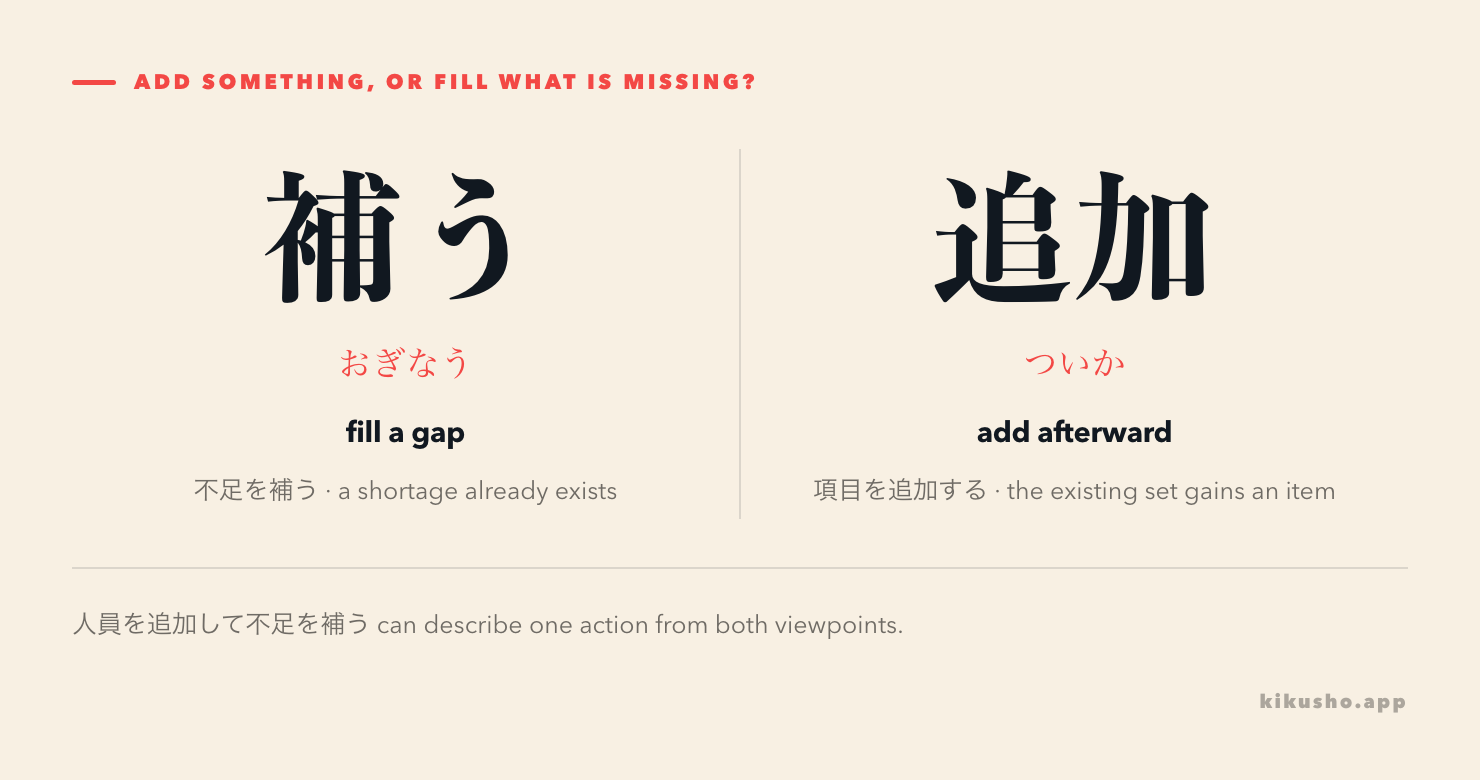
One action can be described from both angles without making the words interchangeable. If a team is short one person, it may 人員を追加して不足を補う, add a staff member and thereby fill the shortage. 追加 reports the new member entering the set; 補う reports the shortage being resolved.
The N2 effort and achievement lesson uses 追加 beside 拡張: adding one new feature is not automatically the same as extending a whole system's capacity. Here the contrast is narrower. Ask whether the sentence points to the added item or to the missing amount it covers.
整備 is work on a system; 整う is the resulting state
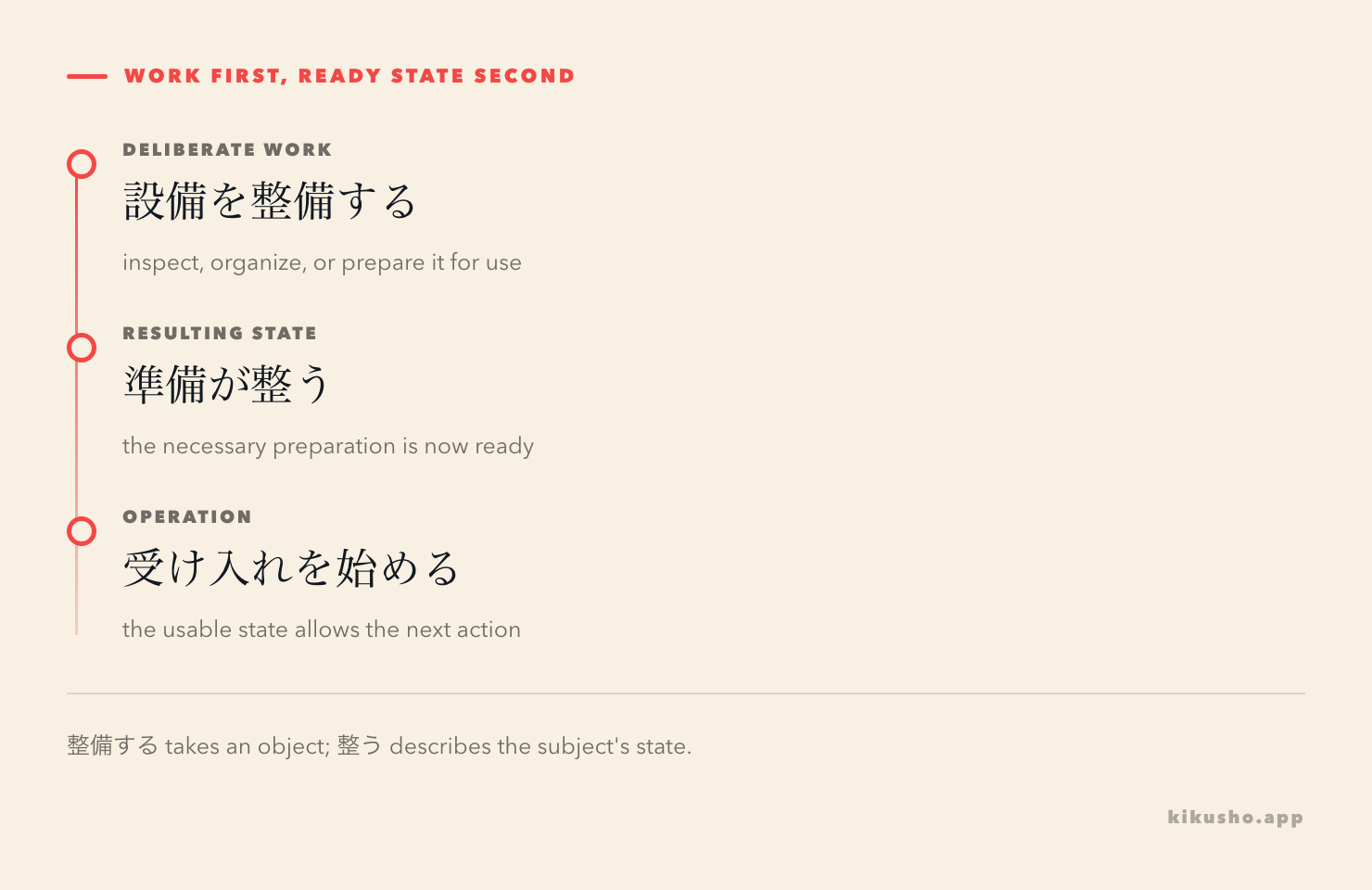
整備(せいび) is a noun and する verb. It can mean maintenance, preparation or systematic organization, but those readings share one idea: making something ready to function. Shogakukan describes putting preparation, equipment or functions into a usable state and gives 車両の整備 and 書類を整備する.
市は災害時の通信設備を整備した。
しは さいがいじの つうしんせつびを せいびした。
The city prepared and upgraded its emergency communications equipment.
With machinery or vehicles, 整備する often means inspect, service and maintain. With 道路, 公園, 制度, 環境, 体制, or 資料, it can mean develop, organize or put the necessary components in place. English therefore changes with the object, while the Japanese keeps the operational-readiness viewpoint.
整う(ととのう) is intransitive. No direct object takes を. A preparation, appearance, set of conditions or agreement reaches an ordered or completed state: 準備が整う, 体制が整う, 条件が整う, 環境が整う, or 話が整う. The dictionary entry covers necessary things becoming complete, a form becoming orderly and a negotiation becoming settled.
必要な機材が届き、受け入れ態勢が整った。
ひつような きざいが とどき、うけいれたいせいが ととのった。
The required equipment arrived, and the reception system was ready.
The spelling 調う also exists. Educational references do not draw the line identically in every case. Kyoiku Shuppan's usage guide broadly associates 整う with bringing disordered things into proper order and 調う with assembling necessary conditions or reaching an agreement, while also listing 準備が整う as established usage. This lesson teaches the assigned spelling 整う and does not claim that every instance of ととのう must use 整.
The relationship is not a fixed grammatical pair in every sentence. A mechanic may 車を整備する, but the natural result is usually 車の整備が終わる or 車が使える状態になる, rather than mechanically changing every example to 車が整う. Treat transitivity as a reliable structural difference, then choose collocations that speakers actually use.
解放 removes a restraint; 開放 removes a barrier to access
解放(かいほう) contains 解, “untie” or “undo.” It releases a person or thing from confinement, control, pressure, duty or another burden. The usual frame is 人・ものを解放する or Nから解放される.
新しい当番制によって、担当者は長時間勤務から解放された。
あたらしい とうばんせいによって、たんとうしゃは ちょうじかんきんむから かいほうされた。
The new duty roster freed the staff member from long working hours.
Shogakukan's 解放 entry centers on freeing something that is bound or restricted. Frequent combinations include 人質を解放する, 束縛から解放する, 重圧から解放される, and 解放感. Computing also uses メモリーを解放する for releasing allocated memory.
開放(かいほう) contains 開, “open.” It opens a gate, room, facility, market or other resource and allows entry or use. The object can be physically left open, or access can be extended to a group.
工事が終わり、市は体育館を住民に開放した。
こうじが おわり、しは たいいくかんを じゅうみんに かいほうした。
Construction ended, and the city opened the gymnasium to residents.
The 開放 entry gives opening doors or gates and allowing free access. Common phrases include 窓を開放する, 施設を一般に開放する, 市場を開放する, and 開放厳禁, a warning that something must not be left open.
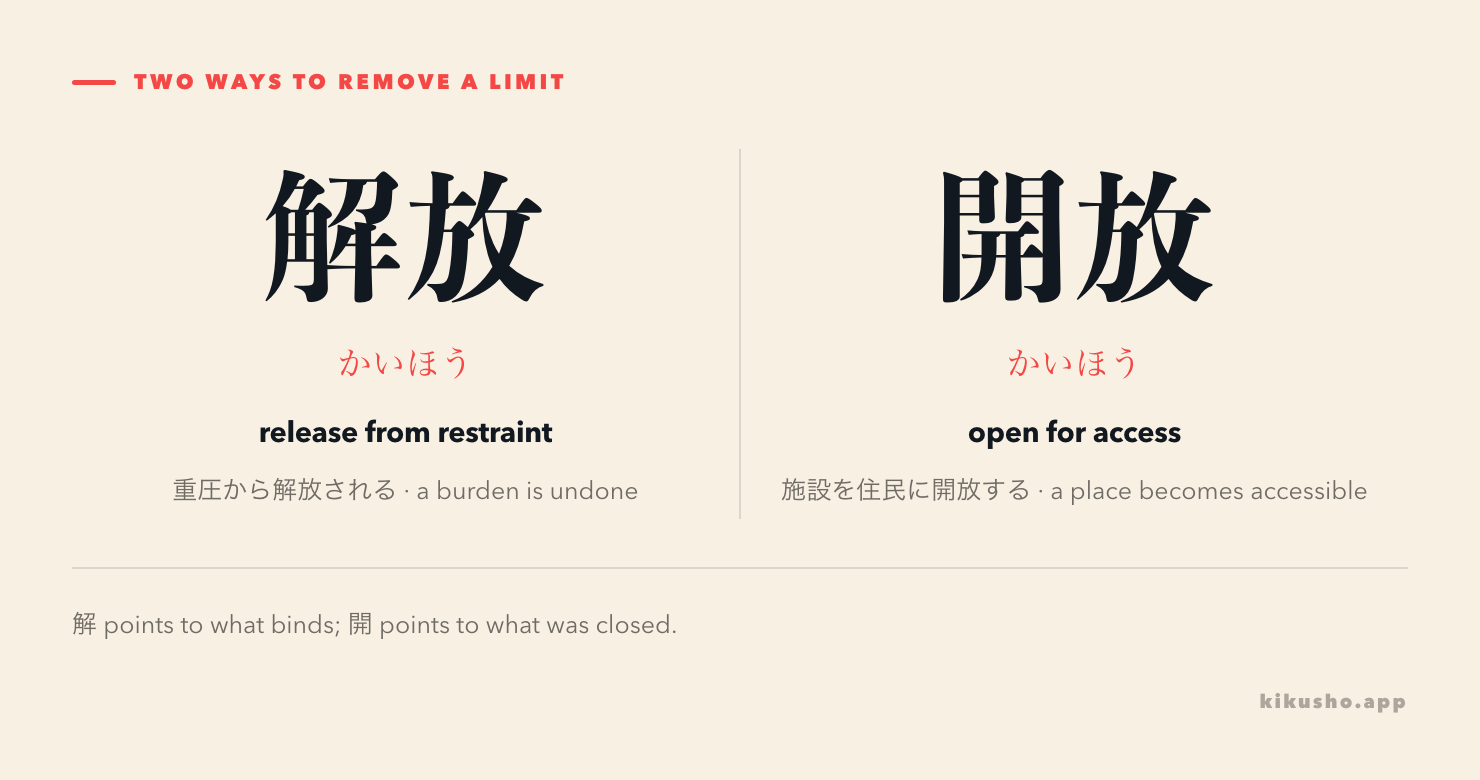
The words overlap around the broad idea of removing a limit, so use the object to choose the kanji. A hostage is under restraint and is 解放される. A library is closed to outsiders and is 一般に開放される. An Aichi Prefecture homophone teaching guide tests exactly this contextual choice with a gym being made available for practice and selects 開放.
One emergency plan uses all six decisions
A community center is preparing to serve as an emergency shelter. The city first 古い通信設備を整備する, services and organizes the old communications equipment. It finds that night staffing is insufficient, so it 交代要員を追加して人手不足を補う, adds relief staff to fill the shortage.
When food, bedding and the contact list are all in place, 受け入れ態勢が整う, the reception system is ready. The city can then 施設を住民に開放する, open the facility to residents. A rotating schedule also 職員を連続勤務から解放する, frees staff from working continuously. The same project contains both かいほう words because it opens a place and releases people from a burden.
For a useful Kikusho card, keep the diagnostic object with the headword. 不足を補う, 項目を追加する, 設備を整備する, 準備が整う, 負担から解放される, and 施設を開放する preserve the particle and the decision that an isolated English gloss would lose. Review the proposed reading, meaning and example before saving the card.
N2 is the curriculum position, with documented disagreement
The two baseline rows assigned to this lesson place all six spellings and readings at N2, but both descend from the same Waller list family. They are one provenance line, not two independent level judgments.
Bunpro agrees on N2 for 補う and 整う, while its current pages place 整備, 追加, 解放, and 開放 at N3. The official JLPT FAQ explains why no current exhaustive official vocabulary specification settles the dispute. Use N2 as this curriculum's review position, and treat earlier exposure to four common words as an advantage.
Practice: diagnose the object and the resulting state
Work through the full sequence before opening the explanations.
1 · Read the gap-filling verb. Select the reading of 補う.
- ① おぎなう
- ② うしなう
- ③ つぐなう
- ④ かなう
2 · Choose the homophone. The city has finished repairs and will make the hall available to local residents. Which word completes the sentence?
来月から、このホールを地域住民に__します。
- ① 解放
- ② 開放
- ③ 整備
- ④ 補足
3 · Release the person. Choose the sentence with the correct spelling and particle.
- ① 休暇を取って、仕事の重圧を開放された。
- ② 休暇を取って、仕事の重圧に解放した。
- ③ 休暇を取って、仕事の重圧から解放された。
- ④ 休暇を取って、仕事の重圧で開放した。
4 · Add or fill. Choose the pair for the two blanks.
説明が短すぎたので、具体例を( 前 )し、足りない情報を( 後 )った。
- ① 前 追加 / 後 補
- ② 前 補 / 後 追加
- ③ 前 整備 / 後 開放
- ④ 前 解放 / 後 整
5 · Work or state. Complete both sentences.
市は避難所の通信設備を( 前 )した。必要な機材も届き、準備が( 後 )った。
- ① 前 整備 / 後 整
- ② 前 整 / 後 整備
- ③ 前 追加 / 後 解放
- ④ 前 補 / 後 開放
6 · Preserve the meaning. Which paraphrase best matches 予備費で不足分を補う?
- ① Use reserve funds to cover the shortfall.
- ② Add a new reserve-fund category for no stated reason.
- ③ Open the reserve fund to the public.
- ④ Release the budget officer from all duties.
7 · Identify the object. Which option contains one natural collocation for each word?
- ① 車両を整備する / 受け入れ態勢が整う
- ② 受け入れ態勢を整う / 車両が整備する
- ③ 人質を開放する / 窓を解放する
- ④ 不足を追加する / 項目を補うだけ追加する
8 · Follow the emergency plan. Choose the only account that preserves every decision.
市は交代要員を加えて人手不足をなくし、使える状態にした体育館を住民が利用できるようにした。その結果、職員は連続勤務をしなくてよくなった。
- ① 要員を追加して不足を補い、整備した体育館を住民に開放し、職員を連続勤務から解放した。
- ② 要員を解放して不足を開放し、整った体育館を職員から追加した。
- ③ 要員を整備して不足を追加し、体育館を重圧から開放した。
- ④ 要員が補い、体育館を解放し、住民を設備に開放した。
Answers and explanations
Choice ①, おぎなう. The verb is 補う. つぐなう is commonly written 償う and focuses on atoning or compensating for damage, while this lesson's word fills a lack or weak point.
Choice ②, 開放. The hall is being opened for residents to enter and use. No person or object is being released from restraint, so 解放 does not fit this access frame.
Choice ③. 重圧から解放された marks the burden with から and the released person as the subject of the passive form. The other choices use the access kanji, an unsuitable particle or both.
Choice ①: 前 追加 / 後 補. A concrete example is added afterward to the explanation, so 具体例を追加する fits. That addition fills missing information, so 足りない情報を補う describes the gap resolved. The inflected answer is 補った.
Choice ①: 前 整備 / 後 整. The city actively works on the equipment: 通信設備を整備した. Preparation then reaches the ready state: 準備が整った. The particles を and が reinforce the transitive and intransitive roles.
Choice ①. The shortage already exists, and reserve funds fill it. The sentence does not merely report a new item, public access or freedom from a duty.
Choice ①. 車両を整備する is deliberate maintenance, while 受け入れ態勢が整う is the resulting ready state. Choice ② reverses transitivity. Choice ③ swaps 解放 and 開放. Choice ④ does not preserve the normal gap-versus-addition relation.
Choice ①. The city adds staff, fills a shortage, prepares the gym for use, opens it to residents and frees employees from continuous shifts. Each object selects the required word, and the two かいほう spellings carry different results.
Common questions
What is the difference between 解放 and 開放?
解放 removes a restraint, burden or restriction and sets someone or something free. 開放 opens a door, space, market or facility and makes it accessible. Both are read かいほう.
What is the difference between 補う and 追加する?
補う fills a shortage, weakness or missing part. 追加する adds something afterward to what already exists. An addition may fill a shortage, but the two words describe different aspects of that action.
What is the difference between 整備する and 整う?
整備する is transitive: someone prepares, maintains or puts equipment, documents, infrastructure or a system into usable order. 整う is intransitive: the necessary preparation or orderly state is ready.
Are all six words officially JLPT N2 vocabulary?
The curriculum's two related baseline rows place all six at N2. Bunpro places 補う and 整う at N2 but four others at N3. The current JLPT does not publish an exhaustive official vocabulary list, so these are study placements rather than official boundaries.