
On this page
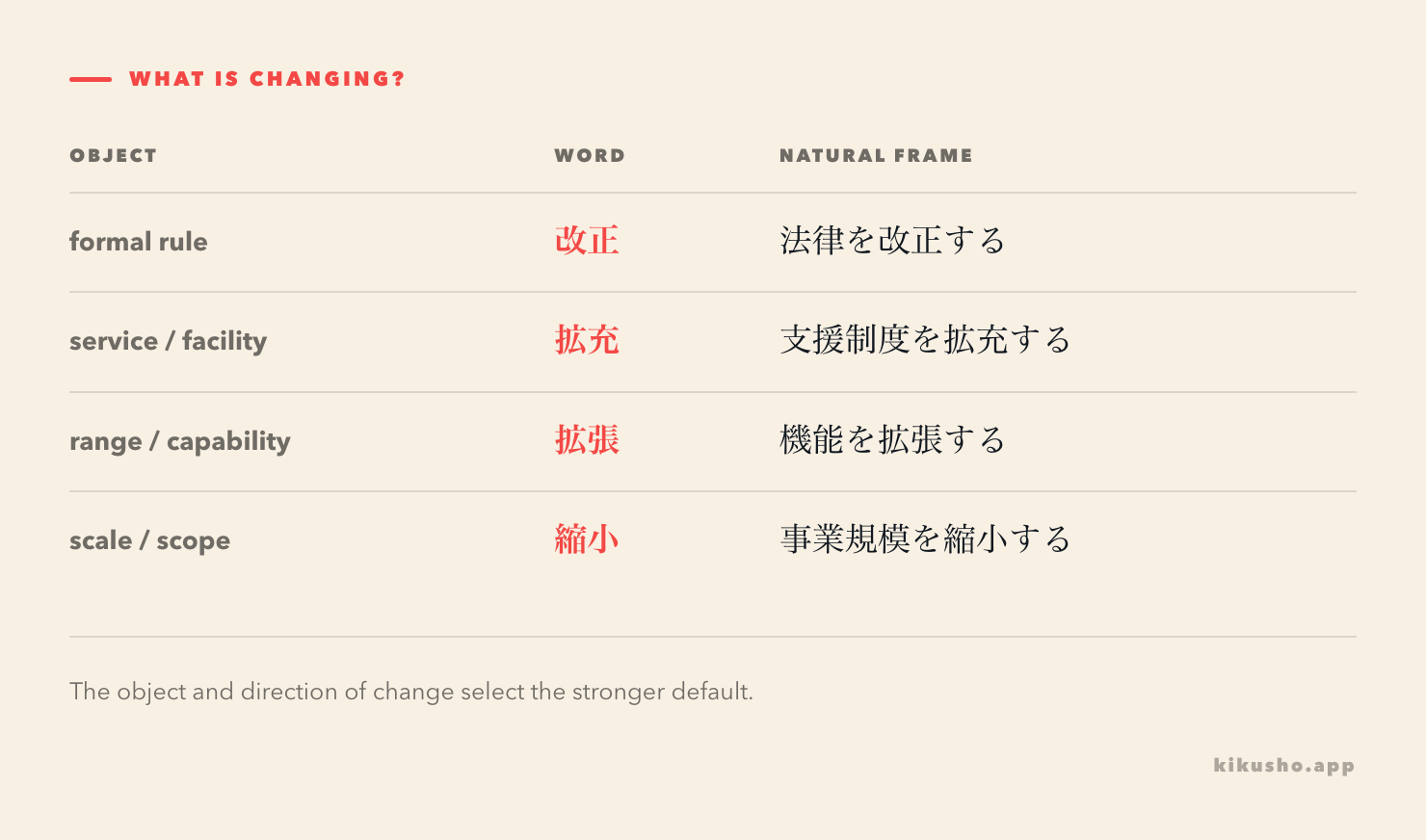
At N2, “revision” and “expansion” split according to what changes: 改正 revises a rule, 拡充 builds out a service, 拡張 extends a range or capability, and 縮小 reduces scale. 功績 and 実績 then evaluate outcomes from different angles: recognized contribution versus demonstrated results.
The planned title includes “effort,” but 努力(どりょく) is not one of this lesson's six assigned headwords. Effort is background here; the actual vocabulary describes institutional change and the record left after work has been done.
Six words connect a decision with its evidence
| Headword | Grammar | Working meaning | Anchor phrase |
|---|---|---|---|
| 改正(かいせい) | Noun / する | formally revise a rule, regulation, law or system | 法律を改正する |
| 拡充(かくじゅう) | Noun / する | expand and make a service, organization or facility more substantial | 支援制度を拡充する |
| 拡張(かくちょう) | Noun / する | extend a range, width, capacity or function | 機能を拡張する |
| 縮小(しゅくしょう) | Noun / する | make or become smaller in scale or scope | 事業規模を縮小する |
| 功績(こうせき) | Noun | a meritorious achievement or contribution | 功績をたたえる |
| 実績(じっせき) | Noun | actual results; a demonstrated track record | 販売実績がある |
The first four commonly form verbs with する. 功績 and 実績 remain nouns in the core patterns here: someone 功績を残す, a committee 功績を評価する, a company 実績がある, or a team 実績を上げる.
改正 changes a rule rather than correcting one sentence
改正(かいせい) is used mainly for rules, regulations, agreements, laws and formal systems. Shogakukan's entry defines it as correcting unsuitable or inadequate points, especially in 規則・規約・法令.
来年、利用者の意見を踏まえて規則を改正する予定だ。
らいねん、りようしゃの いけんを ふまえて きそくを かいせいする よていだ。
Next year, the rules are scheduled to be revised in light of user feedback.
Common compounds make its formal scope visible: 法改正, legal reform; 制度改正, system revision; 税制改正, tax-system reform; and ダイヤ改正, a railway timetable revision.
The nearby N3 words answer different questions. 文章の誤りを修正する corrects a defined error in a text. 手続きを改善する makes a whole procedure work better. 規則を改正する changes the governing rule itself.
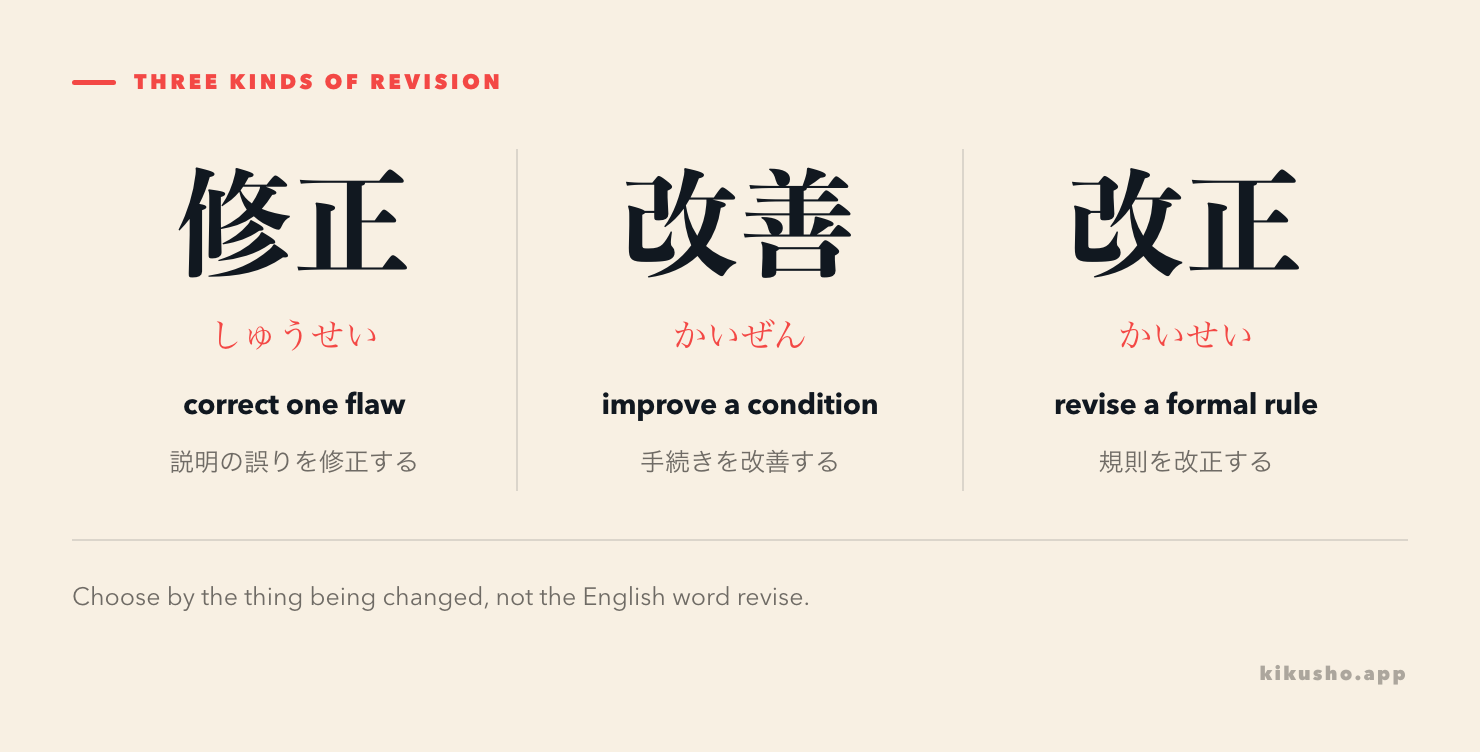
The N3 progress vocabulary lesson teaches 修正 and 改善 in full. Keep that distinction as a prerequisite rather than treating every English “revision” as 改正.
拡充 adds substance; 拡張 extends reach or capacity
Both 拡充(かくじゅう) and 拡張(かくちょう) describe expansion. Their preferred objects show the viewpoint.
拡充 includes the idea of making something fuller or better supplied as it grows. The dictionary definition focuses on widening and enriching an organization or facility. Natural objects include 支援, 設備, 組織, サービス, and 制度.
市は相談窓口を増やし、子育て支援を拡充した。
しは そうだんまどぐちを ふやし、こそだてしえんを かくじゅうした。
The city added consultation desks and expanded its childcare support.
The number of desks increases, but the sentence evaluates the support provision as more substantial. Shogakukan explicitly defines 拡充 as expanding an organization or facility and making it more complete.
拡張 focuses on extending width, range, scale, power or capability. The dictionary entry gives 道路を拡張する and 軍備拡張; technical Japanese also uses 拡張機能, an extension or add-on.
予約システムの機能を拡張し、多言語表示を追加した。
よやくシステムの きのうを かくちょうし、たげんごひょうじを ついかした。
We extended the reservation system's capabilities and added multilingual display.
The old capability has acquired a wider range. Other familiar objects are 道路, 店舗, 領土, メモリー, and 事業. The broad word 拡大 can simply say that area, quantity, influence or scale became larger; it does not by itself add 拡充's fuller provision or 拡張's outward extension.
縮小 reduces scale without saying whether that is good
縮小(しゅくしょう) is the opposite of 拡大. It can be transitive or intransitive: an organization 計画を縮小する, while 市場が縮小する says the market contracts. Shogakukan defines both making something smaller and something becoming smaller.
利用者が減ったため、会社は運行区域を縮小した。
りようしゃが へったため、かいしゃは うんこうくいきを しゅくしょうした。
Because the number of users fell, the company reduced the service area.
Useful objects include 規模, 範囲, 計画, 予算, 生産, and 事業. The word reports direction, not value. A smaller trial may reduce risk; a shrinking service may harm access. The wider sentence supplies the judgment.
This creates a practical four-way test:
- Is a formal rule being revised? Use 改正.
- Is a service or facility being broadened and strengthened? Start with 拡充.
- Is a range, width or capability being extended? Start with 拡張.
- Is the scale or scope becoming smaller? Use 縮小.
The objects overlap in real writing, especially for organizations and facilities. Treat the test as a strong default, then read what the writer wants to emphasize.
功績 praises a contribution; 実績 proves a track record
Both nouns can translate as “achievement,” but they carry different evaluation.
功績(こうせき) presents a deed or body of work as a valuable contribution worthy of credit. It appears in historical accounts, awards, obituaries and formal recognition with 功績を残す, 功績をたたえる, 功績を認める, and 功績は大きい. The element 功 names work successfully accomplished or merit earned through one's actions; the whole compound points toward credit and praise.
長年の研究における功績が認められ、彼女は賞を受けた。
ながねんの けんきゅうにおける こうせきが みとめられ、かのじょは しょうを うけた。
Her contributions through many years of research were recognized, and she received an award.
The sentence evaluates what the researcher contributed, not merely the number of papers she produced. The Japanese Wiktionary 功績 entry likewise centers on an achievement that contributes to a society, organization or group and is worthy of praise.
実績(じっせき) is what has actually been achieved or demonstrated. It often serves as evidence in hiring, procurement, sales, research and project evaluation: 実績がある, 販売実績, 導入実績, 過去の実績, and 実績を上げる. Shogakukan's definition gives actual achievements or results and the frames 実績がある and 実績を上げる.
この会社には、海外で百件以上の導入実績がある。
この かいしゃには、かいがいで ひゃっけんいじょうの どうにゅうじっせきが ある。
This company has a track record of more than one hundred implementations overseas.
The number provides evidence of experience. It does not automatically prove that each implementation was historically important or socially beneficial.
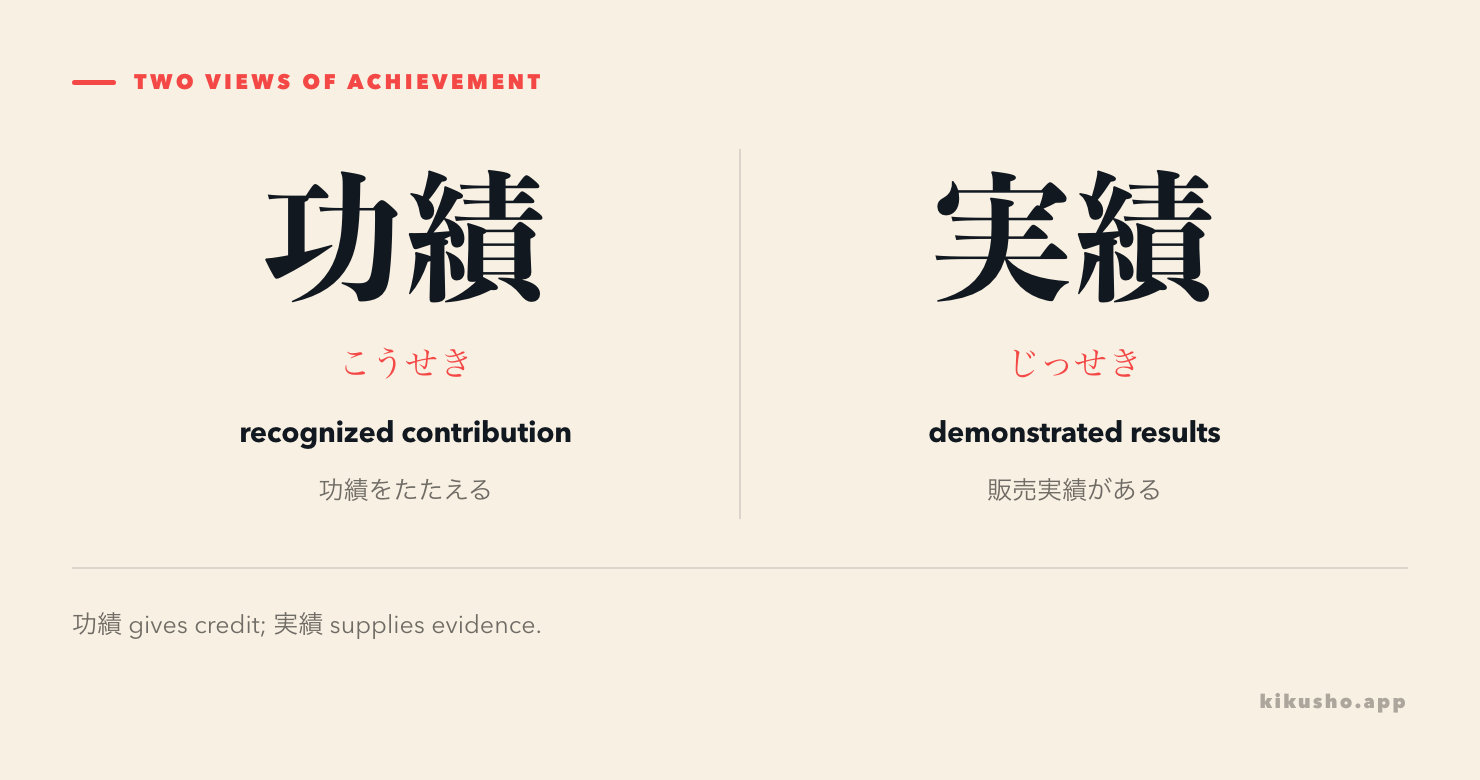
The contrast is not “person versus company.” A researcher can have 研究実績, and a company or team can be credited for a 功績. Ask whether the sentence praises contribution or points to actual results as evidence. The formal worth and sufficiency lesson shows the same difference in judgment: 功績は表彰に値する evaluates merit, while 採用を決めるに足る実績 treats results as sufficient evidence.
One policy report can use all six words
Imagine a city reviewing a language-support program. The council first 制度を改正する so residents can apply online. It 相談窓口を拡充する by adding staff and locations, then システムの機能を拡張する with multilingual forms. A limited budget forces it to 試験地域を縮小する.
When the pilot ends, the committee checks its 実績: the number of consultations, completed applications and languages supported. Years later, if the program has transformed access across the city, an organizer's 功績 may be formally recognized. The same project moves from formal revision, through changes in scope, to two different kinds of evaluation.
In Kikusho, save the whole evidence-bearing phrase rather than a single English gloss. 制度を改正する, 支援を拡充する, 機能を拡張する, 規模を縮小する, 功績をたたえる, and 導入実績がある give the particle and object that make the word retrievable.
N2 is a study placement, not an official boundary
Both reference rows used for this curriculum place all six words at N2 with the readings taught here. Those rows descend from the same Waller vocabulary-list family, so their agreement is one provenance line rather than two independent confirmations.
The official JLPT FAQ says the test organizers stopped releasing the old vocabulary, kanji and grammar specifications after the 2010 revision. Dictionaries verify the readings and uses; they do not certify an official JLPT level. Treat N2 as the sequence for this lesson and expect some resources to introduce common compounds such as 法改正 or 実績がある earlier or later.
Practice: eight questions
Complete all eight before opening the explanations.
1 · Read 拡充. Choose its reading.
- ① かくしょう
- ② かくじゅう
- ③ こうじゅう
- ④ かくちょう
2 · Write じっせき. Choose the spelling for “a demonstrated track record.”
- ① 実責
- ② 実積
- ③ 実績
- ④ 実跡
3 · Read the parts. Which compound uses 充, “fill,” to express expansion that also makes a service more substantial?
- ① 拡張
- ② 縮小
- ③ 改正
- ④ 拡充
4 · Revise the governing rule. Complete the sentence.
委員会は古い規則を__する方針を決めた。
- ① 改正
- ② 功績
- ③ 実績
- ④ 拡充
5 · Extend a capability. Choose the word that best fits the stated change.
新しい入力方法を追加して、アプリの機能を__した。
- ① 縮小
- ② 拡張
- ③ 功績
- ④ 改正
6 · Preserve the claim. What does この会社には十分な販売実績がある say?
- ① The company has demonstrated enough past sales results.
- ② The company deserves an award for public service.
- ③ The company revised the sales law.
- ④ The company reduced every product price.
7 · Recognition or evidence. Choose the pair for the two blanks.
採用委員会は候補者の過去の( 前 )を確認した。受賞式では、地域医療への( 後 )がたたえられた。
- ① 前 功績 / 後 実績
- ② 前 実績 / 後 功績
- ③ 前 拡充 / 後 改正
- ④ 前 縮小 / 後 拡張
8 · Follow the policy report. Choose the only account that keeps all three changes distinct.
市は規則を見直し、相談窓口を増やし、試験地域だけは小さくした。
- ① 規則を改正し、相談窓口を拡充し、試験地域を縮小した。
- ② 規則を功績し、相談窓口を実績し、試験地域を拡張した。
- ③ 規則を拡充し、相談窓口を縮小し、試験地域を改正した。
- ④ 規則を実績し、相談窓口を功績し、試験地域を拡充した。
Answers and explanations
Choice ②: かくじゅう. 拡 is かく and 充 is じゅう in this compound. Choice ④ is the reading of 拡張, the neighbouring word for extending range or capability.
Choice ③: 実績. The second character is 績, which appears in compounds about accumulated work and its results. 積 also reads せき in some compounds, but 実積 is not the track-record word.
Choice ④: 拡充. 充 contributes the idea of filling or making substantial. 拡充 therefore suits an organization, service or facility that is broadened and made more complete.
Choice ①: 改正. The object is a formal rule whose inadequate points will be revised. 功績 and 実績 are nouns for achievements, while 拡充 would mean broadening and strengthening a provision rather than rewriting its rule.
Choice ②: 拡張. Adding a new input method extends what the app can do, so 機能を拡張する fits. 縮小 reverses the direction; 功績 is not a する verb here; 改正 normally takes a rule or formal system.
Choice ①. 販売実績がある points to actual past sales results that can support an evaluation. The sentence does not praise a public contribution, mention a legal revision or promise lower prices.
Choice ②: 前 実績 / 後 功績. A hiring committee examines demonstrated past results as evidence. An award ceremony praises a meritorious contribution to regional medicine.
Choice ①. Formal rules are 改正する, service provision can be 拡充する, and a trial area can be 縮小する. The other options turn 功績 and 実績 into unsuitable verbs or reverse the intended kinds of change.
Common questions
What is the difference between 改正, 修正 and 改善?
改正 is the formal revision of rules, regulations, laws or systems. 修正 corrects a specific error, plan or piece of content. 改善 makes an unsatisfactory condition or process better.
What is the difference between 拡充 and 拡張?
拡充 expands an organization, facility or service while making it more substantial or complete. 拡張 extends a range, width, capacity or function outward. Their uses overlap, so the object and intended change decide the better default.
What is the difference between 功績 and 実績?
功績 presents an achievement as a meritorious contribution worthy of recognition. 実績 focuses on actual results or a demonstrated track record that can support an evaluation or decision.
Are all six words officially JLPT N2 vocabulary?
The two reference rows used here consistently place all six at N2, but they descend from the same Waller list family. The current JLPT publishes no exhaustive official vocabulary list, so N2 is a study estimate.