On this page
These six N2 words describe how work moves from coordination to a settled result: a 打合せ fixes the 日時 and 日程, a 方針 guides the project, 対策 answers risks, and an agreement may finally 成立する. The key is to keep the exact appointment apart from the wider schedule, and the guiding direction apart from the measures taken when something may go wrong.
Six entries divide the work before, during and after a decision
| Word | Reading | Word type and core sense | Anchor phrase |
|---|---|---|---|
| 打合せ | うちあわせ, uchiawase | noun; する verb; advance consultation or coordination meeting | 取引先と打ち合わせをする |
| 成立 | せいりつ, seiritsu | noun; する verb; coming into existence or becoming settled | 契約が成立する |
| 対策 | たいさく, taisaku | noun; する verb; measure taken in response to a problem | 対策を講じる |
| 日時 | にちじ, nichiji | noun; date and time | 会議の日時 |
| 日程 | にってい, nittei | noun; schedule, programme of dates or planned sequence | 日程を調整する |
| 方針 | ほうしん, hōshin | noun; policy or general course of action | 方針を決める |
The inventory headword 打合せ is a recognised spelling. In ordinary writing, 打ち合わせ with kana is very common, and dictionaries also show 打合わせ and 打合せ. All are read うちあわせ. This article uses 打ち合わせ in sentences while retaining the assigned headword in the table.
Kikusho's reference inventory places all six records at N2 and flags no internal level disagreement. Japanesetest4you's 打ち合わせ page and its entries for 成立 and 方針 independently label those words N2. The JLPT organisers publish no exhaustive official vocabulary list. The label tells you when to study these words; it does not define the vocabulary of a live examination.
The N3 meetings and projects set begins one level earlier with proposals, joint work, contracts, implementation, completion and schedule changes.
At N1, the institutional planning and commercial agreements set continues into project conception, agenda setting, estimates, negotiation, task allocation and substantive progress.
The N3 employment and workplace set supplies the people and organisational roles around this process. Here the focus is the process itself: arranging, directing, responding and reaching a valid result.
打ち合わせ is where details are coordinated in advance
打ち合わせ is a consultation held before a task or event so that participants can align details. The point is preparation. It can be a short working discussion between colleagues, a client meeting or the advance coordination before a larger event.
明日のプレゼンについて、営業部と打ち合わせをします。
あしたの プレゼンについて、えいぎょうぶと うちあわせを します。
We will meet with the sales department to coordinate tomorrow's presentation.
取引先との打ち合わせは三時からです。
とりひきさきとの うちあわせは さんじからです。
The meeting with the client starts at three.
The partner commonly takes と: 取引先と打ち合わせをする. The matter can take について or form a compound: 新商品の打ち合わせ. Daijisen defines the central modern sense as consulting beforehand or making preliminary arrangements.
会議 is the broader word for a meeting or conference. A team might hold a small 打ち合わせ before presenting its proposal at a formal 会議. The distinction is a useful tendency rather than a rule based on room size: ask whether the event is being named generally or as advance coordination.
日時 gives one point; 日程 gives the planned sequence
日時 combines the date and the time. It answers “when exactly?”
打ち合わせの日時は10月15日午後2時です。
うちあわせの にちじは じゅうがつ じゅうごにち ごごにじです。
The meeting is at 2 p.m. on 15 October.
日程 is a schedule or programme of dates and activities. It may contain several steps, and it can be adjusted without every event already having an exact clock time.
開発日程を一週間延ばしました。
かいはつにっていを いっしゅうかん のばしました。
We extended the development schedule by one week.
| Question being answered | Choose | Example |
|---|---|---|
| On what date and at what time? | 日時 | 面接の日時を確認する |
| What is the schedule or order of planned dates? | 日程 | 出張の日程を組む |
| Can everyone attend the proposed slot? | 日時 | 候補日時を送る |
| Does the whole project need to move? | 日程 | 日程を変更する |
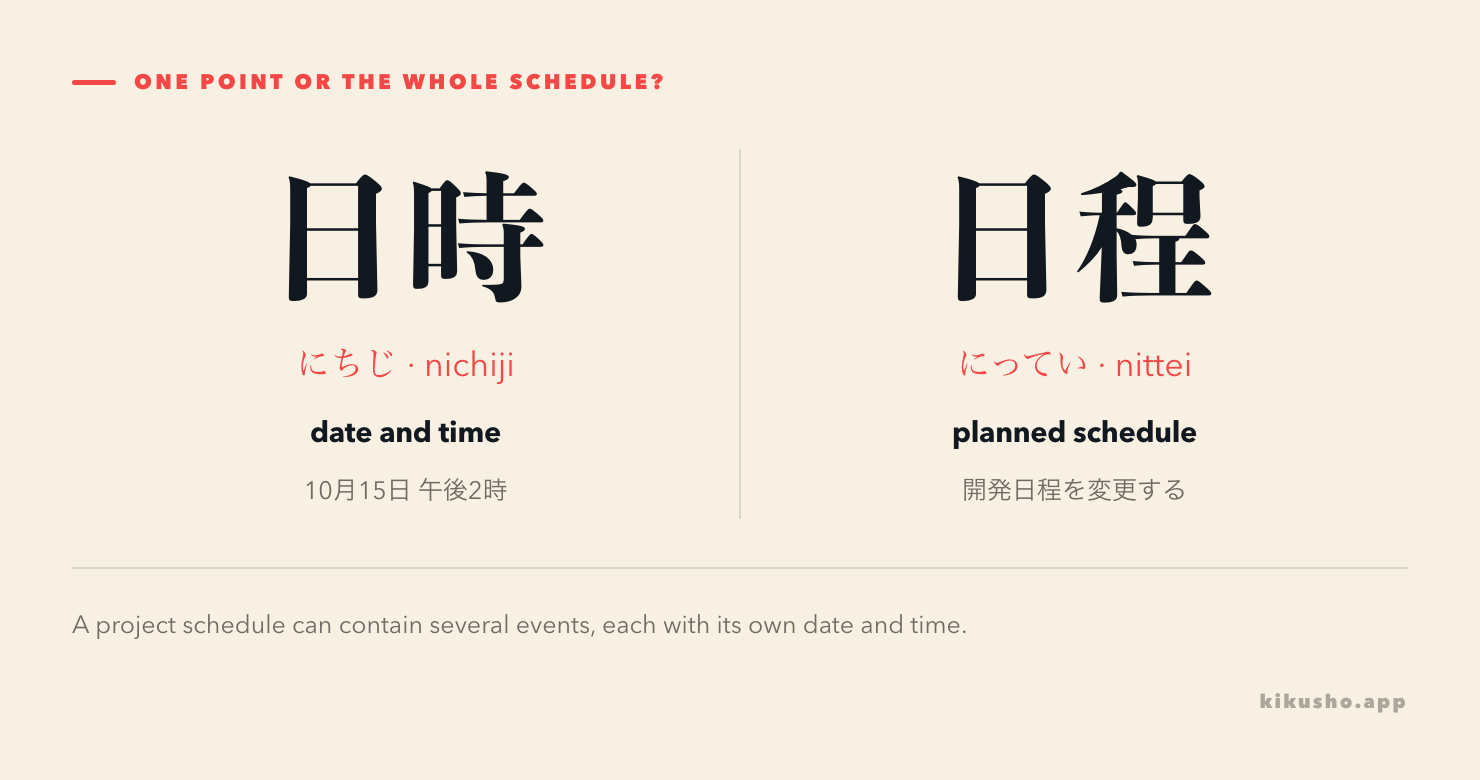
The dictionary definition of 日時 begins with date and time. 日程 covers the daily plan, schedule or dates of work, proceedings or travel. The inventory gloss “agenda” points toward a programme, but English agenda can also mean a list of discussion topics. Japanese 日程 does not by itself name those topics; 議題 does.
方針 sets direction; 対策 responds to a problem
方針 gives the general direction or policy used to carry out a plan. It tells the team what principle should guide later choices.
品質を優先する方針を決めました。
ひんしつを ゆうせんする ほうしんを きめました。
We decided on a policy of prioritising quality.
対策 is a method or measure taken in response to a situation, problem or risk.
情報漏えいを防ぐため、追加の対策を講じます。
じょうほうろうえいを ふせぐため、ついかの たいさくを こうじます。
We will take additional measures to prevent an information leak.
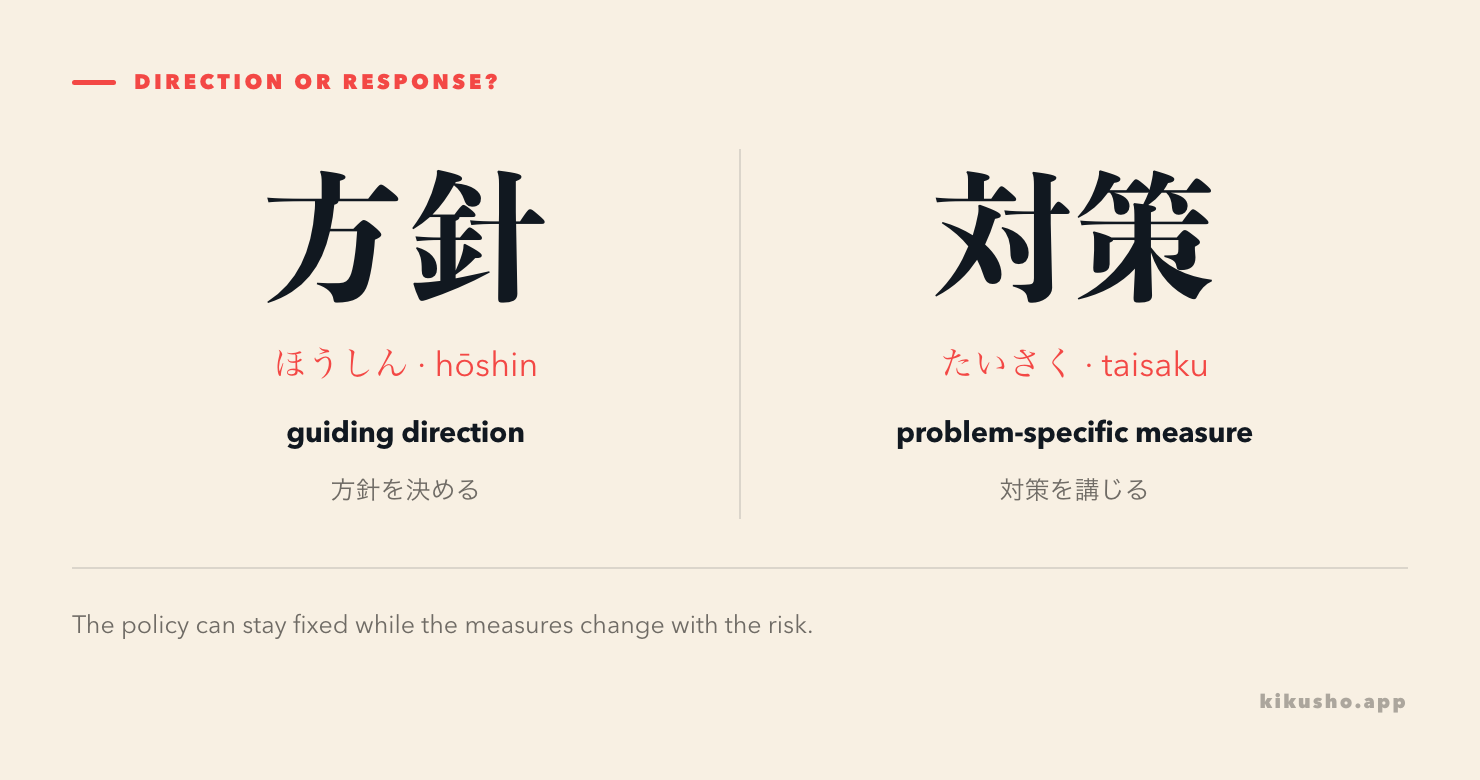
Common partners make the difference visible:
| 方針 | 対策 |
|---|---|
| 方針を決める: decide a policy | 対策を立てる: devise measures |
| 方針を変更する: change course | 対策を練る: work out measures |
| 方針に沿う: follow the policy | 対策を講じる: take measures |
| 基本方針: basic policy | 安全対策: safety measures |
Daijisen defines 方針 as the broad direction aimed at when carrying something out. Its entry for 対策 centres on methods used to respond to another party's attitude or the circumstances of an event.
A company can retain the same 方針 while revising its 対策. For example, its policy may remain 品質を優先する, “prioritise quality,” while a delayed supplier requires a new 納期遅延への対策, “measure against delivery delays.” The policy supplies the compass; the countermeasure handles the obstacle now in front of the team.
The advanced set on discussion, purchasing and hiring adds the する nouns used when the project turns to acquiring goods or staff. It complements this page without changing the policy-versus-measure distinction.
成立 marks a recognised result, not mere completion
成立する says that something comes into existence, becomes established, holds together as a valid proposition, or reaches a settled form. In business contexts, agreements, negotiations and contracts commonly become established this way.
双方が条件に同意し、契約が成立しました。
そうほうが じょうけんに どういし、けいやくが せいりつしました。
Both sides agreed to the terms, and the contract was concluded.
交渉が成立しなければ、計画を見直します。
こうしょうが せいりつしなければ、けいかくを みなおします。
If the negotiations do not produce an agreement, we will review the plan.
The thing that comes into being normally takes が: 契約が成立する. When someone brings it about, the causative appears: 交渉を成立させる, “bring the negotiation to a successful agreement.” Daijisen gives both the sense of becoming formed or settled and examples such as a bill passing and negotiations being brought to agreement.
Do not translate 成立 mechanically as “completion.” 資料の作成が完了した says that preparing the materials is finished. 契約が成立した says that a contract now exists as a settled agreement. The endpoint differs: one is the end of work; the other is the formation of a recognised whole.
In formal provisions, you may meet 成立 beside ものとする. The lesson on assumptions and stipulated rules explains why 契約は双方の署名がそろった日に成立するものとする states the rule under which the contract is deemed to take effect.
A project memo connects all six words
Read the planning note:
新商品の発表に向けて、来週、取引先と打ち合わせを行います。候補日時は10月15日午後2時です。開発日程が遅れているため、まず発売日を優先するか品質を優先するか、基本方針を確認します。部品の不足については、別の会社からも仕入れる対策を検討します。条件について双方が合意すれば、その日に契約が成立する予定です。
In preparation for the new product announcement, we will hold a coordination meeting with the client next week. The proposed date and time is 2 p.m. on 15 October. Because the development schedule is behind, we will first confirm the basic policy: whether to prioritise the launch date or quality. As a measure against the parts shortage, we will consider buying from another company as well. If both sides agree on the terms, the contract is expected to be concluded that day.
Each word has a distinct job:
- 打ち合わせ names the advance coordination.
- 日時 pinpoints the proposed appointment.
- 日程 describes the wider development schedule.
- 方針 sets the priority governing the decision.
- 対策 answers the concrete shortage.
- 成立 marks the agreement coming into effect.
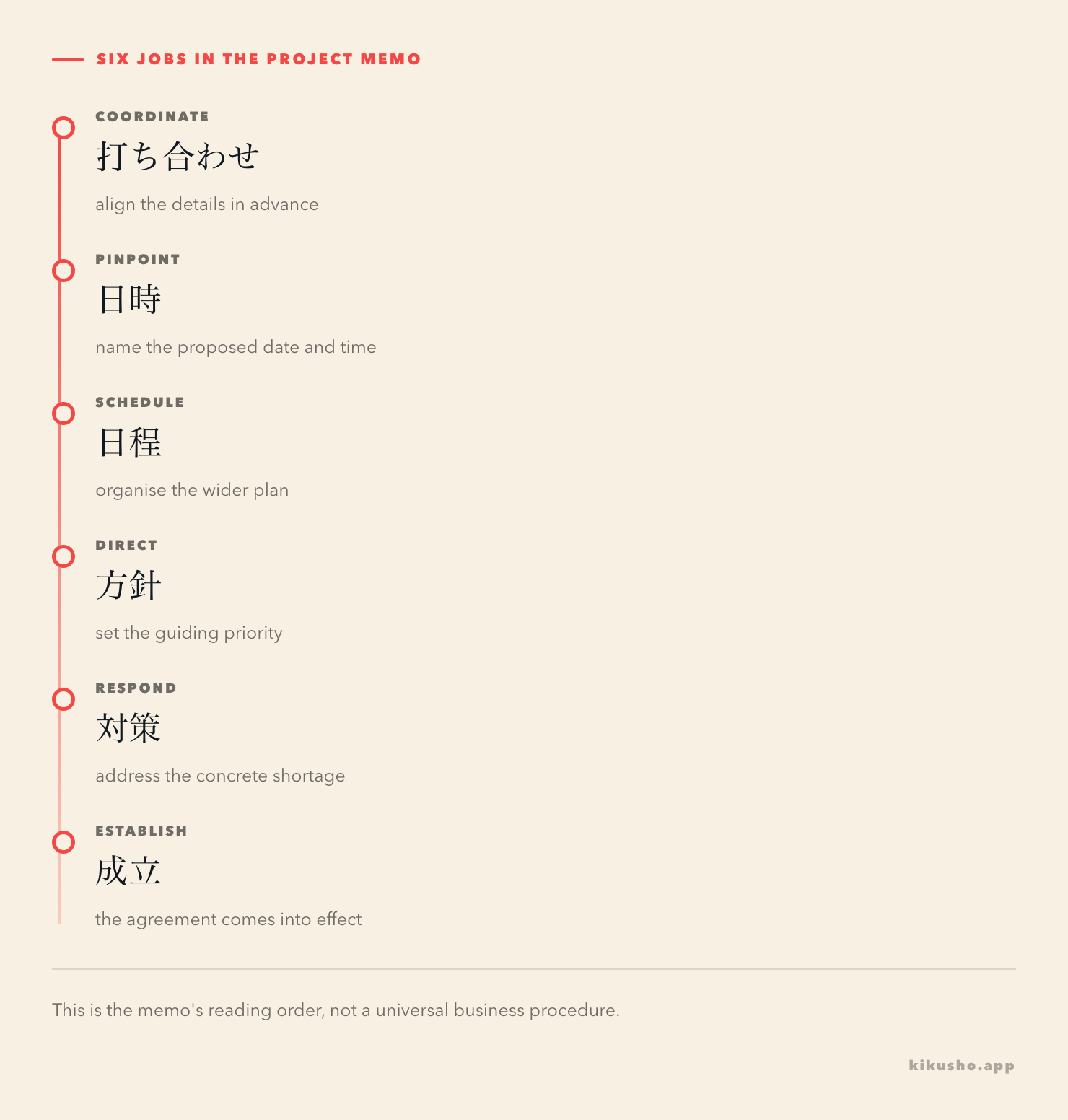
Real projects do not always follow this order. A problem can force another 打ち合わせ after a 方針 is chosen, and an agreement may fail to 成立. The sequence is a reading map for this memo, not a universal business procedure.
Practice
1 · Policy reading. Which kana reproduce 方針?
- A. ほしん
- B. ほうしん
- C. ぼうじん
- D. ほうじん
Keep the long vowel in view before moving to the spelling prompt.
2 · Orthography. Which spelling is the assigned compact form of うちあわせ?
- A. 打合せ
- B. 討合せ
- C. 打会せ
- D. 打合わ
3 · Exact time or schedule. Complete the email: 会議の( )は10月15日午後2時です。
- A. 日程
- B. 方針
- C. 日時
- D. 対策
4 · Wider plan. What does 開発日程を一週間延ばした mean?
- A. We moved one meeting to 1 p.m.
- B. We extended the development schedule by one week.
- C. We concluded the development contract in one week.
- D. We held a meeting about a one-week holiday.
5 · Collocation. Which expression most directly means “take countermeasures” in formal business writing?
- A. 対策が成立する
- B. 対策に沿う
- C. 対策を打ち合わせる
- D. 対策を講じる
6 · Direction or response. The company decides to prioritise safety in all later choices. Which word names that guiding direction?
- A. 方針
- B. 日時
- C. 成立
- D. 打合せ
7 · Formation. Which sentence says that the contract was concluded and now exists as an agreement?
- A. 契約の日程を組みました。
- B. 契約の日時を送りました。
- C. 契約が成立しました。
- D. 契約の対策を練りました。
8 · Paraphrase. What is the main purpose of a 打ち合わせ in the sense taught here?
- A. To announce that every task is complete
- B. To publish an official law
- C. To cancel a schedule without consultation
- D. To coordinate plans or details in advance
9 · Word choice. A supplier delay creates a specific risk. Which phrase fits the team's response?
- A. 遅れの日時
- B. 遅れへの対策
- C. 遅れの成立
- D. 遅れの打合せが成立する
10 · Connected text. Which statement agrees with the project memo?
- A. The development schedule is ahead of plan.
- B. The contract has already been concluded.
- C. The team will consider another supplier as a measure against the shortage.
- D. The meeting is fixed for 15 November at noon.
Recheck the project memo once, then open the disclosure.
Answers and explanations
Use the noun's role in the project, not a shared English translation, to check each answer.
1 · B, ほうしん. 方針 is read ほうしん. The first vowel is long; じん and ぼう do not belong to this reading.
2 · A, 打合せ. 打合せ is the compact inventory spelling. 打ち合わせ is also common and is the form used in most examples above.
3 · C, 日時. The sentence supplies both a calendar date and a clock time. 日程 would name the wider schedule rather than this exact appointment.
4 · B. 日程 is the development schedule, and 一週間延ばした says it was extended by one week. No exact clock time or concluded contract is stated.
5 · D, 対策を講じる. This established collocation means to take or implement measures. The other combinations assign 対策 the wrong relationship.
6 · A, 方針. A continuing principle that guides later choices is a 方針. A problem-specific response would be a 対策.
7 · C, 契約が成立しました. 成立する presents the contract as having come into existence as a settled agreement. The contract is the grammatical subject marked by が.
8 · D. A 打ち合わせ is advance consultation used to coordinate plans or details. It does not itself enact a law, complete every task or cancel a schedule.
9 · B, 遅れへの対策. The delay is the problem toward which the measures are directed. への makes that target relationship explicit.
10 · C. The memo says the team will consider purchasing from another company as a response to the parts shortage. The schedule is delayed, the contract is only expected to be concluded if both sides agree, and the proposed meeting is on 15 October at 2 p.m.
Common questions
What is the difference between 日時 and 日程?
日時 identifies a date and time, such as 10月15日午後2時. 日程 is the schedule or arrangement of dates and activities, so it may cover one day or several stages. A meeting can therefore have both a 日時 and a wider project 日程.
What is the difference between 方針 and 対策?
方針 is the basic direction or policy that guides action. 対策 is a method or measure chosen in response to a particular problem or risk. A team can keep its 方針 while changing its 対策 when circumstances change.
Does 成立 mean that a task is finished?
Not generally. 成立 means that something comes into existence, holds true or becomes settled as a recognised whole. A contract or agreement 成立する when it is concluded; a task simply being completed usually needs another word such as 完了する.
Is 打合せ the same as a formal conference?
打合せ, commonly written 打ち合わせ, is advance consultation or a working meeting used to coordinate details. 会議 is broader and can name a formal meeting or conference. A 打ち合わせ may happen before a presentation, negotiation or larger 会議.