On this page
A character description can praise someone as 謙虚 or 素直, criticize them as 厚かましい, 図々しい or 生意気, and still discuss a concrete 長所 or 短所 without reducing the whole person to one label. 怠る and 欲張り move from personality into what someone does or tries to obtain.
These nine N2 words are judgments, so context and viewpoint matter. Learn what behavior triggered the word, who is evaluating it, and which grammatical form carries that evaluation.
Nine words for evaluating conduct and character
| Word and reading | Class | Working sense | Combination to keep |
|---|---|---|---|
| 厚かましい(あつかましい) | い-adjective | Presumptuous; lacking restraint | 厚かましいお願い |
| 図々しい(ずうずうしい) | い-adjective | Brazen; shamelessly inconsiderate | 図々しい態度 |
| 生意気(なまいき) | Noun / な-adjective | Impertinent beyond one's standing | 生意気な口をきく |
| 謙虚(けんきょ) | Noun / な-adjective | Modest and receptive | 謙虚な態度 |
| 素直(すなお) | Noun / な-adjective | Open, straightforward, unresisting | 素直に認める |
| 怠る(おこたる) | Godan verb | Fail to do a necessary action | 注意を怠る |
| 長所(ちょうしょ) | Noun | Strong point or merit | 長所を生かす |
| 短所(たんしょ) | Noun | Weak point or disadvantage | 短所を補う |
| 欲張り(よくばり) | Noun / な-adjective | Greedy; wanting too much at once | 欲張りな人 |
The list mixes qualities, judgments and an action verb. 謙虚な人 describes a person, while 安全確認を怠る evaluates a specific omission. That difference helps you avoid treating every entry as a permanent personality type.
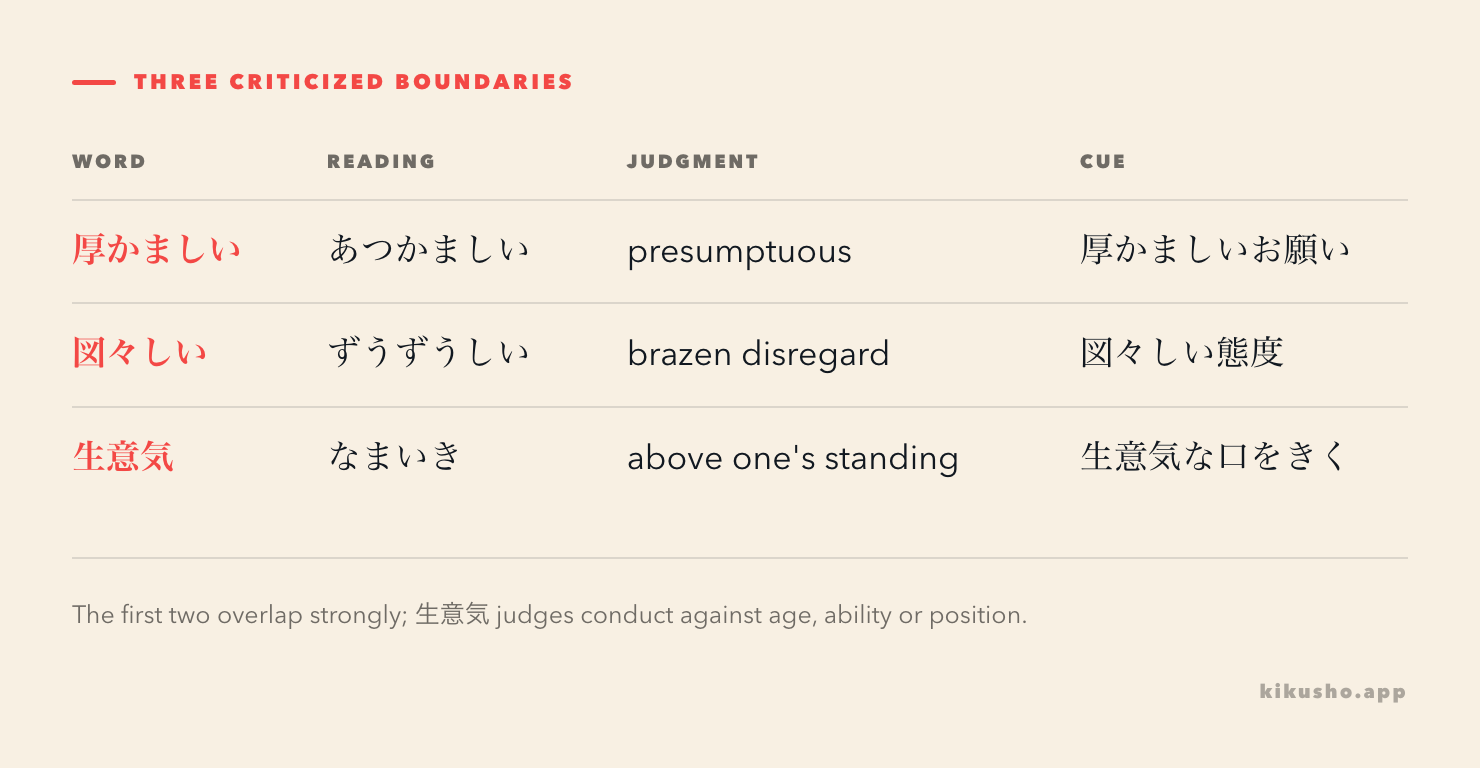
厚かましい, 図々しい and 生意気 criticize different boundaries
厚かましい(あつかましい) describes conduct or a request that lacks proper restraint or reserve. Shogakukan's definition records both 厚かましい人 and the conventional 厚かましいお願いで恐縮です.
厚かましいお願いですが、締め切りを一日延ばしていただけませんか。
あつかましい おねがいですが、しめきりを いちにち のばしていただけませんか。
I realize this is a presumptuous request, but could you extend the deadline by one day?
Calling your own request 厚かましい acknowledges that you are asking for more than is easy to grant. The adjective does not make the request polite by itself; the rest of the sentence still needs an appropriate request form.
図々しい(ずうずうしい) strongly criticizes someone for acting without shame or regard for the burden placed on others. Its spelling contains two long う sounds. The dictionary entry defines it as treating no shame as shame and links it directly to 厚かましい.
自分は何も手伝わなかったのに、利益だけ求めるのは図々しい。
じぶんは なにも てつだわなかったのに、りえきだけ もとめるのは ずうずうしい。
It is brazen to demand only the benefit after helping with nothing.
The two adjectives overlap heavily. A useful difference in practice is the phrase around them: 厚かましいお願い can be a self-critical preface, whereas calling another person 図々しい is a direct and sharp judgment. This is a usage tendency, not a claim that every situation admits only one word.
生意気(なまいき) targets another boundary. It criticizes words or conduct that seem too forward for someone's age, ability or position. The dictionary definition gives 生意気な口をきく and centers on overstepping what one's age or ability warrants.
知識が十分でないのに、専門家に生意気な口をきいた。
ちしきが じゅうぶんでないのに、せんもんかに なまいきな くちを きいた。
Despite lacking sufficient knowledge, he spoke impertinently to the expert.
An adult can be described as 生意気 too; “young person” is a common scenario, not a grammatical requirement. What matters is the speaker's judgment that the person is acting above their standing.
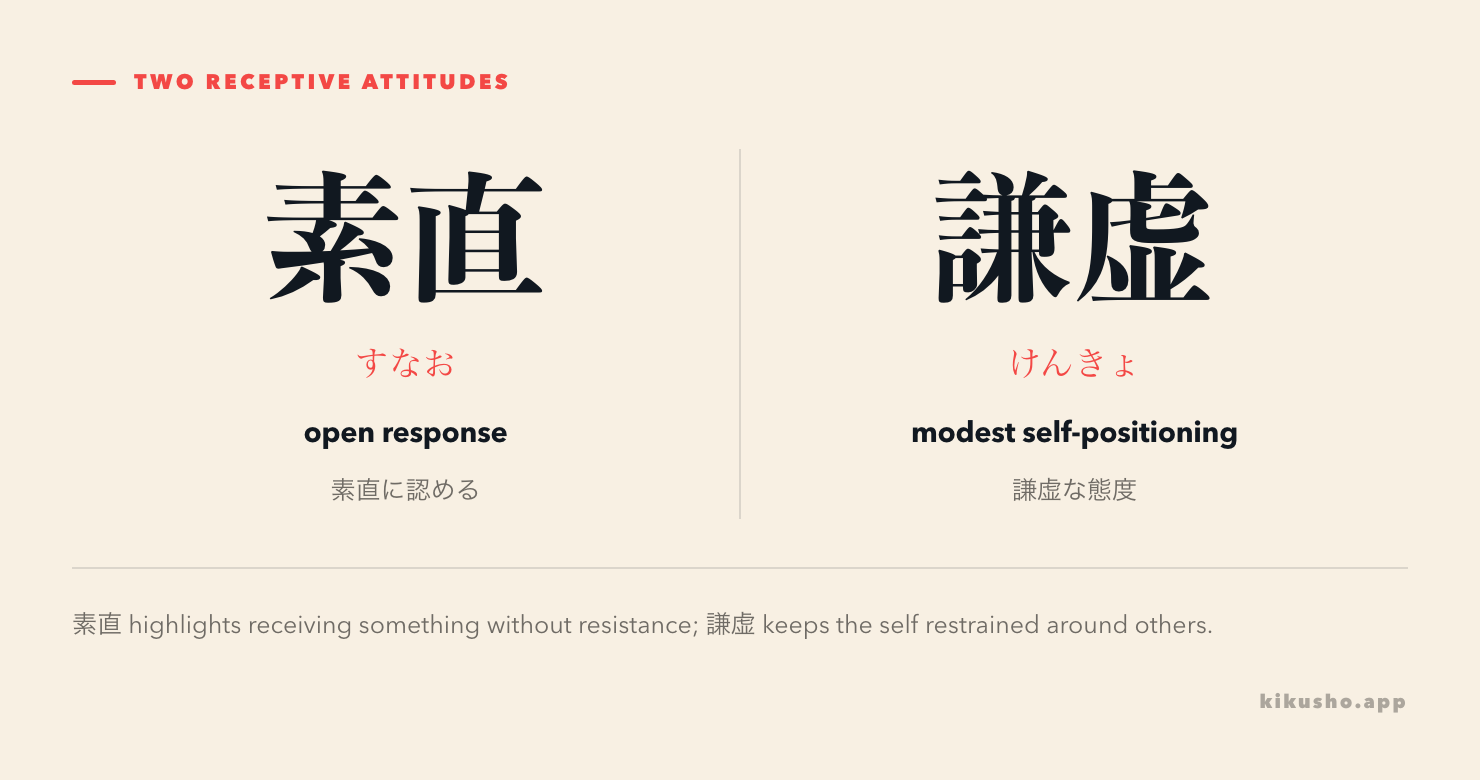
素直 accepts directly; 謙虚 keeps the self in proportion
素直(すなお) has several senses. In interpersonal contexts it often describes someone who is straightforward, free from contrariness, and willing to accept a fact or correction.
間違いを指摘され、彼女は素直に認めて謝った。
まちがいを してきされ、かのじょは すなおに みとめて あやまった。
When the mistake was pointed out, she acknowledged it openly and apologized.
The dictionary entry for 素直 also covers being unaffected or natural, a straight physical shape, and work without an idiosyncratic style. This lesson uses the interpersonal sense. 素直な気持ち, 素直に答える, and 素直に認める present a response without distortion or resistance; they do not simply mean obeying every order.
謙虚(けんきょ) describes modest, restrained conduct and receptiveness to another person's view. Shogakukan records 謙虚な態度 and 謙虚に反省する.
成功した後も、彼は謙虚な態度で周囲の意見を聞いた。
せいこうした あとも、かれは けんきょな たいどで しゅういの いけんを きいた。
Even after succeeding, he listened to the people around him with a modest attitude.
Someone may respond 素直に because they do not resist the truth, and remain 謙虚に because they do not place themselves above others. The first highlights the directness of the response; the second highlights modest self-positioning.
The relationship vocabulary lesson identifies roles such as 上司, 同僚 and 後輩. Those relationships often influence why the same remark is heard as candid, modest or 生意気.
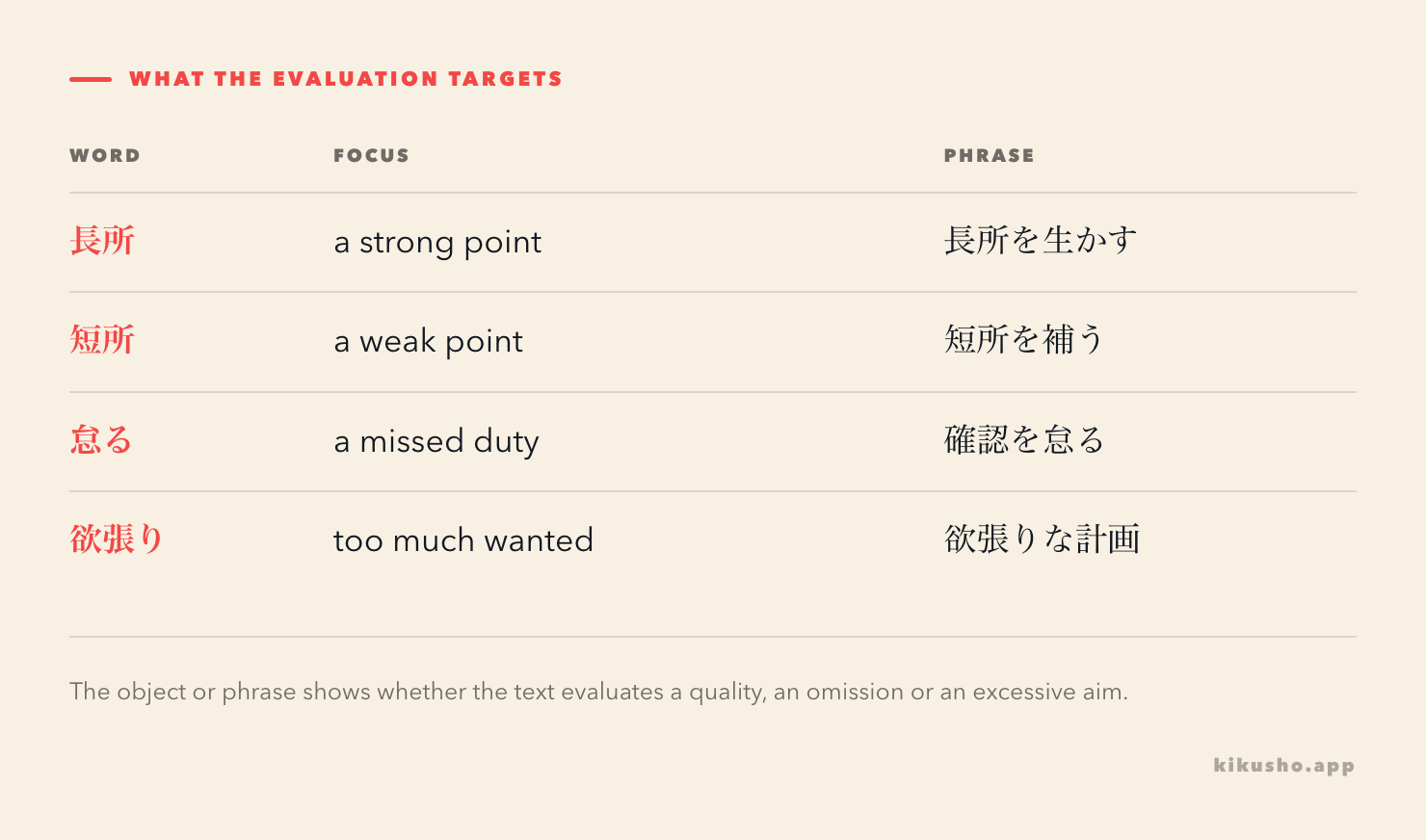
怠る names the duty or check that was missed
怠る(おこたる) is a transitive godan verb. Its object is often a duty, preparation, warning, check or necessary care that someone fails to perform.
安全確認を怠ると、大きな事故につながるおそれがある。
あんぜんかくにんを おこたると、おおきな じこに つながる おそれが ある。
Neglecting the safety check may lead to a serious accident.
Common objects include 注意, 努力, 連絡, 報告, 準備, and 点検. The wording is common in instructions, reports and criticism because it identifies the obligation left undone.
The modern core sense in Shogakukan's entry is failing to do what should be done or letting one's guard down. The same entry records an older literary sense, recovery from illness. That sense is outside the assigned N2 use.
怠ける(なまける) overlaps but more directly pictures someone being lazy or avoiding effort. Compare 勉強を怠ける, “slack off in studying,” with 必要な復習を怠る, “fail to do the necessary review.” The second sentence points to the omitted requirement. The N3 character and behaviour lesson develops 怠ける alongside the personality and conduct words that commonly surround it.
長所 and 短所 evaluate one side, not the whole person
長所(ちょうしょ) is an excellent point, merit or advantage. 短所(たんしょ) is an inferior or weak point. Both can describe a person, a plan, a tool or a method.
この方法の長所は、費用が少なくて済むことだ。
この ほうほうの ちょうしょは、ひようが すくなくて すむことだ。
The strength of this method is that it requires little expense.
ただし、時間がかかるという短所もある。
ただし、じかんが かかるという たんしょも ある。
However, it also has the drawback of taking time.
The 長所 entry gives 長所を伸ばす and 長所を生かす. The 短所 entry defines a deficient point, especially a negative side of character, and sets it against 長所. Other useful combinations are 短所を補う and 短所を改善する.
A sentence such as 彼の短所は慎重すぎることだ evaluates one tendency in a particular context. It does not prove that the person is generally bad. Likewise, a product's 長所 may become a 短所 when the user's needs change.
欲張り can criticize greed or an overloaded aim
欲張り(よくばり) is a noun and な-adjective for a person or stance that wants too much. It can sound morally critical when someone seeks an unfair share:
自分の分を取った後で、他の人の分まで欲しがるなんて欲張りだ。
じぶんの ぶんを とった あとで、ほかの ひとの ぶんまで ほしがるなんて よくばりだ。
Wanting everyone else's share after taking your own is greedy.
It can also be a lighter self-description of trying to fit too many aims into one plan:
一日で十か所も回ろうとするのは、少し欲張りな計画だ。
いちにちで じゅっかしょも まわろうとするのは、すこし よくばりな けいかくだ。
Trying to visit ten places in one day is a slightly overambitious plan.
The dictionary entry classifies 欲張り as a noun and adjectival noun and includes 欲張りな人. Tone depends on the target and stakes: criticism of taking another person's share is sharper than joking about an itinerary.
Read a workplace evaluation without turning it into a fixed label
Consider a review of a project leader:
彼女の長所は、批判を素直に受け止め、成功した後も謙虚でいられることだ。一方、安全確認を怠ることがあるのは短所だ。目標を増やしすぎると、計画が欲張りになってしまう。
かのじょの ちょうしょは、ひはんを すなおに うけとめ、せいこうした あとも けんきょで いられることだ。いっぽう、あんぜんかくにんを おこたることが あるのは たんしょだ。もくひょうを ふやしすぎると、けいかくが よくばりに なってしまう。
Her strength is that she takes criticism openly and stays modest after success. On the other hand, sometimes neglecting safety checks is a weakness. If too many goals are added, the plan becomes overloaded.
The passage moves between a response (素直に受け止める), an attitude (謙虚でいる), a missed obligation (確認を怠る), and an evaluation (長所/短所). None of those requires a permanent judgment about every aspect of the person.
Level labels disagree on two members of the set
The dated reference inventory places all nine records in this N2 section. Its Waller-derived rows disagree about 図々しい, placing it at N2 and N1, while 長所 appears at N2 there and on a separately published JapaneseTest4You N3 page. The Waller descendants form one source family, so repeated rows from that family are not independent confirmation.
These are study-order estimates. The JLPT's official FAQ says the former Test Content Specifications are no longer published, so no current official list assigns every word to one level. The article keeps the useful N2 reading task and reports the boundary rather than hiding it.
A useful card needs the evidence that triggered the judgment. In Kikusho, capture 厚かましい with its demanding request, 生意気 with the overconfident remark, or 怠る with the missed check. A bare gloss such as “bad attitude” cannot test the distinction.
Practice: nine decisions
Keep every answer hidden until you have attempted the full set.
1 · The long vowels. Which reading belongs to 図々しい?
- ① ずずしい
- ② ずうずうしい
- ③ ずうずしい
- ④ ととしい
2 · Restore the verb. Select the kanji for 安全確認を おこたる.
- ① 劣る
- ② 怒る
- ③ 怠る
- ④ 断る
3 · Shape the modifier. Which phrase is grammatically complete?
- ① 謙虚い態度
- ② 謙虚の態度
- ③ 謙虚だ態度
- ④ 謙虚な態度
4 · Preface to a demanding request. Which opening acknowledges that the speaker is asking a lot?
- ① 厚かましいお願いですが
- ② 素直なお願いですが
- ③ 短所のお願いですが
- ④ 怠るお願いですが
5 · Standing and impertinence. A novice speaks as if an experienced specialist knows nothing. Which judgment focuses on overstepping one's ability or position?
- ① 長所
- ② 生意気
- ③ 謙虚
- ④ 素直
6 · Response to correction. Which paraphrase best matches 間違いを素直に認めた?
- ① The person openly acknowledged the mistake without resisting the fact.
- ② The person hid the mistake to protect a colleague.
- ③ The person treated the mistake as a personal strength.
- ④ The person demanded praise for making the mistake.
7 · Two sides of a method. Fill the blanks in order.
費用が少ないのはこの方法の( 前 )だが、時間がかかるのは( 後 )だ。
- ① 前:短所 / 後:長所
- ② 前:長所 / 後:短所
- ③ 前:欲張り / 後:謙虚
- ④ 前:素直 / 後:生意気
8 · A missed obligation. Which sentence uses 怠る in its central modern sense?
- ① 必要な報告を怠ったため、問題の発見が遅れた。
- ② 休日に公園で怠って、楽しく遊んだ。
- ③ 新しい計画を怠りな人に説明した。
- ④ 彼の長所は怠るそうだ。
9 · Read the evaluation. Decide which pair preserves both judgments in the passage.
彼は成功しても( 前 )な態度を保つ。しかし、一度に全部の利益を得ようとするところは少し( 後 )だ。
- ① 前:図々しい / 後:素直
- ② 前:生意気 / 後:短所
- ③ 前:謙虚 / 後:欲張り
- ④ 前:厚かましい / 後:長所
Settle both gaps before opening the panel; the first depends on the attitude after success, and the second on wanting every benefit.
Answers and explanations
②, ずうずうしい. Both repeated syllables contain a long う. The dictionary headword may be displayed as 図図しい, while the assigned and common spelling here is 図々しい.
③, 怠る. 安全確認を怠る means failing to perform a safety check. 劣る is おとる, 怒る is おこる, and 断る is ことわる.
④, 謙虚な態度. 謙虚 behaves as a な-adjective before a noun. It can also appear predicatively as 態度が謙虚だ or adverbially as 謙虚に聞く.
①, 厚かましいお願いですが. The speaker labels the request presumptuous before making it. The phrase acknowledges the burden but still requires a suitably polite request after it.
②, 生意気. The scenario foregrounds a novice behaving as though their ability or standing exceeds that of the specialist. 厚かましい or 図々しい could criticize other aspects of conduct, but 生意気 answers the stated boundary.
①. 素直に認める presents direct acceptance of the fact without twisting or resisting it. It does not imply concealment, praise seeking or treating an error as a merit.
②, 長所 / 短所. Low cost is presented as the method's advantage; taking time is its disadvantage. Both nouns can evaluate a method as well as a person.
①. The required report was not made, so 報告を怠った names an omitted obligation. The other sentences give 怠る impossible adjectival or activity uses.
③, 謙虚 / 欲張り. Staying modest after success is 謙虚な態度. Trying to secure every benefit at once is evaluated as 欲張りだ.
Common questions
What is the difference between 厚かましい, 図々しい and 生意気?
厚かましい and 図々しい overlap in describing shamelessly inconsiderate behaviour. 厚かましい also appears in a conventional self-critical preface to a large request. 生意気 criticizes speech or conduct that oversteps what someone's age, ability or position warrants.
What is the difference between 素直 and 謙虚?
素直 describes openness, honesty or accepting something without twisting or resisting it. 謙虚 describes modest, restrained conduct and a readiness to receive another person's view without placing oneself above them.
What is the difference between 怠る and 怠ける?
怠る usually names a duty, check or necessary action that someone fails to perform, as in 注意を怠る. 怠ける more directly describes being lazy or avoiding work. Their meanings overlap, but their usual focus differs.
Are 長所 and 短所 only used for people's personalities?
No. They can describe good and weak points in a person, plan, method, product or system. Common combinations are 長所を生かす and 短所を補う.