On this page
N2 rail vocabulary follows the passenger through the whole system: buying one-way or return travel, entering through the ticket gate, boarding, transferring, reading which stations a train stops at and leaving at the destination. The fifteen assigned records are 往復(おうふく), 改札(かいさつ), 片道(かたみち), 下車(げしゃ), 指定(してい), 車掌(しゃしょう), 新幹線(しんかんせん), 乗車(じょうしゃ), 線路(せんろ), 定期券(ていきけん), 停車(ていしゃ), 乗り換え(のりかえ), 乗換(のりかえ), 踏切(ふみきり) and 満員(まんいん).
This is a journey vocabulary set, but the words do different jobs. 片道 and 往復 describe the shape of the fare. 乗車, 乗り換え and 下車 divide the movement into stages. 改札, 線路 and 踏切 name parts of the railway system, while 指定, 停車, 車掌 and 満員 help you interpret its rules and condition.
Fifteen records cover tickets, movement, staff and infrastructure
| Rail record | Class and selected sense | Useful pairing |
|---|---|---|
| 往復(おうふく) | noun and する verb: going and returning; round trip | 東京と京都を往復する, make a round trip between Tokyo and Kyoto |
| 改札(かいさつ) | noun and する verb: ticket inspection; also the gate area | 改札を通る, pass through the ticket gates |
| 片道(かたみち) | noun and の adjective: one way; one side of a journey | 片道切符, one-way ticket |
| 下車(げしゃ) | noun and する verb: getting off a train or vehicle | 東京駅で下車する, get off at Tokyo Station |
| 指定(してい) | noun and する verb: designation or specification | 座席を指定する, specify a seat |
| 車掌(しゃしょう) | noun: train or bus conductor | 車掌に尋ねる, ask the conductor |
| 新幹線(しんかんせん) | noun and proper service name: the Shinkansen | 新幹線に乗る, take the Shinkansen |
| 乗車(じょうしゃ) | noun and する verb: boarding or riding a train or bus | 新幹線に乗車する, board the Shinkansen |
| 線路(せんろ) | noun: railway track or roadbed | 線路に入らない, do not enter the tracks |
| 定期券(ていきけん) | noun: commuter or season pass | 定期券を更新する, renew a commuter pass |
| 停車(ていしゃ) | noun and する verb: a vehicle stopping | 各駅に停車する, stop at every station |
| 乗り換え(のりかえ) | noun: transfer between vehicles; full spelling | 乗り換えが一回ある, there is one transfer |
| 乗換(のりかえ) | noun: the same transfer word in a compact spelling | 乗換案内, transfer guide |
| 踏切(ふみきり) | noun: railway level crossing; also a take-off point in sport | 踏切を渡る, cross a railway crossing |
| 満員(まんいん) | noun and の adjective: at capacity with people | 満員電車, a packed train |
The N3 rail lesson reads the operating message through ダイヤ, 発車時刻, 遅れ and 料金. This N2 set reads the passenger's transaction and path through the station.
片道 and 往復 describe the journey, but ticket products can change
片道(かたみち) means one direction of travel. It can modify a ticket, fare, distance or time:
東京から京都まで片道で買いました。
とうきょうから きょうとまで かたみちで かいました。
I bought a one-way ticket from Tokyo to Kyoto.
往復(おうふく) joins 往, going, to 復, returning. It can be the round trip itself or a する verb:
東京と京都を新幹線で往復しました。
とうきょうと きょうとを しんかんせんで おうふくしました。
I made a round trip between Tokyo and Kyoto by Shinkansen.
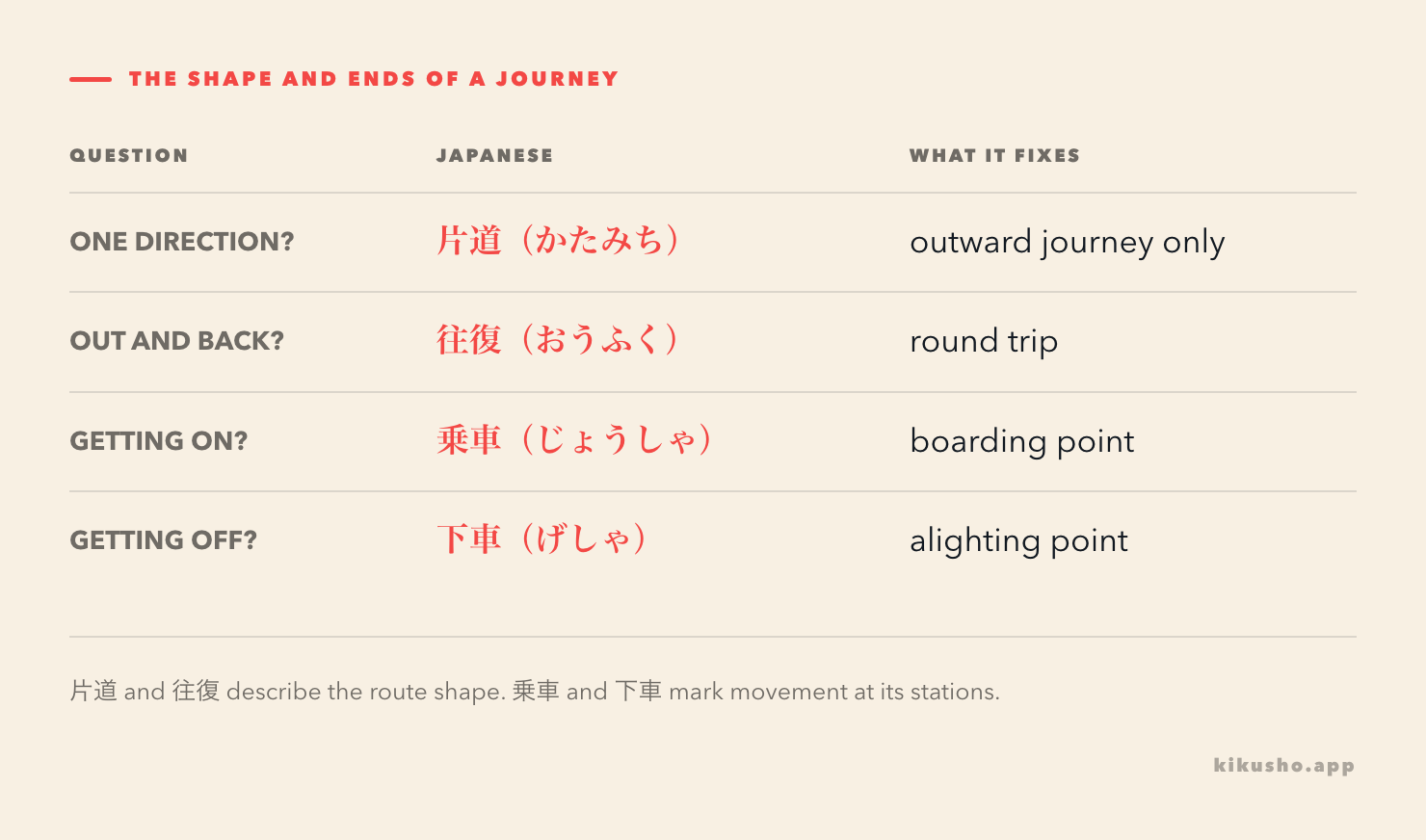
A vocabulary definition should not freeze an old ticket rule. JR companies ended sales of the traditional combined 往復乗車券 in March 2026, along with the former long-distance round-trip discount. JR East's current guidance tells passengers making a return journey to buy a separate ticket for each direction. 往復 still means round trip in ordinary Japanese, and operators can still use it in other product names. It no longer guarantees that one combined JR ticket is available.
改札, 乗車 and 下車 mark three station boundaries
改札(かいさつ) first names the checking or validation of a ticket. It also abbreviates 改札口, the place where that check happens. The dictionary entry records both uses.
- 改札を通る: pass through the ticket gates
- 改札口で待つ: wait at the ticket-gate entrance
- 改札機に定期券をタッチする: tap a commuter pass on the gate machine
乗車(じょうしゃ) is the formal noun and する verb for boarding or riding a train or bus. 下車(げしゃ) is its opposite, getting off. The everyday verbs are 乗る and 降りる; the Sino-Japanese pair appears often in notices, ticket rules and compounds such as 乗車券 and 途中下車.
品川駅から乗車し、名古屋駅で下車します。
しながわえきから じょうしゃし、なごやえきで げしゃします。
I board at Shinagawa Station and get off at Nagoya Station.
The particles reflect the role. The starting station takes から, the vehicle can take に, and the station where the action of getting off happens takes で. JR East defines 途中下車 more narrowly than simply leaving a train: it means exiting the ticket gates at an intermediate station and later continuing the journey on the same eligible ticket.
定期券(ていきけん) is a commuter pass valid for repeated travel over a fixed route and period. The N3 lesson showed that station speech can shorten it to 定期. The full N2 record is what appears in formal phrases such as 定期券区間, the section covered by the pass, and 定期券を更新する, renew a pass.
指定, 停車 and 車掌 tell you how a service is operated
指定(してい) means selecting and fixing a particular person, place, time or thing. It does not mean “reserved seat” by itself in every context. Rail travel supplies compounds that narrow it:
- 指定席: a reserved or assigned seat
- 指定席券: a reserved-seat ticket
- 全席指定: all seats are reserved
- 指定された列車: the specified train
この新幹線は全席指定です。
この しんかんせんは ぜんせきしていです。
All seats on this Shinkansen service are reserved.
Shogakukan's 指定 entry gives the wider act of designating and also records 指定 as an abbreviation of 指定席. A notice such as 全席指定 contains the reserved-seat meaning; 指定の時刻 simply means the specified time.
停車(ていしゃ) describes a vehicle stopping. On a timetable, 停車駅 is a station where the service stops:
この列車は次の駅には停車しません。
この れっしゃは つぎの えきには ていしゃしません。
This train does not stop at the next station.
発車 in the N3 lesson is departure. The sequence is therefore 停車する → 乗客が乗車・下車する → 発車する. 停止 is the wider word for something ceasing movement or activity; train-service notices prefer 停車 when the stop at a station is the point.
車掌(しゃしょう) is the conductor who works aboard the train or bus. The 車掌 definition covers passenger service and safety duties. A station employee is 駅員; the driver is 運転士. The three roles should not collapse into one translation such as “train staff.”
乗り換えについて車掌に尋ねました。
のりかえについて しゃしょうに たずねました。
I asked the conductor about the transfer.
乗り換え and 乗換 are one word with two visible shapes
The inventory contains both 乗り換え and 乗換, each read のりかえ. They name the same act of leaving one vehicle and boarding another. The difference is orthographic, not semantic.
乗り換え keeps the okurigana from 乗り換える and is easy to read in prose. 乗換 removes them for a compact label, as in 乗換案内, 乗換駅 and route-search interfaces. 乗換え is a third spelling you may meet. Shogakukan's 乗換え entry groups these written forms under the same noun.
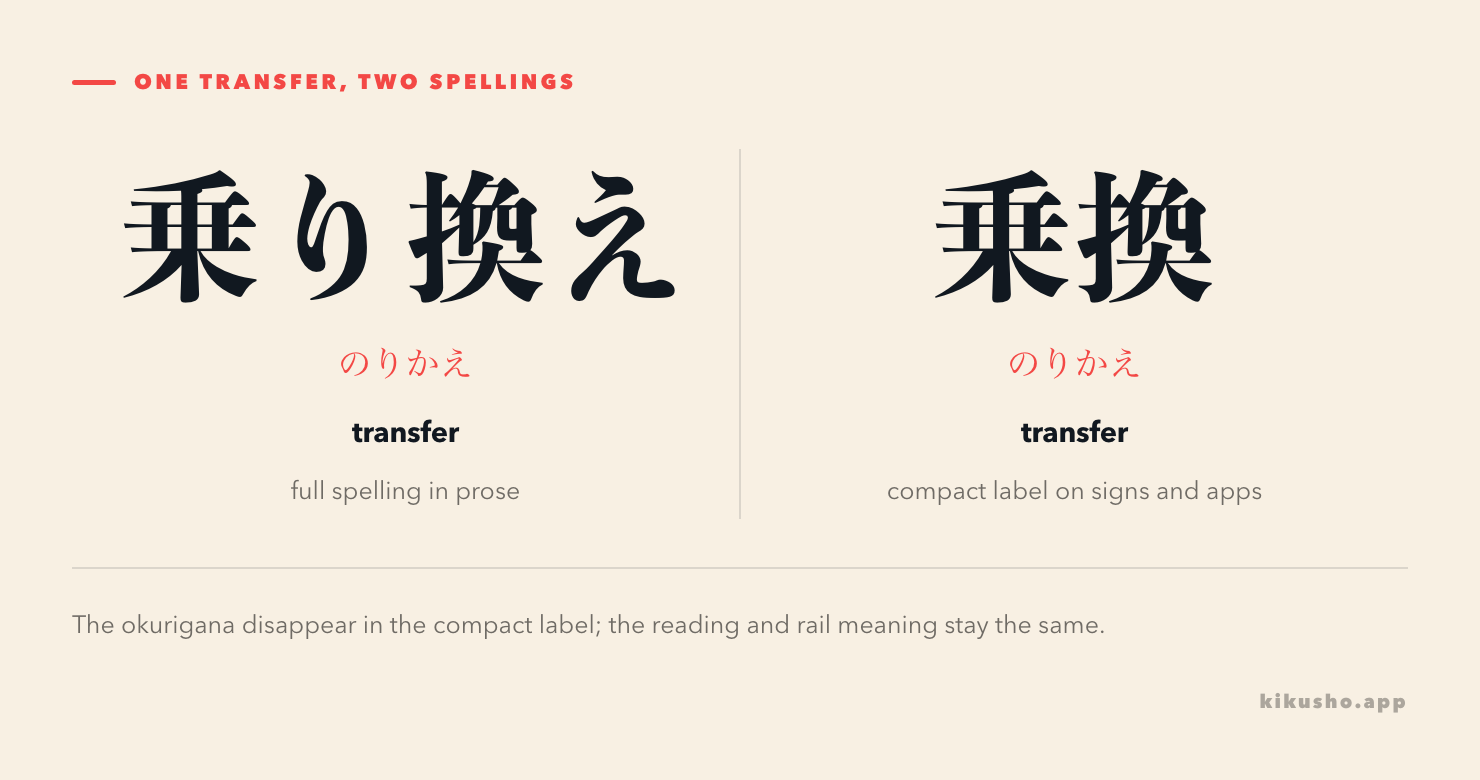
乗換案内では、新大阪駅での乗り換えが必要だと表示されました。
のりかえあんないでは、しんおおさかえきでの のりかえが ひつようだと ひょうじされました。
The transfer guide showed that a transfer at Shin-Osaka Station was necessary.
The N4 verb lesson gives the particle pattern AからBに乗り換える. With the noun, compare 新幹線への乗り換え, a transfer to the Shinkansen, and 地下鉄からの乗り換え, a transfer from the subway.
線路 and 踏切 describe the railway where the road meets it
線路(せんろ) is the railway track or roadbed on which trains run. It is more physical than 路線, which names an organised route or line of service. A train can operate on a 路線; people must not enter the 線路.
踏切(ふみきり) is a place where a railway and a road cross at the same level. The transport ministry's rail-safety notice pairs 線路に入らないで with instructions to stop when a crossing alarm sounds. The dictionary entry also records sports and decision-related senses, but a barrier, warning bell or nearby track selects the railway crossing.
踏切の警報機が鳴ったら、線路に入らないでください。
ふみきりの けいほうきが なったら、せんろに はいらないで ください。
When the crossing alarm sounds, please do not enter the tracks.
A 横断歩道 is a pedestrian crossing on a road. A 踏切 crosses railway tracks. English “crossing” is too broad to preserve that distinction by itself.
満員 counts people; 満席 counts seats
満員(まんいん) means that the permitted number of people has been reached or that a space is packed with people. 満員電車 is a crowded train at capacity. Shogakukan defines 満員 through 定員, the allowed number of people.
朝の列車は満員で、乗車できませんでした。
あさの れっしゃは まんいんで、じょうしゃできませんでした。
The morning train was full, so I could not board.
満席 instead says every seat is occupied or booked. A Shinkansen's 指定席 can be 満席 while passengers still travel in another carriage or under a different ticket arrangement. 満員 looks at people against capacity; 満席 looks at seats against availability.
One trip connects all fifteen records
券売機で片道と往復の運賃を比べた。帰る日が決まっていなかったので、片道の乗車券と新幹線の指定席券を買い、定期券を使わずに改札を通った。乗車後、車掌に停車駅を確認した。車内はほぼ満員だった。乗換案内には「名古屋で乗換」とあり、名古屋駅で別の列車に乗り換えた。目的地で下車すると、駅の近くでは踏切を通る道路が線路を横切っていた。
けんばいきで かたみちと おうふくの うんちんを くらべた。かえる ひが きまって いなかったので、かたみちの じょうしゃけんと しんかんせんの していせきけんを かい、ていきけんを つかわずに かいさつを とおった。じょうしゃご、しゃしょうに ていしゃえきを かくにんした。しゃないは ほぼ まんいんだった。のりかえあんないには「なごやで のりかえ」と あり、なごやえきで べつの れっしゃに のりかえた。もくてきちで げしゃすると、えきの ちかくでは ふみきりを とおる どうろが せんろを よこぎって いた。
I compared the one-way and round-trip fares at the ticket machine. Because my return date was undecided, I bought a one-way base-fare ticket and a reserved-seat ticket for the Shinkansen, then passed through the gate without using my commuter pass. After boarding, I confirmed the stopping stations with the conductor. The train was nearly full. The transfer guide showed “Transfer at Nagoya,” so I changed to another train there. When I got off at my destination, a road crossed the tracks at a railway crossing near the station.
The passage moves in the order the railway requires: fare shape, ticket choice, gate, boarding, service information, transfer and alighting. The N2 map-and-route lesson continues outside the station with 周辺, 付近, 方角 and 道順.
If you save a route result in Kikusho, keep the compact label and the sentence around it. A card built from 名古屋で乗換 should preserve the reading のりかえ and connect it to 名古屋駅で別の列車に乗り換える. That prevents sign-style spelling from becoming a second, disconnected word.
The exact results page included Amiko's N2 travel list, which uses 車掌, 定期券, 改札機 and 指定席 in connected examples, and Learn Japanese Online's station list, which pairs 片道 with 往復 and 改札口. The dictionary and railway sources above verify the particular senses and current ticket rules. N2 here is Kikusho's editorial classification rather than an official checklist: the JLPT organisers explain that no definitive current vocabulary list is published.
The dated Kikusho inventory places all fifteen records at N2. The two baseline files share Tanos/Waller ancestry and therefore count as one source family. One row from that family also places 乗り換え at N1; it does not create independent evidence for a second level. Both 乗り換え and 乗換 remain in this lesson because the inventory tracks their distinct visible spellings, even though dictionaries treat them as one lexical item.
Follow the journey before opening the explanations
1 — Read the staff role. How is 車掌 read?
- ア. しゃしょう
- イ. しゃじょう
- ウ. くるましょう
- エ. しゃそう
2 — Choose the railway spelling. Which word completes “railway crossing” in __を渡る?
- ア. 踏切
- イ. 横断歩道
- ウ. 線道
- エ. 踏線
3 — Choose the journey shape. You know the outward date but have not decided when to return. Which phrase explicitly asks for travel in only one direction?
- ア. 往復でお願いします。
- イ. 片道でお願いします。
- ウ. 定期券でお願いします。
- エ. 満員でお願いします。
4 — Complete the movement. Choose the pair that means “Board at Shinagawa and get off at Nagoya.”
品川駅から__し、名古屋駅で__します。
- ア. 下車 / 乗車
- イ. 停車 / 指定
- ウ. 乗車 / 下車
- エ. 往復 / 片道
5 — Read the compact label. What does 新大阪で乗換 tell the passenger?
- ア. The train stops permanently at Shin-Osaka.
- イ. Change trains at Shin-Osaka.
- ウ. Buy a commuter pass at Shin-Osaka.
- エ. Leave the station through the Shin-Osaka gate.
6 — Interpret 指定. What does 全席指定 mean on a train notice?
- ア. Every train stops at every station.
- イ. Every passenger must use a commuter pass.
- ウ. All seats are reserved or assigned.
- エ. The train is full of standing passengers.
7 — Choose the operating verb. Complete the announcement: この新幹線は京都駅に__しません。
- ア. 改札
- イ. 満員
- ウ. 停車
- エ. 往復
8 — Read the whole instruction. What must the passenger do?
指定席券を確認してから改札を通り、8番線から乗車してください。名古屋駅で下車し、在来線に乗り換えます。
- ア. Use an unreserved seat, leave at Kyoto and walk across the tracks.
- イ. Check the reserved-seat ticket, board from track 8, get off at Nagoya and transfer to a conventional line.
- ウ. Renew a commuter pass at gate 8 and remain on the same train.
- エ. Ask the conductor to buy a round-trip ticket after leaving Nagoya.
Check the route and ticket answers
1. Choose ア, しゃしょう. 車掌(しゃしょう) is the conductor who works aboard a train or bus. 駅員 is station staff, and 運転士 is the driver.
2. Choose ア, 踏切. 踏切(ふみきり) is a level crossing where a road and railway meet. 横断歩道 is a pedestrian road crossing; the other two compounds are not the assigned word.
3. Choose イ, 片道でお願いします. 片道 requests one-way travel. 往復 states an outward and return journey, while 定期券 is a commuter pass and 満員 describes capacity.
4. Choose ウ: 乗車, then 下車. 品川駅から乗車する begins the ride at Shinagawa. 名古屋駅で下車する ends that stage at Nagoya. The reverse order would contradict the stated movement.
5. Choose イ. 乗換 is the compact spelling of 乗り換え, so the label instructs the passenger to change trains at Shin-Osaka. It does not change the reading or meaning.
6. Choose ウ. 指定 means that something has been selected and fixed. In 全席指定, every seat is assigned in advance; the notice says nothing about stopping pattern or crowding.
7. Choose ウ, 停車. 京都駅に停車する means stop at Kyoto Station. The negative announcement says this Shinkansen does not stop there. 発車 would describe departing, not whether Kyoto is a scheduled stop.
8. Choose イ. The sequence is explicit: check the reserved-seat ticket, pass through the gate, board from track 8, get off at Nagoya and transfer to a conventional line. No commuter-pass renewal, track crossing or onboard ticket purchase is stated.
Common questions
What is the difference between 片道 and 往復?
片道(かたみち) is a one-way journey or ticket. 往復(おうふく) is a round trip, travelling out and back. JR companies ended sales of the traditional combined 往復乗車券 in March 2026, but 往復 remains the ordinary word for a round trip.
What is the difference between 改札 and 改札口?
改札(かいさつ) first means checking or validating tickets and can also abbreviate the ticket-gate area. 改札口(かいさつぐち) explicitly names the gate or entrance where that check happens. 改札機 is the gate machine.
Are 乗り換え and 乗換 different words?
No. Both are read のりかえ and mean a transfer between vehicles. 乗り換え is the full kana-and-kanji spelling; 乗換 is a compact spelling common in route searches, signs and labels. 乗換え is another accepted written form.
What is the difference between 満員 and 満席?
満員(まんいん) means a vehicle or venue has reached its capacity for people, as in 満員電車. 満席(まんせき) means every seat is occupied or booked. A train can have no available seats without every carriage being full.