On this page
Six N4 words let you read the decision a timetable is asking you to make: take the 普通(ふつう), wait for the 急行(きゅうこう) or 特急(とっきゅう), 乗り換える(のりかえる), and understand who or what 遅れる(おくれる). The sixth word, 汽車(きしゃ), belongs to rail travel too, but it does not label every modern train in the same way as 電車 or 列車.
These words form a small system. Three classify a service, two describe what happens during the journey, and one requires a historical and regional usage note.
Six words turn a timetable into a travel decision
| Rail word | Word class and practical sense | Phrase to keep |
|---|---|---|
| 普通(ふつう) | noun, な-adjective and adverb: ordinary, usual; local train | 普通に乗る, take the local train |
| 急行(きゅうこう) | noun and する verb: express service; hurry to a place | 急行に乗る, take the express |
| 特急(とっきゅう) | noun: limited express; abbreviation of 特別急行 | 特急券, limited-express ticket |
| 乗り換える(のりかえる) | ichidan verb: leave one vehicle and board another | 東京駅で乗り換える, transfer at Tokyo Station |
| 遅れる(おくれる) | intransitive ichidan verb: be late, fall behind or be delayed | 電車が遅れる, the train is delayed |
| 汽車(きしゃ) | noun: steam train; also train in broader older or regional use | 汽車に乗る, ride a train |
The N5 transport lesson teaches the journey's base verbs and particles: 電車に乗る, 電車を降りる and 駅に着く. This N4 set begins after that first boarding. It helps you choose a service, change it and react when the planned time changes.
普通, 急行 and 特急 describe service patterns, not three kinds of vehicle
The same physical train can be operated under a service label. 普通 is the ordinary or local service. A dictionary definition of 普通列車 says it stops at all or nearly all stations and contrasts it with rapid and express services.
この駅には普通しか止まりません。
この えきには ふつうしか とまりません。
Only local trains stop at this station.
急行 is an express service. The 急行列車 dictionary entry describes a train that stops only at major stations and operates faster than a local service.
急行は次の二つの駅には止まりません。
きゅうこうは つぎの ふたつの えきには とまりません。
The express does not stop at the next two stations.
特急 abbreviates 特別急行(とくべつきゅうこう), “special express,” conventionally translated as “limited express.” The 特急 entry identifies that abbreviation, and its linked definition describes a service with fewer stops than an express.
大阪まで特急で行きます。
おおさかまで とっきゅうで いきます。
I am going to Osaka by limited express.
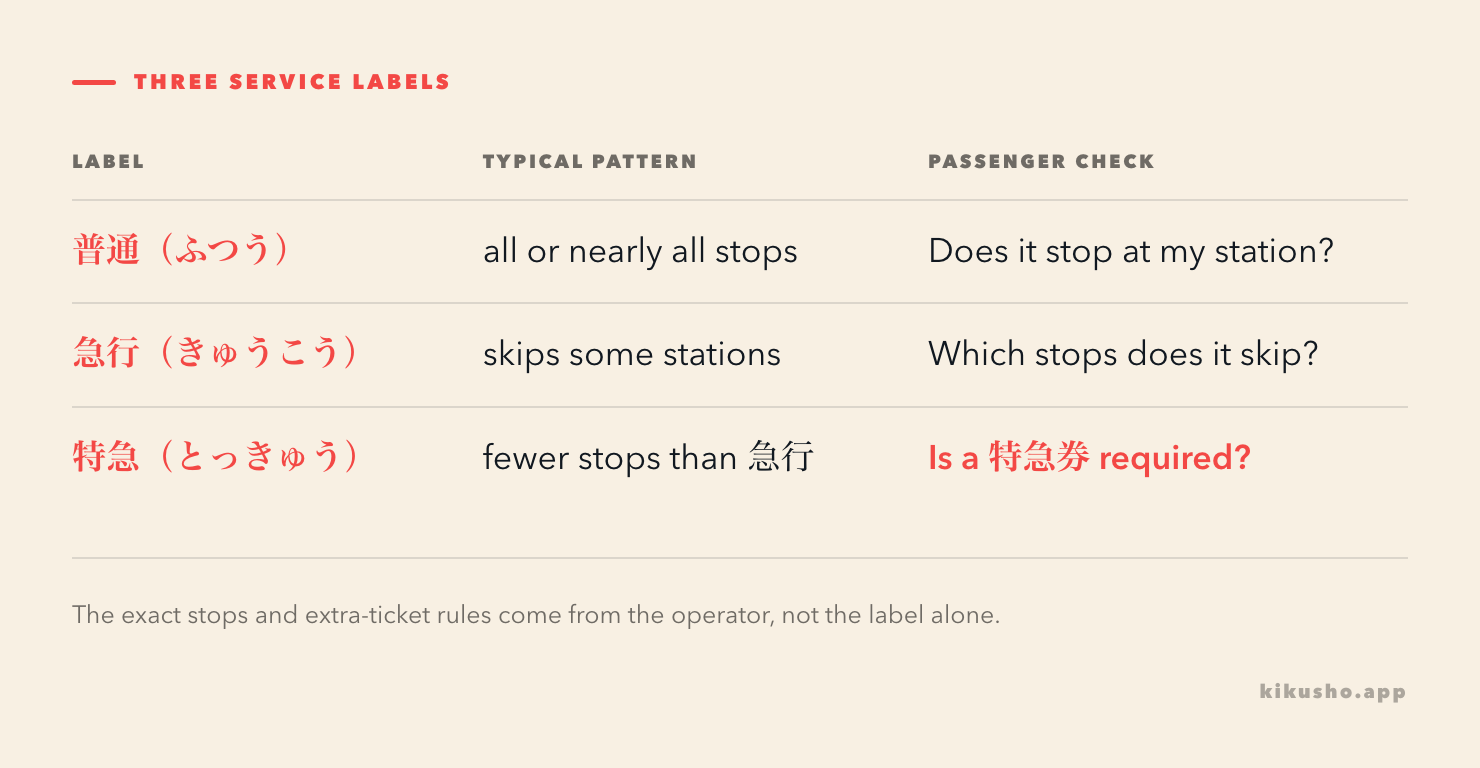
The useful order is usually 普通 → 急行 → 特急, from more stops to fewer. It is not a nationwide promise about every station or fare. Railway companies define their own stopping patterns, and labels such as 快速, 準急 or 通勤急行 can sit between them. A JR limited express commonly requires a base fare plus a 特急券; JR Central's passenger fare rules explicitly regulate limited-express and ordinary-express surcharges. Some private commuter railways use express labels without an extra ticket. Check the operator's stop list and ticket notice instead of inferring the whole rule from the name.
The general word 普通 is wider than trains. 普通の店 is an ordinary shop, and 普通に行く can mean go normally. A departure board supplies the rail sense because 普通 appears beside a destination and time.
乗り換える links the service you leave to the one you board
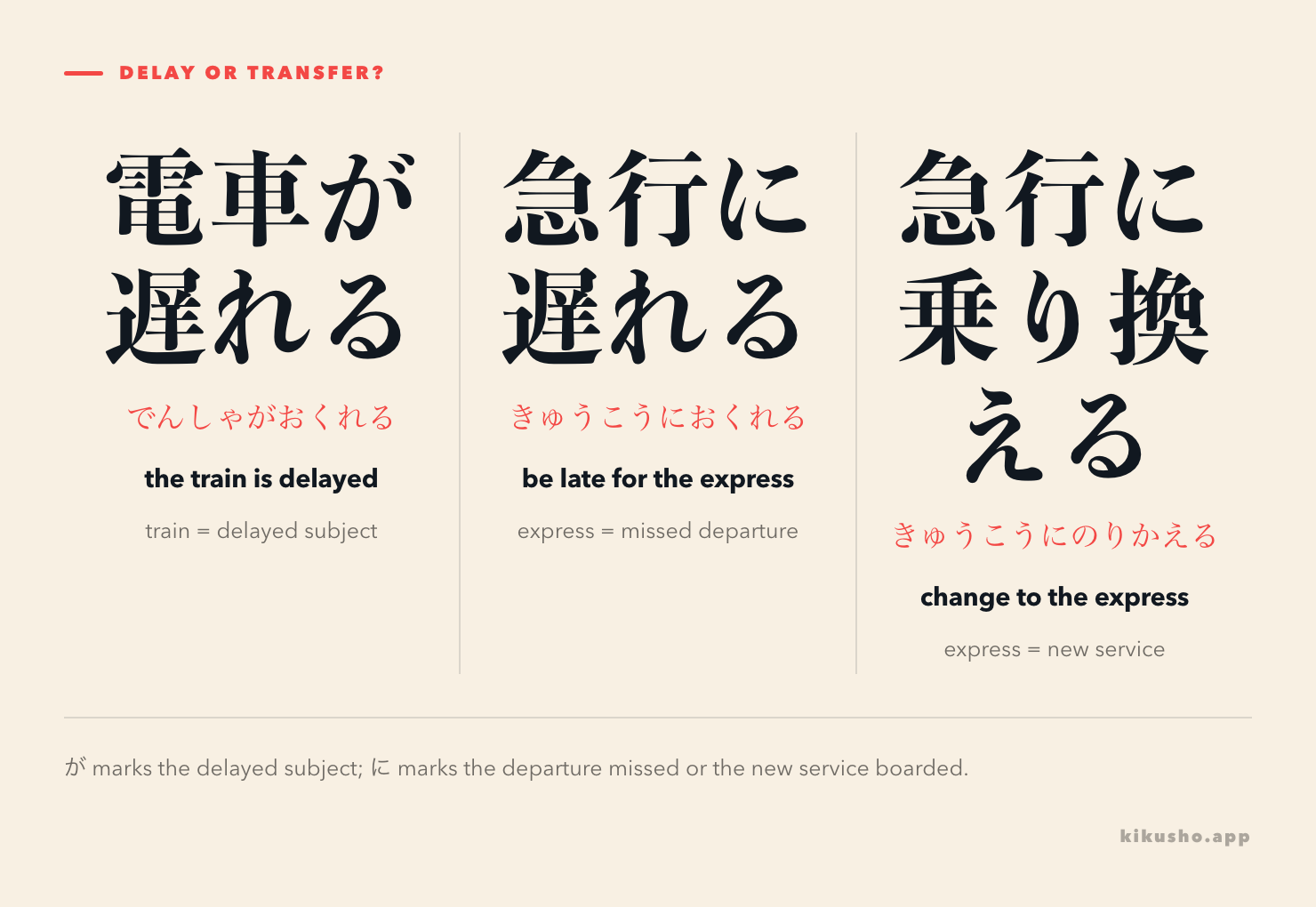
乗り換える joins 乗る, ride, with 換える, exchange or replace. It means getting off one vehicle and boarding another. Shogakukan's 乗り換える entry gives the exact example 各駅停車から急行に乗り換える, changing from a local train to an express.
Use で for the station where the transfer happens:
京都駅で乗り換えてください。
きょうとえきで のりかえて ください。
Please transfer at Kyoto Station.
Use から for the service you leave and に for the service you board:
普通から急行に乗り換えます。
ふつうから きゅうこうに のりかえます。
I change from the local train to the express.
As an ichidan verb, it becomes 乗り換えます, 乗り換えて and 乗り換えた. The noun 乗り換え appears on route apps and signs, but the assigned record here is the verb. Keep the whole pattern AからBに乗り換える when a flashcard needs both the meaning and the particles.
遅れる changes meaning with が and に
遅れる means that someone or something is later than a schedule, behind a standard or unable to meet a set time. The dictionary entry includes a departure time becoming late, a clock running slow and a person falling behind.
With が, the train is the delayed subject:
電車が十分遅れています。
でんしゃが じゅっぷん おくれています。
The train is running ten minutes late.
With に, the following noun is the appointment or departure someone fails to meet:
急行に遅れたので、次の普通に乗りました。
きゅうこうに おくれたので、つぎの ふつうに のりました。
I was late for the express, so I took the next local train.
急行に乗り遅れた makes “missed the express” more explicit. The shorter 急行に遅れた depends on the に pattern and context. With people, 約束に遅れる is be late for an appointment and 学校に遅れる is be late for school.
汽車 is accurate, but it is not the default label for every modern train
汽車 literally points to steam: 汽 carries the idea of vapour, and the original sense is a train pulled by a steam locomotive. The Goo dictionary record gives that sense first, then a broader railway-train sense, especially a long-distance train. Shogakukan's 汽車 examples likewise show the word used for a train in ordinary journey phrases.
昔、この町には汽車が走っていました。
むかし、この まちには きしゃが はしっていました。
Long ago, steam trains ran through this town.
In present urban travel, 電車(でんしゃ) is the natural everyday word for an electric train. 列車(れっしゃ) is the general operational term and works regardless of the power source. 汽車 still appears in historical descriptions, songs, literary language and some regional speech where it can mean a train more broadly. The N4 list is therefore worth recognising, but replacing every occurrence of “train” with 汽車 would sound dated or regionally marked.
One disrupted journey uses all six words
駅に着くと、乗る予定の急行が十分遅れていました。先に出る普通に乗り、途中の駅で特急に乗り換えることにしました。特急券が必要か駅員に確認しました。目的地の駅前には、昔使われていた汽車が展示されていました。
えきに つくと、のる よていの きゅうこうが じゅっぷん おくれていました。さきに でる ふつうに のり、とちゅうの えきで とっきゅうに のりかえる ことに しました。とっきゅうけんが ひつようか えきいんに かくにんしました。もくてきちの えきまえには、むかし つかわれていた きしゃが てんじされていました。
When I arrived at the station, the express I planned to take was ten minutes late. I took a local train leaving first and decided to transfer to a limited express at an intermediate station. I asked the station attendant whether I needed a limited-express ticket. In front of the destination station, an old steam train was on display.
The service labels decide where the train stops. 乗り換える connects two legs of the journey. 遅れる explains why the plan changes. 汽車 appears only when the historical vehicle makes that word appropriate.
Kikusho's dated inventory places all six spelling-and-reading records at N4. Two baseline files share Tanos/Waller ancestry and count as one source family; JapaneseTest4You independently lists 遅れる, 汽車 and 普通 at N4, while Amiko's N4 travel list supports the broader theme. These are editorial study estimates. The JLPT organisers do not publish an exhaustive current vocabulary syllabus.
Practise reading the departure board
1 — Read 特急
How is 特急 read?
- ア. とくきゅう
- イ. とっきゅう
- ウ. どっきゅう
- エ. ときゅう
2 — Choose a local service
Which label normally describes a train that stops at all or nearly all stations?
- ア. 普通
- イ. 急行
- ウ. 特急
- エ. 汽車
3 — Identify the delayed subject
Which sentence means “The train is running ten minutes late”?
- ア. 電車に十分遅れています。
- イ. 電車を十分遅れています。
- ウ. 電車が十分遅れています。
- エ. 電車で十分遅れています。
4 — Build a transfer
Complete the sentence: 普通__急行__乗り換えます。
- ア. に/から
- イ. から/に
- ウ. で/を
- エ. を/で
5 — Pick the transfer location
Which particle fits 京都駅__乗り換えてください?
- ア. が
- イ. を
- ウ. に
- エ. で
6 — Interpret 汽車 precisely
Which statement best describes 汽車 in current Japanese?
- ア. It is the only correct word for every passenger train.
- イ. It specifically began as “steam train” and can have a broader older or regional train sense.
- ウ. It means only an underground electric train.
- エ. It is another reading of 特急.
7 — Put the journey in order
Arrange these parts to say “I change from the local train to the limited express at Nagoya Station.”
- 特急に
- 名古屋駅で
- 普通から
- 乗り換えます
8 — Read the reason for a changed plan
急行が遅れているので、先に出る普通に乗ります。 What will the passenger do?
- ア. Wait for the delayed express without changing the plan.
- イ. Take the local train that departs first.
- ウ. Transfer from a limited express to a steam train.
- エ. Miss the local train because the passenger is late.
Answers and explanations
1. イ, とっきゅう. 特急 is read とっきゅう, with a small っ before きゅう. とくきゅう shows the underlying parts too directly and is not this word's reading.
2. ア, 普通. 普通 is the ordinary or local service and normally makes all or nearly all stops. 急行 and 特急 skip stops; 汽車 names a train rather than a stopping pattern.
3. ウ. 電車が十分遅れています makes the train the delayed subject with が. 電車に遅れる would describe someone being late for the train.
4. イ, から/に. 普通から急行に乗り換えます marks the service left with から and the service boarded with に.
5. エ, で. 京都駅で marks the place where the transfer happens. に can mark the new service in 急行に乗り換える, but the station is the action location here.
6. イ. 汽車 first means a steam train. It can extend to “train” in older, literary or some regional usage, but 電車 and 列車 are more neutral choices for modern services.
7. 名古屋駅で普通から特急に乗り換えます。 で marks the transfer station, から marks the service left, and に marks the limited express boarded.
8. イ. The express is delayed, so the passenger chooses the local service that leaves first. が makes 急行 the delayed subject; 普通に乗る states the revised action.
Common questions
What is the difference between 普通, 急行 and 特急?
普通(ふつう) is a local service that normally stops at all or nearly all stations. 急行(きゅうこう) is an express that skips some stops, and 特急(とっきゅう) is a limited express that generally stops at fewer stations. Exact stops and extra-ticket rules depend on the railway operator.
Does 汽車 mean any train in Japanese?
汽車(きしゃ) originally and specifically means a steam train. It can also mean a railway train, especially in older, literary or some regional usage, but 電車 is the ordinary word for an electric train and 列車 is the general operational term.
How do you say change trains in Japanese?
Use 乗り換える(のりかえる). The station can take で, as in 東京駅で乗り換える, while the two services can be linked with から and に: 普通から急行に乗り換える.
What is the difference between 電車が遅れる and 電車に遅れる?
電車が遅れる means the train is delayed because が marks the delayed subject. 電車に遅れる means someone is late for the train and may miss it. 乗り遅れる makes the missed-boarding meaning explicit.