On this page
At N3, a station message stops being a list of destinations and becomes an account of the service: which train leaves, at what time, from which platform, what has gone wrong and what the passenger must pay. The eleven assigned words are 遅れ(おくれ), 混雑(こんざつ), 最終(さいしゅう), 時刻(じこく), 乗客(じょうきゃく), ダイヤ, 定期(ていき), 発車(はっしゃ), ホーム, 料金(りょうきん) and 列車(れっしゃ).
The useful pattern is scale. 時刻 identifies one time, 発車 one event, and 最終 one service's place at the end of a sequence. ダイヤ describes the planned system around them. When that system slips, a 列車 has an 遅れ, a ホーム becomes crowded, and the railway speaks to its 乗客.
Eleven words turn a departure board into a complete message
| Rail word | Job on the board | Useful pairing |
|---|---|---|
| 遅れ(おくれ) | noun: a delay or lag | 列車に遅れが出る, train delays occur |
| 混雑(こんざつ) | noun and する verb: crowding or congestion | ホームが混雑する, the platform becomes crowded |
| 最終(さいしゅう) | noun and の adjective: final or last | 最終列車, the final train |
| 時刻(じこく) | noun: a point in time; an appointed time | 発車時刻, departure time |
| 乗客(じょうきゃく) | noun: a passenger in a vehicle | 乗客に案内する, inform the passengers |
| ダイヤ | noun: a railway operating schedule; also diamond | ダイヤが乱れる, the schedule is disrupted |
| 定期(ていき) | noun: a fixed period; at a station, a commuter pass | 定期を使う, use a commuter pass |
| 発車(はっしゃ) | noun and する verb: a vehicle's departure | 列車が発車する, a train departs |
| ホーム | noun: a railway platform; also home in other compounds | 3番ホーム, platform 3 |
| 料金(りょうきん) | noun: a fee or charge; sometimes fare | 特急料金, limited-express charge |
| 列車(れっしゃ) | noun: a train or scheduled train service | 最終列車, the final train |
The N4 rail lesson teaches service labels such as 普通, 急行 and 特急, plus the verb 遅れる. This lesson reads the message those services produce when the timetable changes.
時刻, ダイヤ, 発車 and 最終 describe four different parts of a schedule
時刻(じこく) is a point on the clock. It can name the time of any event, not only a train, but the compound 発車時刻 fixes the event as departure:
最終列車の発車時刻は午後十一時四十分です。
さいしゅうれっしゃの はっしゃじこくは ごご じゅういちじ よんじゅっぷんです。
The final train's departure time is 11:40 p.m.
発車(はっしゃ) is the departure event itself. It works as a noun in 発車時刻 and as a する verb in 列車が発車する. The vehicle leaves; a person does not usually 発車.
この列車は三分後に発車します。
この れっしゃは さんぷんごに はっしゃします。
This train will depart in three minutes.
最終(さいしゅう) means final in a sequence. It needs the thing being made final: 最終列車, 最終便 or 最終日. At a station, 最終列車 is explicit; the everyday contraction 終電(しゅうでん) specifically names the last electric train.
ダイヤ operates at a larger scale. In railway language it comes from ダイヤグラム, the diagram of train movements, and now commonly means the operating timetable as a system. Shogakukan's 列車ダイヤ entry describes a chart that plots many trains across distance and time. That is why ダイヤ改正 is a timetable revision and ダイヤが乱れる means the planned pattern has been disrupted.
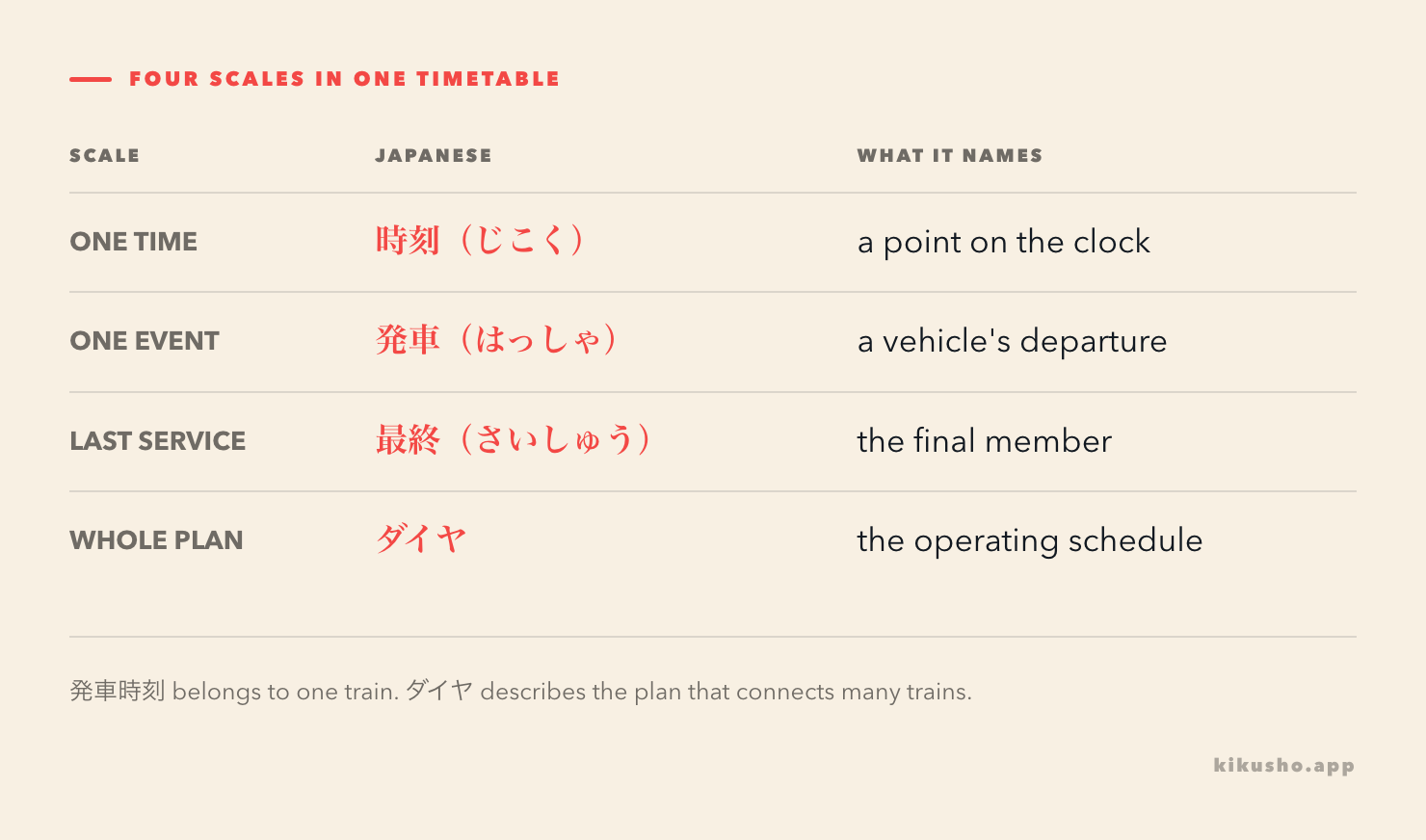
One delayed train can have 10分の遅れ. When the delay changes connections and later services, the operator may report ダイヤの乱れ. English “schedule” can translate both 時刻表 and ダイヤ, but the Japanese nouns point at different-sized objects.
列車, ホーム and 乗客 name the service, its platform and its riders
列車(れっしゃ) is the broad operational word for a train. 電車 identifies a train powered by electricity, while 列車 can describe a service without making its power source the point. The earlier lesson's 汽車 is specifically a steam train in its narrow sense and can sound older or regional when used broadly.
まもなく、2番ホームに列車が到着します。
まもなく、にばんホームに れっしゃが とうちゃくします。
A train will shortly arrive at platform 2.
ホーム is short for プラットホーム at a station. The dictionary definition of プラットホーム gives the raised facility beside the track where passengers board and leave trains, and explicitly records ホーム as its short form. Japanese also borrows English “home” in compounds such as ホームページ and ホームチーム. A platform number and words such as 列車 or 駅 select the railway sense.
乗客(じょうきゃく) is a person travelling in a vehicle. It can cover a train, bus, ship or aircraft. Someone waiting in the station building is an 利用者 or 客 in a wider description; 乗客 views that person in the role of passenger.
駅員が乗客を別のホームへ案内しました。
えきいんが じょうきゃくを べつの ホームへ あんないしました。
A station employee directed the passengers to another platform.
The three nouns form a small scene rather than three interchangeable labels: the 列車 arrives, the ホーム receives it, and the 乗客 board it.
遅れ is the noun behind 遅れる, while 混雑 describes the resulting crowd
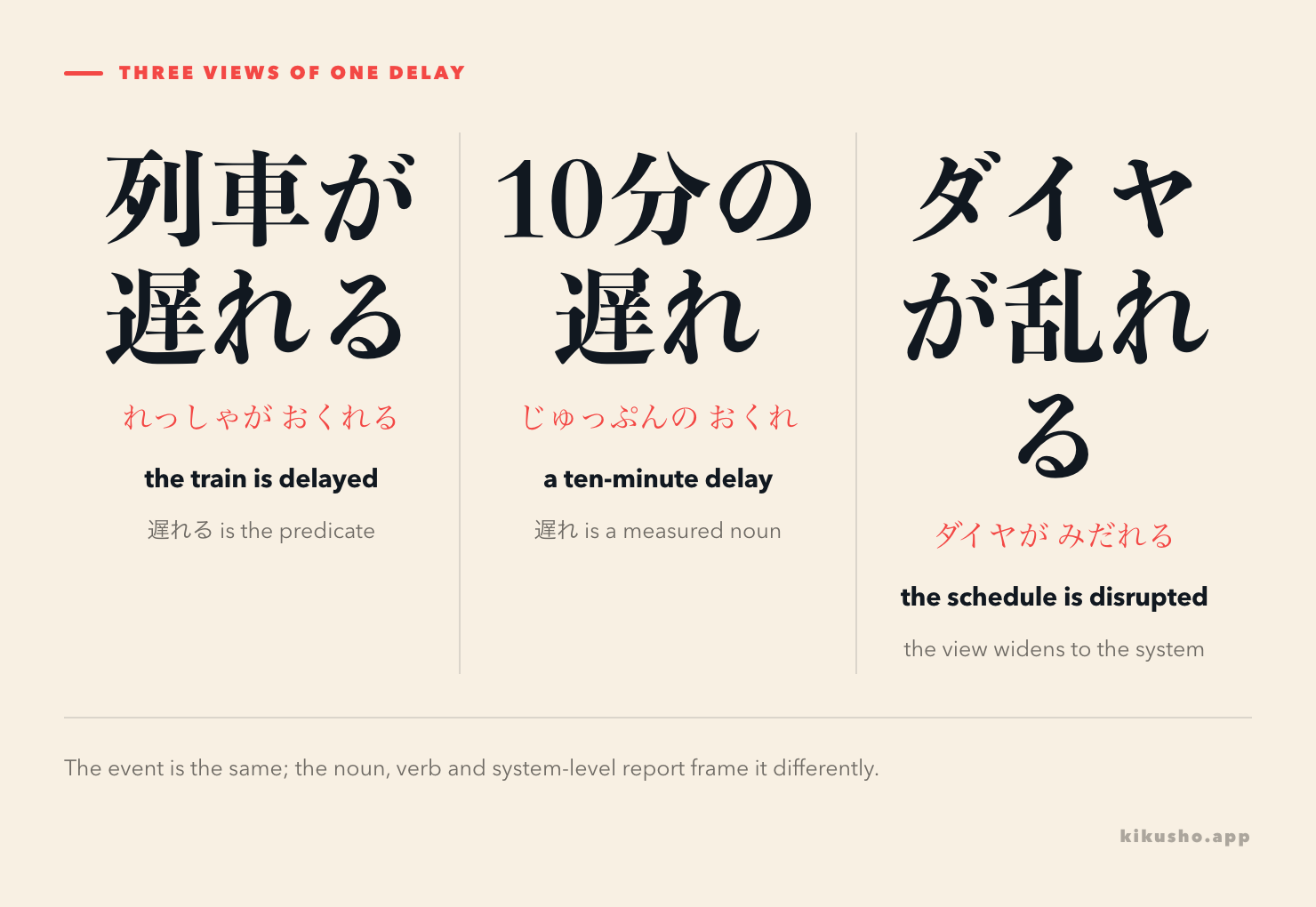
遅れ(おくれ) is the noun made from 遅れる(おくれる). The N4 verb places the delayed thing before が; the N3 noun fits into patterns such as 遅れが出る, 遅れがある and 10分の遅れ. Shogakukan's 遅れ entry uses 列車の遅れが出る for falling behind a decided time.
| View of the event | Japanese | What the grammar does |
|---|---|---|
| the train is delayed | 列車が10分遅れる | 遅れる is the predicate |
| there is a ten-minute delay | 列車に10分の遅れが出る | 遅れ is a noun measured by 10分 |
| the operating plan is disrupted | ダイヤが乱れる | the problem reaches the wider schedule |
混雑(こんざつ) means crowding or congestion in current station language. It can be a noun in 朝の混雑 and a する verb in ホームが混雑する. The inherited gloss “confusion” describes things being mixed together, but it should not make you translate 駅が混雑している as “the station is confused.” The natural reading is that the station is crowded.
列車の遅れで、ホームが混雑しています。
れっしゃの おくれで、ホームが こんざつして います。
The platform is crowded because of train delays.
JR East's current service-information guide uses 列車ごとの混雑状況 for each train's crowding level and 列車に遅れが発生した際 for when a delay occurs. These are ordinary operational collocations, not textbook-only combinations.
料金 names a charge; 定期 names the pass only in the right context
料金(りょうきん) is a general fee or charge. In casual travel questions, it can refer broadly to what a trip costs. Railway ticketing often makes a narrower distinction:
- 運賃(うんちん) is the basic transport fare for travelling from one station to another.
- 料金 is an added charge for a service or facility, as in 特急料金 or 指定席料金.
この列車は運賃のほかに特急料金が必要です。
この れっしゃは うんちんの ほかに とっきゅうりょうきんが ひつようです。
This train requires a limited-express charge in addition to the basic fare.
The assigned word is 料金, so 運賃 is a contrast rather than a second item to memorise here. A sign, operator or conversation may use 料金 more broadly, but a ticket breakdown often preserves the technical difference.
定期(ていき) begins with the idea of a fixed period or regular interval. In station conversation, it commonly shortens 定期券 or 定期乗車券, a commuter pass. The 定期乗車券 dictionary record defines a discounted ticket for repeated travel over a fixed section during a set period and records both 定期券 and 定期 as shortened forms.
定期で乗れる区間を越えたので、区間外の運賃を払いました。
ていきで のれる くかんを こえたので、くかんがいの うんちんを はらいました。
I travelled beyond the section covered by my commuter pass, so I paid the fare for the uncovered section.
Outside a ticket context, 定期 does not automatically mean a pass. 定期試験 is a regular examination, 定期点検 a periodic inspection, and 定期的に means periodically. The station supplies the omitted 券.
One disrupted final service uses all eleven words
定期を使って改札を通り、最終列車の発車時刻を確認した。ダイヤの乱れで列車に10分の遅れが出ており、3番ホームは混雑していた。駅員は乗客に別のホームで待つよう案内した。この列車は特急だったので、私は窓口で特急料金を払った。
ていきを つかって かいさつを とおり、さいしゅうれっしゃの はっしゃじこくを かくにんした。ダイヤの みだれで れっしゃに じゅっぷんの おくれが でて おり、さんばんホームは こんざつして いた。えきいんは じょうきゃくに べつの ホームで まつよう あんないした。この れっしゃは とっきゅうだったので、わたしは まどぐちで とっきゅうりょうきんを はらった。
I used my commuter pass to go through the ticket gate and checked the final train's departure time. The operating schedule was disrupted, the train was running ten minutes late, and platform 3 was crowded. A station employee directed the passengers to wait on another platform. Because this train was a limited express, I paid the limited-express charge at the counter.
Every noun has a job in that report. 最終 modifies the service, 発車時刻 fixes one clock time, and ダイヤ names the wider plan. 遅れ measures the problem, while 混雑 describes its visible effect. The N3 route lesson continues from the board to 経由, 方向 and the path through the station.
When you save a station notice in Kikusho, keep the sentence that joins the system word to the event: ダイヤの乱れにより、列車に遅れが出ています carries more usable information than a card with ダイヤ translated as “schedule.” The relation between the disturbed plan and the delayed train is the part worth reviewing.
Nihongoph's independently written N3 train vocabulary lesson uses 定期券 and ホーム in connected rail examples, while its N3 bus lesson records 乗客 and 発車 with vehicle contexts. JapaneseTest4You separately lists 最終 and 時刻 at N3. These are editorial estimates: the JLPT organisers do not publish an exhaustive current vocabulary list.
The dated Kikusho inventory places all eleven records at N3. One Waller-derived file also places 遅れ at N1, but that file and the N3 baseline belong to the same source family, so the disagreement is recorded rather than counted as independent proof of two levels. Learning the common rail noun here does not claim an official JLPT boundary.
Read the service notice before revealing the answers
1 — Hear the departure call. Choose the reading used for 発車 in 発車時刻.
- ア. はつしゃ
- イ. はっしゃ
- ウ. はっちゃ
- エ. ほっしゃ
Question 2: choose the schedule word. Complete the sentence about a system-wide disruption.
大雪で__が乱れています。
- ア. 時刻
- イ. 発車
- ウ. ダイヤ
- エ. 最終
Question 3: choose the noun form. Which sentence means “A ten-minute train delay has occurred”?
- ア. 列車が10分の遅れました。
- イ. 列車に10分の遅れが出ました。
- ウ. 列車を10分遅れが出ました。
- エ. 列車で10分の遅れるがありました。
Question 4: interpret the station noun. What does ホーム mean in 3番ホームでお待ちください?
- ア. Please wait at home number 3.
- イ. Please wait on platform 3.
- ウ. Please wait inside the third train.
- エ. Please wait at the third ticket gate.
Question 5: identify the pass. Which sentence uses 定期 as an abbreviation for a commuter pass?
- ア. 来週、定期試験があります。
- イ. 機械を定期的に点検します。
- ウ. 定期を使って毎日会社へ通います。
- エ. 会議は定期開催です。
Question 6: read the charge precisely. In formal railway ticketing, what does 特急料金 most specifically name?
- ア. The basic distance fare only
- イ. The added charge for using a limited-express service
- ウ. The price of a commuter pass for any route
- エ. Compensation paid for a delayed train
Question 7: ordering. Build the sentence “The platform is crowded because of train delays” from these chunks.
ホームが / 列車の遅れで / 混雑しています
Question 8: read the whole notice. What should the passenger understand?
最終列車はダイヤの乱れにより、発車時刻が15分遅れます。乗客の皆様は2番ホームでお待ちください。
- ア. The final train has been cancelled and passengers must leave the station.
- イ. The final train will leave fifteen minutes late, and passengers should wait on platform 2.
- ウ. Platform 2 is closed because the first train departed early.
- エ. Every train will use a new permanent timetable from tomorrow.
Answers and explanations
1. Choose イ, はっしゃ. 発車(はっしゃ) has a small っ. 発 contributes はっ before 車(しゃ) in this compound.
2. Choose ウ, ダイヤ. ダイヤが乱れる describes disruption to the operating schedule as a system. 時刻 is one point in time, 発車 one departure event, and 最終 marks the last member of a sequence.
3. Choose イ. 列車に10分の遅れが出ました uses 遅れ as a noun, measured by 10分 and followed by が出る. With the verb, the natural structure would be 列車が10分遅れました.
4. Choose イ. The platform number fixes the railway sense of ホーム. 3番ホームで marks platform 3 as the place where the waiting happens.
5. Choose ウ. Commuting to work every day and the verb 使う supply the ticket context, so 定期 abbreviates 定期券. The other sentences retain the wider sense of regular or periodic.
6. Choose イ. Railway terminology normally separates the basic 運賃 from the additional 特急料金 charged for the limited-express service. 料金 can be broader in ordinary conversation, but this compound is specific.
7. 列車の遅れで、ホームが混雑しています。 で marks the delay as the cause. ホーム is the subject of 混雑している and therefore takes が.
8. Choose イ. 最終列車 identifies the final service, 発車時刻が15分遅れます changes its departure time by fifteen minutes, and the last sentence directs passengers to platform 2. The notice says neither cancellation nor a permanent timetable revision.
Common questions
What is the difference between 時刻 and ダイヤ in Japanese rail travel?
時刻(じこく) is one point in time, so 発車時刻 is a departure time. ダイヤ is the planned pattern or schedule for many train movements. One train can have a changed 発車時刻, while a disruption can disturb the whole ダイヤ.
What does 定期 mean at a Japanese station?
In a rail context, 定期(ていき) commonly abbreviates 定期券, a commuter pass valid for repeated travel over a fixed section and period. Outside the station, 定期 has the wider idea of something regular or fixed-period, as in 定期試験, a regular examination.
What is the difference between 遅れ and 遅れる?
遅れ(おくれ) is a noun meaning a delay, as in 列車に10分の遅れが出る. 遅れる (おくれる) is the verb be delayed or be late, as in 列車が10分遅れる. They describe the same event from different grammatical positions.
Are 料金 and 運賃 the same on Japanese railways?
In ordinary speech, 料金 can broadly mean a fee, charge or fare. Railway terminology often uses 運賃 for the basic cost of transport and 料金 for an added service charge, such as 特急料金. The context and ticket type decide how narrow the distinction is.