On this page
At N2, map language stops being a list of turns and starts describing relationships: the area around a landmark, the axis a road follows, the side a building faces and the order of a route. The nine assigned records are 周辺(しゅうへん), 正面(しょうめん), 上下(じょうげ), 前後(ぜんご), 東西(とうざい), 南北(なんぼく), 付近(ふきん), 方角(ほうがく) and 道順(みちじゅん).
They belong together because each answers one of three questions: what area?, which orientation?, or in what order? The hard part is choosing the scale that the sentence needs.
Nine words organise a route by area, axis and sequence
| Map word | What it contributes | Route phrase |
|---|---|---|
| 周辺(しゅうへん) | noun: the surrounding area; related periphery | 駅周辺, the area around the station |
| 付近(ふきん) | noun: a nearby place; vicinity | 交差点付近, near the intersection |
| 正面(しょうめん) | noun: front; a directly facing position | 建物の正面, the front of the building |
| 方角(ほうがく) | noun: compass direction from a reference point | 北の方角, the direction of north |
| 道順(みちじゅん) | noun: the ordered way to a destination; directions | 道順を説明する, explain the way |
| 東西(とうざい) | noun: east and west; the east–west axis | 東西に延びる, extend east and west |
| 南北(なんぼく) | noun: south and north; the north–south axis | 南北を結ぶ, connect north and south |
| 上下(じょうげ) | noun and する verb: up and down; upper and lower | 上下に動く, move up and down |
| 前後(ぜんご) | noun and する verb: front and back; before and after; approximately | 出発の前後, before and after departure |
The N3 map lesson names route structure with words such as 経由, 方向 and 周囲. This N2 set makes the reference system more precise: 周辺 and 付近 choose the scale, 方角 fixes a compass bearing, and 道順 turns separate landmarks into a sequence.
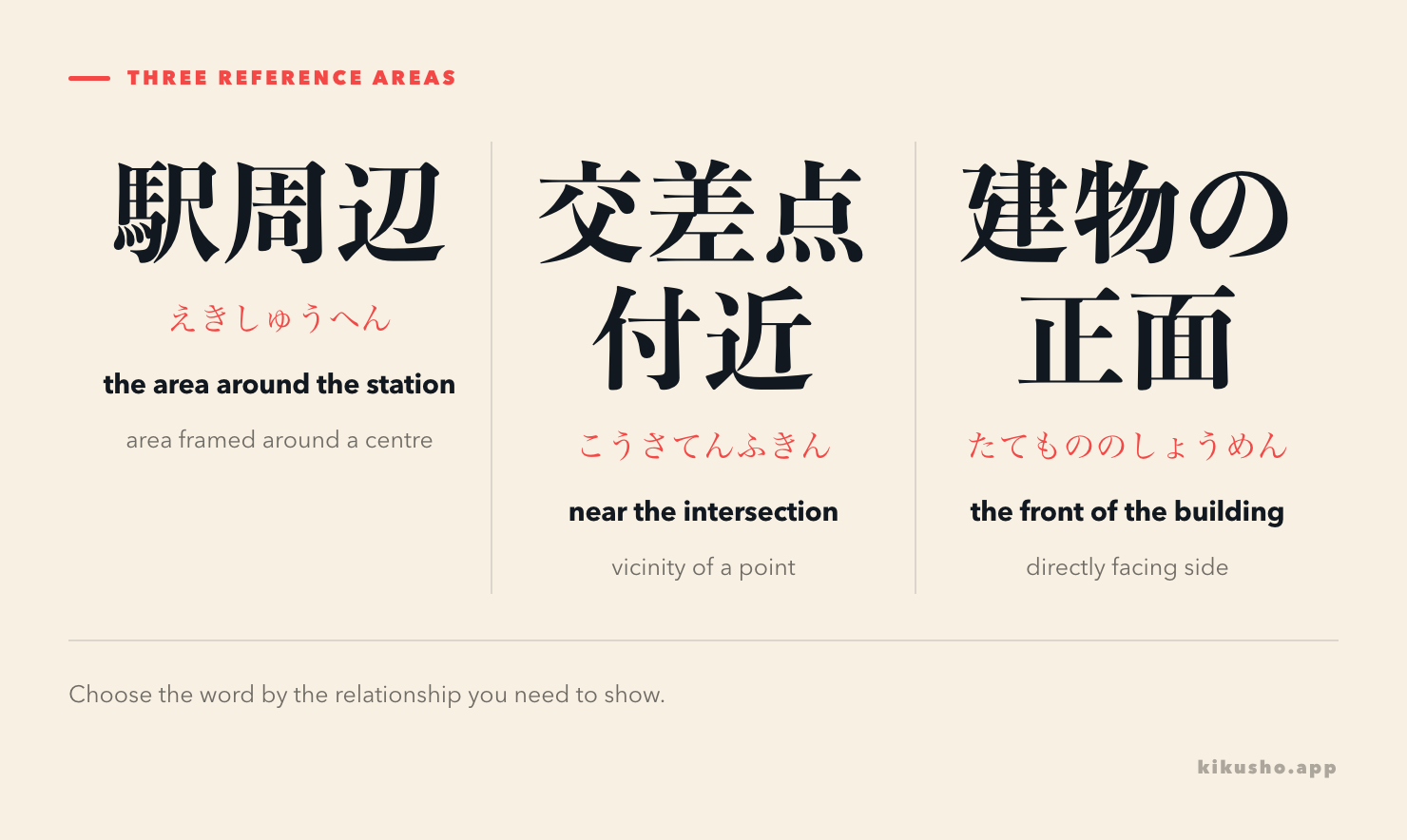
周辺 frames an area; 付近 points near a place
Both words can become “around” or “near” in English, but they frame the map differently. 周辺 treats something as a centre and gathers the area around it. Shogakukan's 周辺 entry gives both the physical area surrounding something and related matters at its periphery.
駅周辺にはホテルが多い。
えきしゅうへんには ホテルが おおい。
There are many hotels around the station.
The sentence surveys a district whose reference point is the station. 付近 is simpler: it identifies a place near the named point. The 付近 dictionary entry defines it as a nearby place, that area or the vicinity.
工事は交差点付近で行われています。
こうじは こうさてんふきんで おこなわれています。
Construction is taking place near the intersection.
Here the intersection locates the work without turning the entire surrounding district into the subject. Japanese does not assign a fixed radius to either word. The useful test is the writer's viewpoint: 周辺 looks outward from a centre, while 付近 says that a place or event is close to a reference point.
正面 is a facing side before it is a figurative stance
正面 names the front of an object or the position directly facing it. It works naturally with buildings and entrances:
バス停は市役所の正面にあります。
バスていは しやくしょの しょうめんに あります。
The bus stop is directly in front of city hall.
正面玄関から入ってください。
しょうめんげんかんから はいって ください。
Please enter through the main entrance.
The inherited source gloss “honesty” is too broad for 正面(しょうめん). The dictionary's 正面 examples extend direct facing into 問題に正面から取り組む, “address a problem head-on.” The fixed expression 正面を切る means to act openly and directly. Those phrases can imply candour, but the route noun itself still means “front” or “directly facing.”
This also differs from 前(まえ). 前 can locate something before, ahead of or in front of a reference point. 正面 is narrower: it highlights the face of the reference object or a directly opposed position.
方角 chooses a compass bearing, while 東西 and 南北 define axes
方角 locates something from a reference point, commonly through east, west, north and south. Shogakukan defines it first as a direction expressed through those cardinal points in its 方角 entry.
山は駅から北の方角に見えます。
やまは えきから きたの ほうがくに みえます。
The mountain can be seen to the north from the station.
方向(ほうこう) is broader. Its usage note allows any way an object faces or proceeds, without requiring a compass reference. That is why 進行方向 is the direction of travel, while 北の方角 anchors a bearing to north.
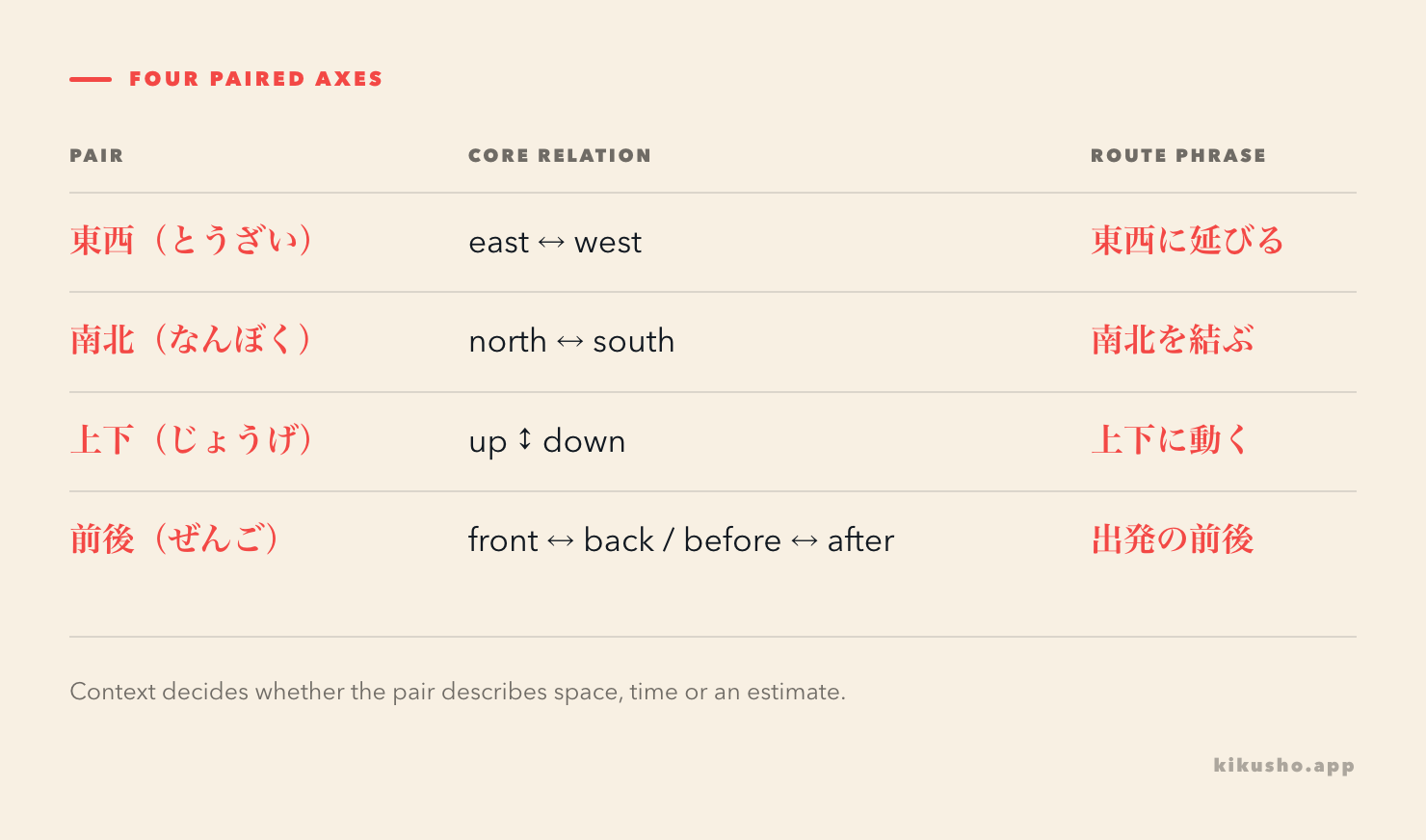
東西 and 南北 pair the cardinal points into axes. They often combine with に for the way something extends or with を for the axis a route spans:
この道路は東西に延びています。
この どうろは とうざいに のびています。
This road extends east and west.
地下鉄が町の南北を結んでいます。
ちかてつが まちの なんぼくを むすんでいます。
The subway connects the north and south of the town.
The 東西 dictionary record also gives extended senses such as East and West, various places and the wider world. In a map description, the physical axis is the default unless the context names cultures, regions or historical blocs. 東西南北 can gather all four points and, by extension, everywhere.
上下 and 前後 reuse a spatial pair in wider contexts
上下 joins 上 and 下 into “up and down” or “upper and lower.” It can name two positions or act with する for movement between them. The 上下 dictionary entry also records clothing sets, volumes and social rank, but a map or building usually activates the physical axis.
エレベーターが建物の中を上下しています。
エレベーターが たてものの なかを じょうげしています。
The elevator is moving up and down inside the building.
Do not confuse this reading with 上下(うえした), the concrete “top and bottom” word examined in the advanced route-reading lesson. The assigned N2 record here is じょうげ, which is productive in compounds such as 上下線 and in the する-verb use.
前後 is more flexible because the same pair can order space, time or quantity. The 前後 entry records all three:
- 車の前後: the front and back of a car
- 出発の前後: before and after departure, or the period around it
- 十分前後: approximately ten minutes
- 説明が前後する: parts of an explanation occur in the wrong order
In 十分前後, 前後 is a suffix-like estimate centred on ten minutes. It does not mean ten minutes before and ten minutes after. In 出発の前後, by contrast, a named event creates the dividing point and the phrase includes time on both sides.
道順 turns map relations into an ordered instruction
道順 is not the road surface and not simply a compass direction. It is the ordered way you follow to reach a destination: which street, landmark and turn comes next.
駅から会場までの道順を説明します。
えきから かいじょうまでの みちじゅんを せつめいします。
I will explain the way from the station to the venue.
地図で道順を確認してから出発しましょう。
ちずで みちじゅんを かくにんしてから しゅっぱつしましょう。
Let's check the route on the map before leaving.
The N4 route lesson supplies movement verbs such as 進む and 戻る. 道順 packages those actions into a sequence that someone can explain, confirm, remember or mistake. 経路(けいろ) can name the path or course itself, including a technical or transport route; 道順 keeps the practical order of getting there in view.
Read the whole set in one route:
駅周辺の地図で道順を確認してください。駅の正面玄関を出ると、東西に延びる大通りがあります。その道を東の方角へ進み、交差点付近で右に曲がります。南北を結ぶ歩道橋を渡り、建物の中を一階まで下りてください。到着時刻は三時前後です。
えきしゅうへんの ちずで みちじゅんを かくにんして ください。えきの しょうめんげんかんを でると、とうざいに のびる おおどおりが あります。その みちを ひがしの ほうがくへ すすみ、こうさてんふきんで みぎに まがります。なんぼくを むすぶ ほどうきょうを わたり、たてものの なかを いっかいまで おりて ください。とうちゃくじこくは さんじぜんごです。
Check the directions on a map of the station area. When you leave by the front of the station, you will find a main road running east–west. Follow it east and turn right near the intersection. Cross the footbridge connecting north and south, then go down to the first floor inside the building. The arrival time is around three o'clock.
The vocabulary does not merely decorate the route. Each word fixes a relationship that a bare sequence of 右 and 左 would leave unstated.
Kikusho's dated inventory places all nine spelling-and-reading records at N2, but its two baseline files descend from the same Tanos/Waller source family. The independently published Amiko N2 directions list supports the wider route theme and includes 道順. Bunpro places 方角 at N3, so that word has a real N2/N3 editorial disagreement. The JLPT organisers do not publish an exhaustive current vocabulary syllabus; these levels are study estimates, not an official boundary.
Practice the route language
1 — Read 道順
What is the reading of 道順?
- ア. どうじゅん
- イ. みちじゅん
- ウ. みちすん
- エ. どうすん
2 — Choose the map scale
Which word best completes the sentence? 駅__にはホテルや飲食店が多い。 The sentence surveys the district around the station.
- ア. 正面
- イ. 方角
- ウ. 周辺
- エ. 前後
3 — Locate a road closure
Which word best completes the report? 事故現場__では道路が閉鎖されています。
- ア. 付近
- イ. 東西
- ウ. 上下
- エ. 道順
4 — Identify the east–west axis
Which sentence says that the road extends along an east–west axis?
- ア. 道路は東西に延びています。
- イ. 道路は東西を説明しています。
- ウ. 道路は東西で迷っています。
- エ. 道路は東西の正面です。
5 — Interpret a time estimate
In 所要時間は二十分前後です, what does 前後 mean?
- ア. In front of and behind twenty minutes
- イ. Before departure and after arrival
- ウ. Approximately twenty minutes
- エ. Twenty minutes in the wrong order
6 — Supply a compass bearing
Choose the better word: 富士山はここから西の__に見えます。
- ア. 道順
- イ. 方角
- ウ. 周辺
- エ. 上下
7 — Build an ordered route
Put these parts in a natural order to say “Please explain the directions from the station to the museum.”
- 美術館までの
- 説明してください
- 駅から
- 道順を
8 — Paraphrase a facing position
Which paraphrase best preserves バス停は市役所の正面にあります?
- ア. The bus stop is somewhere in the wider city-hall district.
- イ. The bus stop moves up and down inside city hall.
- ウ. The bus stop is directly in front of city hall.
- エ. The bus stop is about as far away as city hall.
Answers and explanations
1. イ, みちじゅん. 道順 is read みちじゅん. 道 takes its native reading みち in this compound, and 順 is じゅん.
2. ウ, 周辺. The sentence surveys hotels and restaurants throughout the area surrounding the station, so 駅周辺 fits. 正面 would limit the view to the station's facing side, 方角 is a bearing, and 前後 is an order or approximation word.
3. ア, 付近. 事故現場付近 means the vicinity of the accident site. The site is the reference point used to locate the closure.
4. ア. 東西に延びる means “extend east and west.” に marks the orientation along which the road extends. The other predicates do not form coherent map descriptions with 東西.
5. ウ. After a quantity, 前後 means approximately that quantity. 二十分前後 is about twenty minutes; it does not create two separate twenty-minute periods.
6. イ, 方角. 西の方角 gives a compass-based bearing from the speaker's current reference point. The other words describe a sequence, a surrounding area or a vertical pair.
7. 駅から美術館までの道順を説明してください。 駅から marks the starting point, 美術館まで marks the destination, の attaches that span to 道順, and を marks what should be explained.
8. ウ. 市役所の正面 identifies the directly facing front of city hall. The sentence does not survey the wider surroundings, describe vertical movement or estimate distance.
Common questions
What is the difference between 周辺 and 付近?
周辺(しゅうへん) presents the area around a reference point and can also describe related peripheral matters. 付近(ふきん) simply identifies a nearby place or vicinity. 駅周辺 can frame a whole station district, while 事故現場付近 directs attention to somewhere near the accident site.
What is the difference between 方角 and 方向?
方角(ほうがく) commonly locates something by a compass-based bearing from a reference point, such as 北の方角. 方向(ほうこう) is broader and can describe any way something faces or moves, including 進行方向.
Can 前後 mean approximately?
Yes. After a number, 前後(ぜんご) means approximately that number, as in 十分前後, about ten minutes. Elsewhere it can mean front and back, before and after, or the period around an event.
Does 正面 mean honesty?
正面(しょうめん) normally means the front or a directly facing position. Directness appears in phrases such as 正面から向き合う and 正面切って反対する, but translating the noun by itself as honesty is misleading.