On this page
A match can be a 試合, but the moment when victory and defeat are decided is a 勝負. This N2 set adds seven words for contest outcomes, structured exercise and movement: 勝負, 相撲, 体操, 跳ぶ, 跳ねる, 引き分け and マラソン.
Seven words from preparation to result
| Role | Word | Reading | Part of speech | Core sense | Anchor phrase |
|---|---|---|---|---|---|
| Contest | 勝負 | しょうぶ | noun / する-verb | victory and defeat; contest | 勝負をつける, settle the contest |
| Sport | 相撲 | すもう | noun | sumo wrestling | 相撲を取る, wrestle sumo |
| Exercise | 体操 | たいそう | noun / する-verb | physical exercise; gymnastics | 準備体操をする, do warm-up exercises |
| Leap | 跳ぶ | とぶ | godan verb | jump across or over | 障害物を跳ぶ, clear an obstacle |
| Bounce | 跳ねる | はねる | ichidan verb | spring; bounce | ボールが跳ねる, a ball bounces |
| Result | 引き分け | ひきわけ | noun | draw; tie | 引き分けに終わる, end in a draw |
| Endurance | マラソン | まらそん | noun | marathon | マラソンを完走する, finish a marathon |
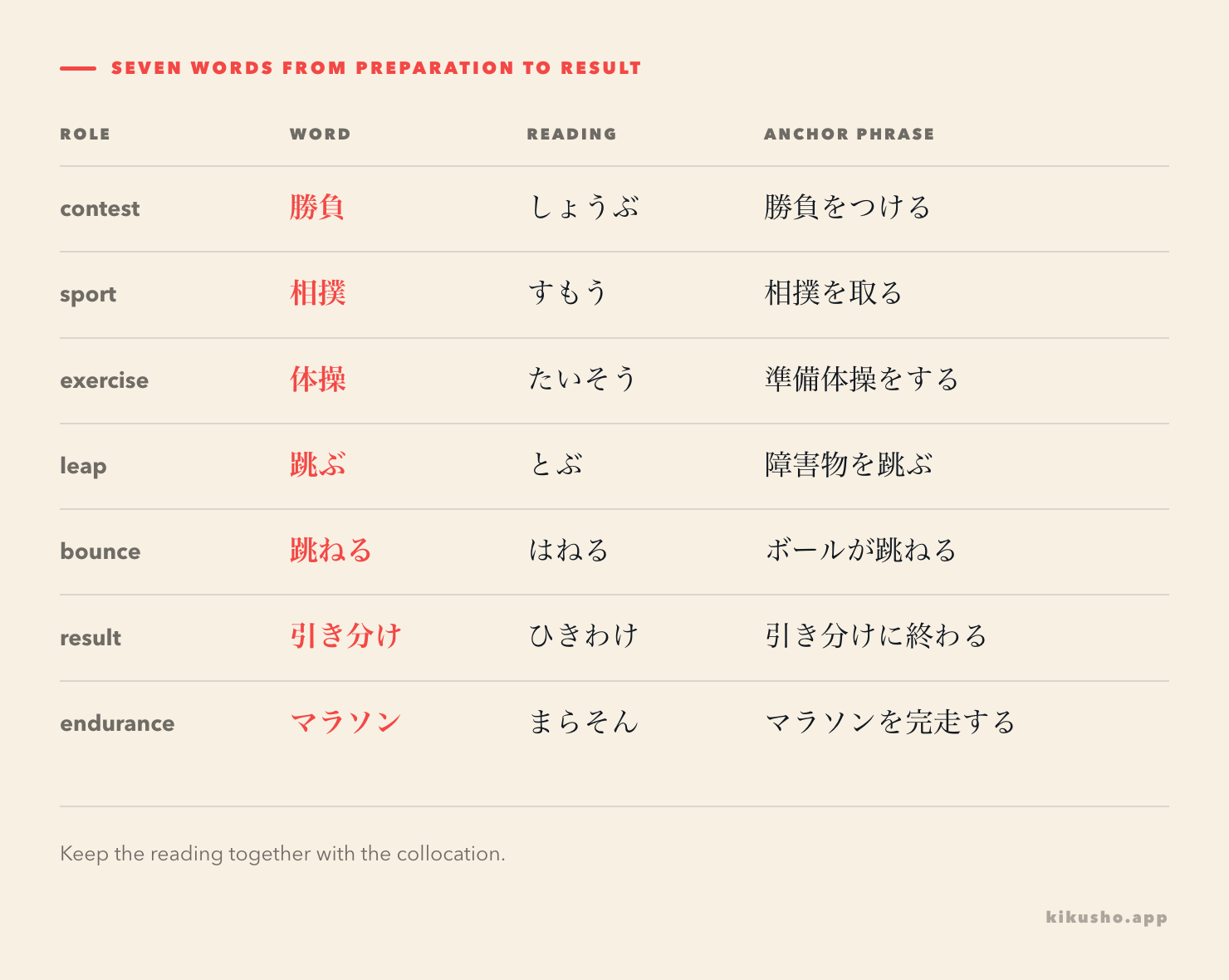
Keep the phrase in the final column with the word. 相撲を取る and 引き分けに終わる are more useful memory units than the English labels “sumo” and “draw.”
勝負 is the contest, not simply one match
試合(しあい) names a particular match or game. 勝負(しょうぶ) frames an encounter in terms of victory and defeat, or marks the decisive attempt that will settle the result. Kotobank's 大辞泉 entry gives both the state of winning or losing and the act of deciding which side wins.
後半の一点で勝負が決まった。
The contest was decided by one point in the second half.
ここで勝負に出なければ、優勝する機会を失う。
If we do not make our decisive move now, we will lose our chance to win the championship.
Use 勝負をする for having a contest, 勝負をつける for settling it and 勝負に出る for taking a decisive chance. A scheduled game can be a 試合 before anyone plays; 勝負 brings the result and the struggle into focus.
相撲 and マラソン choose different event verbs
相撲(すもう) is the sport, but Japanese describes participating with 相撲を取る. The verb 取る does not mean “take” literally in this expression. Kotobank's dictionary entry records this established use.
子どものころ、兄と庭で相撲を取った。
When I was a child, I wrestled sumo with my older brother in the garden.
マラソン combines naturally with 走る, but a result sentence often uses 完走する, “finish the whole race.” Kotobank also records the figurative idea of a long, sustained effort.
初めてのマラソンを四時間で完走した。
I finished my first marathon in four hours.
交渉は一日中続くマラソンになった。
The negotiations became a marathon lasting all day.
体操 is a routine, while 運動 is broader
運動(うんどう) can cover physical activity in general. 体操(たいそう) usually points to an organized sequence of movements for health or training, and it can also abbreviate 体操競技, competitive gymnastics. Kotobank's 大辞泉 definition covers both uses.
練習の前に、全員で準備体操をした。
Before practice, everyone did warm-up exercises together.
妹は大学で体操競技を続けている。
My younger sister continues competitive gymnastics at university.
If someone says 健康のために運動する, the activity could be walking, swimming or cycling. 毎朝体操する suggests a repeated movement routine.
跳ぶ crosses space; 跳ねる springs back
Both verbs can be translated as “jump,” and both may be written with 跳. The scene decides which verb you need.
跳ぶ(とぶ) presents a jump through space, over a boundary or across a gap. Kotobank's entry for 飛ぶ・跳ぶ records 跳ぶ for leaping into the air and clearing an obstacle.
選手は最後の障害物を軽々と跳んだ。
The athlete cleared the final obstacle with ease.
跳ねる(はねる) emphasizes springing, rebounding or splashing. A Shogakukan synonym guide contrasts the forward or upward travel of 跳ぶ with the springing movement of 跳ねる, while Kotobank lists bounce and splash senses.
ゴムのボールが床で何度も跳ねた。
The rubber ball bounced on the floor several times.
車が水たまりを通り、泥が跳ねた。
A car went through a puddle, and mud splashed up.
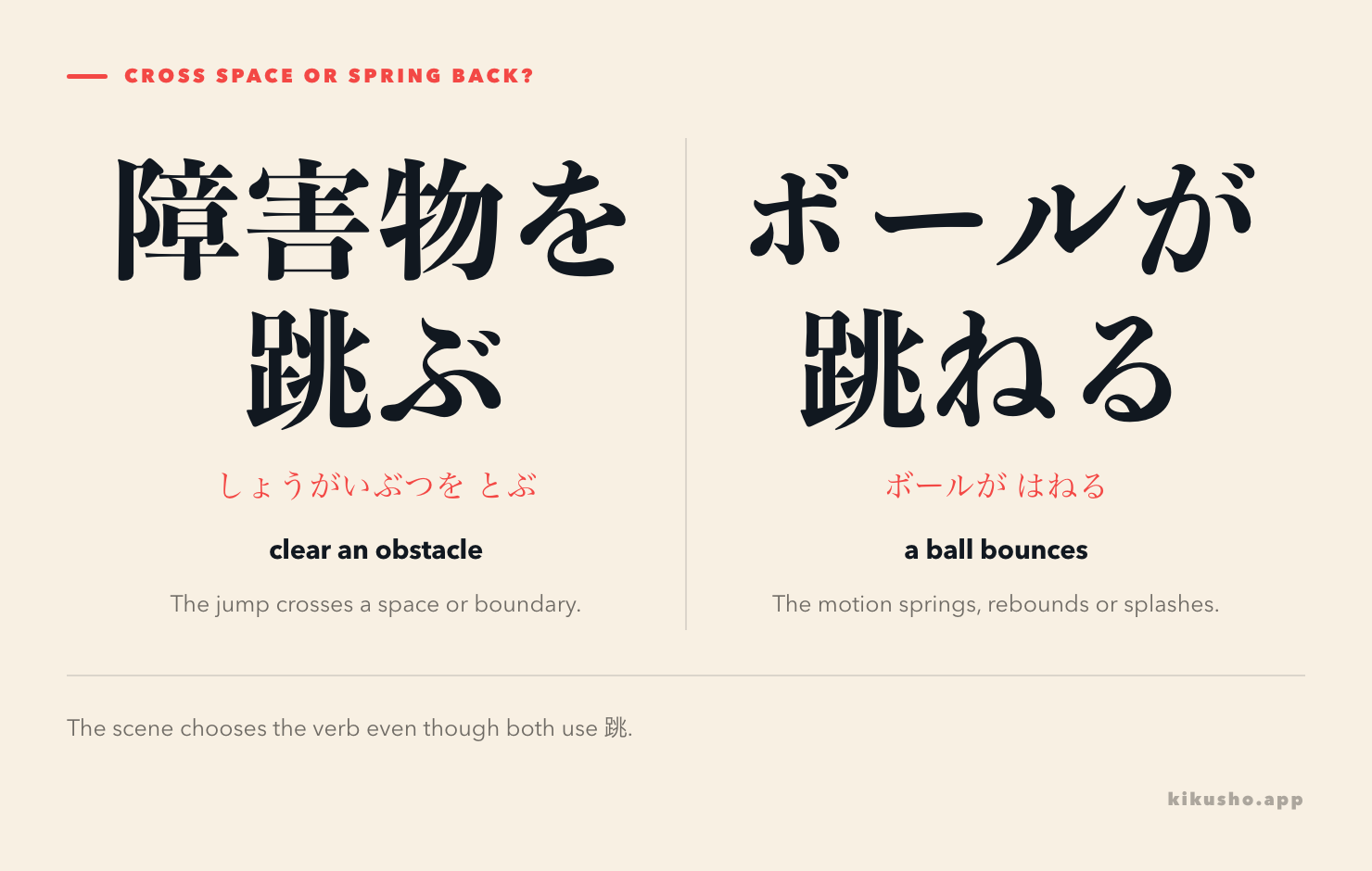
The object pattern helps. A person 障害物を跳ぶ crosses the obstacle; a ball が跳ねる moves by its own rebound. In another sense, 跳ねる can also describe drops or mud splashing, so do not reduce it to an animate jump.
引き分け names a result without a winner
引き分け(ひきわけ) is a draw: the contest ends without either side winning. Kotobank records expressions such as 引き分けに持ち込む, to bring a contest to a draw.
両チームが一点ずつ取り、試合は引き分けに終わった。
Each team scored one point, and the match ended in a draw.
同点(どうてん) means that the scores are equal at a particular moment. A game may be 同点 with five minutes remaining and still produce a winner. It becomes an 引き分け only when the applicable rules leave the final result tied.
The level label deserves one caution. Kikusho's two source snapshots come from the same list family but disagree: one assigns 引き分け to N2 and the other to N1. The JLPT does not publish an exhaustive official vocabulary list, so this lesson keeps it in the N2 study set and states the disagreement instead of treating either label as definitive.
The N3 sports lesson supplies the prerequisite network around 競技, 選手, 審判, 記録, 応援 and 優勝. This lesson continues from that foundation without reassigning those words.
Build cards around the whole event
In Kikusho, save arguments and collocations with the headword. A card for 跳ねる should show ボールが高く跳ねた; a card for 跳ぶ can show 障害物を跳んだ. For outcome nouns, contrast 同点になった during play with 引き分けに終わった after the result is final.
Check the distinctions
Question 1
What is the reading of 勝負?
Question 2
Choose the better verb: 選手はフェンスを__。
The athlete jumped over the fence.
- 跳んだ
- 跳ねた
Question 3
Which sentence naturally describes a bouncing ball?
- ゴムのボールが何度も跳んだ。
- ゴムのボールが何度も跳ねた。
Question 4
Complete the established expression meaning “wrestle sumo”: 相撲を__。
Question 5
Paraphrase this result with 引き分け: 勝ったチームはなかった。
Question 6
Which word fits both phrases: 準備__ and __競技?
Question 7
Complete the short report with 勝負 and 引き分け.
両チームとも攻撃が速く、いい__だった。しかし、最後まで差がつかず、試合は__に終わった。
Answers and explanations
1 · 勝負 reading
しょうぶ. 勝負 refers to victory and defeat, a contest or the act of settling which side wins.
2 · Crossing the fence
跳んだ. The athlete crosses the fence as an obstacle, so 跳ぶ fits the movement through space.
3 · The bouncing ball
ゴムのボールが何度も跳ねた。 A ball rebounds from the surface, which is the springing movement expressed by 跳ねる.
4 · The sumo expression
相撲を取る. 取る is the established verb in this expression.
5 · A drawn result
試合は引き分けに終わった。 The final result has no winner. 同点 would only state that the scores are equal.
6 · The exercise compound
体操. 準備体操 is a warm-up routine, and 体操競技 is competitive gymnastics.
7 · Contest and result
勝負 / 引き分け. いい勝負 describes a closely contested encounter; 引き分けに終わった states the final tied result.
The shared sports theme is only the entrance. The durable distinctions live in the verbs and particles: a contest is settled, sumo is taken, a marathon is completed, a ball bounces and an obstacle is crossed.
Common questions
Which seven N2 sports words are in this lesson?
The set is 勝負(しょうぶ), 相撲(すもう), 体操(たいそう), 跳ぶ(とぶ), 跳ねる(はねる), 引き分け(ひきわけ)and マラソン. Learn each word with its usual verb or particle rather than as an isolated translation.
What is the difference between 跳ぶ and 跳ねる?
跳ぶ describes a jump that crosses space or clears an obstacle, as in 障害物を跳ぶ. 跳ねる focuses on springing or bouncing, as in ボールが跳ねる.
What is the difference between 勝負 and 試合?
試合 is a particular game or match. 勝負 focuses on the contest as a test of victory and defeat, or the decisive moment when the result is settled.
Is 引き分け an N2 or N1 word?
Kikusho teaches 引き分け in this N2 set. Two snapshots from the same source family disagree, placing it at N2 and N1, so treat the level as a study guide rather than an official boundary.