On this page
These ten words describe a competition from preparation to result: 訓練 builds skill, a 選手 enters a 競技, a 審判 applies the rules, spectators 応援する, and the event produces a 記録 or an 優勝. The action words 蹴る and 打つ(ぶつ), plus スキー, need extra attention because spelling and context decide what kind of movement you mean.
Ten words for one competition
| Role | Word | Reading | Core sense | Anchor phrase |
|---|---|---|---|---|
| Support | 応援 | おうえん | support; cheering; noun / する-verb | 選手を応援する, cheer for an athlete |
| Discipline | 競技 | きょうぎ | competitive event or discipline | 競技に参加する, enter an event |
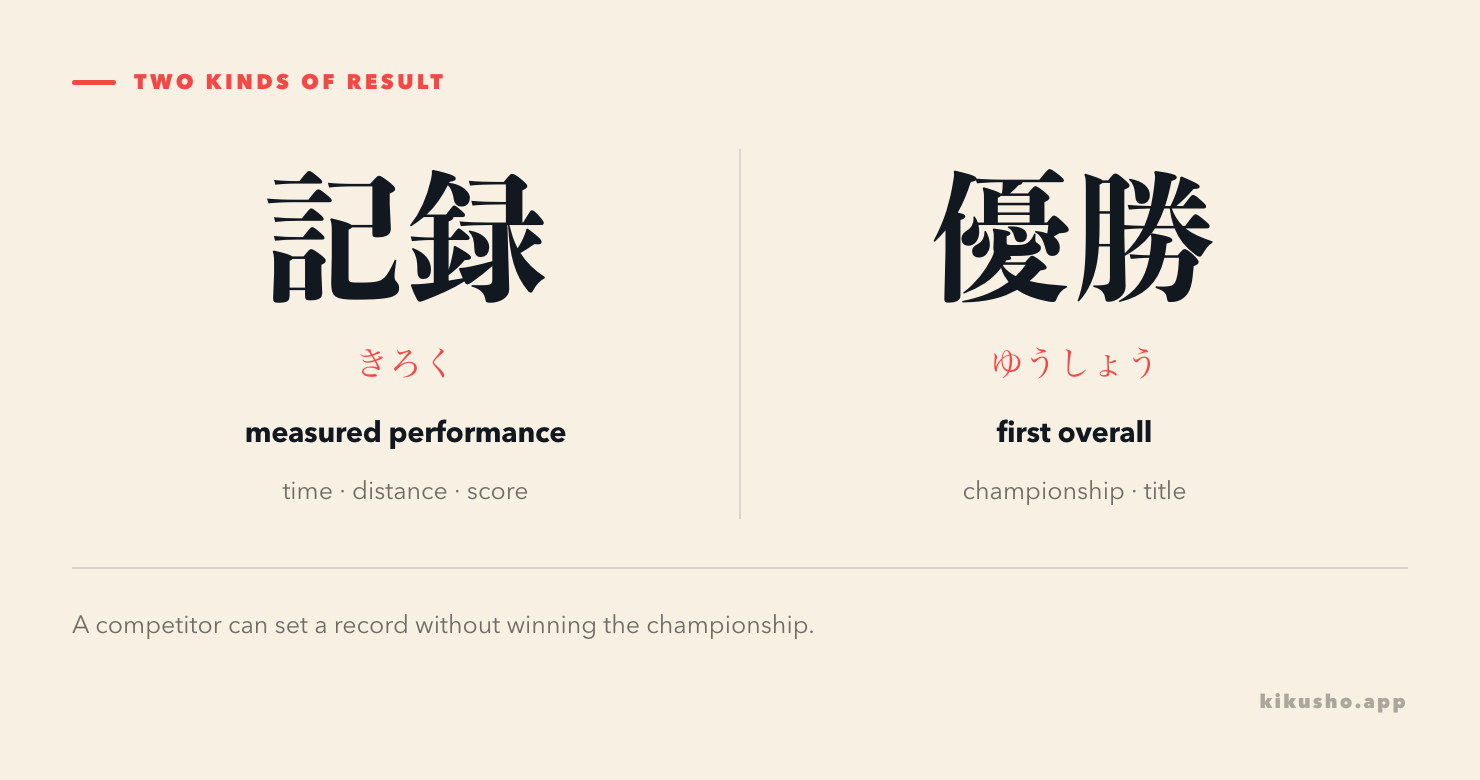
| Measured result | 記録 | きろく | record; recorded result | 記録を更新する, improve or break a record |
| Preparation | 訓練 | くんれん | systematic training | 訓練を受ける, undergo training |
| Foot action | 蹴る | ける | kick; push forcefully with the foot | ボールを蹴る, kick a ball |
| Official | 審判 | しんぱん | judgment; referee; officiating | 審判が笛を吹く, the referee blows the whistle |
| Activity | スキー | すきー | ski; skiing | スキーをする, go skiing |
| Competitor | 選手 | せんしゅ | player; athlete; selected competitor | 代表選手, representative athlete |
| Strong strike | 打つ | ぶつ | hit; strike; often written ぶつ | 頭をぶつ, hit someone on the head |
| First place | 優勝 | ゆうしょう | overall victory; championship | 大会で優勝する, win a tournament |
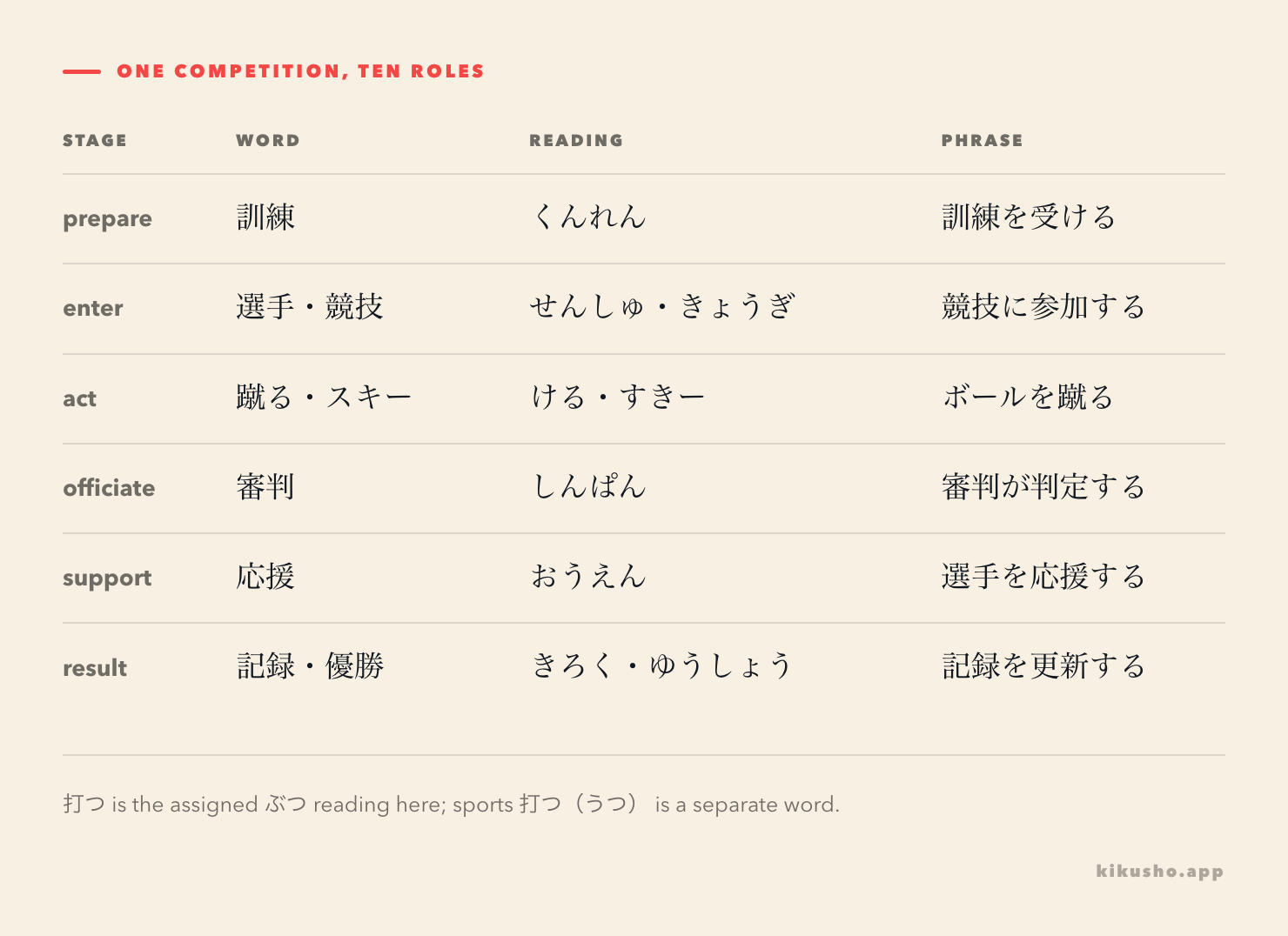
The table contains nouns, する-verbs and two ordinary godan verbs. Keep the whole phrase in the last column. English “support,” “record” and “win” can hide which particle or verb Japanese requires.
競技, 選手 and 審判 define the event
競技(きょうぎ) is an activity in which people compare skill or physical ability under rules. It can name a whole discipline or an event on a programme.
水泳には、いくつもの競技種目があります。
すいえいには、いくつもの きょうぎしゅもくが あります。
Swimming has many competitive events.
百人以上の選手がこの競技に参加しました。
ひゃくにんいじょうの せんしゅが この きょうぎに さんかしました。
More than one hundred athletes entered this event.
Kotobank defines 競技 as competing in skill or physical ability according to rules. That makes it broader than 試合, one particular game or match. Football is a 競技; a semifinal played on Saturday is a 試合. The N4 sports lesson teaches 試合, 競争, 勝つ and 負ける as prerequisites.
選手(せんしゅ) is a person selected to compete, or more generally a player or athlete. It names a person, not a team.
その選手は日本代表に選ばれました。
その せんしゅは にほんだいひょうに えらばれました。
That athlete was selected for Japan's national team.
The old source gloss “team” is too broad for the headword itself. 選手団 can mean a delegation or team of athletes, while 選手 identifies one competitor. Kotobank's 選手 entry connects the word with selection for an event and with professional sport.
審判(しんぱん) can mean the act of judging, the ruling, or the official who decides whether play follows the rules. Sport usually makes the referee sense clear.
審判が反則だと判断して、試合を止めました。
しんぱんが はんそくだと はんだんして、しあいを とめました。
The referee judged it a foul and stopped the match.
審判をする means to officiate; 審判の判定 is the referee's decision. The word also belongs to legal and religious contexts, so Kotobank's definition lists several senses before the sports official.
訓練 prepares a skill; 蹴る performs an action
訓練(くんれん) is organized training intended to build a skill or ability. It can be given, received or continued.
選手たちは毎朝、体力をつける訓練をしています。
せんしゅたちは まいあさ、たいりょくを つける くんれんを して います。
The athletes train every morning to build physical strength.
新しい審判は特別な訓練を受けます。
あたらしい しんぱんは とくべつな くんれんを うけます。
New referees undergo special training.
Kotobank's 訓練 entry distinguishes systematic instruction and acquisition from 練習, repeated practice done to improve a skill. The two overlap in some phrases, but not everywhere: 避難訓練 is a safety drill, while ピアノの練習 is piano practice.
蹴る(ける) is a transitive godan verb. The foot strikes or pushes something, so that target takes を.
選手は右足でボールを強く蹴りました。
せんしゅは みぎあしで ボールを つよく けりました。
The player kicked the ball hard with the right foot.
The conjugation is 蹴る → 蹴ります → 蹴った → 蹴らない. The verb can also mean to reject a proposal in expressions such as 要求を蹴る, but the physical sense anchors this lesson. Kotobank also records 地面を蹴る, pushing hard against the ground, and the figurative rejection sense.
スキー is a loanword whose long vowel belongs to its spelling. It can name the ski itself or the activity, depending on context. Use スキーをする or スキーに行く for the activity.
冬休みに家族と北海道へスキーに行きました。
ふゆやすみに かぞくと ほっかいどうへ スキーに いきました。
I went skiing in Hokkaido with my family during winter break.
Do not drop the final ー when writing the assigned word. In the inventory, its reading appears as すきー because the reading field converts the katakana sounds to hiragana; normal Japanese writing keeps スキー.
応援, 記録 and 優勝 describe support and results
応援(おうえん) means lending support. In sport it commonly means encouraging a player or team through voices, applause or other support.
観客は最後まで地元のチームを応援しました。
かんきゃくは さいごまで じもとの チームを おうえんしました。
The spectators supported the local team until the end.
The supported person or team takes を with 応援する. 選手に声援を送る is another way to describe sending cheers to an athlete, but 応援 is broader than shouting. Kotobank's 応援 entry separates general assistance from the sport-specific act of encouraging a competitor.
記録(きろく) has a general sense of preserving information and a sports sense of a measured performance or best result.
彼女は百メートルで大会記録を更新しました。
かのじょは ひゃくメートルで たいかいきろくを こうしんしました。
She set a new meet record in the 100 metres.
Common phrases are 記録を出す, produce a result; 記録を更新する, improve the record; and 記録を破る, break the record. Kotobank's 記録 entry explicitly separates preserved information from a numerical sporting result.
優勝(ゆうしょう) means finishing first overall or winning a championship. It is a noun and a する-verb.
私たちのチームは決勝に勝って、全国大会で優勝しました。
わたしたちの チームは けっしょうに かって、ぜんこくたいかいで ゆうしょうしました。
Our team won the final and took the national championship.
Use 試合に勝つ for winning one match and 大会で優勝する for taking first place in the tournament. A fast time may become a 記録 even if another athlete is faster, and a champion can win without setting a record. The Japan Sport Association uses 競技, 選手, 応援 and 優勝 together in its report from the national sports festival, giving an independent real-world example of the network taught here.
打つ(ぶつ) is not sports 打つ(うつ)
The assigned item is 打つ(ぶつ), a godan verb meaning to hit or strike. It is often written ぶつ in ordinary text.
兄弟げんかで弟の肩をぶってしまった。
きょうだいげんかで おとうとの かたを ぶってしまった。
During a fight between brothers, I ended up hitting my younger brother on the shoulder.
Its forms are ぶつ → ぶちます → ぶった → ぶたない. The passive is ぶたれる. Goo's dictionary entry for 打つ(ぶつ) derives it from うつ and defines striking, punching or hitting a body part.
The same spelling also represents the separate word 打つ(うつ). In sports, ボールを打つ is normally ボールをうつ, “hit the ball,” and the past is 打った(うった). That うつ item already has its canonical explanation in the N4 sports lesson. A card that stores only 打つ is incomplete: the reading determines the word, its conjugation and its likely object.
The N3 label has three disputed edges
Kikusho assigns these ten spelling-and-reading records to this N3 lesson. The dated source snapshots disagree at three edges: 応援 also appears at N2, 蹴る appears at N2 in one snapshot, and 打つ(ぶつ) has a separate comparison page that points to 打つ(うつ) at N4. The Waller-derived inventory copies share one source family, so repeated rows do not become independent proof.
The official JLPT does not publish an exhaustive vocabulary syllabus. Use N3 as the position of this lesson in a study sequence. The words' readings and usage matter more than forcing every dictionary sense into one level.
When you capture a match report in Kikusho, include the phrase that identifies the role: 競技に参加する, 選手を応援する, 審判が判定する, 記録を更新する, or 大会で優勝する. For 打つ, always keep the reading and object together.
Practice: complete every event before checking the results
Event 1 · read the official
How do you read 審判 in 審判が試合を止めた?
A. しんばん B. しんぱん C. しんはん D. せんぱん
Event 2 · write the title
Which written form is ゆうしょう, “winning the championship”?
A. 優勝 B. 勇勝 C. 優賞 D. 有勝
Event 3 · build the compound
Which compound completes 大会__を更新する, “set a new meet record”?
A. 応援 B. 訓練 C. 記録 D. 競技
Event 4 · name the discipline
Which sentence most naturally describes judo as one discipline on a multi-sport programme?
A. 柔道はこの大会の競技の一つです。 B. 柔道はこの大会の審判の一つです。 C. 柔道はこの大会の優勝の一つです。 D. 柔道はこの大会の選手の一つです。
Event 5 · choose the drill
The fire department runs an organized emergency drill. Which phrase fits best?
A. 避難記録 B. 避難優勝 C. 避難訓練 D. 避難選手
Event 6 · separate two verbs
Which pair gives the intended readings?
ラケットでボールを打つ / けんかで相手をぶつ
A. ぶつ / うつ B. うつ / ぶつ C. ける / うつ D. うつ / ける
Event 7 · separate two results
An athlete posts the best time ever but is later disqualified and does not finish first. Which statement preserves the vocabulary distinction?
A. 記録 and 優勝 must both apply. B. 優勝 can apply, but 記録 cannot. C. 記録 can describe the measured result, while 優勝 does not describe the final rank here. D. Neither word can refer to sport.
Event 8 · support the athlete
Complete the sentence naturally: 観客は決勝に出る選手( )応援した。
A. が B. に C. で D. を
Lock in all eight choices before opening the review.
Answers and explanations
1 · Referee reading: B, しんぱん. The sports official is 審判(しんぱん). しんばん is recorded as a variant in some dictionaries, but it is not the assigned standard reading here; the other options misread one or both characters.
2 · Championship spelling: A, 優勝. 優 supplies the “superior/first” element and 勝 carries victory. The distractors replace one character with a homophone or a related-looking choice but do not spell the word.
3 · Record compound: C, 記録. 大会記録 is a meet record, and 記録を更新する means to improve or replace the existing best result. The other nouns do not combine with 更新する to express a measured performance.
4 · Discipline: A. 競技 names a competitive discipline or event. 審判 and 選手 are people or roles, while 優勝 is the overall winning result.
5 · Organized drill: C, 避難訓練. 訓練 fits organized instruction or a drill intended to build a response. 記録 would preserve information, and 優勝 and 選手 belong to competitive results and participants.
6 · Verb readings: B, うつ / ぶつ. Hitting a ball with a racket uses 打つ(うつ). The assigned 打つ(ぶつ) means to strike a person or body and is commonly written in kana. The spelling alone does not select the reading.
7 · Result distinction: C. 記録 describes the measured performance, while 優勝 states the final first-place result. The scenario deliberately separates them: a recorded time and championship rank answer different questions.
8 · Support particle: D, を. With 応援する, the supported person or team is the direct object: 選手を応援する. に belongs naturally in 声援を選手に送る, which uses a different verb.
The event now reads as a sequence: a 選手 completes 訓練, enters a 競技, follows the 審判, acts by 蹴る or another discipline-specific verb, receives 応援, aims for a 記録, and may finish with 優勝.
Common questions
What is the difference between 競技 and 試合?
競技(きょうぎ)is a competitive discipline or an activity governed by rules; it can also refer to competing. 試合(しあい)is one particular match or game. サッカー is a 競技, while tonight's final is one 試合.
What is the difference between 記録 and 優勝?
記録(きろく)is a recorded result or performance, often expressed as a time, distance or score. 優勝(ゆうしょう)means finishing first overall or winning a championship. A competitor can set a record without winning the event.
Is 打つ read うつ or ぶつ?
Both readings exist as different words. Sports expressions such as ボールを打つ normally use うつ. This lesson's assigned item is 打つ(ぶつ), to hit or strike someone or a body part, and it is often written in kana.
Are all ten words officially assigned to JLPT N3?
No exhaustive official JLPT vocabulary list exists. Kikusho places these records in this N3 lesson, while its source snapshots disagree about 応援, 蹴る and 打つ(ぶつ). Treat N3 as a study scope rather than an exclusive rule.