On this page
A sports sentence becomes much easier when you learn its roles together: the activity, the match, the action and the result. This N4 set gives you 柔道(じゅうどう), 水泳(すいえい) and テニス, then connects them to 試合(しあい), 競争(きょうそう), 打つ(うつ), 投げる(なげる), 勝つ(かつ) and 負ける(まける).
The nine words do not all behave alike. Sports can combine with する, physical actions take an object with を, and a contest or opponent takes に with 勝つ and 負ける. Keeping those frames is more useful than memorising nine English labels.
Why these words belong together
Each word occupies one place in the same scene. You choose a sport, enter or watch a match, move the ball, and learn the result.
| Scene | Headword | Kana | Sense and word class | Phrase to keep |
|---|---|---|---|---|
| Sport | 柔道 | じゅうどう | judo; noun | 柔道をする, do judo |
| Sport | 水泳 | すいえい | swimming; noun / する-verb | 水泳を習う, learn swimming |
| Sport | テニス | テニス | tennis; noun | テニスをする, play tennis |
| Event | 試合 | しあい | match, game; noun | テニスの試合, a tennis match |
| Competition | 競争 | きょうそう | competition, race; noun / する-verb | 友達と競争する, compete with a friend |
| Action | 打つ | うつ | hit, strike; transitive う-verb | ボールを打つ, hit a ball |
| Action | 投げる | なげる | throw; transitive る-verb | ボールを投げる, throw a ball |
| Result | 勝つ | かつ | win, defeat; intransitive う-verb | 試合に勝つ, win a match |
| Result | 負ける | まける | lose, be defeated; intransitive る-verb | 試合に負ける, lose a match |
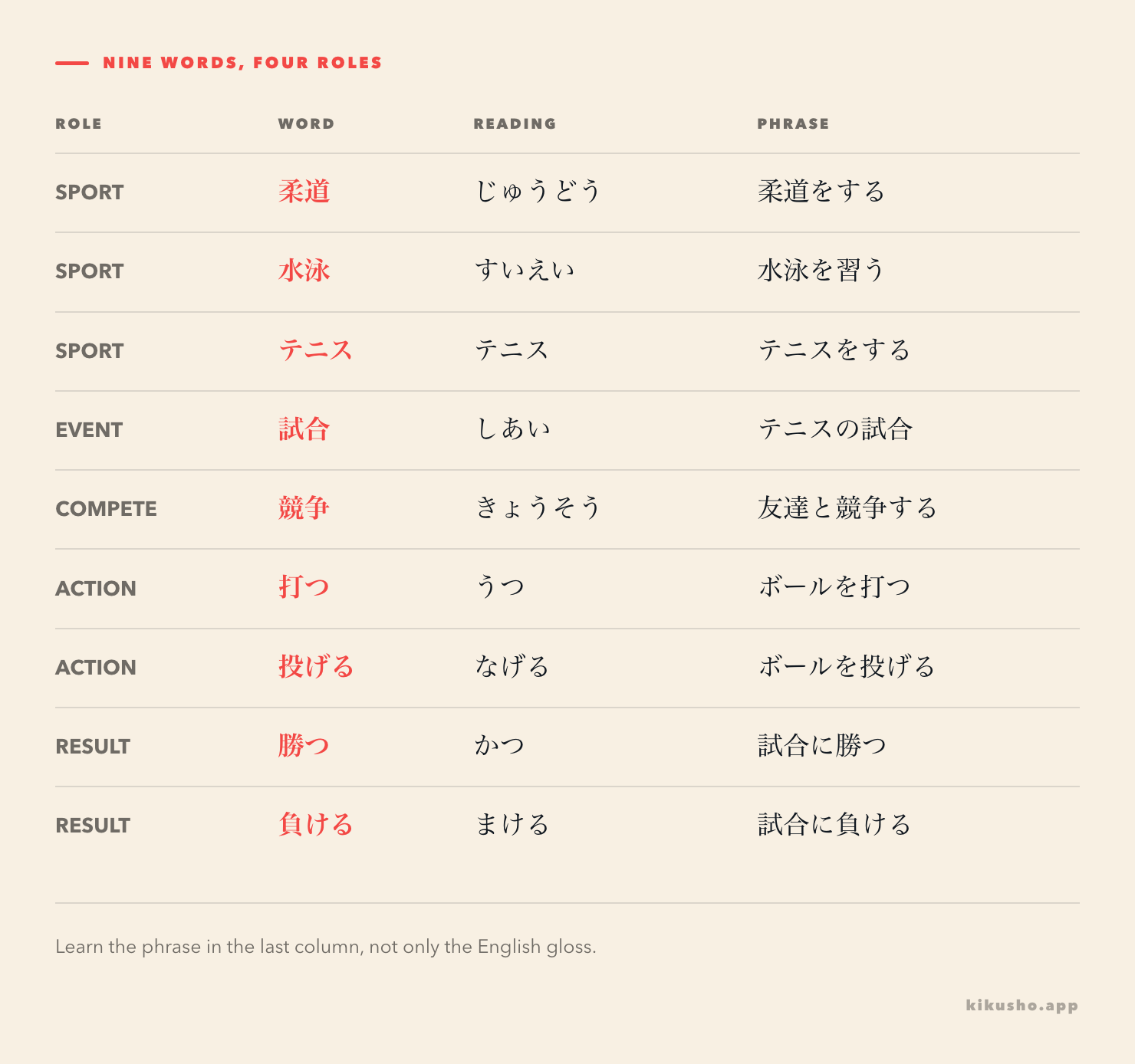
The readings contain three long vowels worth hearing clearly: じゅうどう, すいえい and きょうそう. テニス stays in katakana. The four everyday verbs use kanji followed by hiragana, and their dictionary endings tell you how they conjugate.
The set itself: sport, event, action, result
柔道, 水泳 and テニス name activities. With the neutral verb する, the ordinary learner pattern is 柔道をする, 水泳をする and テニスをする. Other verbs can make the relationship more exact:
姉は週に二回、柔道を習っています。
あねは しゅうに にかい、じゅうどうを ならっています。
My older sister takes judo lessons twice a week.
夏はプールで水泳をします。
なつは プールで すいえいを します。
I go swimming at the pool in summer.
日曜日に友達とテニスをしました。
にちようびに ともだちと テニスを しました。
I played tennis with a friend on Sunday.
Bunpro records 柔道, 水泳 and テニス as N4 nouns and gives the same activity patterns. Water itself is 水(みず), but 水泳 uses the on-reading すい. That is the same sound-building principle explained in the N4 kanji compounds lesson.
試合 names a particular event: one game, bout or match. You can watch it with 試合を見る, take part with 試合に出る, or state its result with 試合に勝つ / 負ける.
競争 is wider. It describes people, teams, companies or other parties pursuing the same outcome. It can be the noun in 競争が激しい, “competition is intense,” or combine with する in 兄と競争する, “compete with my older brother.” Bunpro's 競争 entry confirms the reading and both noun and する-verb uses.
二人は駅まで競争しました。
ふたりは えきまで きょうそうしました。
The two raced each other to the station.
That race may be informal and need no organised 試合. Conversely, 昨日の試合 points to a scheduled event, while 昨日の競争 focuses on the competing itself.
打つ and 投げる keep the ball as their object
The contrast is in the movement. 打つ brings a hand, racket or bat into contact with something. 投げる sends something through the air. Both are transitive, so the ball takes を.
| Movement | Frame | What happens |
|---|---|---|
| strike | ボールを打つ | a racket, bat or hand hits the ball |
| throw | ボールを投げる | the hand releases the ball through the air |
田中さんがボールを投げて、山田さんが打ちました。
たなかさんが ボールを なげて、やまださんが うちました。
Tanaka threw the ball, and Yamada hit it.
The past forms differ because 打つ is an う-verb and 投げる is a る-verb: 打った and 投げた. Their objects do not change. Bunpro's 打つ entry classifies it as a transitive N4 verb meaning to strike, while its 投げる entry verifies the ordinary throwing sense.
These verbs extend beyond sport. 打つ can describe typing or receiving an injection, and 投げる can mean casting or abandoning something. This lesson keeps the physical N4 meanings because the object and motion make them concrete.
勝つ and 負ける point to the contest with に
English treats “win the match” as a verb plus direct object. Japanese usually frames the event as the field in which the result occurs:
私たちのチームは試合に勝ちました。
わたしたちの チームは しあいに かちました。
Our team won the match.
テニスの試合に負けました。
テニスの しあいに まけました。
I lost the tennis match.
The opponent can take the same particle: 強い相手に勝つ, beat a strong opponent; 弟に負ける, lose to one's younger brother. To add the score, use で:
二対一で試合に勝ちました。
にたい いちで しあいに かちました。
We won the match two to one.
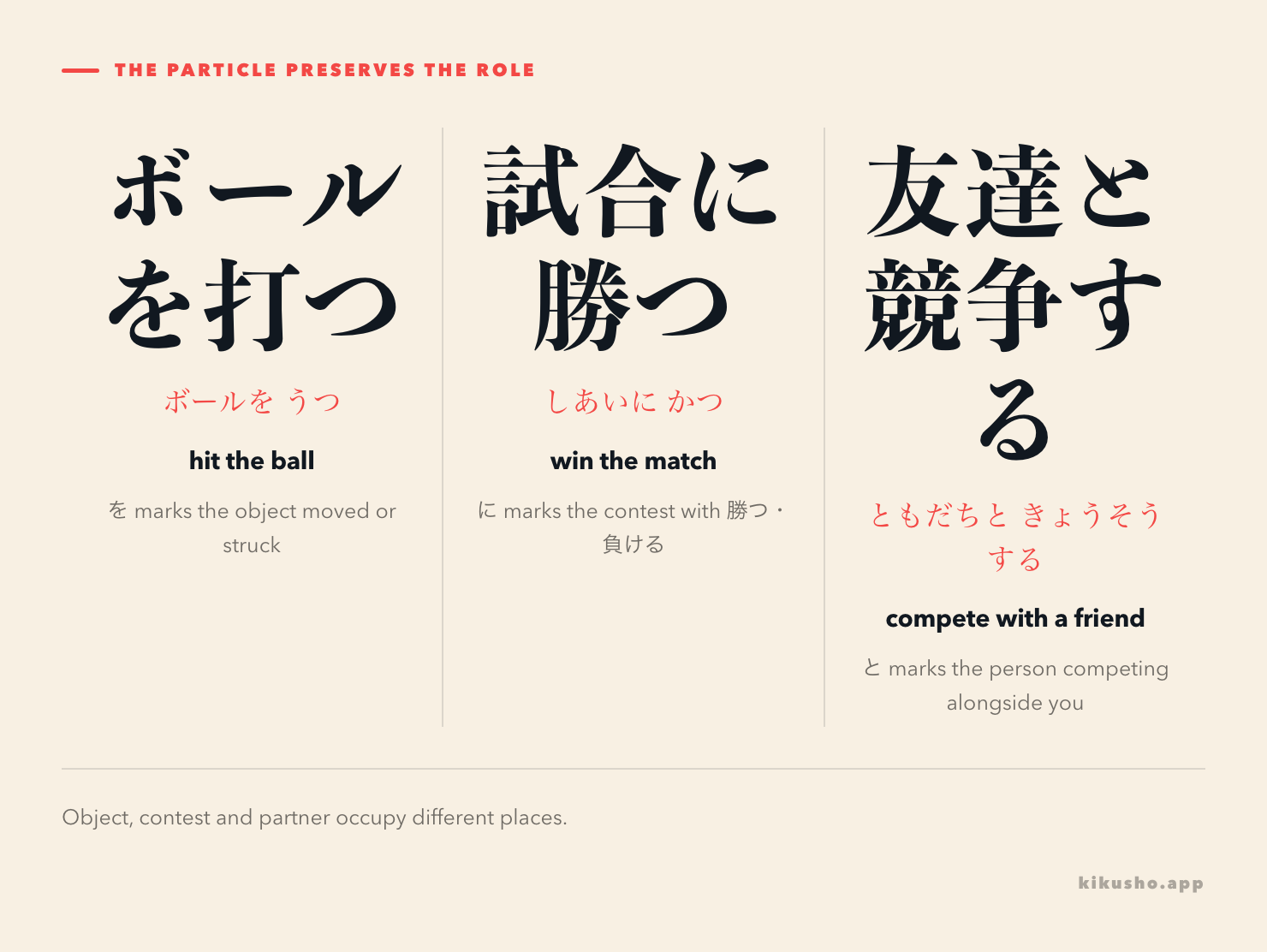
Daijisen defines 勝つ as gaining the advantage after fighting or competing, and gives 競争に勝つ as a standard frame. Its 負ける entry supplies the matching 試合に負ける. Bunpro independently places both 勝つ and 負ける at N4.
This shared に lets you learn the pair as one frame rather than translating each word separately. The result changes; the match stays in the same grammatical place.
The level label is a study estimate
The dated Kikusho inventory places all nine items at N4. Both baseline snapshots trace back to Waller, which makes them a single independent placement signal. Japanesetest4You separately lists 打つ, 勝つ, 競争, 試合 and 負ける at N4, while Bunpro labels every item in this set N4. The references agree here, but that agreement is not an official syllabus.
The JLPT FAQ confirms that learners now receive test specifications and samples rather than a definitive catalogue of every word, kanji and grammar point. Read “N4 vocabulary” as a practical study placement. You may meet テニス or 柔道 much earlier in conversation, while 競争 may arrive later in reading.
Which ones you will meet first
The concrete words tend to arrive first: テニスをする, 水泳をする, ボールを投げる and ボールを打つ. A scoreboard or conversation adds 試合に勝つ and 試合に負ける. 競争 reaches beyond sport, so it also appears in school, work and business contexts.
When you save one of these words in Kikusho, keep the smallest phrase that preserves its role. A photo of a club notice may give you 柔道の試合, while a spoken recap may give you 二対一で負けた. Check the generated reading and example before saving. The later card then returns the particle and situation together with the word.
Eight questions from the court and pool
Question 1
The word 競争 appears on a school race notice. Choose its full long-vowel reading.
- A. きょうそう
- B. きょうぞう
- C. けいそう
- D. きょそう
Question 2
A club poster gives the reading じゅうどう. Which option uses the standard kanji?
- A. 重動
- B. 柔道
- C. 柔動
- D. 重道
Question 3
A player uses a racket. Choose the verb that completes ラケットでボールを( )。
- A. 打ちます
- B. 投げます
- C. 負けます
- D. 競争します
Question 4
Your team has just won. Which Japanese report uses the result verb with the right particle?
- A. 私たちのチームは試合を勝ちました。
- B. 私たちのチームは試合で勝ちをしました。
- C. 私たちのチームは試合に勝ちました。
- D. 私たちのチームに試合が勝ちました。
Question 5
Two friends ran to the station to see who was faster. Which word best describes what they did?
- A. 水泳
- B. 試合
- C. 柔道
- D. 競争
Question 6
A player releases a ball through the air. Select the Japanese line that reports it.
- A. ボールを投げました。
- B. テニスに投げました。
- C. 試合を投げに勝ちました。
- D. 相手が投げるに負けました。
Question 7
Which paraphrase preserves the meaning of 試合で弟に負けました?
- A. I beat my younger brother before the match.
- B. I lost to my younger brother in the match.
- C. My younger brother threw the match.
- D. I competed with my younger brother at swimming.
Question 8
Read the short text: 日曜日、友達とテニスをしました。私はボールを上手に打てましたが、試合には負けました。 Which statement is true?
- A. The speaker won because they hit the ball well.
- B. The speaker threw the ball but did not play tennis.
- C. The speaker played tennis, hit the ball well and lost the match.
- D. The speaker watched a judo match with a friend.
Answers and explanations
Answer 1
A. きょうそう. Both syllables contain long vowels: きょう and そう. B voices the s sound, C changes the first reading, and D removes part of the long-vowel pattern.
Answer 2
B. 柔道. 柔道 is read じゅうどう and means judo. The other choices combine familiar-looking characters but are not the assigned spelling.
Answer 3
A. 打ちます. A racket strikes the ball, so 打つ supplies the action. 投げる would describe releasing the ball through the air. 負ける describes a result, and 競争する describes competing.
Answer 4
C. 私たちのチームは試合に勝ちました. 試合 takes に with 勝つ when it names the contest won. A copies the English direct-object frame. B is not the ordinary expression for this meaning, and D reverses the roles of the team and match.
Answer 5
D. 競争. Running toward the same destination to see who is faster is competition or a race. 試合 normally points to a match or game; 水泳 is swimming and 柔道 is judo.
Answer 6
A. ボールを投げました. 投げる is transitive, and the thrown object takes を. B marks tennis as a destination, while C and D combine particles and predicates into frames that do not express throwing a ball.
Answer 7
B. I lost to my younger brother in the match. 弟に marks the opponent to whom the speaker lost, 試合で supplies the setting, and 負けました gives the result. The other choices change the winner, action or sport.
Answer 8
C. The speaker played tennis, hit the ball well and lost the match. テニスをしました identifies the sport, ボールを上手に打てました reports a successful action, and 試合には負けました still gives a losing result. Hitting well does not guarantee winning.
Common questions
What is the difference between 試合 and 競争?
試合(しあい)is a particular match or game in which sides compete. 競争(きょうそう) is the broader act or condition of competing, including races, business and other attempts to reach the same goal first.
Which particle follows 試合 with 勝つ and 負ける?
Use に for the contest whose result you describe: 試合に勝つ means to win the match, and 試合に負ける means to lose the match. An opponent can also take に, as in 相手に勝つ.
What is the difference between 打つ and 投げる in sports?
打つ(うつ)means to hit or strike an object, as in ボールを打つ. 投げる(なげる) means to send an object through the air with a throwing motion, as in ボールを投げる. The object takes を with both verbs.
Are these nine words officially assigned to JLPT N4?
Kikusho's dated reference inventory and Bunpro place all nine at N4, but the JLPT does not publish an exhaustive official vocabulary list. Level labels are therefore study estimates rather than official assignments.