On this page
小説 and 漫画 name two kinds of story; 翻訳 moves a text into another language, while 訳(わけ) explains why a situation makes sense. The shared kanji 訳 hides this lesson's main trap: ほんやく contains the translation reading やく, but the assigned standalone word is わけ, a reason, explanation or set of circumstances.
Four words and four different jobs
| Function | Entry | Reading | Word class and core sense | Phrase to remember |
|---|---|---|---|---|
| A prose story | 小説 | しょうせつ | noun: novel; prose fiction | 小説を読む, read a novel |
| A story in panels | 漫画 | まんが | noun: manga; comic; cartoon | 漫画を読む, read manga |
| Moving meaning between languages | 翻訳 | ほんやく | noun and する verb: translation; translate | 小説を翻訳する, translate a novel |
| What explains a situation | 訳 | わけ | noun: reason; explanation; circumstances | 何か訳がある, there is some reason |
The heading mentions books, films and storytelling because that is the curriculum theme, but these four assigned records centre on written stories and translation. This lesson does not quietly add a film word that belongs to another record. Its useful work is narrower: separate two reading formats, then separate two meanings hidden behind 訳.
If 本(ほん), “book,” is still new, begin with the N5 home and classroom vocabulary lesson. 本 names the physical book broadly; 小説 and 漫画 tell you what kind of content it contains.
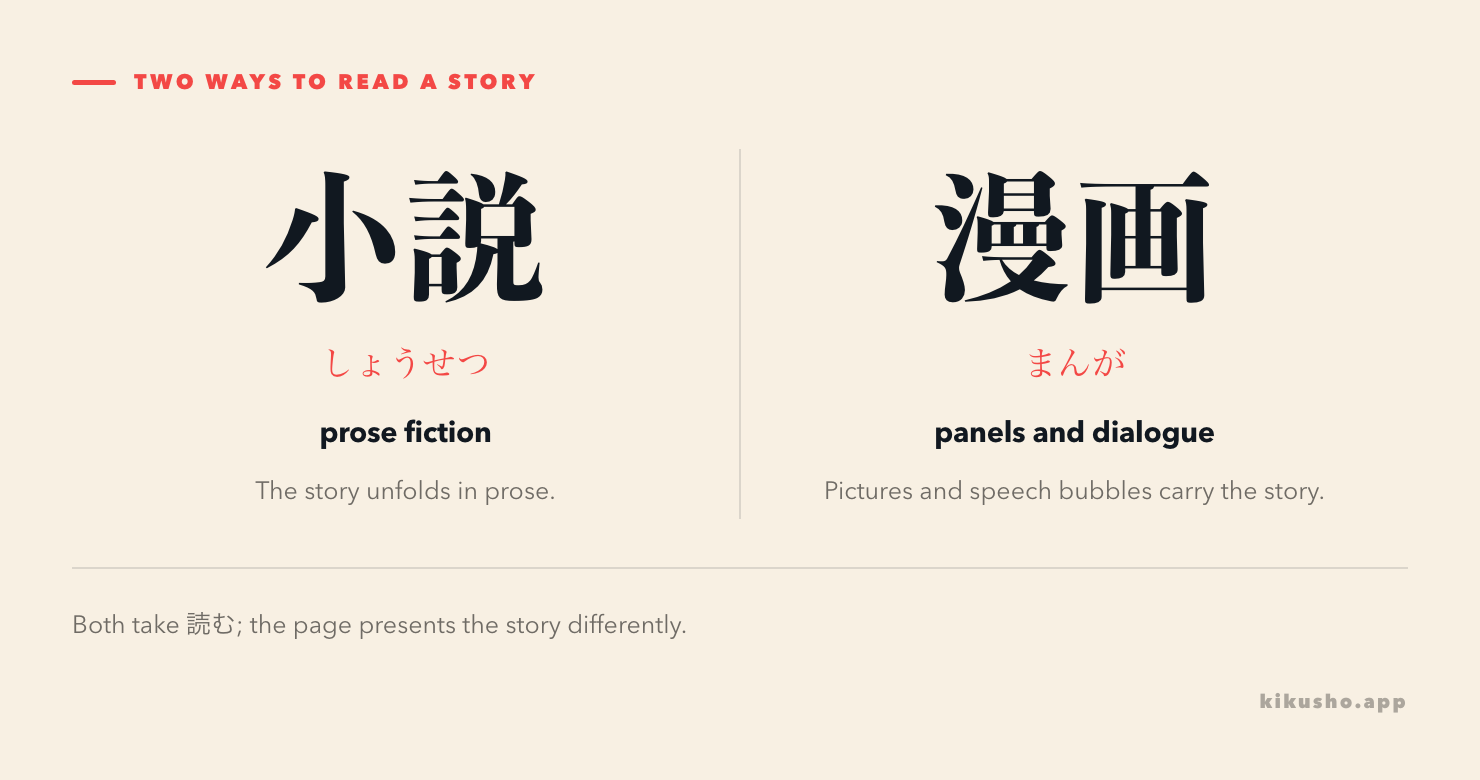
小説 is prose fiction; 漫画 tells the story in panels
小説(しょうせつ) is a novel or another work of prose fiction. Its ordinary partner is 読む(よむ), “to read”:
電車の中で短い小説を読みました。
でんしゃの なかで みじかい しょうせつを よみました。
I read a short novel on the train.
Useful compounds narrow the kind of fiction: 短編小説(たんぺんしょうせつ) is a short story or short novel, and 推理小説(すいりしょうせつ) is a mystery novel. Kanjipedia defines 小説 as prose that represents people or society through an author's imagination and design. Kotobank's 小説 entry likewise places it among prose forms rather than poetry or drama.
漫画(まんが) can mean manga, comics or a cartoon. In the storytelling sense, pictures appear in sequence and usually carry dialogue:
妹は毎週、新しい漫画を読んでいます。
いもうとは まいしゅう、あたらしい まんがを よんでいます。
My younger sister reads a new manga every week.
Kotobank's 漫画 entry includes both a humorous or satirical picture and a story made from a sequence of pictures, often with dialogue. Context decides whether 漫画 refers to one cartoon image, comics as a form or a bound manga volume.
Both kinds of bound book can be counted with 冊(さつ):
- 小説を一冊買いました。 — I bought one novel.
- 漫画を三冊借りました。 — I borrowed three manga volumes.
The counter changes pronunciation in forms such as 一冊(いっさつ) and 八冊(はっさつ). The guide to twelve Japanese counters shows the sound changes separately; here, keep the content distinction in focus.
翻訳 is translation and behaves like a する word
翻訳(ほんやく) names a translation and becomes the verb “to translate” with する. Kotobank defines 翻訳 as replacing text expressed in one language with text carrying the same meaning in another.
この小説は二十か国語に翻訳されています。
この しょうせつは にじゅっかこくごに ほんやくされて います。
This novel has been translated into twenty languages.
The passive 翻訳される is common when the translated work matters more than the translator. When you name both directions, mark the source with から and the target with に:
兄はその漫画を日本語から英語に翻訳しました。
あには その まんがを にほんごから えいごに ほんやくしました。
My older brother translated that manga from Japanese into English.
The structure is stable:
text を + source language から + target language に + 翻訳する
You do not need every part in every sentence. この本を英語に翻訳する is complete when the source language is obvious, and 英語から翻訳する works when the target language is already understood.
For ordinary language study, 翻訳 most often concerns written material. 通訳(つうやく) is the usual word for live interpreting between speakers. That contrast is helpful, but 通訳 is not one of this lesson's four target cards.
訳(わけ) explains the situation
The standalone noun in this lesson is 訳(わけ). It can name the reason, explanation, circumstances or logic that makes a situation understandable:
彼が急に帰ったのには、何か訳があると思います。
かれが きゅうに かえったのには、なにか わけが あると おもいます。
I think there is some reason why he suddenly went home.
遅れた訳を話してください。
おくれた わけを はなして ください。
Please explain why you were late.
The second sentence does not ask for a translated text. It asks for the circumstances behind being late. Kotobank lists the わけ senses of 訳 as logic, meaning, reason and circumstances, while Kanjipedia's 訳 entry supports the reason and circumstances reading.
This lexical noun also developed into grammar patterns such as わけだ, わけではない and わけがない. In those patterns it is normally written in kana and helps express a conclusion, partial denial or impossibility. The full わけ grammar lesson keeps those constructions separate. At N4, first make the concrete noun familiar through phrases such as 何か訳がある and 訳を話す.
The same kanji does not guarantee the same reading
In 翻訳(ほんやく), 訳 uses the on-reading やく and contributes the idea of translation. In the assigned standalone word 訳(わけ), it uses the kun-reading わけ and points to a reason or explanation.
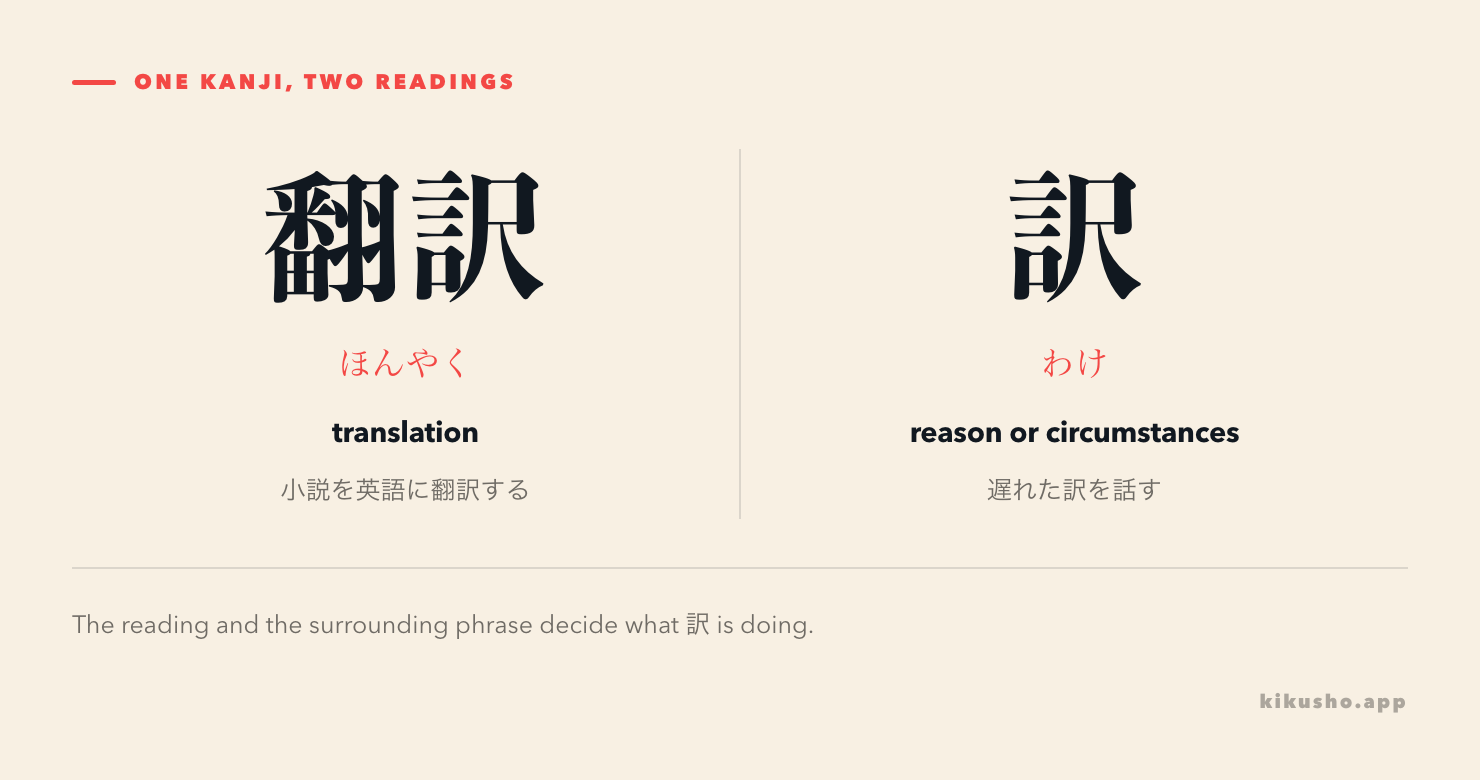
Do not turn that into the false rule “訳 never means translation by itself.” 訳(やく) can itself mean a translation, as in 新しい訳, “a new translation.” The safe rule is that spelling alone is insufficient:
- 翻訳(ほんやく) — translation; translating
- 訳(やく) — a translation or translated version in some contexts
- 訳(わけ) — reason; explanation; circumstances
The lesson's inventory record is specifically 訳(わけ). Read the kana when it is supplied, and use the neighbouring words when it is not.
One reading group, four separate cards
Picture a small book club discussing a new release:
来月、この小説の英語の翻訳が出ます。同じ物語の漫画もありますが、作者が名前を変えた訳はまだ分かりません。
らいげつ、この しょうせつの えいごの ほんやくが でます。おなじ ものがたりの まんがも ありますが、さくしゃが なまえを かえた わけは まだ わかりません。
An English translation of this novel comes out next month. There is also a manga of the same story, but we still do not know why the author changed the name.
All four items appear without collapsing into one vague “story” card. 小説 supplies the prose work, 翻訳 supplies its other-language version, 漫画 supplies a different visual format, and 訳(わけ) asks for the explanation behind a decision.
That separation matters when you capture examples in Kikusho. A photo of a review or speech bubble may contain several useful terms, but keep 漫画を読む, 小説を翻訳する and 何か訳がある on distinct cards. The phrase is the cue that tells you which reading and meaning to retrieve. If manga is your reading goal, the practical guide to starting manga before you feel ready shows how furigana, conversational contractions and pictures change the task.
A note about the N4 placement
All four assigned spelling-reading records carry an N4 label in Kikusho's dated reference inventory, and that inventory records no level disagreement. Its two imported N4 snapshots descend from one shared source, Tanos/Waller; their agreement counts as a single placement tradition. A separately published headword list also puts 小説 at N4.
The official JLPT FAQ says the revised exam no longer releases the old specification document with its vocabulary and kanji lists. That leaves dictionaries to confirm language facts, not test placement. N4 here is therefore a useful study order rather than a boundary set by the exam maker.
Practice: finish every question before revealing the notes
Question 1 · read the prose form
Choose the correct reading for 小説.
A. しょうせつ B. しょうぜつ C. こせつ D. しょうせち
Question 2 · write the translation word
Which spelling matches ほんやく, “translation”?
A. 翻訳 B. 翻約 C. 反訳 D. 本訳
Question 3 · choose the story format
A book tells its story mainly through panels, pictures and speech bubbles. Which word fits?
A. 小説 B. 訳 C. 漫画 D. 翻訳
Question 4 · follow the translation direction
What does 日本語から英語に翻訳しました mean?
A. I translated from English into Japanese. B. I translated from Japanese into English. C. I explained why I studied Japanese. D. I read an English manga in Japanese.
Question 5 · explain the hidden circumstances
Which word completes 彼が来ないのには、何か__がある?
A. 小説 B. 漫画 C. 翻訳 D. 訳
Question 6 · paraphrase the request
Which sentence best restates 遅れた理由を説明してください, “Please explain why you were late”?
A. 遅れた訳を話してください。 B. 遅れた漫画を読んでください。 C. 小説を英語にしてください。 D. 翻訳の訳を買ってください。
Question 7 · connect the four words
Read this sentence: この小説は漫画にもなり、英語に翻訳されましたが、題名を変えた訳は分かりません。 Which statement is correct?
A. The manga was translated from English, and its reason is obvious. B. The novel became a manga and was translated into English, but the reason for changing the title is unknown. C. The writer explained why the English novel has no pictures. D. The title is a translation of the word 漫画.
The four targets have now appeared as reading, spelling, context, particle direction and paraphrase prompts.
Answers and explanations
1 · Reading the novel: A, しょうせつ. 小説 is read しょうせつ. The voiced ぜつ and the shortened alternatives do not match the assigned spelling-reading record.
2 · Writing translation: A, 翻訳. 翻訳 is read ほんやく. 反訳 exists as a different, uncommon spelling in some contexts, but it is not the assigned everyday form; the other choices do not write this word.
3 · Recognising panels: C, 漫画. 漫画 tells a story through sequential pictures, often with dialogue. 小説 is prose fiction, while 翻訳 and 訳 describe neither format.
4 · Tracking languages: B. から marks Japanese as the source and に marks English as the target. Reversing those particles reverses the translation direction.
5 · Naming the reason: D, 訳. 何か訳がある means there is some reason or some unexplained circumstance. Read this standalone word わけ in the sentence.
6 · Paraphrasing an explanation: A. 遅れた訳を話す asks someone to tell the reason or circumstances behind being late. It does not ask for a translation.
7 · Reading the full account: B. 小説 is the original prose work, 漫画 is another format, 英語に翻訳されました reports an English translation, and 題名を変えた訳 asks why the title changed.
Keep the contrasts attached to short phrases: 小説を読む, 漫画を読む, 英語に翻訳する and 何か訳がある. Those cues make the right reading and meaning available before the shared kanji can mislead you.
Common questions
What four N4 storytelling words does this lesson teach?
The four assigned words are 小説(しょうせつ), a novel; 漫画(まんが), manga or comics; 翻訳(ほんやく), translation or to translate; and 訳(わけ), a reason, explanation or set of circumstances.
What is the difference between 翻訳 and 訳(わけ)?
翻訳(ほんやく)means translation and can take する. The assigned standalone word 訳(わけ)means a reason, explanation or circumstances. The kanji 訳 can also be read やく in words connected with translation, so the reading and context decide.
What is the difference between 小説 and 漫画?
小説(しょうせつ)is prose fiction, such as a novel or short story. 漫画(まんが) tells its story through sequential pictures, usually with written dialogue. Read both with 読む and count bound volumes of both with 冊.
How do you show the source and target languages with 翻訳する?
Use から for the source and に for the target: 日本語から英語に翻訳する means translate from Japanese into English. The text being translated normally takes を.
Are these four words officially N4 vocabulary?
No exhaustive official JLPT vocabulary list is published. Kikusho's dated reference inventory places these four spelling-reading records at N4 without an internal disagreement, so N4 is a practical study placement, not an official line.