On this page
The curtain rises on a 舞台, but a complete performance scene needs more than the stage: a 公演 takes place in a 劇場, musicians give an 演奏, and the 観客 respond with 拍手. This N3 set teaches 17 words that connect instruments, performers, public events and museum visits.
The complete set
| Scene role | Entry | Spoken form | What it names | Phrase to keep |
|---|---|---|---|---|
| Music | 演奏 | えんそう | noun / する-verb: playing music; musical performance | バイオリンを演奏する |
| Music | 音 | おん | noun: a musical or linguistic sound unit | 一音下げる |
| Visual art | 絵画 | かいが | noun: painting; pictorial art | 絵画を展示する |
| Performer | 歌手 | かしゅ | noun: singer | 人気歌手 |
| Audience | 観客 | かんきゃく | noun: audience member; spectator | 観客を集める |
| Instrument | 楽器 | がっき | noun: musical instrument | 楽器を演奏する |
| Arts | 芸術 | げいじゅつ | noun: art; the arts | 芸術に触れる |
| Venue | 劇場 | げきじょう | noun: theatre; playhouse | 劇場に入る |
| Event | 公演 | こうえん | noun / する-verb: public performance | 公演を行う |
| Performer | 女優 | じょゆう | noun: female actor | 映画女優 |
| Sound | 音 | ね | noun: resonant sound, voice or cry | 笛の音 |
| Performer | 俳優 | はいゆう | noun: actor | 舞台俳優 |
| Response | 拍手 | はくしゅ | noun / する-verb: applause; clapping | 拍手を送る |
| Institution | 博物館 | はくぶつかん | noun: museum | 博物館を見学する |
| Instrument | バイオリン | ばいおりん | noun: violin | バイオリンを弾く |
| Instrument | 笛 | ふえ | noun: flute; pipe; whistle | 笛を吹く |
| Stage | 舞台 | ぶたい | noun: stage; performance setting | 舞台に立つ |
The repeated spelling 音 represents two assigned words here. Keep the reading in the card or sentence, because 一音(いちおん) and 笛の音(ふえのね) do different work.
Instruments become an 演奏
楽器(がっき) is the category. バイオリン and 笛(ふえ) are members of it, but they select different action verbs in ordinary phrases:
- バイオリンを弾く, play the violin
- 笛を吹く, play or blow a flute or whistle
- 楽器を演奏する, play a musical instrument
演奏(えんそう) names the act of realizing music in sound. Kotobank's dictionary entry defines it as playing music and records it as a noun and する-verb.
姉は舞台でバイオリンを演奏した。
My older sister played the violin on stage.
遠くから笛の音が聞こえてきた。
The sound of a flute came from far away.
The verb 演奏する can take the instrument or the musical work as its object. バイオリンを演奏する focuses on the instrument; モーツァルトの曲を演奏する identifies the music.
Three readings of 音 divide the sound
The earlier N4 cultural-events lesson teaches 音(おと), the ordinary general noun for an audible sound. N3 adds two narrower readings.
音(おん) treats a sound as a countable or classifiable unit. Music can move 一音下がる, down one note. Language can distinguish 母音(ぼいん) and 子音(しいん), vowels and consonants. It also appears in 音読み(おんよみ), a Sino-Japanese kanji reading.
音(ね) presents a sound as something with a quality that reaches the listener: 笛の音, 鐘の音, 虫の音. Kotobank's 音 entry notes that ね often describes a comparatively delicate or emotionally suggestive sound, voice or cry.
最後の音を半音下げてください。
Please lower the final note by a semitone.
秋の夜に虫の音を聞いた。
I listened to the sounds of insects on an autumn night.
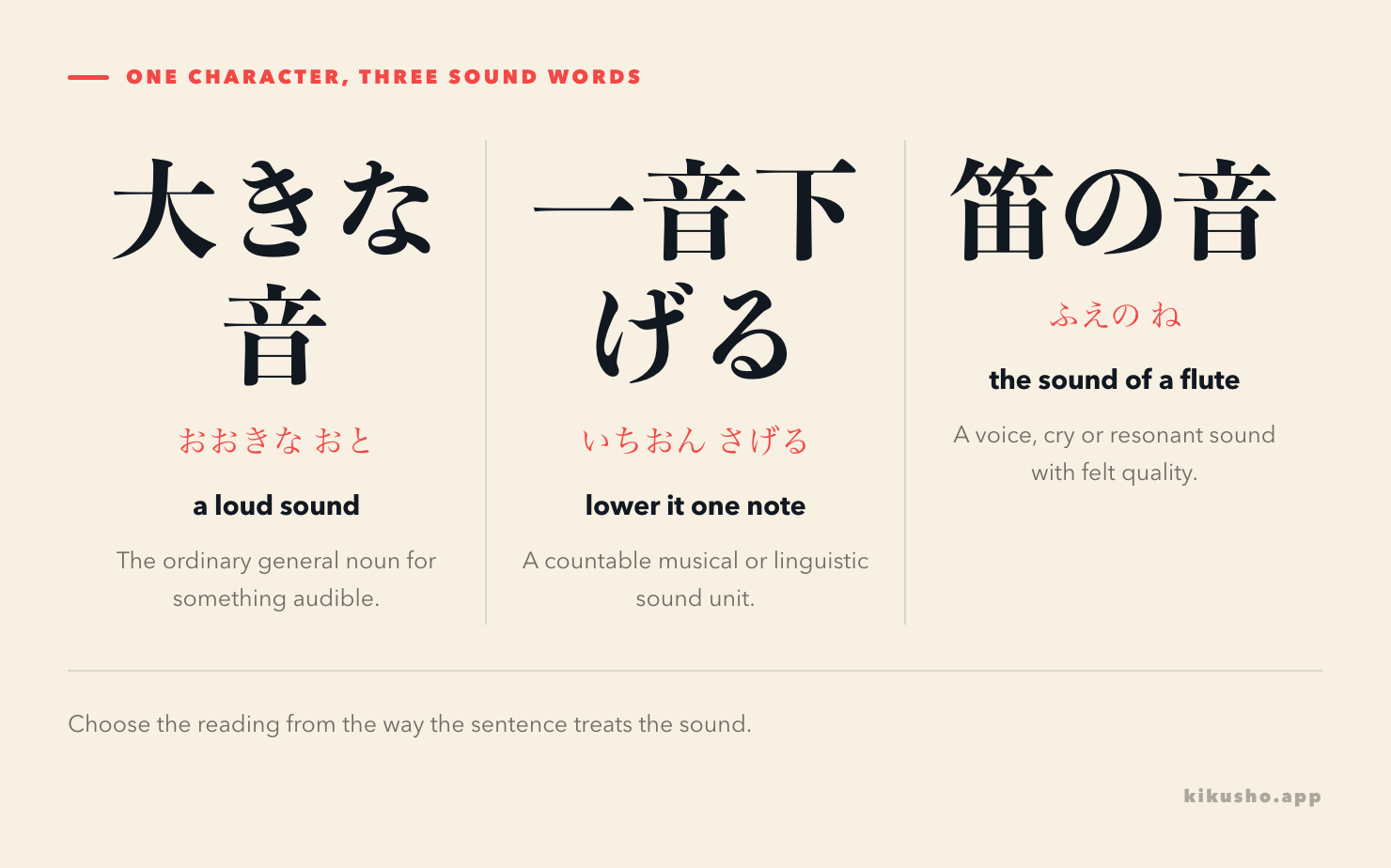
Do not substitute one reading mechanically. 大きな音がした normally uses おと because it reports a sound that occurred. 笛の音が美しい uses ね to attend to the instrument's tone.
演奏 happens inside a 公演
演奏 answers “what musical act occurred?” 公演(こうえん) answers “what public presentation was scheduled or held?” A 公演 may be a concert, play, dance performance or traditional performing-arts event. The Japan Foundation uses the words together when it reports musicians giving an 演奏 during a 公演, which shows the event-action distinction in real institutional writing.
来月、この劇場で二回の公演を行います。
Next month, we will give two performances at this theatre.
公演の途中で、歌手が一人で笛を演奏した。
During the performance, the singer played a flute alone.
The Japan Foundation's current performing-arts pages group music, theatre and dance under 舞台芸術 and describe public performances across those fields. Its report on MIKAGE PROJECT uses 楽器, 演奏, 観客 and 公演 in one real account.
The event has a place, a stage and an audience
劇場(げきじょう) is the building or venue. 舞台(ぶたい) is the stage within it, or by extension the setting and world of performance. A performer 舞台に立つ; an audience member 劇場に入る.
観客(かんきゃく) can be one spectator or the audience collectively. The audience's response is 拍手(はくしゅ), used with 拍手する, 拍手が起こる or 拍手を送る.
俳優が舞台に現れると、観客から拍手が起こった。
When the actor appeared on stage, applause rose from the audience.
公演が終わるまで、観客は大きな拍手を送り続けた。
The audience continued applauding loudly until the performance ended.
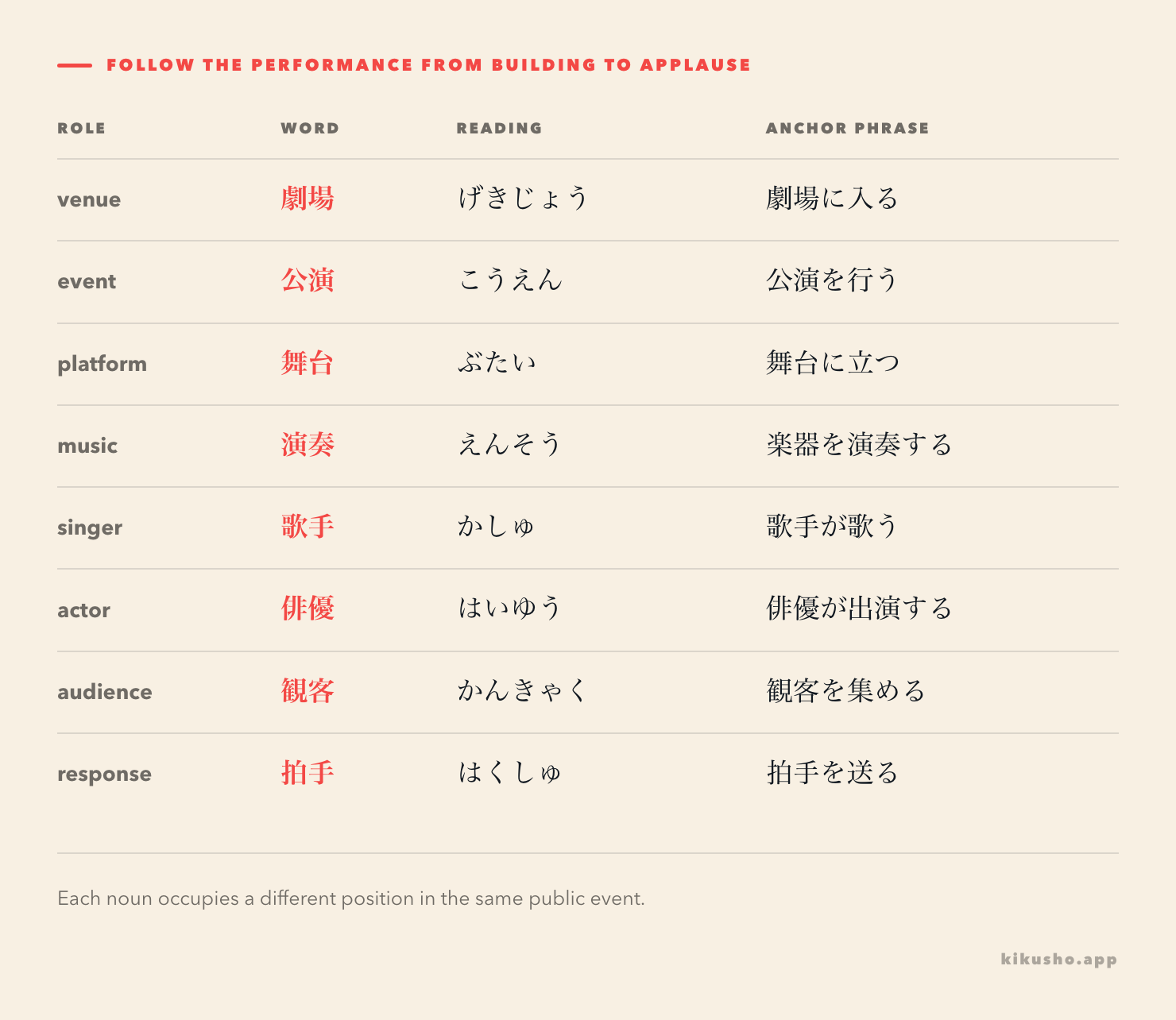
The particle changes the viewpoint. 観客が拍手する makes the audience the actor. 観客に拍手する would mean applauding the audience, which reverses the expected direction.
歌手, 俳優 and 女優 name different performers
歌手(かしゅ) sings as an occupation or public role. 俳優(はいゆう) acts in theatre, film or television. It is a general term and does not itself specify gender. Kotobank defines 俳優 through professional acting on stage and screen.
女優(じょゆう) explicitly means a female actor. The corresponding dictionary entry defines it as a woman who is a 俳優. Use it when the gendered label is relevant; use 俳優 when it is not.
その俳優は映画だけでなく、舞台にも出演している。
That actor appears not only in films but also on stage.
主演女優が観客の質問に答えた。
The lead actress answered questions from the audience.
若い歌手が公演の最後に新しい曲を歌った。
A young singer sang a new song at the end of the performance.
The person and the event also choose different verbs. A 俳優が出演する, an actor appears in a production; organizers 公演を行う, hold a performance.
絵画 is one form inside 芸術
絵画(かいが) names painting as a medium or an individual painted work. Kotobank describes images made on a flat support with pigments or drawing materials.
芸術(げいじゅつ) is the wider category of artistic activity and its products. It includes painting, sculpture, music, literature, theatre, film and dance, as Kotobank's definition makes explicit. One 絵画 can be an 芸術作品; not every 芸術 is an 絵画.
この博物館では、江戸時代の絵画を展示している。
This museum displays paintings from the Edo period.
音楽も演劇も、社会と深く関わる芸術だ。
Music and theatre are both arts deeply connected with society.
博物館(はくぶつかん) is a museum in the broad institutional sense. A museum may preserve historical objects, scientific specimens, cultural materials or works of art. 美術館(びじゅつかん), already taught at N4, narrows the focus to visual art.
博物館で古い楽器を見た後、美術館で近代絵画を見た。
After seeing old instruments at the museum, I saw modern paintings at the art museum.
That sentence keeps the institution and collection distinct. It also prevents English “museum” from erasing the useful choice between 博物館 and 美術館.
Keep the relationships on the card
This set is easiest to remember as a route rather than 17 isolated translations. In Kikusho, a photo of a theatre poster can preserve 公演を行う, while a sentence captured from a review can preserve 観客から拍手が起こった. For the repeated spelling 音, keep both the reading and the surrounding phrase visible: 一音下げる and 笛の音 must never become the same card.
The N1 arts-production lesson continues from this scene with 曲, 演出, 衣装, 美術 and 上演. Those words describe the work being composed, staged and produced; this N3 lesson supplies the people, places and public event around it.
Read the whole performance
Question 1
How do you read 観客?
- かんかく
- かんきゃく
- けんきゃく
- かんぎゃく
Question 2
Which word completes the phrase meaning “play the violin”?
バイオリンを__。
- 吹く
- 弾く
- 描く
- 立つ
Question 3
Choose the intended reading of 音 in 最後の音を一音下げた.
- おと
- ね
- おん
- こえ
Question 4
Which sentence describes a scheduled public performance rather than the act of playing music?
- ピアノを演奏した。
- 劇場で二回の公演を行った。
- 笛の音を聞いた。
- 楽器を練習した。
Question 5
Complete the natural response: 俳優が舞台に出ると、観客から__が起こった。
Question 6
Paraphrase 女性の俳優 with one assigned word.
Question 7
Choose the broader category.
- 絵画 is one form of 芸術.
- 芸術 is one form of 絵画.
Question 8
Complete the connected report with 劇場, 舞台, 観客 and 拍手.
__に入ると、__では俳優がもう演技をしていた。最後に__が立ち上がり、大きな__を送った。
Resolve the four roles before opening the performance notes.
Answers and explanations
1 · Audience reading
かんきゃく. 観客 names an audience member or spectators collectively. The second character begins with the contracted sound きゃく.
2 · Instrument action
弾く. A violin is a stringed instrument, so バイオリンを弾く is the ordinary phrase. 笛 instead takes 吹く.
3 · A counted note
おん. 一音 treats the musical note as a unit, and the sentence asks for that same reading of 音. おと is the general sound noun; ね attends to a resonant sound or voice.
4 · Event or musical act
劇場で二回の公演を行った. The counter 二回 and 公演を行う describe two scheduled public presentations. 演奏した describes the musical act itself.
5 · Audience response
拍手. 拍手が起こる means applause arises. The source can be marked with から: 観客から拍手が起こった.
6 · Gender-specific performer
女優. 女優 specifically identifies a female actor. 俳優 remains the general occupation word.
7 · Medium and category
絵画 is one form of 芸術. 絵画 is painting, while 芸術 includes music, literature, theatre, dance, film, painting and other arts.
8 · The performance chain
劇場 / 舞台 / 観客 / 拍手. The theatre is the venue, the actor performs on the stage, and the audience sends applause.
A review becomes precise when each noun keeps its role. The next time you read a cultural listing, trace who performs, what they perform, where the event happens and how the audience responds.
Common questions
What is the difference between 演奏 and 公演?
演奏(えんそう)is the act of playing music. 公演(こうえん)is a public performance or its scheduled presentation, and can refer to theatre, dance or music. A concert 公演 can contain several 演奏.
How are the readings 音(おん), 音(ね)and 音(おと)different?
おん is used for a musical or linguistic unit such as one note or one sound. ね often evokes a voice, cry or resonant sound, as in 笛の音. おと is the ordinary general word for an audible sound.
Is 俳優 only a male actor?
No. 俳優(はいゆう)is the general occupation word for an actor and can refer to a person of any gender. 女優(じょゆう)specifically identifies a female actor when that distinction matters.
What is the difference between 美術館 and 博物館?
美術館 focuses on works of visual art. 博物館 is the broader museum term for institutions that collect, preserve, study and display materials related to history, nature, science, culture or art.