On this page
A house can be described from the outside inward: 住宅, 建築, 屋根, 床, 居間, 家具, then the 毛布 on the sofa or bed. These seven N3 nouns move beyond naming individual household objects and let you describe a dwelling as a building, a shared space and a place arranged for daily life.
Why these words belong together
The N4 room vocabulary lesson names a mirror, wall, curtain, shelf, drawer, bedding, light, heating and cooling. N3 changes the scale. 住宅 and 建築 can appear in property information or discussions of buildings. 屋根 and 床 identify structural surfaces. 居間 and 家具 describe how an interior is used, while 毛布 narrows the bedding to one particular item.
Current search results are crowded with long home-vocabulary lists. Onigiri Anki's N3 home guide includes 居間, 家具 and 住宅 among dozens of housing and daily-life terms; Nihongo Net groups 毛布 with furniture and household articles. The useful pattern here is smaller: start with the dwelling, pass through its structure, and finish with what people arrange and use inside it.
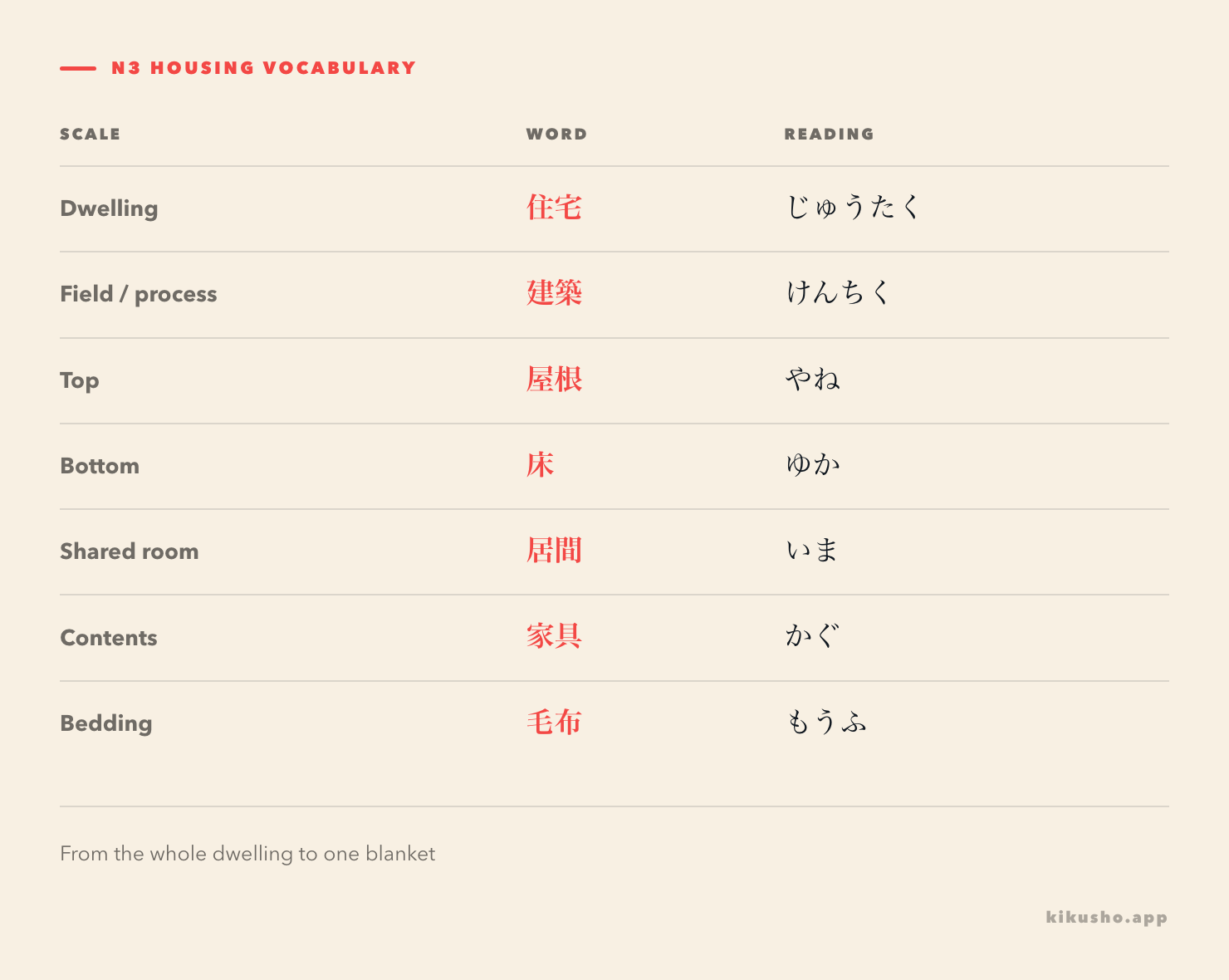
The seven nouns, from building to room
| Scale | Word | Reading | Part of speech and sense | Phrase partner |
|---|---|---|---|---|
| Dwelling | 住宅 | じゅうたく | noun: house, residence, housing | 住宅を建てる, build a house |
| Building activity or field | 建築 | けんちく | noun / する noun: construction, architecture | 住宅を建築する, construct a residence |
| Upper structure | 屋根 | やね | noun: roof | 屋根を修理する, repair the roof |
| Lower interior surface | 床 | ゆか | noun: floor | 床を掃除する, clean the floor |
| Shared room | 居間 | いま | noun: living room | 居間でくつろぐ, relax in the living room |
| Interior contents | 家具 | かぐ | collective noun: furniture | 家具を配置する, arrange furniture |
| Bedding | 毛布 | もうふ | noun: blanket | 毛布を掛ける, put a blanket over someone or oneself |
The readings and core senses are supported by Japanese dictionaries. Kotobank defines 住宅 as a house intended for people to live in and 建築 as constructing a building, the resulting work, or the relevant techniques. Its entries for 居間, 家具, 屋根 and 毛布 verify the room, furniture, roof and blanket senses used here. Kanjipedia separately verifies 床(ゆか) for a floor surface.
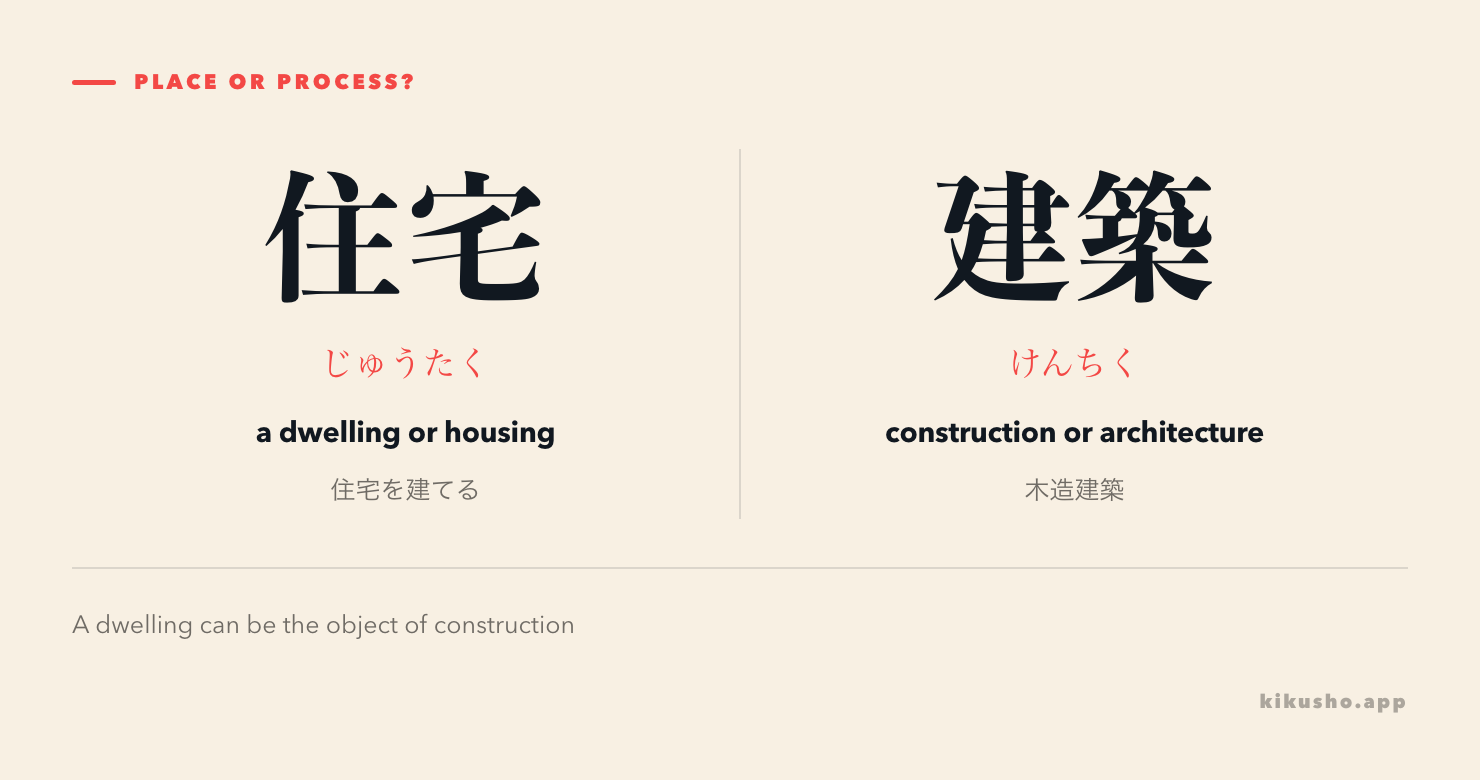
住宅 is the dwelling; 建築 is what is built or done
住宅 answers “what kind of place is it?” It names a house, residence or housing intended for people:
この地域には新しい住宅が増えています。
New housing is increasing in this area.
It appears in compounds such as 住宅地, a residential area, and 公営住宅, public housing. Translating it as “resident” would be wrong in the ordinary modern sense taught here; the person is 住民(じゅうみん), while 住宅 is the dwelling.
建築 answers a different question. It can name the act of constructing a building, a work of architecture, or the field itself:
駅の近くに図書館を建築しています。
They are constructing a library near the station.
日本の木造建築に興味があります。
I am interested in Japanese wooden architecture.
As a verb, use 建築する with the structure being built. In everyday speech, 家を建てる is often simpler for “build a house.” 建築 becomes useful when the construction process, building type or architectural field is in focus.
屋根 and 床 frame the building vertically
屋根 is the covering at the top of a building. It protects the interior from rain, wind and sunlight. Natural partners include 屋根を修理する, repair the roof, and 屋根に雪が積もる, snow accumulates on the roof.
台風で屋根が壊れました。
The roof was damaged in the typhoon.
床(ゆか) is the surface you stand or walk on inside. Use 床を掃く, sweep the floor, 床を拭く, wipe the floor, or 床に座る, sit on the floor.
子どもがおもちゃを床に並べました。
The child arranged the toys on the floor.
The reading needs care. The isolated floor noun here is ゆか. The same character can be とこ in words connected with a bed or sleeping place, including 寝床(ねどこ), and しょう in compounds such as 病床(びょうしょう), hospital bed. The assigned N3 record is specifically 床(ゆか), floor.
居間 and 家具 describe a room as lived space
居間(いま) is the room where members of a household sit, talk, watch television or spend shared time. リビング is also common, but 居間 remains useful in descriptions and written material.
家族は夕食の後、居間でテレビを見ました。
After dinner, the family watched television in the living room.
Do not confuse it with 今(いま), “now.” The pitch pattern may differ, but written context already settles the noun: 居間の家具 can only mean the living-room furniture.
家具 is a collective category. Chairs, tables, beds and cabinets are pieces of 家具. Japanese normally says 家具を買う for buying furniture and can count pieces as 家具を三点買う, “buy three items of furniture.” 家具たち is not the ordinary way to make it plural.
引っ越す前に、大きな家具を処分しました。
Before moving, I disposed of the large furniture.
That collective sense distinguishes 家具 from one concrete item. The N4 lesson's 棚 and 引き出し can both belong to 家具, but 家具 itself does not tell you which item is meant.
毛布 is one layer of bedding
毛布 is a thick blanket, traditionally woollen but also made from mixed or synthetic fibres. It is not the general word for every kind of bedding. 布団 can name padded bedding; 毛布 names the blanket layer.
寒かったので、毛布をもう一枚掛けました。
It was cold, so I added another blanket.
The counter 枚(まい) works because a blanket is treated as a flat item. Common verbs include 毛布を掛ける, put a blanket over someone or oneself, 毛布にくるまる, wrap oneself in a blanket, and 毛布を洗う, wash a blanket.
This word is useful precisely because “bedding” is too broad in a cold-room scene. If someone asks for 毛布, bringing a pillow or merely pointing to the 布団 misses the requested layer.
Save the scale with the word
These nouns become easier when a phrase preserves their scale: 住宅地 is an area of dwellings, 木造建築 classifies architecture, 屋根を修理する points to the top of a building, and 床を拭く points to the surface underfoot. Inside, 居間の家具 names a category of objects, while 毛布を掛ける ends with one concrete action.
If a property listing, repair notice or furniture label gives you one of these words, Kikusho can draft its card from a photo or pasted line. Keep the compound or action that fixed the meaning and check the reading before saving. A card for 床 that retains 床を拭く is far less likely to drift toward とこ than one headed only by the kanji.
Practice
Question 1: reading
How is 住宅 read?
- ア. じゅたく
- イ. じゅうたく
- ウ. じゅうだく
- エ. じゅたけ
Question 2: choose the noun
Which word means “furniture” as a collective category?
- ア. 建築
- イ. 住宅
- ウ. 家具
- エ. 居間
Question 3: floor reading
In 床を掃除する, which reading fits 床?
- ア. とこ
- イ. しょう
- ウ. ゆか
- エ. どこ
Question 4: building scale
Which sentence means “The roof was damaged in the typhoon”?
- ア. 台風で床が壊れました。
- イ. 台風で屋根が壊れました。
- ウ. 台風で家具が建築しました。
- エ. 台風で居間を掛けました。
Question 5: context
Your family is watching television together in the shared living room. Which place noun fits?
- ア. 居間
- イ. 住宅
- ウ. 屋根
- エ. 毛布
Question 6: word relationship
Which statement correctly relates 住宅 and 建築?
- ア. 住宅 is a blanket; 建築 is furniture.
- イ. 住宅 is a roof; 建築 is a living room.
- ウ. 住宅 is a dwelling; 建築 can name constructing buildings or architecture.
- エ. 住宅 is a floor; 建築 is a resident.
Question 7: usage
Which phrase naturally means “put a blanket over oneself”?
- ア. 毛布を掛ける
- イ. 毛布を建てる
- ウ. 毛布を建築する
- エ. 毛布を配置する
Question 8: paraphrase
What does 引っ越す前に、大きな家具を処分しました mean?
- ア. Before moving, I repaired the large roof.
- イ. Before moving, I disposed of the large furniture.
- ウ. After moving, I arranged the living room.
- エ. After moving, I bought a thick blanket.
Answers and explanations
Answer 1
イ. じゅうたく. 住 is じゅう and 宅 is たく in this compound. The long vowel belongs in the first half.
Answer 2
ウ. 家具. 家具 names furniture collectively. 建築 is construction or architecture, 住宅 is housing, and 居間 is a living room.
Answer 3
ウ. ゆか. 床 is ゆか when it names the floor being cleaned. とこ appears in sleeping-place uses and しょう in compounds such as 病床.
Answer 4
イ. 台風で屋根が壊れました. 屋根 is the roof and が marks what was damaged. The other sentences substitute a floor or combine nouns with verbs that do not express the requested event.
Answer 5
ア. 居間. 居間 is the shared living room. 住宅 names the dwelling as a whole, 屋根 is above it, and 毛布 is a blanket.
Answer 6
ウ. 住宅 is a dwelling; 建築 can name constructing buildings or architecture. A 住宅 may be built through 建築, but the two nouns identify different parts of that relationship.
Answer 7
ア. 毛布を掛ける. 掛ける is the natural verb for placing a blanket over someone or oneself. 建てる and 建築する belong with buildings; 配置する commonly belongs with furniture or equipment.
Answer 8
イ. Before moving, I disposed of the large furniture. 引っ越す前に sets the time before moving, 大きな家具 is the object, and 処分しました means disposed of.
Common questions
What is the difference between 住宅 and 建築?
住宅(じゅうたく) is a house or housing intended for people to live in. 建築(けんちく) is constructing buildings, a constructed work, or the field and techniques of architecture. A 住宅 can be the object of 建築する.
Is 居間 the same as リビング?
Both can name the shared living room in a home. 居間(いま) is the native noun used in this N3 set; リビング and リビングルーム are common loanword alternatives. Context distinguishes 居間 from 今(いま), meaning now.
How do you read 床 when it means floor?
Read 床 as ゆか when it means the surface of a room: 床を掃除する, clean the floor. The same kanji is read とこ in words connected with a sleeping place, such as 寝床(ねどこ), so the written character alone does not fix one reading in every word.
Are all seven words officially assigned to JLPT N3?
Kikusho's dated reference inventory places all seven at N3, and its compared source observations show no disagreement. The JLPT publishes no exhaustive official vocabulary list, so N3 remains a source-based study estimate.