On this page
Open a bedroom door and the nouns arrive in a useful order: 壁 around you, カーテン at the window, a 鏡 nearby, and a 布団 to prepare before sleep. This N4 set adds nine words for describing what a room contains and what you do with it, rather than another broad list of everything found in a house.
Why these words belong together
The earlier N5 home and classroom set gives you the room, window, chair and desk. These N4 words let you look more closely. Three name fixed or visible parts of the scene: 鏡, 壁 and カーテン. Two organise belongings: 棚 and 引き出し. 布団 belongs to the nightly routine. 電灯, 暖房 and 冷房 change the room's light or temperature.
Search results often mix rooms, appliances, chores and rental vocabulary in lists of dozens of words. Irodori's home lesson, published by the Japan Foundation, instead shows why the last pair belongs together: 冷房 and 暖房 appear as opposing modes on an air conditioner. This lesson keeps that practical grouping but teaches only the nine assigned spelling-and-reading records.
The nine words and the phrases that carry them
All nine are nouns. The phrase column matters because an English label does not tell you whether Japanese puts an object on something, in it, opens it, switches it on, or lays it out.
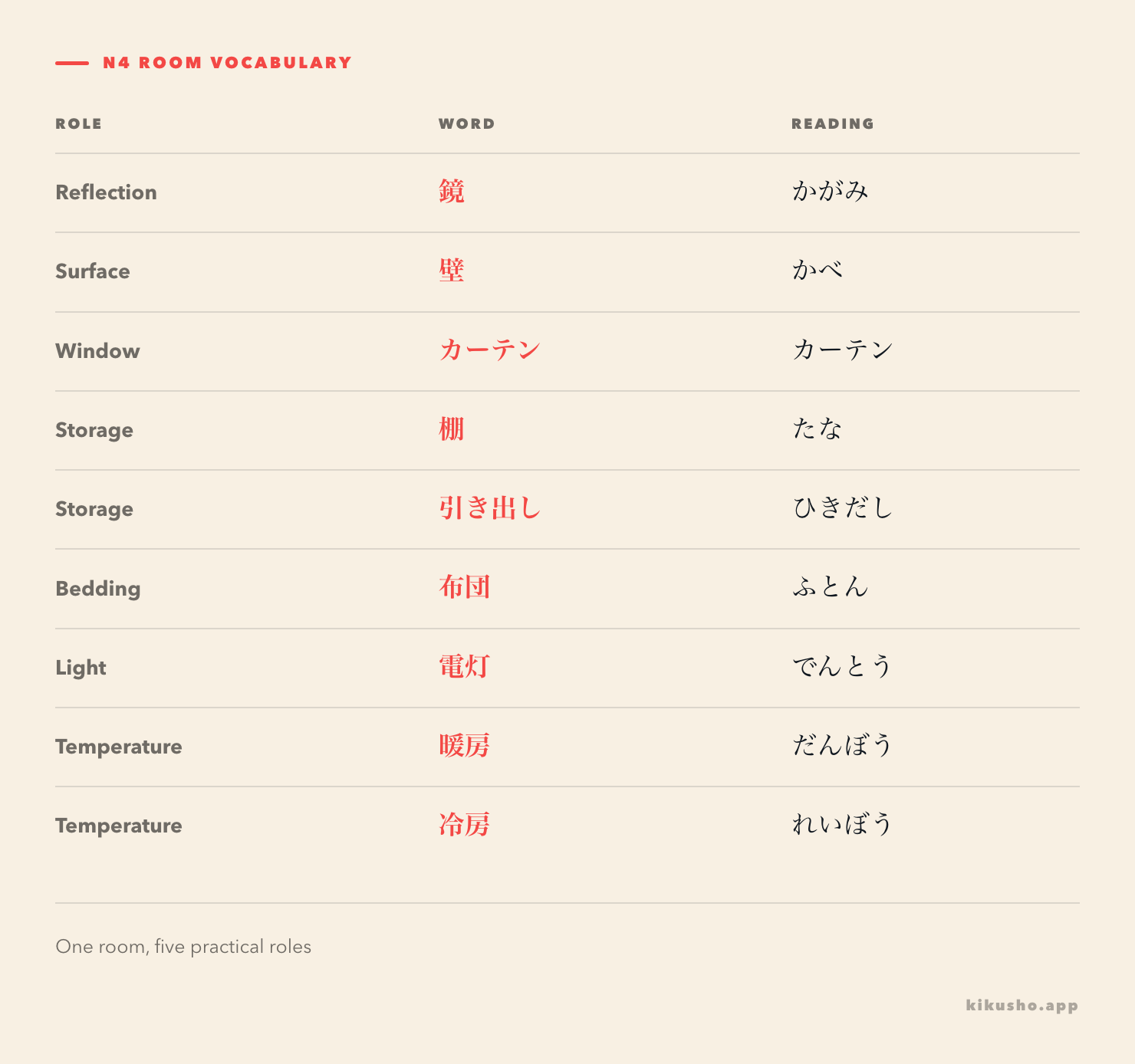
| Role in the room | Word | Reading | Sense | Useful phrase |
|---|---|---|---|---|
| What reflects you | 鏡 | かがみ | noun: mirror | 鏡を見る, look in a mirror |
| What encloses the room | 壁 | かべ | noun: wall | 壁に絵を掛ける, hang a picture on the wall |
| What covers the window | カーテン | カーテン | noun: curtain | カーテンを閉める, close the curtains |
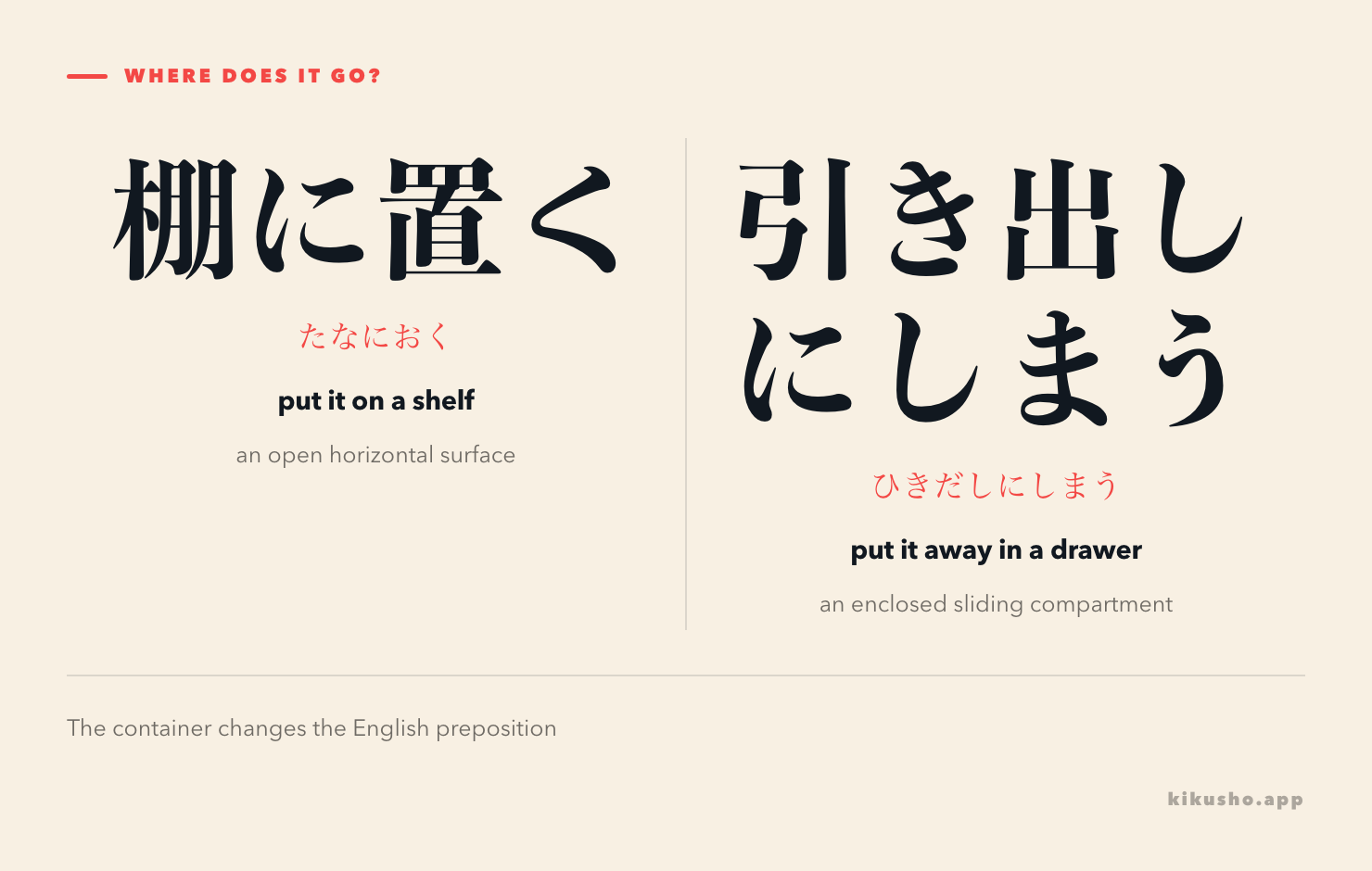
| Open storage | 棚 | たな | noun: shelf, rack | 棚に本を置く, put a book on a shelf |
| Enclosed storage | 引き出し | ひきだし | noun: drawer | 引き出しに鍵をしまう, put a key away in a drawer |
| Bedding | 布団 | ふとん | noun: bedding, futon | 布団を敷く, lay out bedding |
| Electric lighting | 電灯 | でんとう | noun: electric light | 電灯を消す, turn off the light |
| Heating mode | 暖房 | だんぼう | noun / する noun: heating | 暖房をつける, turn on the heating |
| Cooling mode | 冷房 | れいぼう | noun / する noun: cooling, air conditioning | 冷房を切る, turn off the cooling |
The dictionary evidence agrees with these everyday senses. Kotobank's entries describe 鏡 as an object that reflects an image, 壁 as the structure that divides or encloses space, and 棚 as a horizontal surface for holding objects. Its entries for 電灯, カーテン, 暖房 and 冷房 verify the readings and the room functions used here. The separately published goo dictionary entry for 布団 gives the bedding sense and the collocations 布団を敷く and 布団を上げる.
The room surface decides に, and the object decides the verb
With 壁 and 棚, the particle に marks the surface or destination:
壁に時計が掛かっています。 A clock is hanging on the wall.
棚に写真を置きました。 I put a photograph on the shelf.
The same particle appears with a drawer, but English changes from “on” to “in” because the container changes:
パスポートは引き出しにしまってあります。 The passport has been put away in the drawer.
棚 usually leaves the stored object visible or directly reachable. 引き出し names the sliding compartment itself. The compound is related to 引き出す, “to pull out,” which matches the physical movement of a drawer. It also has later meanings such as a bank withdrawal or a person's stock of ideas, but those are outside this room-focused N4 item.
鏡 chooses a different verb. 鏡を見る is the ordinary phrase for looking in a mirror. When the reflected thing becomes the subject, use 映る(うつる):
鏡に窓が映っています。 The window is reflected in the mirror.
The mirror is marked by に as the place where the image appears. This is not the same structure as 鏡を見る, where the mirror is what you look at.
Curtains and bedding have their own action pairs
You open and close curtains:
朝、カーテンを開けて、部屋を明るくしました。 In the morning, I opened the curtains and made the room bright.
At night, カーテンを閉める closes them. The same verbs work for doors and windows, so the noun identifies what moves. The katakana spelling カーテン comes from English “curtain”; keep the long vowel mark ー when writing it.
You do not normally 開ける a 布団. Bedding is laid out with 敷く(しく) and folded with たたむ:
寝る前に布団を敷きます。 I lay out the bedding before sleeping.
起きたら、布団をたたみます。 After I get up, I fold the bedding.
English “futon” can suggest a low sofa or mattress. Japanese 布団 is broader bedding, including 敷き布団, the bedding underneath you, and 掛け布団, the covering over you. The room scene and action tell you which part matters.
電灯 is the light; 冷房 and 暖房 are modes
電灯 names an electric light. Its common action pair is つける / 消す:
部屋を出るとき、電灯を消してください。 Please turn off the light when you leave the room.
In everyday conversation, someone may say 電気をつける for turning on the light. That does not make 電灯 incorrect. It gives you a more specific noun for the light or lamp powered by electricity.
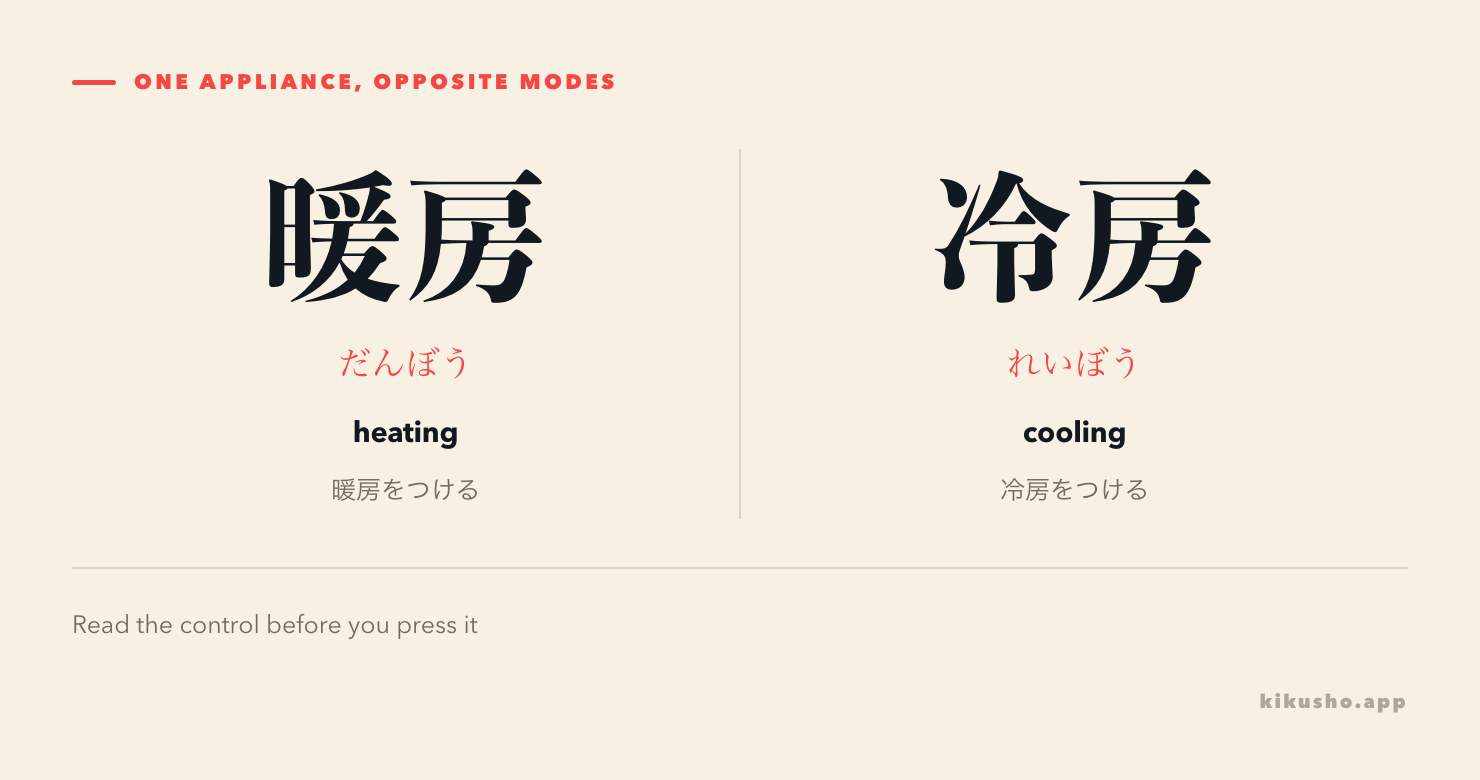
冷房 and 暖房 both contain 房(ぼう), but you should learn the whole words. 冷房 cools an interior; 暖房 heats it. They can take をつける, を入れる, を切る, or work with する:
暑いので、冷房をつけてもいいですか。 It is hot, so may I turn on the cooling?
この部屋は暖房がよくきいています。 The heating works well in this room.
An エアコン is the appliance. 冷房 and 暖房 are the cooling and heating functions you select. On a remote control, choosing the wrong word reverses the result even though the machine is the same.
No exhaustive official JLPT vocabulary list fixes these words to a level. Kikusho's September 2026 reference inventory places all nine at N4, and its compared N4 source observations show no placement disagreement. That is useful study evidence, not a claim that the test maker publishes this exact set.
Keep the instruction with the household noun
A label stuck to a shelf can teach 棚, but the phrase 棚に置く teaches how the word enters a sentence. The same improvement works for the rest: 鏡を見る, カーテンを閉める, 布団を敷く, 電灯を消す, 冷房をつける. Each pair gives the noun an action you can recall in a real room.
If you meet one on a remote control or household note, Kikusho can draft a card from the photo or pasted text. Check the reading before saving, and keep the instruction rather than cropping down to one noun. When the card returns offline, 冷房を切る preserves both the word and the action the button was asking for.
Practice
Question 1: pronounce the noun
How do you pronounce 引き出し?
- ア. ひきだし
- イ. ひきでし
- ウ. びきだし
- エ. ひきだす
Question 2: write the noun
Choose the spelling for かがみ, “mirror.”
- ア. 壁
- イ. 鏡
- ウ. 棚
- エ. 電灯
Question 3: storage
You put a key away inside a drawer. Which sentence fits?
- ア. 鍵を棚で掛けます。
- イ. 鍵を引き出しにしまいます。
- ウ. 鍵を壁に閉めます。
- エ. 鍵を鏡で置きます。
Question 4: room routine
Which phrase means “lay out the bedding”?
- ア. 布団を開ける
- イ. 布団を掛ける
- ウ. 布団を敷く
- エ. 布団を映す
Question 5: appliance mode
The room is hot. Which control mode lowers the room temperature?
- ア. 電灯
- イ. 暖房
- ウ. 冷房
- エ. 引き出し
Question 6: usage
Which sentence naturally means “Please turn off the light when you leave the room”?
- ア. 部屋を出るとき、電灯を消してください。
- イ. 部屋を出るとき、電灯を敷いてください。
- ウ. 部屋を出るとき、電灯を閉めてください。
- エ. 部屋を出るとき、電灯をしまってください。
Question 7: paraphrase
Which English sentence best matches 棚に本を置きました?
- ア. I put the book away in a drawer.
- イ. I hung the book on the wall.
- ウ. I looked at the book in a mirror.
- エ. I put the book on a shelf.
Question 8: scene
Complete the natural sequence: 朝、__を開けて、部屋を明るくしました。
- ア. カーテン
- イ. 暖房
- ウ. 布団
- エ. 鏡
Answers and explanations
Answer 1
ア. ひきだし. This is the noun 引き出し, “drawer.” ひきだす in エ is the related verb 引き出す, “to pull out,” rather than the requested noun reading.
Answer 2
イ. 鏡. 鏡 is read かがみ. 壁 is かべ, 棚 is たな, and 電灯 is でんとう.
Answer 3
イ. 鍵を引き出しにしまいます. 引き出し is the drawer, に marks the storage destination, and しまう means to put something away. The other choices combine nouns, particles and verbs that do not describe this scene.
Answer 4
ウ. 布団を敷く. 敷く is the usual verb for laying out bedding. 開ける goes with curtains, doors or windows. 掛ける can refer to covering oneself with a 掛け布団, but it does not express laying out the whole sleeping place requested here.
Answer 5
ウ. 冷房. 冷房 is cooling. 暖房 heats the room, 電灯 provides light, and 引き出し is a drawer.
Answer 6
ア. 部屋を出るとき、電灯を消してください. 電灯を消す is the natural light-and-action pair. 敷く belongs with bedding, 閉める with curtains or other things that close, and しまう with objects put away.
Answer 7
エ. I put the book on a shelf. 棚 is a shelf, に marks the destination, and 置きました is the polite past of 置く, “to put.” A drawer would be 引き出し; a wall would be 壁.
Answer 8
ア. カーテン. Opening the curtains can make a room bright in the morning. The other nouns do not normally take 開ける in this scene.
Common questions
What is the difference between 棚 and 引き出し?
棚(たな) is a shelf or rack where things rest on a horizontal surface. 引き出し(ひきだし) is a drawer that slides out from furniture. Use 棚に置く for placing something on a shelf and 引き出しにしまう for putting it away in a drawer.
Do 冷房 and 暖房 mean the air conditioner itself?
They name cooling and heating, and can also refer to the equipment that provides them. エアコン is the appliance. On its controls, 冷房(れいぼう) selects cooling and 暖房(だんぼう) selects heating.
Is a Japanese 布団 the same as a Western futon sofa?
布団(ふとん) is bedding filled with cotton, feathers or similar material. In an ordinary bedroom scene, 布団を敷く means to lay out bedding and 布団をたたむ means to fold it. The English loanword futon may name a different piece of furniture.
Are these nine words officially assigned to JLPT N4?
Kikusho's dated reference inventory places all nine at N4 and the compared source observations agree. The JLPT does not publish an exhaustive official vocabulary list, so the level remains a study estimate rather than an official syllabus statement.