On this page
A label says 綿100%, a product page offers 花柄, and a friend says the shirt 似合う. This N3 set teaches twelve entries that let you move from fabric and pattern to fit and fashion, while keeping apart the readings hidden behind 柄 and 綿.
The N5 clothing lesson remains the guide to basic garments and 着る, はく and かぶる. The N4 fabric lesson teaches 絹, 毛 and six other prerequisite nouns. Here the new work is reading and using 柄、生地、袖、似合う、布、ベルト、綿、模様、流行 and the written form 被る in their assigned senses.
Twelve entries form four useful groups
| Entry | Reading | Part of speech | Meaning taught here | Useful combination |
|---|---|---|---|---|
| 柄 | え | noun | handle or grip | 傘の柄: umbrella handle |
| 被る | かぶる | godan verb | wear on the head; be covered; take blame | 罪を被る: take the blame |
| 柄 | がら | noun | pattern; design | 花柄のシャツ: floral shirt |
| 生地 | きじ | noun | fabric; material; dough | 生地を選ぶ: choose fabric |
| 袖 | そで | noun | sleeve | 袖をまくる: roll up one's sleeves |
| 似合う | にあう | godan verb | suit; look good on | 人に似合う: suit a person |
| 布 | ぬの | noun | cloth; a piece of cloth | 布を切る: cut cloth |
| ベルト | ベルト / beruto | noun | belt | ベルトを締める: fasten a belt |
| 綿 | めん | noun | cotton yarn or fabric | 綿100%: 100% cotton |
| 模様 | もよう | noun | pattern; appearance or state | 水玉模様: polka-dot pattern |
| 流行 | りゅうこう | noun, する verb | fashion, trend; spread | 流行している: be in fashion |
| 綿 | わた | noun | cotton plant; loose fibre or padding | 綿を詰める: fill with padding |
The list contains ten spellings but twelve assigned spelling-reading entries. Treating the repeated kanji as one English gloss would lose the most testable part of the set.
柄 and 綿 each split into two readings
柄(がら) means a pattern or design on cloth and other surfaces. It appears directly after a motif noun:
姉は花柄のスカートを選びました。 あねははながらのスカートをえらびました。 “My older sister chose a floral skirt.”
柄(え) means the part of a tool or object that you hold. It is not a clothing word, even though the curriculum source row sits beside the fashion sense:
風が強かったので、傘の柄をしっかり握りました。 かぜがつよかったので、かさのえをしっかりにぎりました。 “Because the wind was strong, I gripped the umbrella handle firmly.”
Digital Daijisen's 柄 entry separates がら, including a fabric pattern, from え, the rod-shaped handle attached to an object. Context therefore decides both the reading and the meaning.
綿(めん) commonly names cotton yarn or cotton fabric. Material labels and compounds favour this reading:
このシャツは綿100%です。 このシャツはめんひゃくパーセントです。 “This shirt is 100% cotton.”
綿(わた) names the plant or loose, fluffy fibre and padding:
ぬいぐるみに綿を詰めました。 ぬいぐるみにわたをつめました。 “I filled the stuffed toy with padding.”
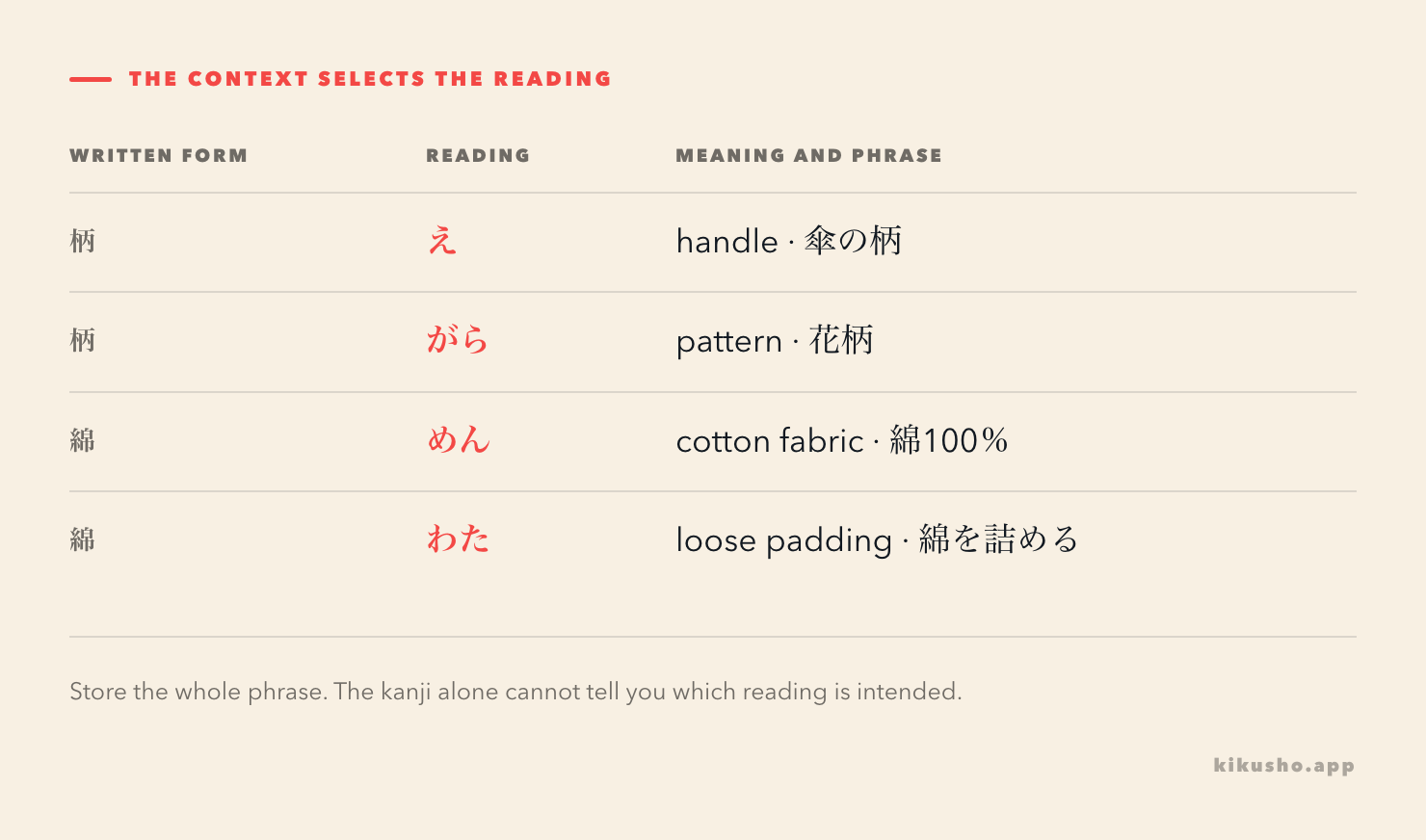
The dictionary entry for 綿 records めん for cotton yarn and woven cotton, while わた covers the plant and loose fibre. The split is practical rather than absolute in every historical or specialist context. For this lesson, store the combinations 綿生地(めんきじ) and 綿を詰める(わたをつめる).
布, 生地, 柄 and 模様 describe different layers
布(ぬの) is the broad physical word for cloth. You can cut it, fold it, spread it or make something with it:
柔らかい布で小さな袋を作りました。 やわらかいぬのでちいさなふくろをつくりました。 “I made a small bag from soft cloth.”
生地(きじ) often treats fabric as material selected before it becomes a finished garment. A shop may offer thick or thin 生地, and a maker may choose it:
この生地は薄いので、夏の服に向いています。 このきじはうすいので、なつのふくにむいています。 “This fabric is thin, so it is suitable for summer clothes.”
The boundary is not absolute: the two words can overlap when both mean fabric. 布 foregrounds the cloth as a physical thing; 生地 commonly foregrounds it as material for a product. The independently authored TKG learner's dictionary entry for 生地 also records bread dough and a person's true nature. The curriculum baseline's “birthplace” gloss conflicts with the assigned reading: birthplace is 生地(せいち), while this entry is きじ. That inherited gloss is not taught here.
Once the cloth has a design, 柄(がら) and 模様(もよう) can both translate as “pattern.” 花柄、縞柄 and 無地 name familiar pattern categories. 模様 can describe the visible figures themselves, as in 水玉模様, and extends beyond fabric to the appearance or state of an event:
白い布に青い波の模様があります。 しろいぬのにあおいなみのもようがあります。 “There is a blue wave pattern on the white cloth.”
Digital Daijisen gives both the decorative pattern sense and wider meanings such as a situation's state or an inferred outlook. Do not force a rigid swap rule: 花柄 and 花模様 can both be natural, but the first readily labels a pattern type while the second points to the flower design or figures.
袖 and ベルト bring the fabric onto the body
袖(そで) is a sleeve. Useful descriptions use 袖 as the subject, while actions take it as an object:
- 袖が長い/短い: the sleeves are long or short
- 袖をまくる: roll up one's sleeves
- 袖に腕を通す: put an arm through a sleeve
この上着は袖が少し長すぎます。 このうわぎはそでがすこしながすぎます。 “The sleeves of this jacket are a little too long.”
ベルト normally takes 締める(しめる), “fasten or tighten,” 緩める(ゆるめる), “loosen,” and 外す(はずす), “remove.” NINJAL's ベルト entry records ベルトを締める/緩める.
ズボンが少し大きいので、ベルトを締めました。 ズボンがすこしおおきいので、ベルトをしめました。 “The trousers were a little big, so I fastened my belt.”
似合う links an item to the person it suits
In the basic clothing pattern, the item takes が and the person takes に:
その花柄のシャツは弟によく似合います。 そのはながらのシャツはおとうとによくにあいます。 “That floral shirt really suits my younger brother.”
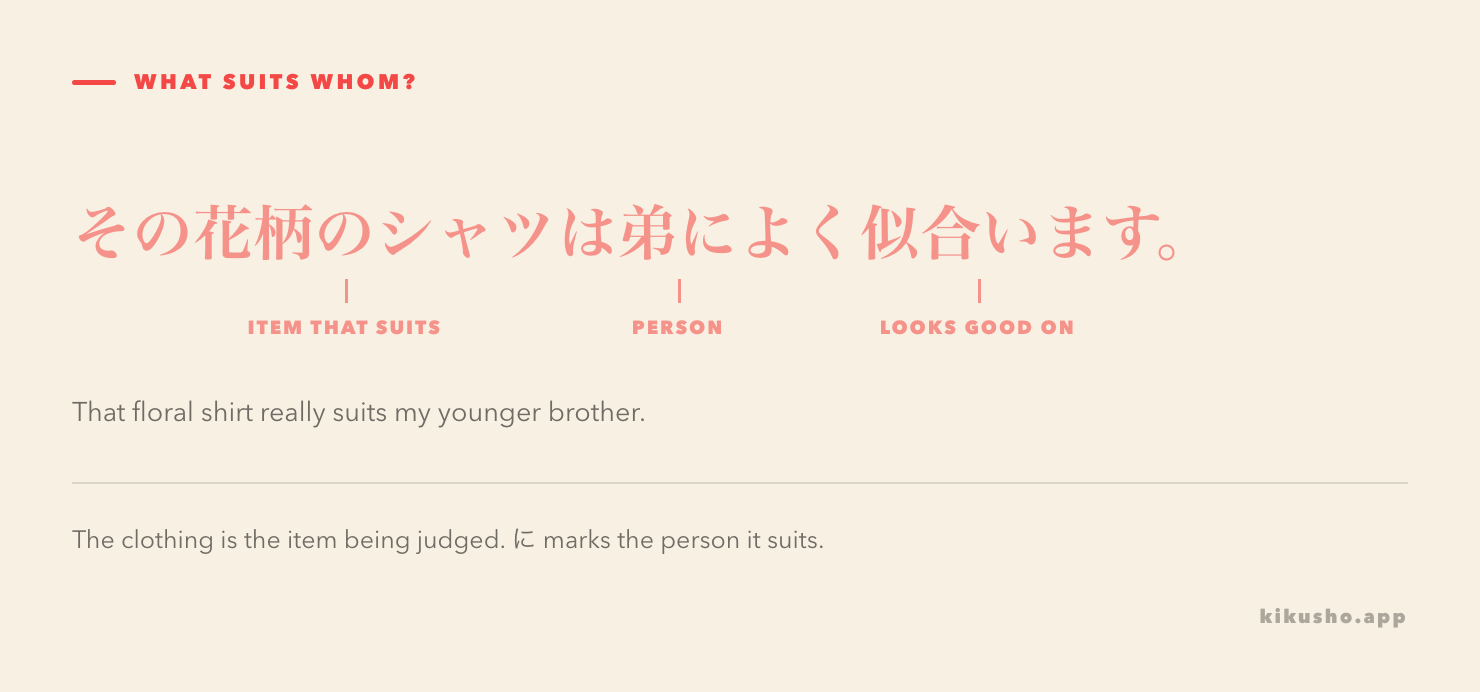
The topic marker は can replace が when the item is already the topic, as in the example above. The underlying relation is still 服が人に似合う. NINJAL's case-frame entry for 似合う gives 母には着物が似合う, “Kimono suits my mother.”
Do not confuse 似合う with 合う. この服は私に似合う judges how the clothing looks with the person. この服は体に合う can judge physical fit or size.
流行 moves a pattern through society
流行(りゅうこう) means that a fashion, style, expression or other phenomenon spreads and becomes popular. It works as a noun and with する:
今年は大きな花柄が流行しています。 ことしはおおきなはながらがりゅうこうしています。 “Large floral patterns are in fashion this year.”
Useful combinations include 流行する, 流行の服, 流行を追う and 流行遅れ. The same word also describes a disease spreading, so context distinguishes fashion from an epidemic. Digital Daijisen's 流行 entry records both senses. 流行り(はやり) is a related reading and noun, but the assigned entry here is りゅうこう.
被る reaches beyond putting on a hat
At N5, かぶる is the verb used with 帽子. At N3, recognise the kanji 被る and extend the verb beyond clothing:
| Object | Meaning of 被る |
|---|---|
| 帽子を被る | put on or wear a hat |
| 毛布を被る | pull a blanket over oneself |
| ほこりを被る | be covered in dust |
| 罪を被る | take the blame |
彼は友達の代わりに罪を被りました。 かれはともだちのかわりにつみをかぶりました。 “He took the blame in place of his friend.”
The curriculum assigns 被る(かぶる). NINJAL's かぶる entry documents the headwear, covering and responsibility senses, including 罪をかぶる. The same spelling also has the separate reading こうむる in formal combinations such as 損害を被る, “suffer damage.” The baseline gloss “to suffer” belongs more naturally with that separate reading, so it is not treated as the definition of every かぶる here.
The dated Kikusho inventory places all twelve spelling-reading records at N3 and records no level disagreement. Its two main observations descend from the same Waller/Tanos family, so they are one baseline rather than two independent judgments. A current N3 clothes and fashion comparison independently matches central items such as 似合う, 袖, 柄(がら), 布 and 綿(めん), but no private study list is an official syllabus. As the official JLPT FAQ notes, the current test does not release a fixed vocabulary specification; N3 here is a study placement, not a promise that all twelve words will appear.
On an iPhone, Kikusho can turn a garment label or shop description into editable cards. For this set, keep the evidence that selects the reading: 綿100%(めん), 綿を詰める(わた), 花柄(がら) and 傘の柄(え) are more useful than a card that gives one kanji and one loose English gloss. Saved cards and audio remain available for offline review.
Practice: eight decisions before the key
Choose every answer first, then scroll to the numbered explanations.
Question 1 — reading in context. What sound does the bold 柄 have here?
風が強いので、傘の柄をしっかり持ってください。
ア. え イ. がら ウ. へい エ. つか
Question 2 — orthography. Choose the kanji for わた, the loose padding placed inside a stuffed toy.
ア. 布 イ. 綿 ウ. 袖 エ. 柄
Question 3 — context. Choose the word that best completes the sentence.
夏のシャツを作るために、薄くて軽い( )を選びました。
ア. 生地 イ. 袖 ウ. ベルト エ. 流行
Question 4 — context. Which sentence uses 被る for taking blame or responsibility?
ア. 帽子を被って外に出ました。 イ. 毛布を被って眠りました。 ウ. 弟の代わりに罪を被りました。 エ. 棚の本がほこりを被っています。
Question 5 — paraphrase. What does その青いシャツは田中さんによく似合います mean?
ア. The blue shirt is the right physical size for Mr Tanaka. イ. The blue shirt looks good on Mr Tanaka. ウ. Mr Tanaka made the blue shirt from cloth. エ. Mr Tanaka follows the latest blue-shirt trend.
Question 6 — usage. Choose the natural sentence for “This floral skirt suits my sister.”
ア. この花柄のスカートは姉によく似合います。 イ. 姉はこの花柄のスカートをよく似合います。 ウ. この花柄のスカートに姉がよく似合います。 エ. 姉にこの花柄のスカートを似合います。
Question 7 — kanji reading. How is 綿 normally read in 綿100%のシャツ?
ア. わた イ. きぬ ウ. めん エ. ぬの
Question 8 — context. Choose the sentence that says polka-dot patterns are currently in fashion.
ア. 水玉模様が流行しています。 イ. 水玉模様が損害を被っています。 ウ. 水玉模様が袖をまくっています。 エ. 水玉模様が綿を詰めています。
Answers and explanations
Answer 1: ア, え. 傘の柄 is the handle of an umbrella, so 柄 is read え. 柄 is がら when it names a pattern. へい is an on-reading found in other words, and つか can name a sword hilt, but neither reads this everyday umbrella phrase.
Answer 2: イ, 綿. 綿 is read わた when it names loose cotton or padding. 布 is ぬの, cloth; 袖 is そで, sleeve; 柄 can be え or がら in this lesson.
Answer 3: ア, 生地. The speaker is selecting light fabric in order to make a summer shirt, so 生地 is the natural material noun. 袖 is one part of a garment, ベルト is an accessory and 流行 is a trend.
Answer 4: ウ. 罪を被る means to take blame, guilt or responsibility onto oneself. A uses the headwear sense, B the covering sense and D the “be covered in dust” sense. All four instances are read かぶる here, but their objects select different senses.
Answer 5: イ. 似合う evaluates the visual harmony between the shirt and the person: the shirt looks good on Mr Tanaka. Physical size uses expressions such as サイズが合う or 体に合う. The sentence says nothing about making the shirt or following a trend.
Answer 6: ア. The garment is the topic and the person it suits takes に: この花柄のスカートは姉に似合います. The other options give 似合う an object with を or reverse the item-person relation.
Answer 7: ウ, めん. On a material label, 綿 names cotton yarn or fabric and is normally read めん. わた names the plant or loose fibre and padding. 絹(きぬ)is silk, while 布(ぬの)is cloth in general.
Answer 8: ア. 水玉模様 means a polka-dot pattern, and 流行しています says it is currently popular or in fashion. The other verbs require a person, business, garment part or object capable of receiving their action; a pattern cannot naturally perform them here.
Common questions
How do you read 柄 in Japanese?
柄 is がら when it means a pattern, as in 花柄, but え when it means the handle of a tool, as in 傘の柄. The kanji alone does not determine the reading; the object and sense do.
What is the difference between 布 and 生地?
布(ぬの)is the general word for cloth and can describe a piece of cloth. 生地(きじ)often treats fabric as the material selected for making a garment. 生地 also means dough or a person's unvarnished nature in other contexts.
Is 綿 read めん or わた?
Both readings exist. 綿(めん)commonly refers to cotton yarn or cotton fabric, especially on labels and in compounds. 綿(わた)refers to the cotton plant or loose fluffy fibre and padding. Learn the reading with its context.
How do you say that clothes suit someone in Japanese?
Use garment が person に 似合う. For example, そのシャツはあなたによく似合います means “That shirt really suits you.” The item normally takes が and the person takes に.