On this page
The 19 words in this N5 set let you name places in a home, objects in a room, and the things you read or write at a desk. Start at 玄関, reach 部屋, and look at 机: those three nouns already tell you which Japanese phrase you need, rather than leaving you with a mixed English list of "home vocabulary."
Why these words belong together
Imagine showing a friend around a house before you sit down to study. 家 is the whole house; 玄関 is its entryway; 部屋 is a room within it. You can point to a ドア or 窓, sit on an 椅子, and find a 本 on the 机. When you reach for 紙 or 手紙, the room has not changed, but the kind of thing you are naming has.
That route is the lesson's organising rule. A place can be labelled 「ここは庭です」, "This is the garden"; an object can be identified as 「これはペンです」, "This is a pen." A text or writing tool needs a verb beside it: 本を読む, "read a book," or 鉛筆で書く, "write with a pencil." The Japan Foundation's Irodori home lesson checks the house tour and its place words; the separately authored TUFS basic-vocabulary module places books, printed texts, furniture and writing tools in their own real-life groups. Neither source is an official exhaustive JLPT N5 word syllabus.
The nineteen nouns, with their readings and phrase partners
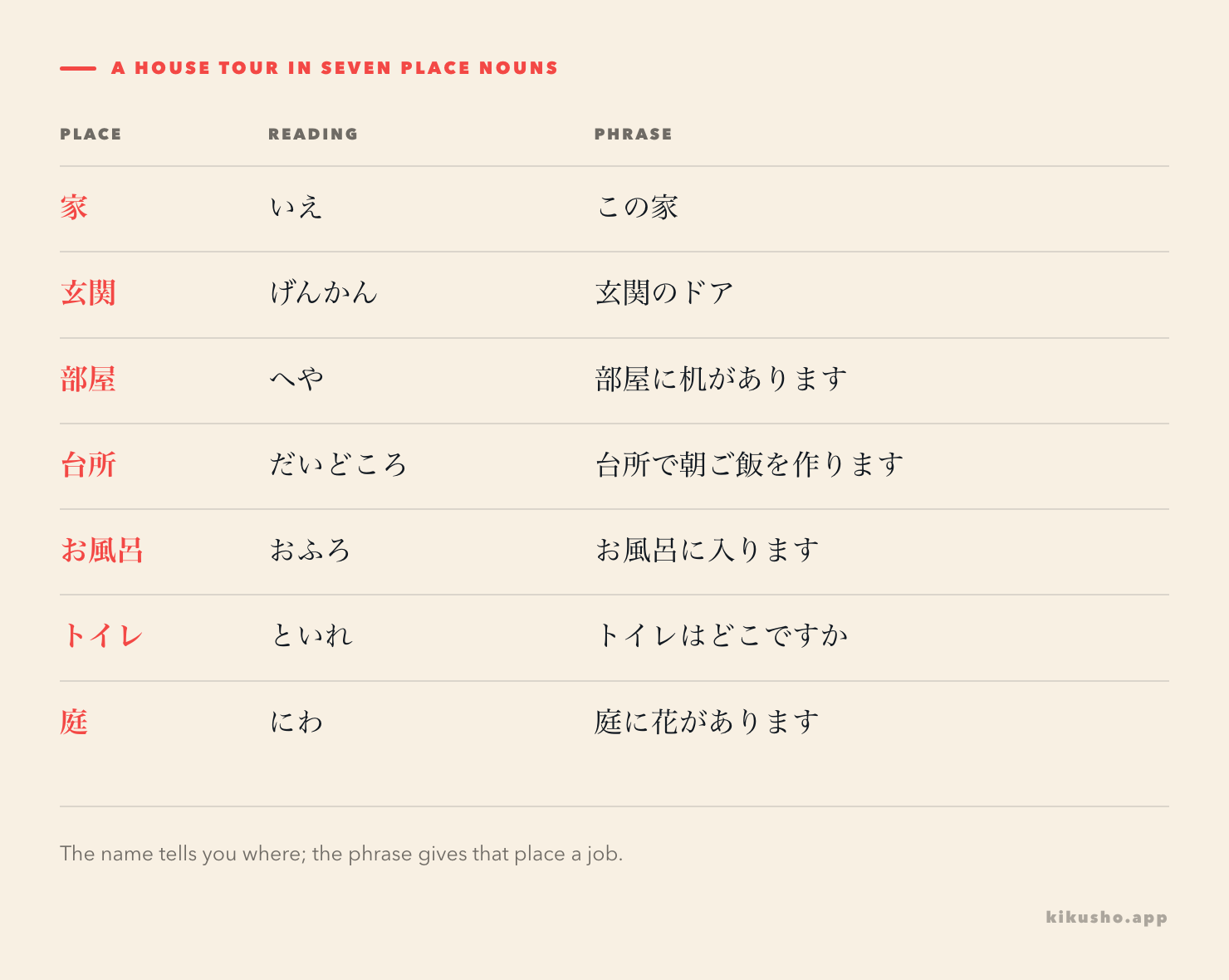
Every row is an assigned vocabulary item. The reading column gives pronunciation in kana, including for loanwords normally written in katakana. The short phrase shows the word's job; verbs and other nouns in those phrases are context, not extra inventory credit on this page.
| Where it belongs | Written word | Reading | Part of speech and sense | Phrase partner |
|---|---|---|---|---|
| Home places | 家 | いえ | noun: house, home | この家, this house |
| Home places | 玄関 | げんかん | noun: entryway | 玄関のドア, the entryway door |
| Home places | 部屋 | へや | noun: room | 部屋に机があります, there is a desk in the room |
| Home places | 台所 | だいどころ | noun: kitchen | 台所で朝ご飯を作ります, make breakfast in the kitchen |
| Home places | お風呂 | おふろ | noun: bath, bathing place | お風呂に入ります, take a bath |
| Home places | トイレ | といれ | noun: toilet, toilet room | トイレはどこですか, where is the toilet? |
| Home places | 庭 | にわ | noun: garden, yard | 庭に花があります, there are flowers in the garden |
| Room objects | 椅子 | いす | noun: chair | 椅子に座ります, sit on a chair |
| Room objects | 机 | つくえ | noun: desk | 机の上に本があります, there is a book on the desk |
| Room objects | ドア | どあ | noun: door | ドアを開けます, open the door |
| Room objects | 窓 | まど | noun: window | 窓を開けます, open the window |
| Study materials | 鉛筆 | えんぴつ | noun: pencil | 鉛筆で名前を書きます, write a name with a pencil |
| Study materials | ペン | ぺん | noun: pen | ペンで名前を書きます, write a name with a pen |
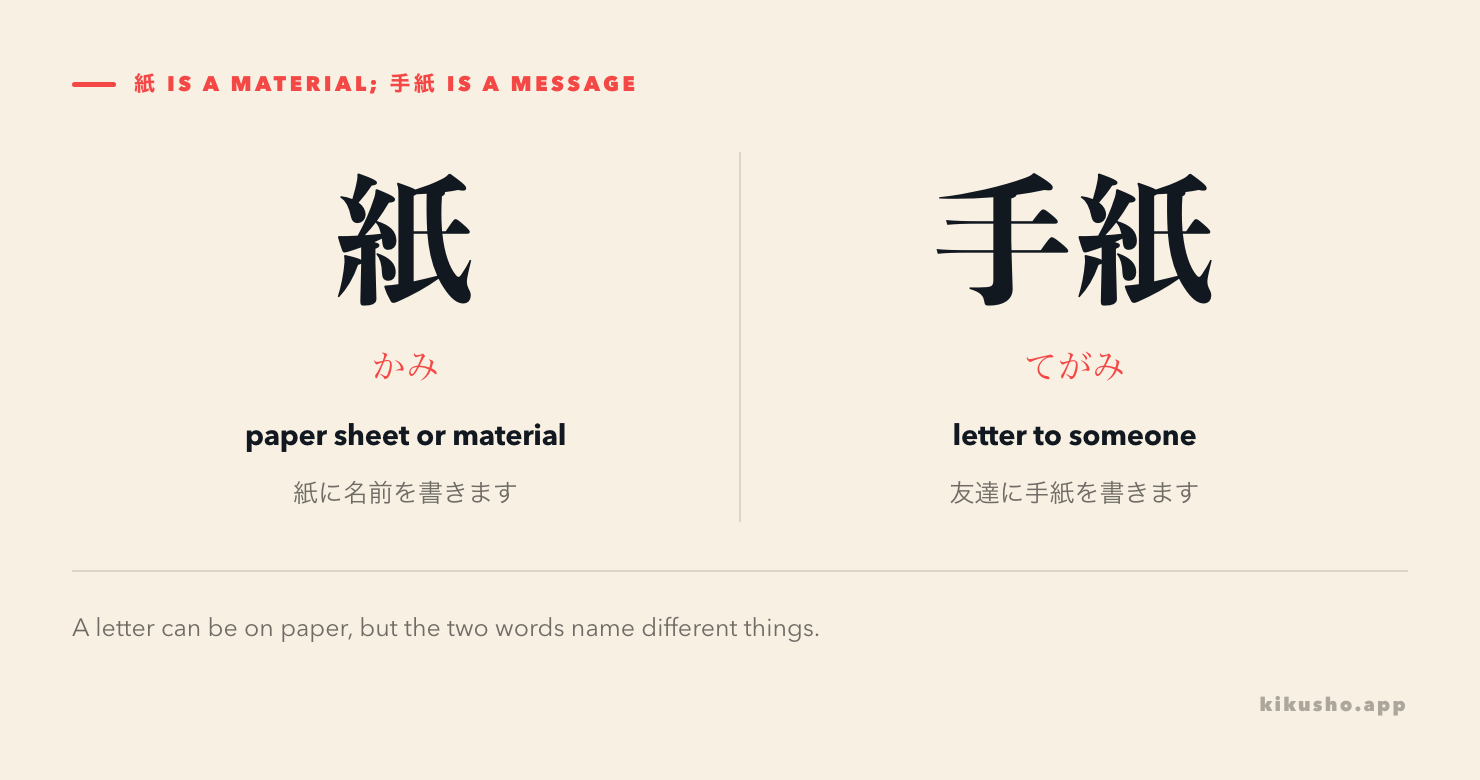
| Study materials | 紙 | かみ | noun: paper | 紙に名前を書きます, write a name on paper |
| Study materials | 手紙 | てがみ | noun: letter | 友達に手紙を書きます, write a letter to a friend |
| Study materials | 本 | ほん | noun: book | 本を読みます, read a book |
| Study materials | 雑誌 | ざっし | noun: magazine | 雑誌を読みます, read a magazine |
| Study materials | 新聞 | しんぶん | noun: newspaper | 新聞を読みます, read a newspaper |
| Study materials | 辞書 | じしょ | noun: dictionary | 辞書を引きます, look something up in a dictionary |
The Japan Foundation's Irodori starter word list checks 玄関, お風呂, トイレ, 部屋, 台所 and 庭 as beginner house words. The TUFS module lists 家, 部屋, 窓, ドア, 庭, furniture and writing tools, and the four reading materials under separate scenes. For harder readings, the TUFS 鉛筆 entry gives えんぴつ, its 手紙 entry gives てがみ, and the NINJAL pronunciation examples check ざっし, じしょ, つくえ and てがみ in sentences.
A place name changes its particle with the sentence
部屋に机があります locates a desk: 部屋 is the place, 机 is the thing there, and あります says it exists. 部屋で本を読みます says you read a book in the room: now the room is the site of an activity. The place stayed the same, while に changed to で because the verb's job changed. The Irodori house worksheet checks 部屋に机、いす with あります; the N5 location-words lesson explains the same existence-versus-activity contrast without turning these 19 nouns into a second grammar syllabus.
机の上 means "on the desk"; 机 supplies the reference and 上(うえ) names the position. 玄関のドア uses の for a different relationship, the door at the entryway. These are short phrases worth keeping intact. 机 on its own tells you "desk," but 机の上に本があります gives you a place you can point to. The TUFS grammar examples independently use 机の上 with books; the N5 の lesson handles that noun link in more detail.
The vocabulary is about words, not a promise that the table teaches every locative particle. You may first meet トイレ in the direct question トイレはどこですか, and 庭 in 庭に花があります. Hearing one phrase is enough to know what the noun can name; the verb and particle tell you what it does in that particular sentence.
The two English "bathrooms" and the two kinds of paper
お風呂 is the bath or the place for bathing. トイレ is the toilet or toilet room. A loose English translation such as "bathroom" can hide this difference, especially when a home has separate rooms for them. If someone asks 「トイレはどこですか」, giving the bathing room would answer the wrong question. The Japan Foundation's house tour labels them separately, and the Irodori word list names both.
紙(かみ) is paper as a material or sheet. 手紙(てがみ) is a letter addressed to someone. A letter can be written on paper, but a blank sheet is not yet a 手紙. The NINJAL 紙 dictionary entry gives the material sense and writing on paper, while the TUFS 手紙 entry gives the message sense and sending a letter. Their second kanji is shared; their readings and roles are not.
鉛筆 and ペン are both writing tools, but a pencil leaves graphite and a pen leaves ink. In 鉛筆で名前を書きます, で marks the tool used for writing. 紙に名前を書きます marks the surface you write on. The English verb "write" will not choose the Japanese particle for you. The TUFS tools module lists pencil and pen separately, and its Japanese grammar examples independently use pencils as concrete objects.
Four things to read, and a chair with a disputed level
At a desk, 本 is a book, 雑誌 a magazine, 新聞 a newspaper and 辞書 a dictionary. All four can be read, but 辞書を引く points to looking something up rather than reading from first page to last. 雑誌 and 新聞 both contain printed articles; the first is a magazine and the second a newspaper. The TUFS library word group separates the four, and the NINJAL pronunciation examples independently say 雑誌を買いました and 辞書を引いてみてください.
椅子(いす) is a chair beside that desk. The inventory assigns its spelling and reading to this N5 lesson, but one Waller-derived baseline observation puts it at N3. The separate TUFS chair entry verifies the word, reading and sense; the Japan Foundation's starter worksheet writes いす in a basic room scene. Those teaching sources show beginner usefulness, but they do not settle an official JLPT placement. You may see the everyday word in kana as いす as well as the kanji 椅子; the two spellings name the same chair here.
The assigned reading for 家 is いえ. The same kanji can also be read うち in a conversational home sense; the NINJAL うち entry explicitly distinguishes that reading from neutral いえ. Keep この家(このいえ) on this card. A different 家(うち) use is a later separate card, not another one of the 19 items counted here.
Start with the phrase you noticed
On a house visit, start with 玄関 and 部屋. At a classroom desk, choose 鉛筆 or ペン according to the tool in your hand, then 紙 or 手紙 according to whether you mean a sheet or a message. This short path gives the 19 words a purpose; there is no need to recite them in alphabetical order.
If a door label or school note gives you one of these words, Kikusho can draft a card from the photo or the text. Check the reading and example before saving it, then review it offline later. For 手紙, keep the surrounding phrase that shows who the letter is for; for 机, keep the object that is on it. That small piece of the scene keeps the saved noun from drifting back into an isolated English gloss.
Try the words in two scenes
Question 1. A room label says 玄関. Which reading matches this entryway noun? a) げんかん b) だいどころ c) へや d) つくえ.
Question 2. Your teacher says しんぶん, "newspaper." Which written word is it? a) 新間 b) 雑誌 c) 新聞 d) 辞書.
Question 3. You need a blank sheet for writing, not a message to send. Which assigned noun names the material? a) 手紙 b) 紙 c) 本 d) 雑誌.
Question 4. A pencil is required rather than a pen. Which phrase means "write a name with a pencil"? a) ペンで名前を書きます b) 紙に名前を書きます c) 鉛筆に名前を書きます d) 鉛筆で名前を書きます.
Question 5. At a house, you need the toilet rather than a bath. Which word should you ask for? a) お風呂 b) 台所 c) トイレ d) 庭.
Question 6. You see a desk in a room. Which sentence says "There is a desk in the room"? a) 部屋で机を読みます b) 部屋に机があります c) 机に部屋があります d) 部屋を机があります.
Question 7. At the desk, which pair correctly means "a book" and "a dictionary" in that order? a) 雑誌 / 新聞 b) 手紙 / 本 c) 辞書 / 本 d) 本 / 辞書.
Answers and explanations
The first scene tests place and object names; the second tests what is written, read or used. Check the Japanese job in each prompt before the English gloss.
Answer 1. a) げんかん reads 玄関. だいどころ reads 台所, the kitchen; へや reads 部屋, room; つくえ reads 机, desk.
Answer 2. c) 新聞 is しんぶん, newspaper. 雑誌 is a magazine and 辞書 a dictionary. 新間 swaps the second kanji and is not the assigned spelling.
Answer 3. b) 紙 names paper as a sheet or material. 手紙 is a letter, a message; 本 and 雑誌 are things you read. A blank sheet is not yet a letter.
Answer 4. d) 鉛筆で名前を書きます uses 鉛筆 for the pencil and で for the tool. a) uses a pen; b) names paper as the surface; c) makes the pencil a writing surface with に, which is not the intended meaning.
Answer 5. c) トイレ asks for the toilet. お風呂 is the bath or bathing place; 台所 is the kitchen and 庭 the garden. An English "bathroom" gloss cannot decide this for you.
Answer 6. b) 部屋に机があります locates the desk in the room. a) says a desk is read in a room; c) puts a room inside a desk; d) gives あります an object marked by を instead of the existing thing marked by が.
Answer 7. d) 本 / 辞書 is book then dictionary. a) is magazine then newspaper; b) is letter then book; c) reverses dictionary and book. Both chosen nouns have readings in the table above.
Common questions
Is 家 always read いえ?
No. 家 can also be read うち in other contexts. The assigned N5 vocabulary item on this page is 家(いえ), meaning house or home; learn that reading with a phrase such as この家 before adding the other reading separately.
Does お風呂 mean the same thing as トイレ?
No. お風呂(おふろ) refers to a bath or bathing place; トイレ(といれ) refers to a toilet or toilet room. Japanese homes commonly separate them.
Is 手紙 just a sheet of 紙?
No. 紙(かみ) is paper as a material or sheet. 手紙(てがみ) is a letter, a message written to someone. You can write a 手紙 on 紙, but the words identify different things.
Why does this N5 list include 椅子 when one reference puts it at N3?
Kikusho's dated inventory assigns 椅子(いす), chair, to this N5 lesson; one source list instead places it at N3. Beginner teaching materials use いす, but no official exhaustive JLPT vocabulary list settles that level.