

On this page
Japanese school and work vocabulary becomes easier to use when you separate places, people's roles, and activities. These eleven words let you locate an office, recognise who heads a department, and distinguish taking an exam from doing research.
They belong in one set because the same conversation often needs all three categories: where someone is, who they are, and what they are doing. Most are ordinary nouns you can use in everyday speech. Knowing a workplace noun does not require speaking in elaborate business Japanese.
Eleven words, with the phrases that make them usable
Read the middle column aloud before covering it. All eleven words can function as nouns. The last column gives a small phrase to learn with each one; the activity words receive more detail below.
| Word | Reading | Meaning and part of speech | Useful phrase |
|---|---|---|---|
| 会議 | かいぎ | meeting; noun, also used with する | 会議に出る: attend a meeting |
| 課長 | かちょう | section chief; noun, job title | 課長に聞く: ask the section chief |
| 研究 | けんきゅう | research; noun / する verb | 日本の歴史を研究する: research Japanese history |
| 高校 | こうこう | high school; noun | 高校に通う: attend high school |
| 工場 | こうじょう | factory; noun | 工場で働く: work at a factory |
| 校長 | こうちょう | school principal; noun, job title | 校長の話: the principal's talk |
| 試験 | しけん | examination; noun; also a する verb for testing | 試験を受ける: take an exam |
| 社長 | しゃちょう | company president; noun, job title | 社長に会う: meet the company president |
| 事務所 | じむしょ | office; noun | 事務所に戻る: return to the office |
| 中学校 | ちゅうがっこう | junior high / middle school; noun | 中学校の先生: a junior high school teacher |
| 部長 | ぶちょう | department or division head; noun, job title | 部長と話す: speak with the department head |
This page sits in our N4 vocabulary sequence. Our reference inventory assigns these eleven entries to N4, and Japanesetest4you separately labels 高校 and 研究 N4. Such labels guide study order; they are not official promises about what will appear on a test. You may meet several of these words earlier in a beginner course.
Places, people and activities take different partners
A noun's meaning tells you which verb is likely to follow. An office is somewhere you return to. A department head is someone you speak with. A meeting is something you attend. Learning those short combinations makes a word usable before you can produce a long sentence.
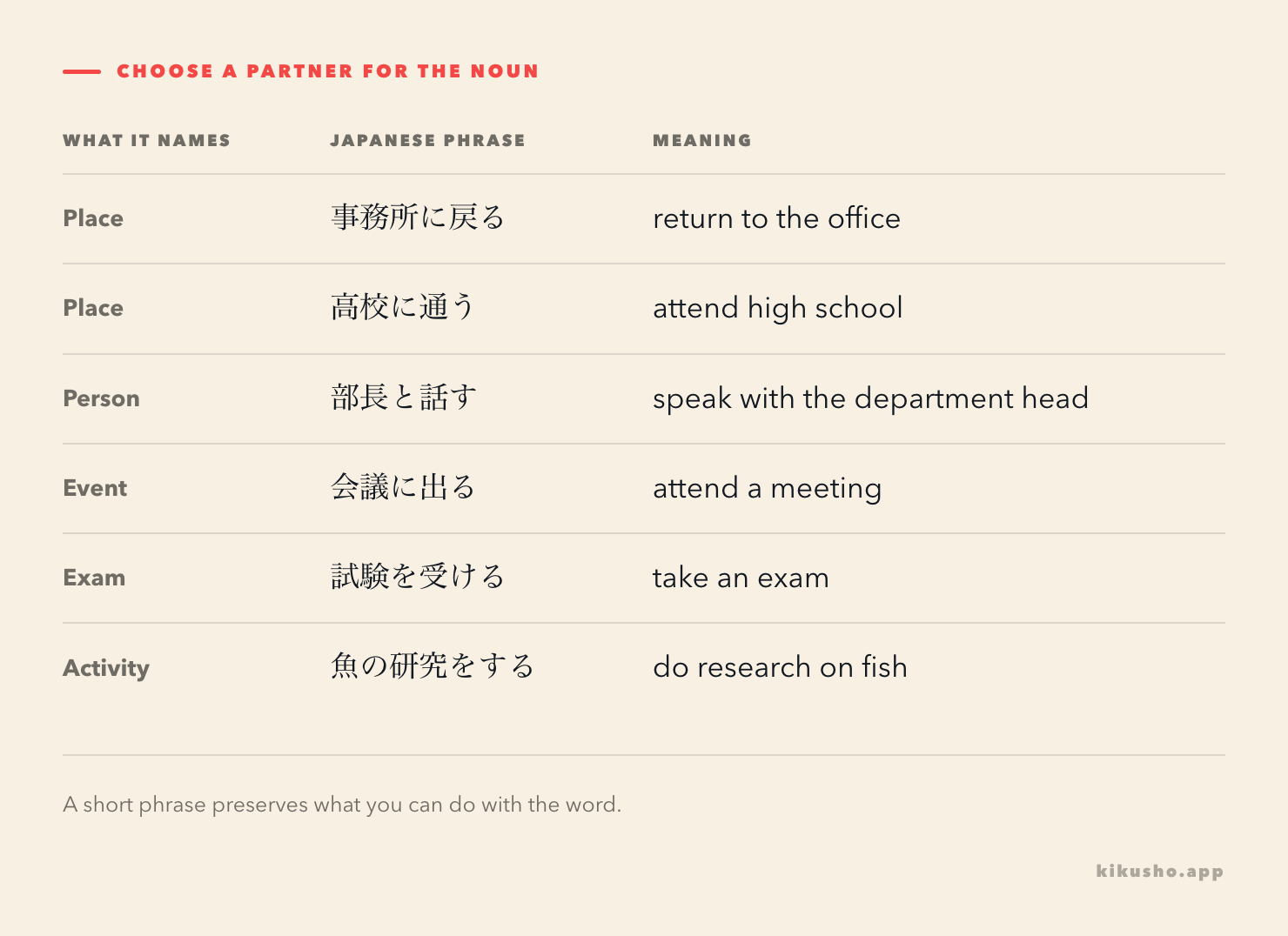
Four places you can point to
事務所 is an office where administrative work happens. It can be a company's office or an office serving another organisation; it does not by itself name the whole company. 工場 identifies a place where goods are manufactured or processed. An office may be inside a factory, so the two words can describe different parts of the same workplace. These senses follow Daijisen's entries for 事務所 and 工場.
鍵は事務所にあります。
かぎは じむしょに あります。
The key is in the office.
この工場ではパンを作っています。
この こうじょうでは パンを つくっています。
This factory makes bread.
中学校 names the school itself, not a pupil. 高校 names high school and is the shortened form of 高等学校(こうとうがっこう). The Japan Foundation's Erin school materials use both school names and introduce that abbreviation. The modern school sense of 中学校 is also documented in Daijisen.
あの中学校には大きな図書館があります。
あの ちゅうがっこうには おおきな としょかんが あります。
That junior high school has a large library.
姉はバスで高校に通っています。
あねは バスで こうこうに かよっています。
My older sister goes to high school by bus.
Here 通う(かよう)means regularly going somewhere, as a student does. In 中学校, keep the small っ: ちゅうがっこう. 高校 has two long vowels, こうこう, without that doubled consonant.
Four titles identify who is responsible
The final 長 is read ちょう in all four titles in this set. The first part identifies the organisation or unit: 校長 heads a school, 社長 heads a company, 部長 heads a 部, and 課長 heads a 課. Daijisen confirms the responsibilities behind 校長, 部長 and 課長.
| Title | Typical scope | Short example |
|---|---|---|
| 校長(こうちょう) | school | 校長の話を聞きました。 I listened to the principal's talk. |
| 社長(しゃちょう) | company | 社長は今、大阪にいます。 The company president is in Osaka now. |
| 部長(ぶちょう) | department / division | 部長と予定を確認しました。 I checked the schedule with the department head. |
| 課長(かちょう) | section | 課長に質問しました。 I asked the section chief a question. |
Readings for the example verbs: 聞きました(ききました), 予定(よてい), 確認しました(かくにんしました), 質問しました(しつもんしました). 大阪 is おおさか.
A common company structure places 部長 above 課長, with 社長 leading the company. These three titles are selected points in the structure; other positions may sit between them. The English label “manager” is too broad to tell you which Japanese title someone holds. Use the person's actual title. Human Academy's guide explains the relative ranks and the use of surname plus title when addressing a superior, as in 田中部長(たなかぶちょう).
For how the relationship with your listener changes respectful language, continue with Japanese politeness levels. Recognising a title and choosing honorific verb forms are separate learning tasks.
Three activities need more than the English word “do”
会議 is a meeting for discussion or consultation. Learn 会議があります, “there is a meeting,” and 会議に出る, “attend a meeting.” The dictionary also permits 会議する; the noun is not restricted to one verb partner. See Daijisen on 会議.
明日の会議には課長も出ます。
あしたの かいぎには かちょうも でます。
The section chief will also attend tomorrow's meeting.
研究 involves investigating a subject in depth. 日本の歴史を研究する means researching Japanese history; it says more than reviewing a few vocabulary cards. In everyday English, both activities might be called “studying,” but the research meaning matters here. Daijisen records investigation and deep consideration as the core sense.
大学で魚の研究をしています。
だいがくで さかなの けんきゅうを しています。
I am doing research on fish at university.
試験 has an exam sense and a broader testing sense. As the candidate, you take an exam: 試験を受ける. 試験する can mean testing something's qualities or performance, so it does not simply replace “take an exam.” This distinction follows Daijisen's two senses.
土曜日に日本語の試験を受けます。
どようびに にほんごの しけんを うけます。
I will take a Japanese exam on Saturday.
If the schedule includes words such as 最近 or もうすぐ, the next useful layer is Japanese time words.
Similar sounds can send you to the wrong person
高校, 工場 and 校長 all begin with こう. The rest of the word separates a high school, a factory and a principal. 課長 begins with short か, while 社長 begins with しゃ. Learning only the shared ending ちょう will not tell you whose name is on a door.
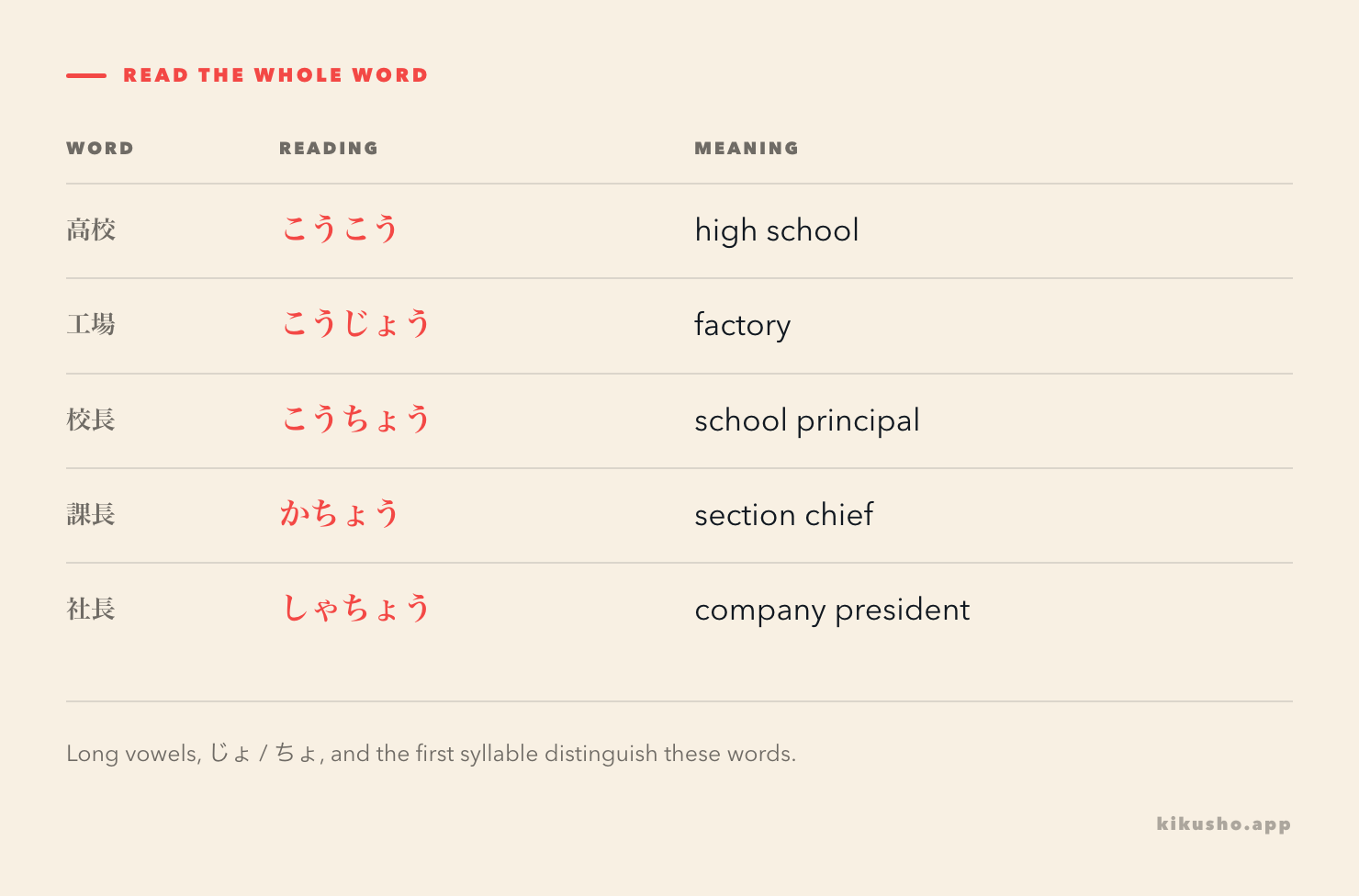
工場 also has the dictionary reading こうば, often associated with a smaller workshop. This lesson practises こうじょう; encountering こうば later does not make either reading a mistake. The separate reading is a recognition note, not a second vocabulary target here.
Choose the words attached to your next real conversation
For a school visit, begin with 中学校, 高校 and 校長. For an office visit, keep 事務所 and the title of the person you will meet. If you have an exam date, learn 試験 with 受ける rather than memorising an isolated English gloss.
In Kikusho, a photo of a school notice can become material for later review. Check the generated reading and edit the example so it preserves the part of the notice you needed to understand. A card for 校長 is more useful when you remember which person's message you were reading.
Practice: finish all eight questions before checking
Choose one answer for each question. Write your choices down; the complete answer block follows Question 8. The questions practise readings, spelling, meaning in context and usage.
Question 1
Read 校長の話を聞きました aloud. Which kana spell 校長 here?
- A. こうじょう
- B. かちょう
- C. こうちょう
- D. しゃちょう
Question 2
Choose the kanji for じむしょ: 鍵はじむしょにあります。
- A. 事務所
- B. 事無所
- C. 字務所
- D. 事務書
Question 3
Choose the word for the manufacturing site described here.
ここでは毎日、機械を使ってパンを作っています。この( )は駅の近くにあります。
Glosses: 毎日(まいにち)every day; 機械(きかい)machine; 使う(つかう)use; 駅の近く(えきのちかく)near the station.
- A. 課長
- B. 社長
- C. 試験
- D. 工場
Question 4
You are describing the head of a section called 課. Which title fits?
- A. 社長
- B. 課長
- C. 校長
- D. 部長
Question 5
You are the candidate taking an exam on Sunday. Complete the sentence.
日曜日に試験を( )。
- A. 通います
- B. 話します
- C. 受けます
- D. 戻ります
Question 6
Which sentence uses 研究 naturally?
- A. バスを研究して、駅まで行きました。
- B. 暑いので、研究を一杯飲みました。
- C. 研究を着て、学校に行きました。
- D. 大学で海の生き物を研究しています。
Glosses: 暑い(あつい)hot; 一杯(いっぱい)one cup; 着る(きる)wear; 海の生き物(うみのいきもの)marine organisms.
Question 7
Choose the reading of 中学校.
- A. ちゅうがっこう
- B. ちゅうかっこう
- C. ちゅうがこう
- D. ちゅがっこう
Question 8
Choose the best word for the scheduled discussion.
明日、みんなで来月の予定について話し合います。( )は午前十時からです。
Glosses: 来月(らいげつ)next month; 予定(よてい)plans; 話し合う(はなしあう)discuss; 午前十時(ごぜんじゅうじ)10 a.m.
- A. 高校
- B. 会議
- C. 社長
- D. 中学校
Answers and explanations
Answer 1
C. こうちょう. 校長 is the principal. こうじょう is the factory reading practised here; かちょう and しゃちょう name a section chief and company president. The sentence means “I listened to the principal's talk.”
Answer 2
A. 事務所. This is the spelling of the office word じむしょ. The other options substitute a similar-looking or similarly read character; none is the word for “office.” The sentence says the key is in the office.
Answer 3
D. 工場. The sentence identifies a site that manufactures bread with machinery: “This factory is near the station.” 課長 and 社長 are people; 試験 names an exam or test. None names the production site described.
Answer 4
B. 課長. The question explicitly names the unit 課. 部長 heads a 部; 社長 is company president; 校長 is school principal. “Boss” alone would leave several possibilities, which is why the unit is specified.
Answer 5
C. 受けます. 試験を受けます means “I will take an exam.” 通います means attending or going regularly and does not fit 試験を; 話します means speak; 戻ります means return. None expresses the candidate's action here.
Answer 6
D. 大学で海の生き物を研究しています. “I am researching marine organisms at university.” A makes researching a bus the means of travelling to the station; it does not express taking the bus. B treats research as a drink, and C treats it as clothing. D gives 研究する an appropriate subject of investigation.
Answer 7
A. ちゅうがっこう. Preserve both long vowels, the voiced が, and the small っ before こ. B changes が to か; C drops the doubled consonant; D shortens the first vowel. The word names a junior high school, not its pupils.
Answer 8
B. 会議. “Tomorrow we will all discuss next month's plans. The meeting starts at 10 a.m.” The first sentence supplies a discussion event for the second to name. 高校 and 中学校 are schools; 社長 is the company president. They do not name that event.
Common questions
Does 中学校 mean a junior high school student?
No. 中学校, read ちゅうがっこう, names the school. To refer to a pupil without learning another compound yet, use 中学校の生徒, a student at a junior high school.
Are 課長 and 部長 the same job title?
課長 heads a section called 課; 部長 heads a department or division called 部. In a typical company structure, 部長 ranks above 課長. English translations and exact responsibilities depend on the organisation.
Is this the complete N4 school and work vocabulary list?
This lesson teaches eleven selected words and their uses. It is part of an N4 study sequence, not a complete exam list. The JLPT does not publish an exhaustive official vocabulary syllabus.