On this page
These N3 school-and-study words separate four things that English often calls simply “learning”: the act of memorising, the wider study process, the memory that remains, and the lessons you learn. The set also gives you the classroom nouns needed to say where that work happens and what you use: 教科書, 黒板, 筆, 読書 and 文字.
The N4 lesson in this sequence covers preparation and review with 予習 and 復習. Here the focus moves inside that routine: what you study, what you memorise, and what stays in memory.
Eleven records, ten written forms
The curriculum assigns eleven spelling-reading records because 文字 appears twice, once as もじ and once as もんじ. Both belong in the lesson, but they are not interchangeable in every modern phrase.
| Place in the scene | Japanese | Kana | Practical sense | Phrase to keep |
|---|---|---|---|---|
| Memory action | 暗記 | あんき | memorisation, learning by heart; noun / する-verb | 単語を暗記する, memorise words |
| Study process | 学習 | がくしゅう | study, learning; noun / する-verb | 日本語を学習する, study Japanese |
| What remains | 記憶 | きおく | memory, recollection, retention; noun / する-verb | 記憶に残る, remain in one's memory |
| Learning verb | 学ぶ | まなぶ | learn, study, take lessons from; transitive verb | 経験から学ぶ, learn from experience |
| Main text | 教科書 | きょうかしょ | textbook; noun | 教科書を開く, open a textbook |
| Writing surface | 黒板 | こくばん | blackboard; noun | 黒板に書く, write on the blackboard |
| Writing tool | 筆 | ふで | writing or painting brush; noun | 筆で字を書く, write a character with a brush |
| School stage | 中学 | ちゅうがく | junior high or middle school; noun | 中学に通う, attend junior high school |
| Reading activity | 読書 | どくしょ | reading books; noun / する-verb | 読書をする, read books |
| Ordinary reading | 文字 | もじ | written character, letter, writing; noun | 文字を書く, write characters |
| Marked reading | 文字 | もんじ | written character; older or marked reading | 十文字, a cross shape |
The small distinction in the first four rows matters more than four English translations. It lets you describe a complete chain: 教科書で学習する, 大切な言葉を暗記する, and later find that phrase still 記憶に残っている.
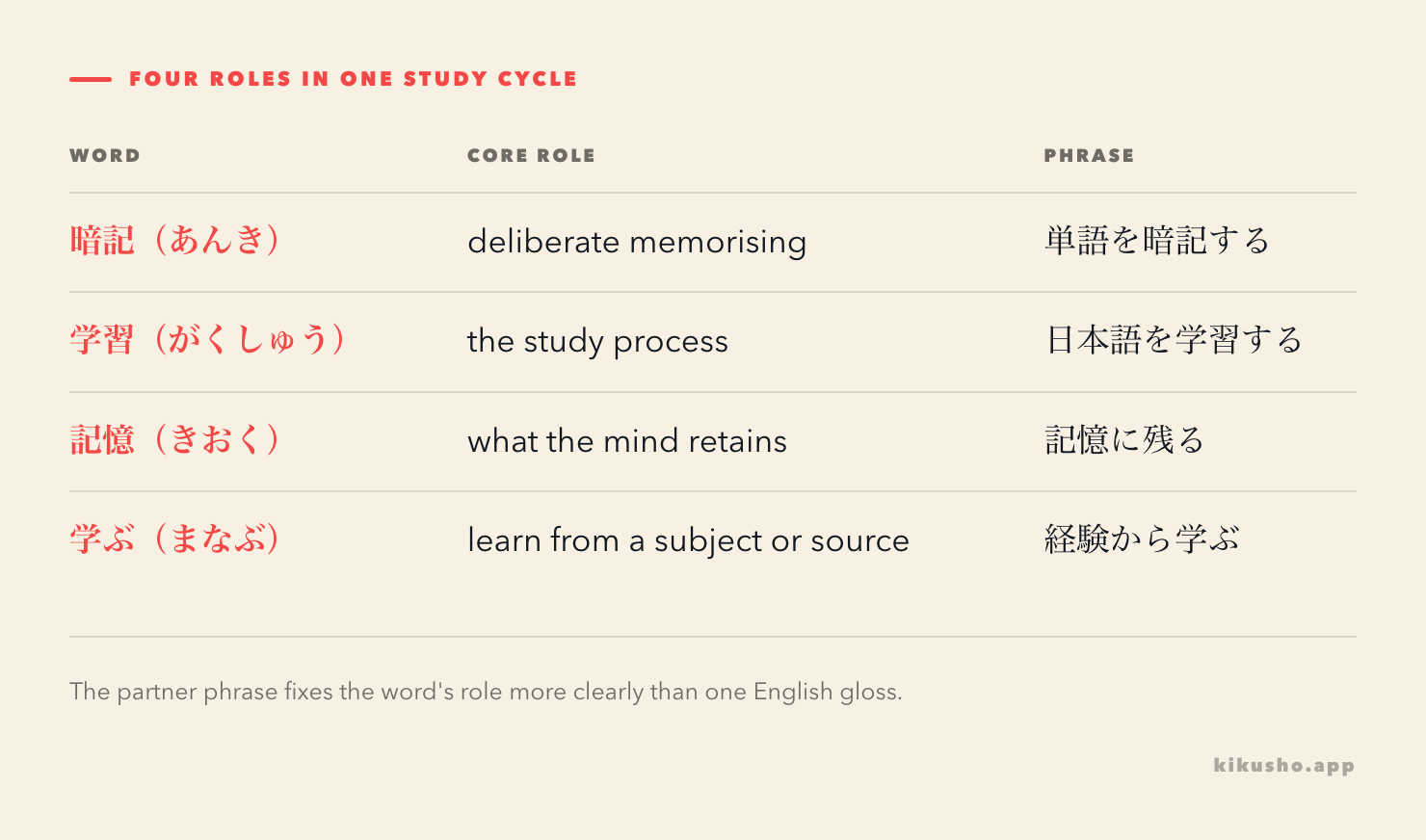
暗記 is an action, 学習 is a process, 記憶 is what the mind holds
暗記する means deliberately putting material into memory so that you can reproduce it without looking. Kanjipedia's 暗記 entry defines it in terms of learning something well enough to say it without seeing it. It fits vocabulary, dates, formulas and speeches:
試験の前に、漢字の読み方を暗記しました。
しけんの まえに、かんじの よみかたを あんきしました。
Before the exam, I memorised the kanji readings.
学習 covers the broader work of acquiring knowledge or a skill. A learner can make a 学習計画, use 学習教材, or study a language over months. Memorisation may be one method inside that process, but 学習 does not imply learning something word for word.
毎朝三十分、日本語を学習しています。
まいあさ さんじゅっぷん、にほんごを がくしゅうしています。
I study Japanese for thirty minutes every morning.
記憶 names the mental record or capacity. It often combines with に残る, を失う, がある or がない. It can also take する, but the noun patterns are especially useful because they prevent you from treating it as a synonym for every kind of studying.
中学の先生の言葉が今も記憶に残っています。
ちゅうがくの せんせいの ことばが いまも きおくに のこっています。
My junior high school teacher's words remain in my memory even now.
Bunpro labels 暗記 as N3 but places 記憶 at N4. That disagreement is useful evidence against treating an unofficial level label as a hard boundary. The official JLPT guidebook states that exhaustive vocabulary, kanji and grammar lists are not published for the current test.
学ぶ is the verb that reaches beyond a study plan
学ぶ can take a subject with を, a place with で, or a source with から:
| Pattern | Example | What it says |
|---|---|---|
| subject + を学ぶ | 大学で歴史を学ぶ | study history at university |
| place + で学ぶ | 教室で日本語を学ぶ | learn Japanese in a classroom |
| source + から学ぶ | 失敗から学ぶ | learn from a mistake |
The last pattern shows why 学ぶ reaches beyond formal study. A mistake, experience or person can teach you a lesson even when no course exists. 学習する is natural when the sentence treats learning as an organised activity, as in オンラインで日本語を学習する. 日本語を学ぶ is equally natural and less administrative.
教科書だけでなく、会話からも自然な表現を学びました。
きょうかしょだけでなく、かいわからも しぜんな ひょうげんを まなびました。
I learned natural expressions from conversation as well as from the textbook.
Choose the noun when you want to label or modify the process, as in 学習方法 and 学習時間. Choose 学ぶ when the sentence needs a direct, flexible learning action.
教科書, 黒板 and 筆 take different particles
These three nouns name objects, but their usual partners reveal different roles. A textbook supplies content, a blackboard receives writing, and a brush performs the writing.
教科書の四十ページを開いてください。
きょうかしょの よんじゅっページを ひらいてください。
Please open your textbook to page forty.
先生は黒板に新しい文字を書きました。
せんせいは こくばんに あたらしい もじを かきました。
The teacher wrote a new character on the blackboard.
書道の時間に筆で自分の名前を書きました。
しょどうの じかんに ふでで じぶんの なまえを かきました。
During calligraphy class, I wrote my name with a brush.
In these examples, 黒板に marks the surface or destination of the writing, while 筆で marks the instrument. 教科書で学ぶ can use で too, but there the textbook is the resource or means of learning. Bunpro puts 教科書 and 黒板 in its N5 material, while 筆 appears in its N3 material. This lesson keeps all three because the assigned set tests their readings and their roles together.
中学 and 読書 name a stage and an activity
中学 commonly refers to junior high school or the junior high stage. 中学校(ちゅうがっこう) is the full institutional name, and 中学生(ちゅうがくせい) names a student.
中学の時、図書館でよく読書をしました。
ちゅうがくの とき、としょかんで よく どくしょを しました。
When I was in junior high school, I often read books at the library.
読書 names reading as an activity, especially reading books. 読む describes the action performed on a particular object: 教科書を読む, メールを読む, 記事を読む. You can say 読書が好きです for “I like reading,” but a specific email normally takes メールを読みます, not メールを読書します.
The phrase 読書をする is correct, though 読書する and simply 本を読む are also available. Use the noun when you want to discuss the activity or habit: 読書時間, 読書習慣, 読書が趣味です.
Read ordinary 文字 as もじ
For a character, letter or piece of writing in an ordinary modern sentence, use 文字(もじ):
この教科書は文字が小さくて、読みにくいです。
この きょうかしょは もじが ちいさくて、よみにくいです。
The print in this textbook is small and difficult to read.
黒板の文字をノートに写してください。
こくばんの もじを ノートに うつしてください。
Please copy the writing on the blackboard into your notebook.
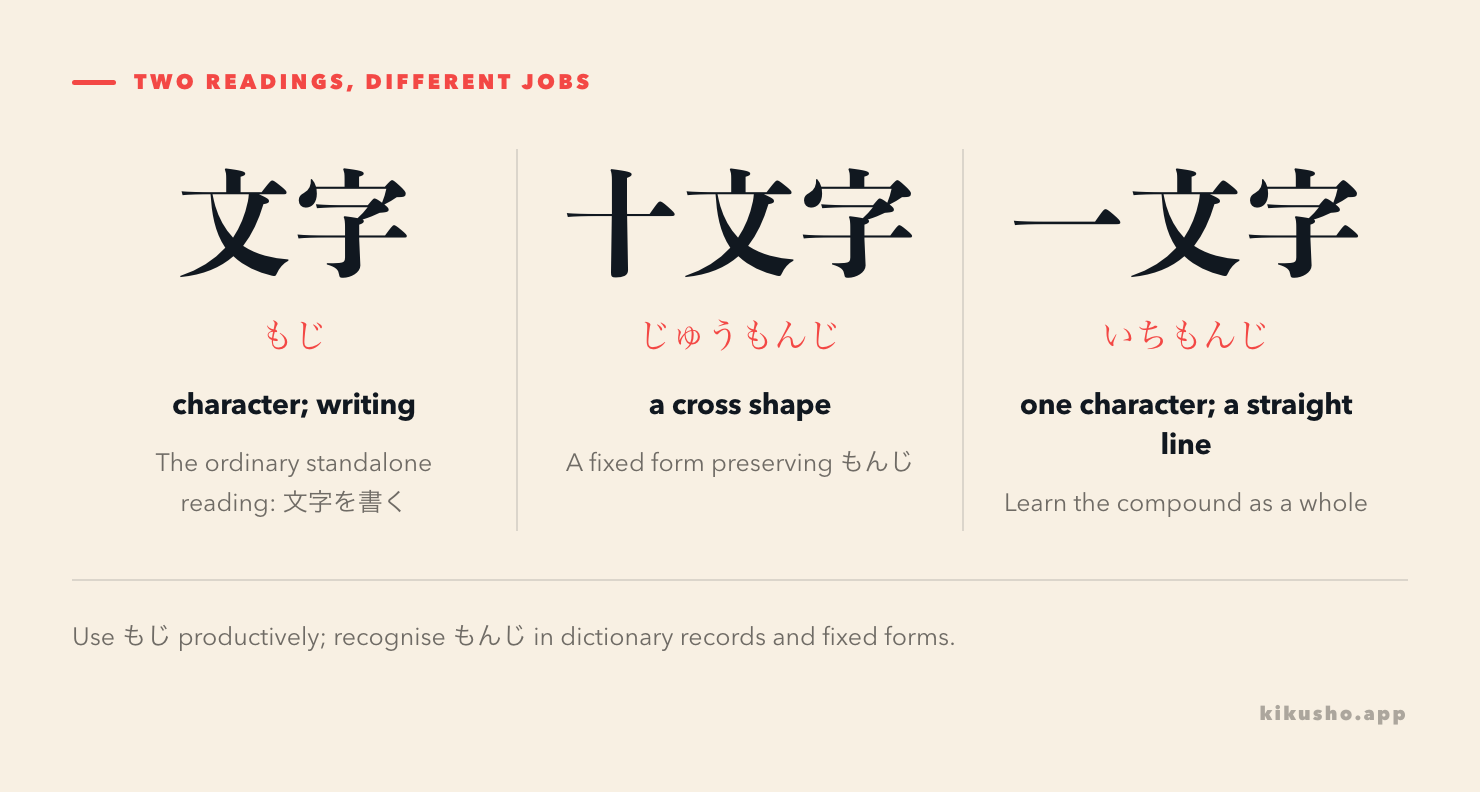
The dictionary record もんじ still needs to be recognised, but it should not replace もじ in those sentences. Daijisen's 文字 entry gives もじ as the ordinary headword, explains its historical relationship to もんじ, and records もんじ as the same word in uses such as 十文字. The reading survives transparently in fixed forms:
| Form | Reading | Meaning |
|---|---|---|
| 文字 | もじ | a written character; writing |
| 十文字 | じゅうもんじ | the shape of the character 十; a cross shape |
| 一文字 | いちもんじ | one character; the shape of 一; a straight horizontal line |
紙を十文字に切りました。
かみを じゅうもんじに きりました。
I cut the paper in a cross shape.
Kotobank's 十文字 entry confirms both the reading and the cross-shape sense. For practical production, say 文字を書く(もじをかく). Treat standalone もんじ as a marked recognition item, then learn the fixed compounds individually.
Put the whole study scene together
The words become easier to separate when each has a job in one short scene:
中学の時、教科書を読んで大切な言葉を暗記しました。先生が黒板に書いた文字もノートに写しました。毎日の学習で学んだことは、今も記憶に残っています。
ちゅうがくの とき、きょうかしょを よんで たいせつな ことばを あんきしました。せんせいが こくばんに かいた もじも ノートに うつしました。まいにちの がくしゅうで まなんだ ことは、いまも きおくに のこっています。
In junior high school, I read my textbook and memorised important words. I also copied the writing the teacher put on the blackboard into my notebook. What I learned through daily study still remains in my memory.
If you save a phrase from a textbook or school notice in Kikusho, keep the partner that fixes its role: 単語を暗記する, 経験から学ぶ, or 記憶に残る. The particle and verb preserve the distinction that an isolated English gloss loses.
Practice the roles before opening the solutions
Item 1
Which reading matches 黒板?
- A. くろいた
- B. こくばん
- C. くろばん
- D. こくはん
Item 2
Which written form matches あんき, “memorisation”?
- A. 暗記
- B. 案記
- C. 暗紀
- D. 安気
Item 3
You deliberately learn twenty words by heart for a test. Complete 試験のために単語を二十個( )。
- A. 記憶に残りました
- B. 暗記しました
- C. 読書しました
- D. 黒板にしました
Item 4
Which sentence most naturally means “I learned from that mistake”?
- A. その失敗を学習時間にしました。
- B. その失敗から学びました。
- C. その失敗を暗記に残しました。
- D. その失敗で読書しました。
Item 5
Complete the classroom sentence: 先生は( )に文字を書き、学生は( )を開きました。
- A. 筆 / 黒板
- B. 教科書 / 筆
- C. 黒板 / 教科書
- D. 読書 / 中学
Item 6
Select the natural use of 読書.
- A. 毎晩三十分、読書をします。
- B. 友達のメールを読書しました。
- C. 黒板を読書に書きました。
- D. 教科書が筆を読書しました。
Item 7
Which statement about 文字 is accurate?
- A. The ordinary standalone reading is もんじ, and もじ is obsolete.
- B. It must always be read もじ, including 十文字.
- C. The ordinary standalone reading is もじ; もんじ is older or marked and survives in fixed forms.
- D. もじ means a textbook, while もんじ means a blackboard.
Item 8
Read the passage: 毎朝、教科書で日本語を学習しています。新しい言葉は暗記しますが、使わないと記憶に残りません。 Which summary is best?
- A. The learner reads for pleasure and never memorises words.
- B. The learner studies Japanese and memorises new words, but use is needed for them to remain in memory.
- C. The learner writes on a blackboard with a brush every morning.
- D. The learner stopped studying Japanese in junior high school.
Answers and explanations
Answer 1
B. こくばん. 黒板 is read こくばん. Choice A gives separate native readings to the two kanji, C mixes the native reading くろ with ばん, and D changes the voiced ばん to はん.
Answer 2
A. 暗記. 暗記 combines 暗 and 記. The distractors replace one kanji with a similar-looking or same-sound character, but none forms the assigned word.
Answer 3
B. 暗記しました. The sentence describes a deliberate act of learning a fixed set by heart. 記憶に残りました would mean that something remained in memory and would require a different sentence structure. The other choices do not describe memorisation.
Answer 4
B. その失敗から学びました. Source + から + 学ぶ expresses learning from an experience. The other choices combine nouns and particles in ways that do not express that relationship.
Answer 5
C. 黒板 / 教科書. A teacher writes characters on a blackboard, so 黒板 takes に. A student opens a textbook, so 教科書 takes を. 筆 could be marked by で as the instrument, but 筆に書く would not fit this scene.
Answer 6
A. 毎晩三十分、読書をします. 読書 naturally names book reading as an activity or habit. A specific email takes メールを読む. Choices C and D do not assign meaningful roles to the nouns.
Answer 7
C. The ordinary standalone reading is もじ; もんじ is older or marked and survives in fixed forms. Use もじ in productive phrases such as 文字を書く. Learn fixed readings such as 十文字(じゅうもんじ)separately instead of applying もんじ to every occurrence.
Answer 8
B. The learner studies Japanese and memorises new words, but use is needed for them to remain in memory. 学習 describes the daily study process, 暗記 the deliberate memorisation, and 記憶に残る the later retention. The other summaries add events that the passage does not state.
Common questions
What is the difference between 暗記, 学習 and 記憶?
暗記(あんき)is the deliberate act of memorising something so that you can reproduce it. 学習(がくしゅう)is the wider process of studying or learning. 記憶(きおく)is memory itself, a recollection, or the act of retaining information. You can therefore 暗記する facts as part of 学習, then hope they remain in your 記憶.
What is the difference between 学ぶ and 学習する?
Both can mean to learn or study. 学ぶ(まなぶ)is a flexible verb used for a subject, skill, lesson or insight, including learning from experience. 学習する(がくしゅうする)sounds more like undertaking a course or organised process of study and is common in educational writing.
Is 文字 read もじ or もんじ?
Use もじ for the ordinary standalone word meaning a written character or writing. Dictionaries also record もんじ as an older or marked reading. It survives clearly in fixed words such as 十文字(じゅうもんじ)and 一文字(いちもんじ), so learners should recognise it without replacing もじ in ordinary phrases.
Are all these words officially assigned to JLPT N3?
No exhaustive official JLPT vocabulary list is published. Kikusho's two related inventory snapshots assign these eleven spelling-reading records to N3, while other learning resources place familiar items such as 教科書, 黒板 and 記憶 earlier. Treat N3 here as the lesson's study scope, not a claim that every item is exclusive to that level.