On this page
If you keep a Duolingo streak, you already own a spaced-repetition engine. It decides when to show you 食べる again, and it is not guessing: the app tracks which words you keep getting right and stretches the gap between them. So for the vocabulary Duolingo itself teaches, you do not need a second review system. The problem is the word Duolingo never taught you, the one on the ramen shop's board, the one a coworker used twice, the one in the subtitle you rewound. Duolingo will never schedule those, because it does not know they exist. Whether you also need something like Anki comes down to a single question: how much of the Japanese you care about lives outside the course.
Duolingo already runs spaced repetition, over its own word list
The first thing to be fair about is that Duolingo does the thing spaced repetition is supposed to do. Its practice sessions bring a word back before you are likely to lose it and widen the interval as you keep getting it right. The practice hub and the review exercises are that machinery made visible. If you have wondered whether you need flashcards on top of your streak, this is why the answer is not an automatic yes: an engine is already running.
But an SRS engine is only as good as the deck it runs on, and Duolingo's deck is the course. Every word it can resurface is a word one of its lessons introduced, in the order the tree lays out. That is a real deck, maintained for you, and for a beginner it is plenty to be getting on with. It just has an edge, and the edge is exactly where your own Japanese begins.
The words worth keeping are the ones you met, not the ones you were taught
Think about which words you most want to hold onto. Usually they are not the ones a lesson handed you. They are the ones that cost you something: the sign you had to photograph, the word a friend used that you stopped to ask about, the line of dialogue you replayed three times. Those arrive with a scene attached, and that scene is a second route back to the meaning, which is what makes them stick when a drilled list slides off.
None of them are in Duolingo's course. お会計 at the café counter, 定休日 on a shuttered shop, ネタバレ when a friend stops themselves mid-sentence: ordinary, useful, and completely outside the tree. Duolingo cannot bring back a word it never taught, so each one lands in the same place, your memory for a day and then gone.
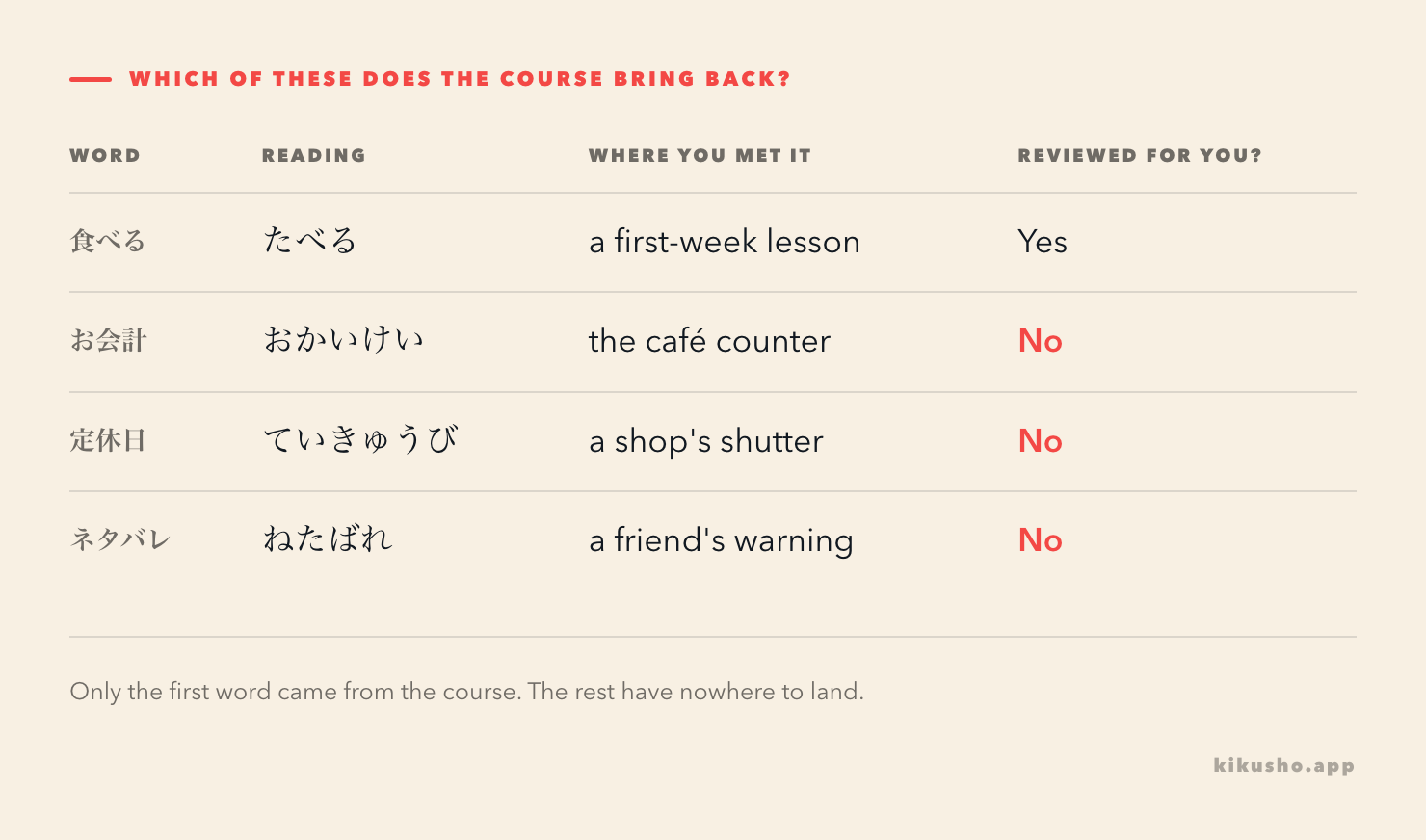
The moment a word comes from your life instead of a lesson, the app that was reviewing everything for you goes silent, and you are back to writing it on your hand.
A course can only review what the course chose
This is not a flaw Duolingo could patch. It is what a course is. A syllabus decides in advance which words you will meet and when, and its review system inherits that same list; it can only reschedule what the curriculum already contains. The strength of that design is that a beginner never has to decide what to study. The cost is that the app's picture of your Japanese stops at the boundary of its own tree.
It is the same limit a downloaded flashcard deck runs into, words chosen by someone else in an order set for someone else, except Duolingo hides it better because the reviewing feels automatic. A premade deck at least sits there looking like a chore you have to face. Duolingo's built-in practice feels like the reviewing is handled, which is precisely why the gap is so easy to miss. You are being shown words on a schedule, so it seems as though your memory is covered. It is covered, for one slice of your vocabulary.
Tapping the right tile is not recalling the word cold
There is a second gap underneath the first. Even for the words Duolingo does teach, the kind of remembering it trains is not the kind the street asks for. A lot of Duolingo review shows you the word among a small set of options, or gives you the English and a bank of tiles to assemble. You succeed by recognising the right piece. That is real practice, and it is the easier half of memory.
The wild offers no options. When the waiter asks what you want, or a sign has to be read before your train leaves, the word is not on the screen to be picked out. You have to produce it from nothing. Recognition and recall are different skills, and passing a recognition test can leave you certain you know a word you cannot summon when it counts.
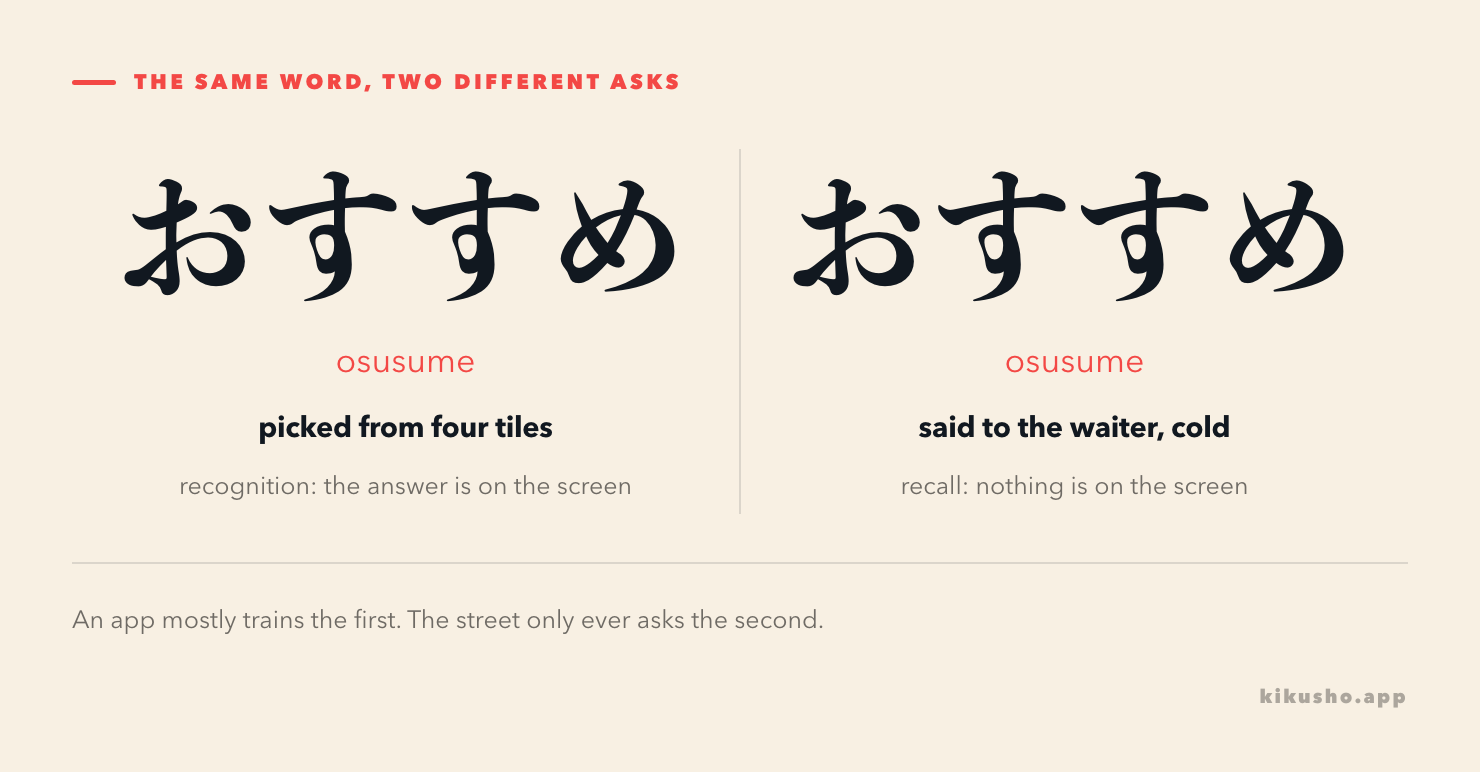
A review that only ever asks you to recognise is training you for a test the world does not set. It is one reason a word you drilled in an app can evaporate the moment you need it live, and why recall against a blank, timed to the edge of forgetting, is what fixes a word.
"Do I need Anki?" is the wrong question
So, do you need Anki? Not Anki as such. What you need is somewhere the words you meet outside the course can land and come back on a schedule. Anki is one such place, and a good one, but it asks you to build every card by hand: type the word, look up the reading, write the meaning, choose a sentence. That friction is why so many people start a deck and abandon it inside a fortnight. The tool is not the point. The habit is: catch the word while you still remember where you met it, and let a scheduler decide when you see it next.
What decides whether the habit survives is how cheap the capture is. If keeping the word from the menu means two minutes at your desk that evening, you will not do it, and the word is gone the same way it was gone before you ever opened Duolingo. This is the job Kikusho was built to remove. You photograph the menu, say the phrase, or paste the subtitle line, and a finished card is waiting: the reading, the meaning, an example sentence and native audio, already assembled and reviewable offline. It sits alongside Duolingo rather than replacing it. Duolingo keeps drilling its course; the words from your own week finally have somewhere to go.
When Duolingo on its own is the right amount
There is a real case where none of this applies. If you are right at the start, and the only Japanese in your life is the Japanese in the app, then the course is your whole vocabulary and its review covers all of it. A second system there is just overhead: you would be building a capture habit with nothing to capture. Duolingo is well made for that stage, and reaching for Anki in week two is mostly a way to feel busy.
The picture changes the moment Japanese starts reaching you from outside the app: a trip, a show you follow, a class, a person you talk to. That is when words begin arriving faster than any course could have planned for, and when "Duolingo is handling my reviews" stops being true without ever announcing it.
The week your own words outnumber the course's
If you keep going, there is a point where the words you have caught from your own life outnumber the ones any app taught you. It tends to arrive without fanfare. You look at your reviews one morning and most of them are words with a place and a day attached, a menu, a station, something a friend said, and only a handful came from a lesson. That is the moment your Japanese stops being the course's and becomes yours.
Duolingo can carry you to the edge of that shift, and it is good at the part it owns. What it cannot do is follow a word home from the places you actually live in the language. Keeping those is a separate habit, and the earlier you start it, the shorter the trail of lost words behind you.
Common questions
Does Duolingo use spaced repetition?
Yes. Its practice brings a word back before you are likely to forget it and widens the gap each time you get it right, which is the core of spaced repetition. The limit is scope: it can only reschedule words its own lessons introduced, so anything you meet outside the course is never queued.
Do I really need Anki if I use Duolingo?
Only for the words Duolingo never teaches. Its review already covers its own course, so a second system earns its place the moment you start meeting Japanese elsewhere, on a menu, in a subtitle, in a conversation, that the app cannot see. What you need is somewhere those words land, not Anki specifically.
Can I add my own words to Duolingo's review?
No. Duolingo does not let you create your own cards or feed outside vocabulary into its practice; you study the course as it was built. Keeping the words you meet in the wild needs a separate tool that lets you capture and schedule your own.
Isn't recognising a word in Duolingo the same as knowing it?
Not quite. Much of Duolingo's practice asks you to pick the right option or assemble a word bank, which trains recognition. Using a word cold, reading a sign or answering a question, needs recall, a harder skill, so a word you know inside the app can still fail you in the moment.