On this page
Anki can drill a grammar point until you recognise its shape on sight and can produce that shape on demand. What it cannot do on its own is teach you to reach for that point in a sentence you are building for the first time, and for grammar that reaching is most of the skill.
For vocabulary the gap barely exists. A word is the same thing every time it turns up, so a card that returns 経験(けいけん)to you at the right moment has done the whole job: you needed experience, and experience is what came back. A grammar point works the other way. It is a rule, and a rule shows itself only by running over sentences the card never contained. That is why Anki can feel like it quits the moment you move from words to grammar, and it decides exactly how far a card carries a rule before the rest of the work has to happen in reading, listening and speech.
What spaced repetition is built to do
A review scheduler has one job: bring a card back just before you would have forgotten it, and push it further out each time you get it right. That is the whole mechanism, and it is a good one. Anki, and the FSRS scheduler that modern Anki and Kikusho both run on, tracks a single quantity per card, roughly how fast that card's memory is fading, and times the next showing to catch it on the edge.
Notice what the scheduler never inspects: the content of the card. It does not know whether the front says 経験 or a whole clause. It knows only that a fixed unit came back, and whether you produced the answer. That is a perfect match for a word, because a word is a fixed unit. The thing the schedule returns is the exact thing you will need in the wild, unchanged. The question is whether a grammar point is a fixed unit in the same way, and it is not.
A word is one item; a grammar point is a rule
Hold 経験 up against a grammar point and the mismatch is immediate. 経験 means experience on the card, on a sign, in a conversation, in an essay. The card holds all of it. Meet it again and there is nothing new to learn; the review just refreshes what the card already carried.
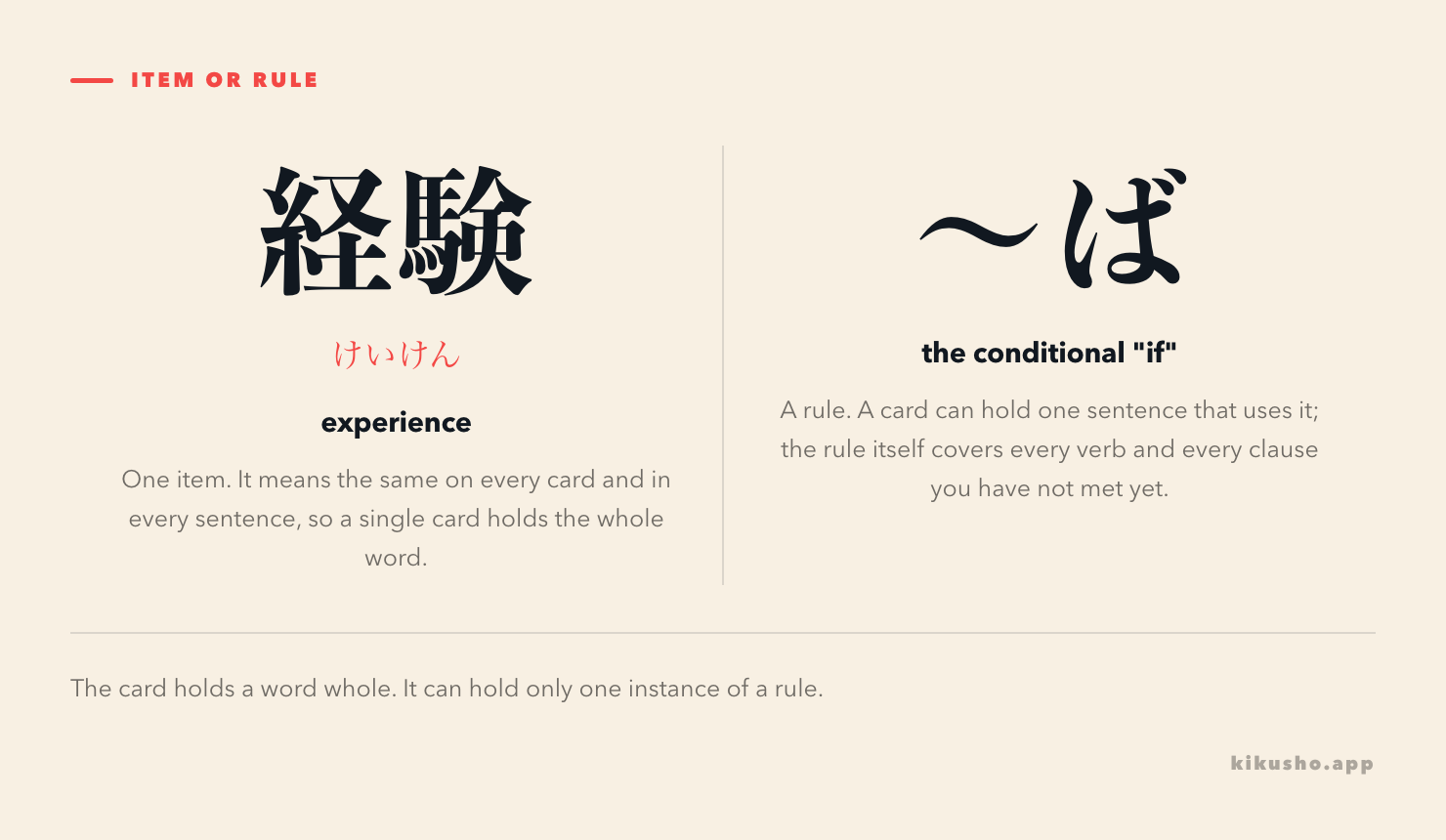
The conditional ~ば holds nothing so tidy. It is not a unit that returns unchanged; it is an instruction for turning one predicate into another, and it produces a different surface form for every word it touches. A card can show you 安ければ買う, "if it's cheap, I'll buy it," but that sentence is one output of the rule, not the rule. The rule is the thing that also gives you 行けば and 食べれば and すれば, in clauses you have not written yet. Put the sentence on a card and the schedule will faithfully return that sentence. It cannot return the rule, because the rule was never on the card in the first place.
The part a card holds well: the form
None of this means Anki is useless for grammar. There is a real slice of every grammar point that behaves exactly like a word, and that slice is the mechanical form: how the point conjugates and what it attaches to. That part is finite, it does not change with context, and drilling it until it is automatic is precisely what a scheduler is good at.
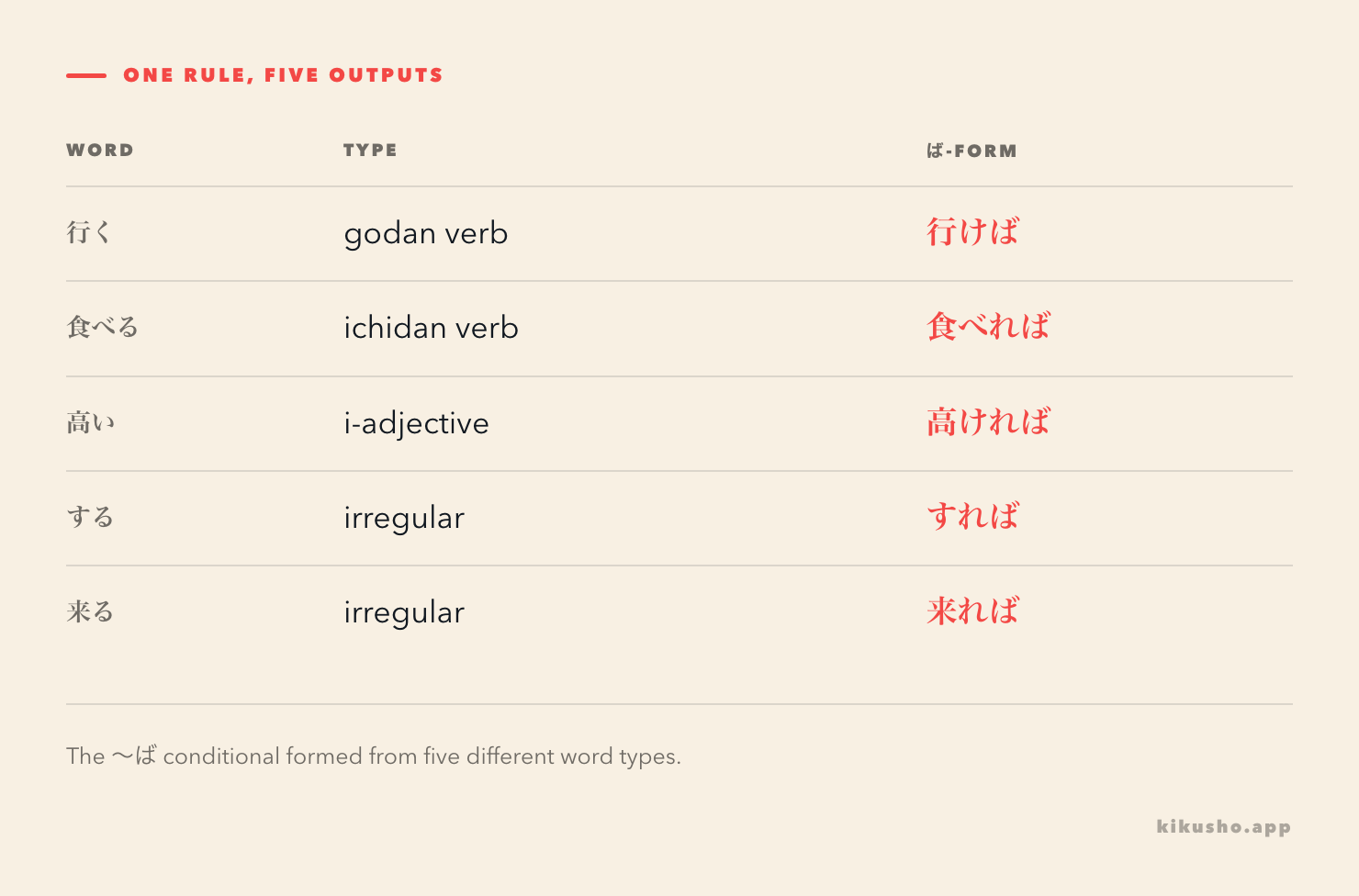
Take ~てしまう, the ending that marks an action finished off or regretted. Knowing that 食べる plus this ending gives 食べてしまった, "ended up eating it all," is a mechanical fact with a fixed answer, and a card that makes you produce 食べてしまった from 食べる rehearses it perfectly well. The same goes for how ~ば attaches across verb classes in the table above. If a form keeps coming out wrong in your writing, a card that isolates the conjugation will fix it, the same way a card fixes a reading you keep missing. This is the honest yes inside the question: for the form, Anki teaches grammar the way it teaches words.
The part it never rehearses: the choice
Here is where the form stops being enough. たら, ば, と and なら all land in English as "if," and knowing how to conjugate each one tells you nothing about which the sentence in your head wants. That decision is the grammar, and it is the one thing a card structurally cannot ask you, because on the card the choice has already been made.
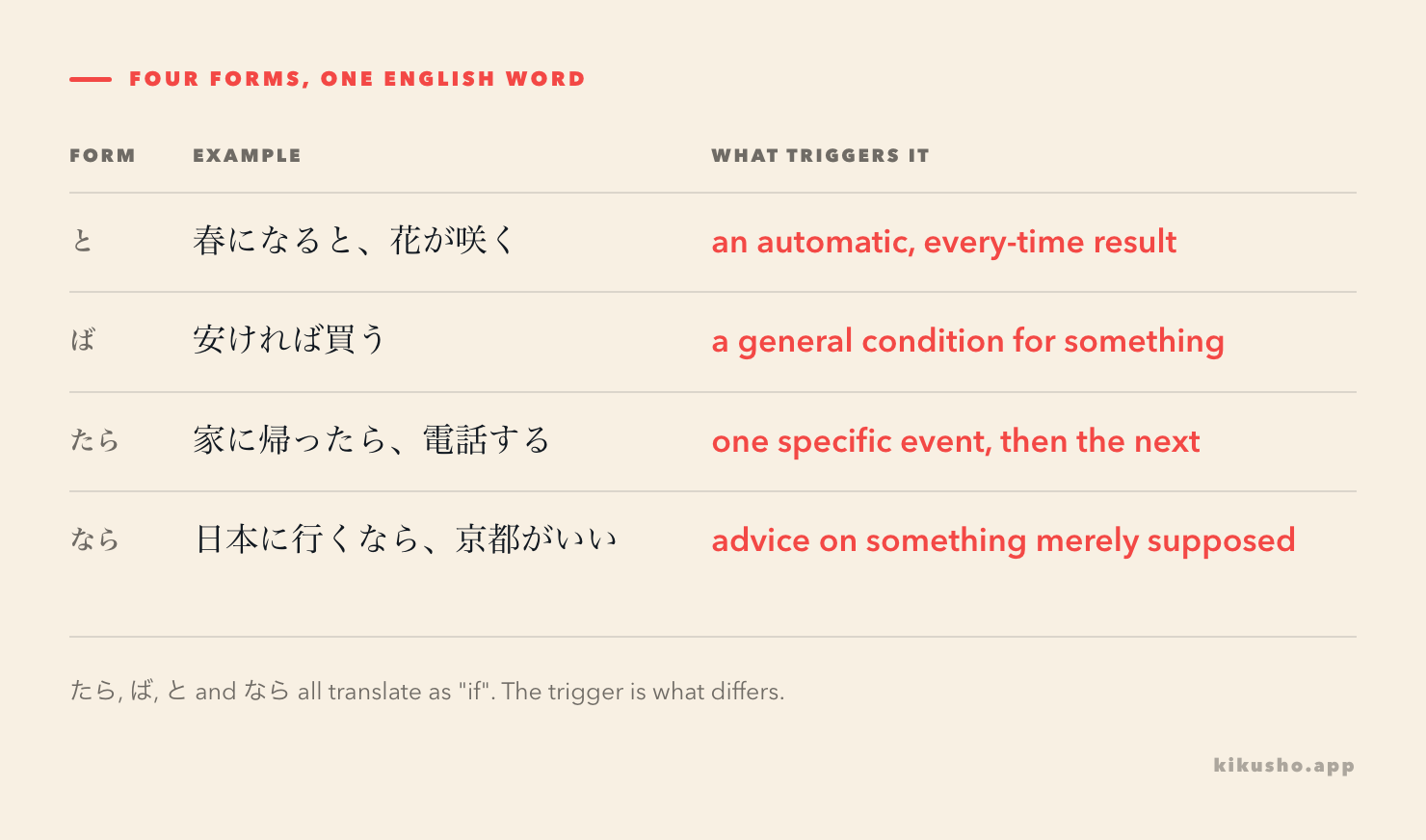
A card can drill 春になると、花が咲く, "when spring comes, the flowers bloom," until the sentence is effortless. What it never does is put you at the moment before that sentence exists, when you have a thought about spring and flowers and have to decide that this is a と situation and not a たら one. The card shows you the finished sentence with the fork already resolved. Your own speech hands you the fork itself, and picking the wrong branch is how you end up fluent in forms you still cannot use. The difference between と and たら, or between ば and なら, is a rule about which situation calls for which, and a rule about situations can only be practised on situations.
One example sentence is an instance, not the rule
This is why the example sentence on a grammar card matters so much more than the label. A card that reads ~ば on the front and "conditional" on the back teaches you to recite a name. A card that keeps a real sentence, and makes you produce the form inside it, at least rehearses the point doing its job. The sentence is where the teaching lives, exactly as it is for the words you keep in sentences rather than alone: the clause carries the particle, the register and the situation, and a bare form carries none of them.
But one sentence is one instance, and a rule is the pattern across many. Meet ~ば in a price, in a set of directions, in a proverb, and you slowly triangulate what it does; review the single sentence 安ければ買う a hundred times and you have learned that one sentence very well. The card can strengthen an encounter you already had. It cannot manufacture the range of encounters a rule needs to generalise, and it cannot close the gap between recognising a point in a finished sentence and producing it in a new one. That second skill is built by recalling against a blank, not by seeing the answer again, and for grammar the blank is a whole sentence you have not composed yet.
The cards worth making are the sentences that taught you the rule
So the way to use Anki for grammar is almost the reverse of the instinct. The instinct is to card the rule: find a clean textbook example, drill the abstract point, expect the schedule to install it. The move that works is to card the encounter, the actual sentence where the form did something you did not expect, or where you first understood why it was that form and not its neighbour. That card carries the choice baked in, because you met the situation before you met the sentence, and reviewing it re-runs a real instance of the rule rather than a definition of it.
This is the shape of grammar study Kikusho fits. When a form catches you in a subtitle, on a sign, in a line you had to reread, you keep that sentence: photograph it, say it, or paste it in, and the card comes back with the sentence intact, its reading, the sense, and audio, so what you review is the moment the rule was doing its work. Do that across a week of reading and your conditional cards are not four abstract entries but a dozen real sentences, each one a situation that chose its form, which is the raw material a rule generalises from. The schedule then does for grammar what it does for anything: keeps those encounters from fading before the pattern behind them has set.
That is the part the original question misses. Anki can teach you grammar, but only the grammar you have already met somewhere else, and only if you feed it the meetings rather than the rules. The abstract point was never going to fit on a card. The sentence that taught it to you always did.
Common questions
Can you learn Japanese grammar with Anki at all?
Part of it, yes. Anki drills the mechanical side of a grammar point well: how it conjugates, what it attaches to, the shape it takes. What it cannot train on its own is the live choice of which point a sentence needs, since a card only ever tests one point already decided for you. That decision is built by meeting the form in reading, listening and speech.
What kind of grammar card actually works in Anki?
A cloze or production card built from a real sentence, one that hides the form and makes you produce it in context. A card with a form on the front and its name on the back trains you to recite a label, not to use the point. The example sentence is what does the teaching, so the more of it the card keeps, the more the card is worth.
Why do my grammar cards feel useless even when I remember them?
Because remembering the card is not the skill you need. On the card the sentence is already finished, so you are recognising a point that has already been chosen; in your own speech you have to choose it before the sentence exists. Recall of a finished form and production of a new one are different abilities, and only the first fits on a card.
Is sentence mining the same as learning grammar with Anki?
It is the good version of it. Mining keeps real sentences you met, so each card carries the particle, the register and the situation that made one form right, instead of an abstract rule. It still needs volume and it still needs output, because a rule generalises only across many sentences, not from one you review.