On this page
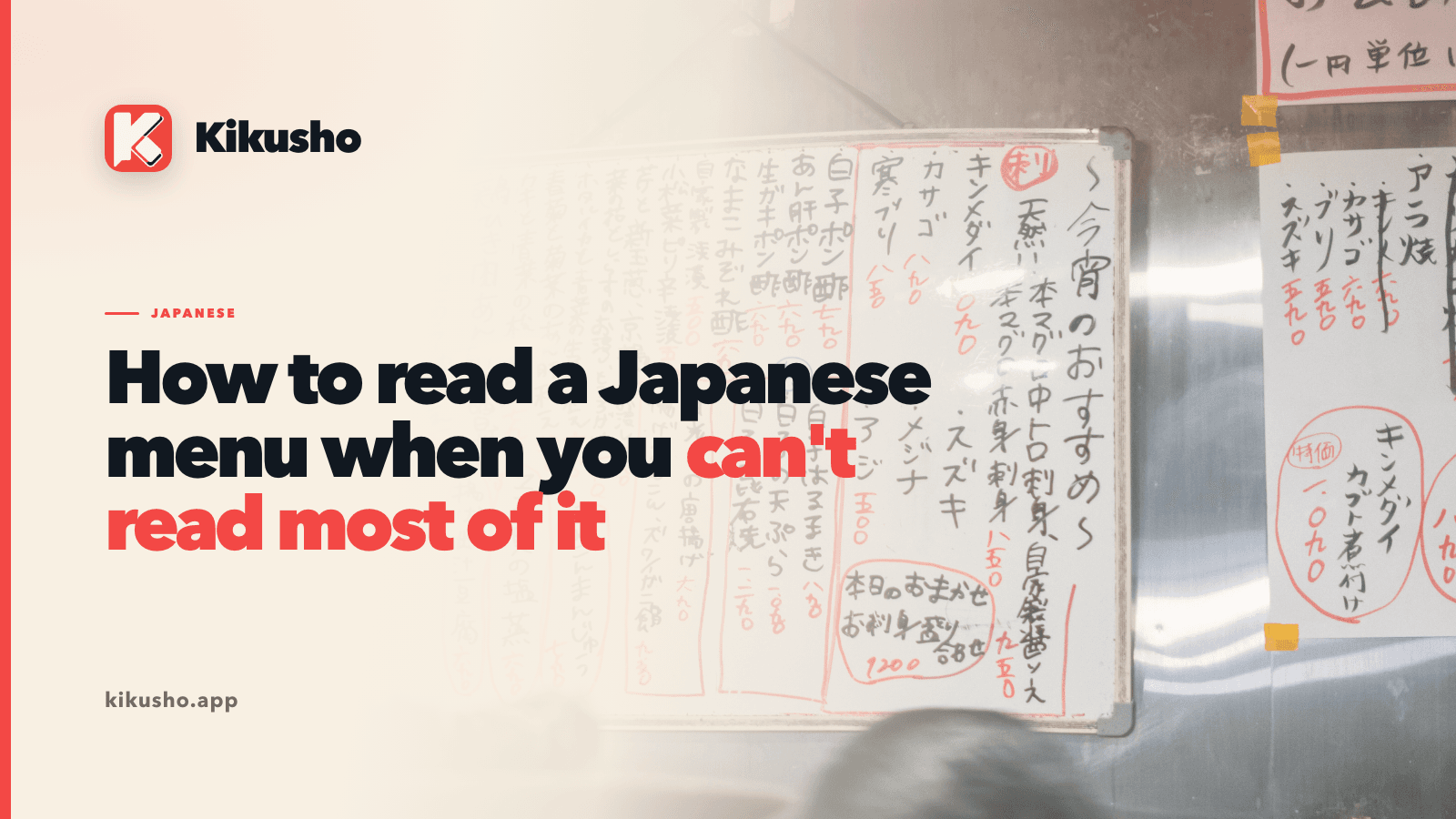
You don't need to read a Japanese menu to order well from it. You need the price, which is already in numerals, a handful of words that control size and spice on almost every menu you'll meet, and a way to hold onto the two or three dish names you actually can't place. Everything else on the page is decoration around information you already have.
That's a different problem from "learn to read Japanese," and it's solvable in an afternoon, not a semester.
The price and the picture are already doing most of the work
Look at what a menu is actually structured to tell you before you read a single kanji. Prices are numerals, 850円, ¥1200, so you already know what everything costs. Photos, when a restaurant has them, tell you the shape and colour of a dish more reliably than a word you'd have to look up anyway. Sets are visually grouped, usually in a boxed section separate from the à la carte items, so structure tells you "this is a bundle" before you can read the word for it.
None of that is a substitute for knowing what you're eating. But it's enough to order something reasonable, at a price you chose, without reading a character, which is worth knowing before you try to do better.
A short list of words runs almost every menu you'll ever see
The part of a menu that changes restaurant to restaurant is the dish names. The part that doesn't is the scaffolding around them, and it's a short list:
- 定食 (teishoku) — a set meal: main, rice, soup, a small side, usually the best value on the page.
- 単品 (tanpin) — à la carte, ordered alone rather than as part of a set.
- 並 / 大盛り / 小盛り (nami / oomori / komori) — regular, large and small portion.
- 税込 / 税抜 (zeikomi / zeinuki) — tax included or excluded from the price shown.
- 辛さ (karasa) — spice level, often followed by a number you can point at.
- おすすめ (osusume) — the house recommendation, usually flagged separately.
- 本日の〜 (honjitsu no) — "today's," where の joins 本日 to whatever follows, a soup or a special.
- 品切れ (shinagire) — sold out, sometimes handwritten over a printed item.
- ラストオーダー (rasuto oodaa, "last order") — the cutoff time for ordering, in katakana.
That's nine words, and they cover set structure, portion, price, spice and availability on a huge share of menus regardless of cuisine. A ramen shop and a teishoku counter use most of the same scaffolding. Learn them once and every menu after the first becomes easier to scan, because you're no longer reading unfamiliar characters, you're recognising a layout you've already seen.
Katakana is often naming the dish for you, not hiding it
A lot of what looks unreadable on a menu is katakana rendering a word you already know: カレー is curry, ハンバーグ is hamburg steak, サラダ is salad, ビール is beer. Sound it out syllable by syllable and the word often arrives before you've consciously translated anything. カ-レ-ー is closer to "curry" than most kanji compounds are to their English gloss.
This isn't true of every katakana word. Some borrowings have drifted far enough from the source that sounding them out won't help, because Japanese reshapes loanwords to fit its own sound system before you ever see them. But as a first move, reading katakana phonetically and listening for what it resembles is one of the fastest wins available to someone who can't read kanji yet: it turns "unreadable" into "say it out loud and check."
What to do with the word that stops you cold
Every menu has one: a dish name in kanji you don't know, no photo, staff who are busy, a line forming behind you. The instinct is to guess, order something safe instead, or promise yourself you'll look it up later. The look-up rarely happens. By the time you're back at a table with a signal, you don't remember which characters stopped you, only that something did.
What actually works is capturing the word at the table, before you order, so the decision about what it means happens later instead of never. Point a phone at the line on the menu, or read it aloud if you can sound it out even roughly, and keep the photo or the phrase, not just the memory of being confused.
This is the exact moment Kikusho is built for. Point the camera at the menu and highlight the item you're stuck on, up to five things on one photo, each becoming its own card with the word, its reading, what it means, and an example sentence, all reviewed before it's saved. You still order in the moment. You just stop losing the word once the meal is over.
The same handful of words come back on the next menu, and the one after that
This is what makes a menu worth actually studying rather than just surviving: it repeats. The scaffolding words above show up again next week. The dish names you capture from what you order, because you liked it, or because you want to order it again, are exactly the words most worth keeping, since they already have a meal attached to them. That's the same principle that makes signs and everyday phrases stick better than a vocabulary list: a word you met while doing something is easier to hold onto than one you met in isolation.
What determines whether those captured words are still there in a month isn't how memorable the meal was. It's whether something brought the word back to you before you forgot it: a review, timed before the memory faded rather than after. Capture the word at the table; let the schedule handle whether you still know it by the time you're reading the next menu.
Read enough menus this way and the unreadable part gets smaller each time, not because you sat down and memorised a vocabulary list, but because the words that matter to you kept showing up, and you kept keeping them.
Common questions
Do I need to learn hiragana and katakana before I can read a menu?
Katakana matters more than kanji here. Dish names borrowed from other languages are written in it, and it's a closed set of 46 characters, so it pays back the study time almost immediately. Hiragana helps with endings and short native words like 辛い or 冷たい. Kanji you can collect as you go; a menu will not wait for you to finish it first.
What if a dish name uses a kanji I've never seen and it isn't in katakana?
That's usually a place name, a proper noun, or a shop's own naming, and guessing from characters alone will not get you far. Point at the item, photograph it, or ask what's in it. Capture the word so the next menu that uses it is one you already know.
How many menu words are actually worth memorizing?
Fewer than the length of any single menu suggests. The words that control size, price and spice reappear on nearly every menu you'll meet, in any cuisine, so they pay for themselves almost immediately. Dish names are the part that keeps expanding, and the part you capture from what you actually order, not from a list.