On this page
You come back from a week off, open the deck, and the counter reads three hundred and eighty. The number lands like a bill, and the two responses it invites — nuke the deck and start clean, or stop opening the app for good — are both the wrong move. What to do instead is smaller than either: cap how many cards you clear a day, turn off new ones until the pile is gone, and let it drain over a few ordinary sessions. Nothing was erased while you were away, and most of those cards are words you still know.
The reason the counter feels like a debt is worth pulling apart, because the panic it triggers is what ends decks, not the missed days themselves. A break does little damage to your memory. Coming back to the evidence of it, one large number on one screen, does most of the damage instead.
The overdue count is a pile, not a penalty
Start with what the number is. Anki shows you every card due today plus every card that came due while you were gone, added together into one figure at the top of the deck. Nine days away does not create three hundred new obligations. It takes the ten or twenty cards that would have surfaced on each of those days and stacks them onto the morning you return. The counter is not measuring how far you have fallen behind. It is measuring how many separate days you compressed into one.
That distinction matters because the number is the thing you react to, and it is the least informative part of the screen. A deck that hands you forty cards a day for nine days and a deck that hands you three hundred and sixty on day ten hold exactly the same cards. One of them shows the total on a single line, and the total is alarming in a way the daily trickle never was.
A week away doesn't reset your cards
The deeper fear is not about the count but about the words: that a week without review let them evaporate, so you are starting each card from nothing. The scheduler disagrees, and it is built precisely around this case.
Modern Anki runs on FSRS, the same scheduler that decides what each review button changes, and it keeps two different numbers for every card. One is stability: roughly, how durable the memory is, how long the word can sit before your chance of producing it drops to the target. The other is retrievability: how likely you are to recall it right now, which slides downward the longer it has been since you saw the card. A break moves only the second number. Stability is a property of how well you learned the word, and sitting untouched for a week does not undo it.
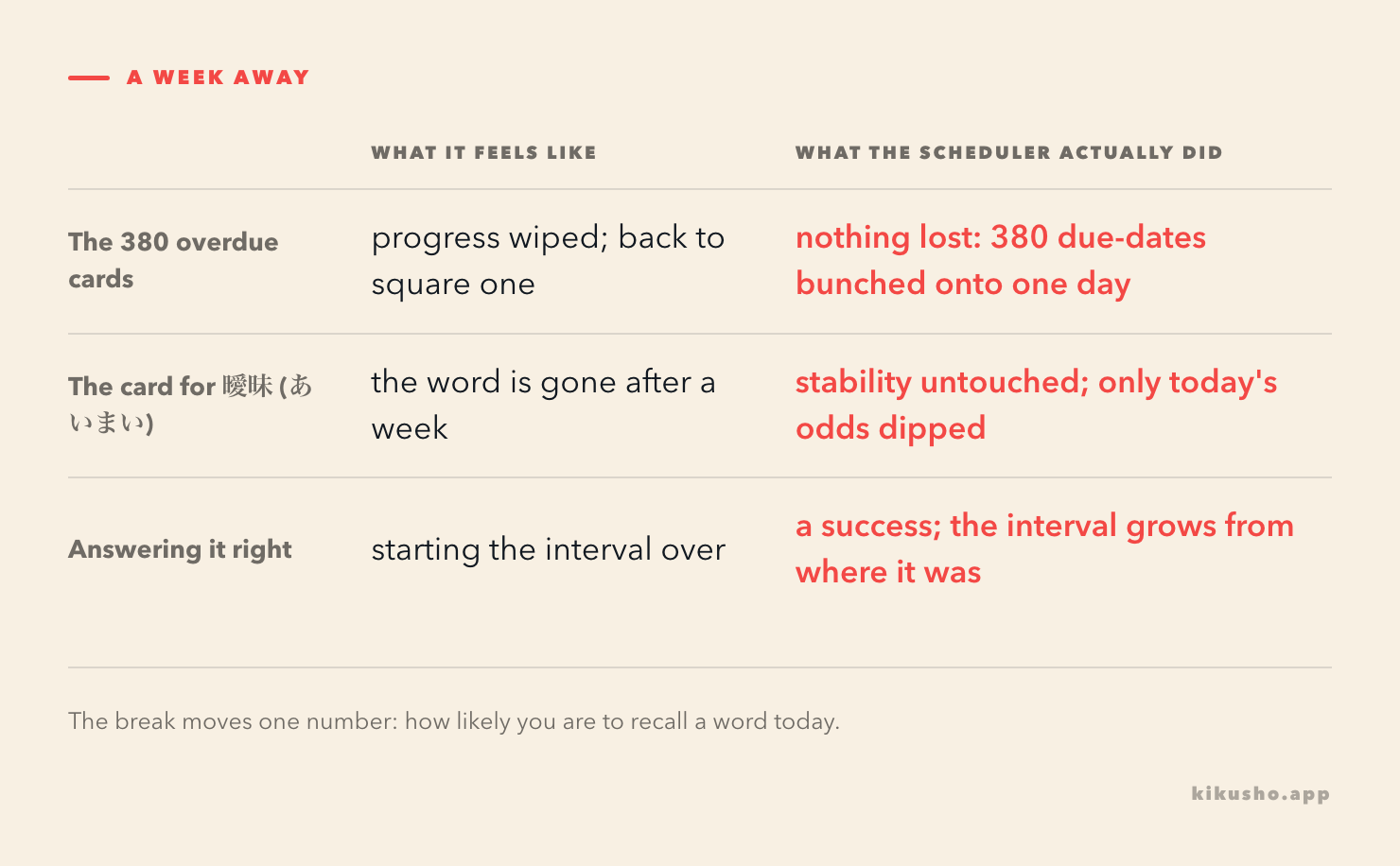
When you finally answer an overdue card and get it right, that counts as a success. The card keeps the interval it earned and grows from there, as though the review had come a little late rather than never. So the miss feels worse than it is. A card overdue by a week is not a card you failed. It is a card you have not been asked about yet, and the only thing the gap changed is that the asking is now slightly harder.
A late review is often a stronger review
That extra difficulty turns out to work in your favour, and the reason comes from how memory is built. A recall teaches you most when it costs something, and it only costs something once the word has started to slip. A card reviewed exactly on time, or early, is recalled while you still hold it comfortably, and a comfortable recall does very little for you. A card reviewed a little late makes you reach for the answer, and the reaching is where the memory strengthens.
So a slightly overdue pile is not merely harmless. Cleared with honest ratings, it is a more valuable session than the same cards would have been on their due date. You are being tested at the harder, more useful moment, on words the deck had been saving up for you.
The qualification lives in the word slightly. There is a real difference between a card a week late, which you reach for and find, and a card two months late that you have genuinely lost. The first is a strong review. The second is a lapse, and it should be marked as one and allowed to come back soon. Most of a post-holiday backlog is the first kind, which is the real reason it clears faster than the number implies: you still know the words.
The wall is what makes people quit, not the words
If the words are mostly fine and a late review is often a good one, why do breaks end so many decks? Because the thing you meet on your return is not the words. It is the number, and the number was designed by nobody to be encouraging.
Three hundred and eighty is not a quantity you can hold in your head as a single session. It reads as failure, as a heap of chores, as proof that you are the sort of person who does not keep things up. None of that is in the cards. It is in the counter. And the standard reactions to that feeling all make the deck worse, which is worth looking at head on, because the instinct is strong and every option it offers is a trap.
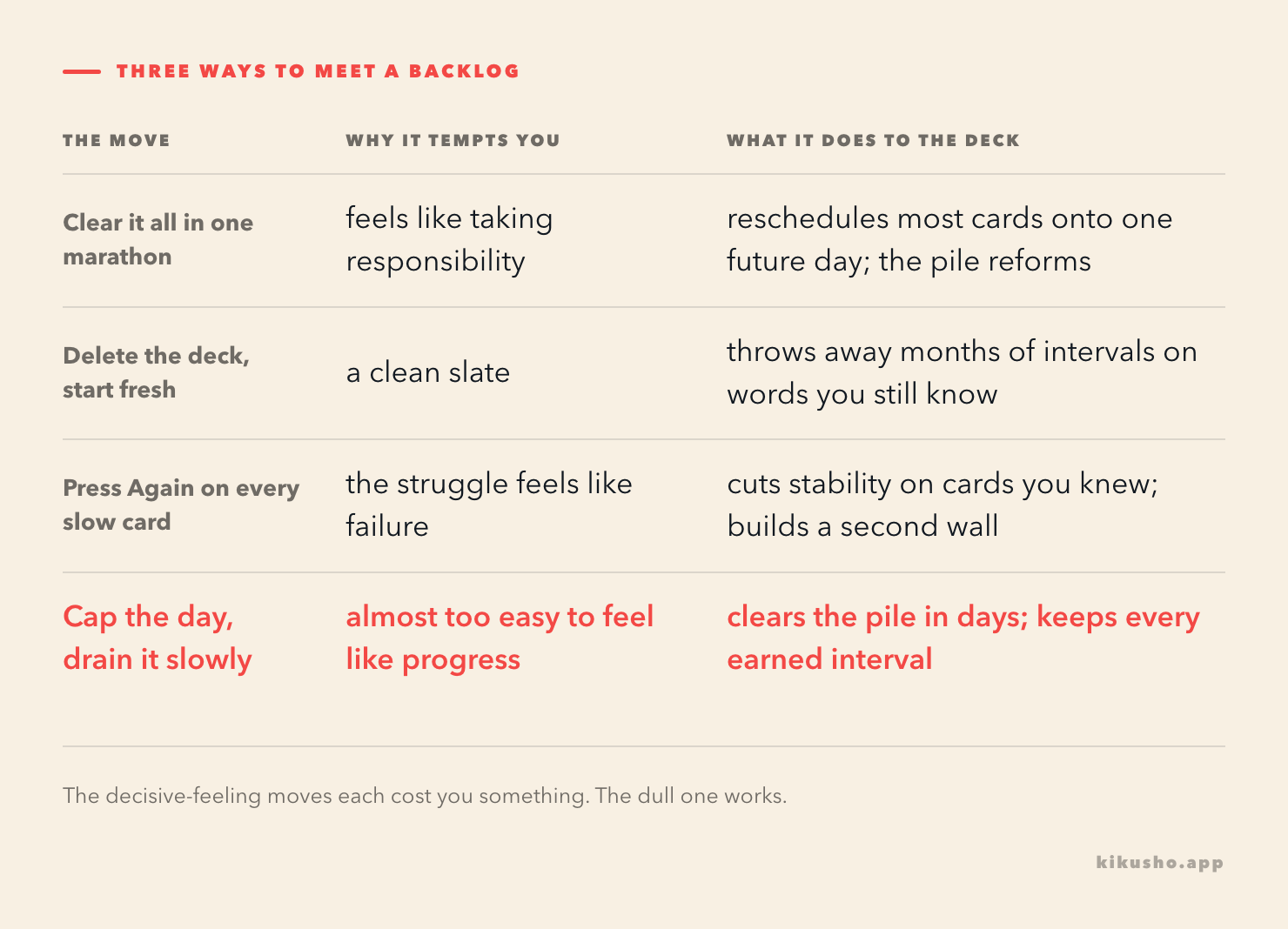
The first move is to clear it all in one marathon. It feels like taking responsibility, and it fails for a mechanical reason: reviewing three hundred cards in one sitting sends most of them to a new interval on roughly the same future day, so you have not drained the pile, you have rescheduled it to land on your head again in a month. A backlog cleared in one go becomes a backlog reborn.
The second move is to delete the deck and start over. This throws away the one thing the break did not touch, the intervals you spent months building, and it resets the cards you still know — most of them — to day one alongside the few you actually lost. You would be paying for a week's absence with a year's progress.
The third move is the subtle one. Faced with a card that comes slowly, the temptation is to press Again, because the recall was a struggle and Again feels like the truthful answer. But Again is the button for a recall that did not happen: no answer, or the wrong one. Press it on a card you did produce and you cut the card's stability and drop it to a few minutes, manufacturing a second wall out of cards that were fine. If you got the answer, even slowly, the button is Hard.
Bound the day, then let it drain
The move that works is unglamorous. Set a limit on how many cards you will review in a day, turn off new cards entirely, and do a normal short session. Come back tomorrow and do it again. Anki lets you cap reviews per deck in its options, so you can decide the pile meets you forty at a time instead of all at once. If you would rather not touch a setting, just stop when your forty are done and close the app.
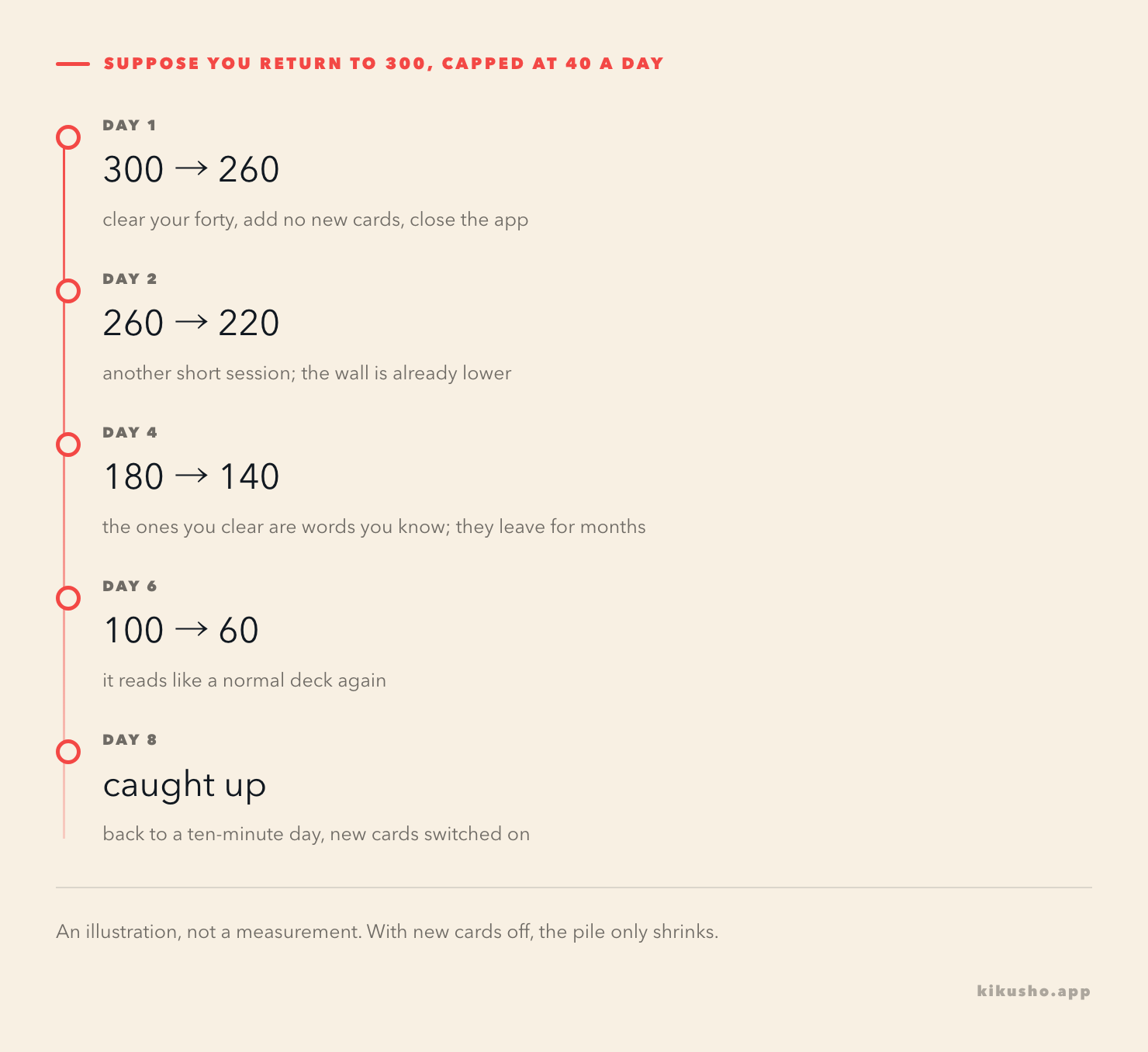
The arithmetic is friendlier than the counter suggests. With new cards switched off, the deck can only lose cards each day, never gain them, so unlike an ordinary morning the pile has nowhere to go but down. Because most of the backlog is words you still know, the cards you clear leave for long intervals and do not come back soon, so almost nothing you clear returns to bother you. A pile that looked like a month of penance is usually gone inside a week, and every one of those sessions was the short, daily kind that keeps a deck alive rather than the marathon that kills it.
There is a reason a lapse so often becomes an ending, and it has less to do with the reviews than with what restarting demands. A deck you built by hand is only as alive as your willingness to keep building it, so a break raises a second, larger question: not just whether to clear the backlog, but whether to go back to making cards at all. Kikusho is built so that question never arrives. Keeping a word you meet takes a few seconds rather than an evening, so a gap never compounds into a rebuilding job, and coming back is only ever answering cards that are already waiting. Reviewing is never metered: the free plan caps how many new cards you create each day and never limits how many you review, so a backlog is never sitting behind a paywall on the morning you find the resolve to face it.
The break was the real test
It helps to see what a break is from the deck's point of view. Every interval you have earned is a bet that you will still know the word after a gap, and the only way to settle that bet is to let the gap happen and then check. A week away is that check, run on every card at once. The overdue pile is not the schedule breaking down. It is the schedule collecting on its promise, asking each word whether it survived on its own.
For most of the cards the answer comes back yes, and that yes is worth more than any on-time review could have handed you, because it was earned across a real absence rather than a tidy three-day gap. The handful that come back no are precisely the words the deck existed to catch. Either way, the pile was never a verdict on you. It was the first honest news in a week about what you actually know.
Common questions
Will a week off Anki ruin my progress?
No. The scheduler tracks how durable each memory is separately from how long it has been since you saw the card, and only the second thing changes while you are away. Answer an overdue card correctly and it keeps the interval it had already built, then grows from there. Most of a backlog is words you still know.
Should I clear all my overdue Anki cards in one sitting?
No. A single marathon reschedules most of those cards to the same future day, so the pile reforms weeks later. Cap your reviews per day, turn off new cards, and do a short session daily until it drains — usually within a week, because most of the backlog is words you still recall.
Should I press Again on overdue cards I recall slowly?
Only if you truly could not produce the answer. Again is a lapse: it cuts the card's stability and drops it to a few minutes. If you got there, even slowly, press Hard. Pressing Again on cards you knew builds a second backlog of short-interval reviews out of words that were fine.
Is it bad to review Anki cards late?
Rarely. A card a little overdue is recalled with more effort, and effortful recall strengthens a memory more than an early, easy one, so a slightly late review is often a better review. The exception is a card months overdue that you have genuinely forgotten; mark that as a lapse and let it come back soon.