On this page
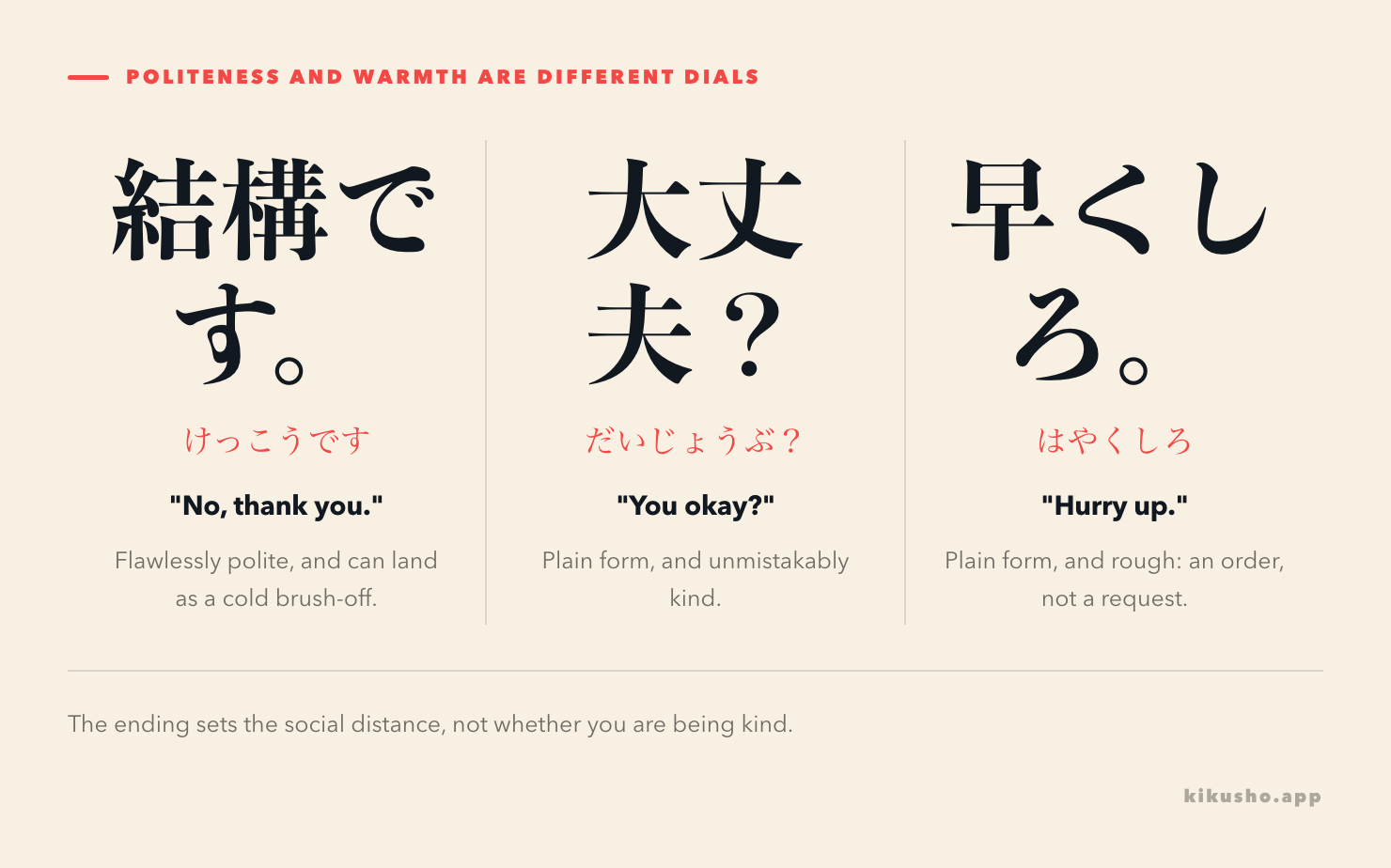
No: plain form is not rude, and answering in です/ます to everyone to stay on the safe side is its own mistake. Plain form signals that the distance between two people has closed, so the trouble is never the grammar itself. It begins when that signal is aimed at the wrong relationship: offered to someone who expected to be kept at a polite distance, or withheld from someone who expected to be let in.
The word "rude" points at the wrong thing. It sounds like a property of the form, when it is really a property of the fit between the form and the person you are speaking to.
Casual speech is closeness, not carelessness
Politeness of the ending and kindness of the message are two separate dials. You can be cutting in flawless です/ます, and you can be warm in bare plain form. The ending tells the listener how much social distance you are keeping; it says almost nothing about whether you are being nice to them.
What plain form actually marks is that you and the listener are inside the same circle: the same age group, a family, close friends, or a senior giving a junior permission to relax. Between peers this casual register even has a name, ため口. It is not です/ます with the manners scraped off. It is a different setting that reports something true about the relationship.
The reason it can feel like rudeness to a beginner is an accident of how the language is taught. Almost every model sentence in a first textbook is polite, so plain form shows up later looking like the polite version with something removed. Subtract the です, the thinking goes, and you must be subtracting respect. But nothing was subtracted. A different thing was switched on.
The real mistake is a mismatch with the relationship
Some people expect です/ます from you and will notice its absence: a stranger, someone clearly older, anyone speaking to you in a service or professional role, a senior at work. Plain form aimed at them lands the way calling a stranger by their first name lands. Not cruel, just presumptuous, a claim of closeness that was not yours to make.
Direction matters as much as the people involved. A senior can speak to you in plain form while you still owe them です/ます back, and that asymmetry is not rudeness on their part or servility on yours. It is the register doing its job, marking who ranks where. The same logic runs through the honorific system that sits on top of this one, where a group boundary can override rank outright. Plain-versus-polite is the layer underneath, and it turns on one question: has this relationship earned the closeness the form assumes?
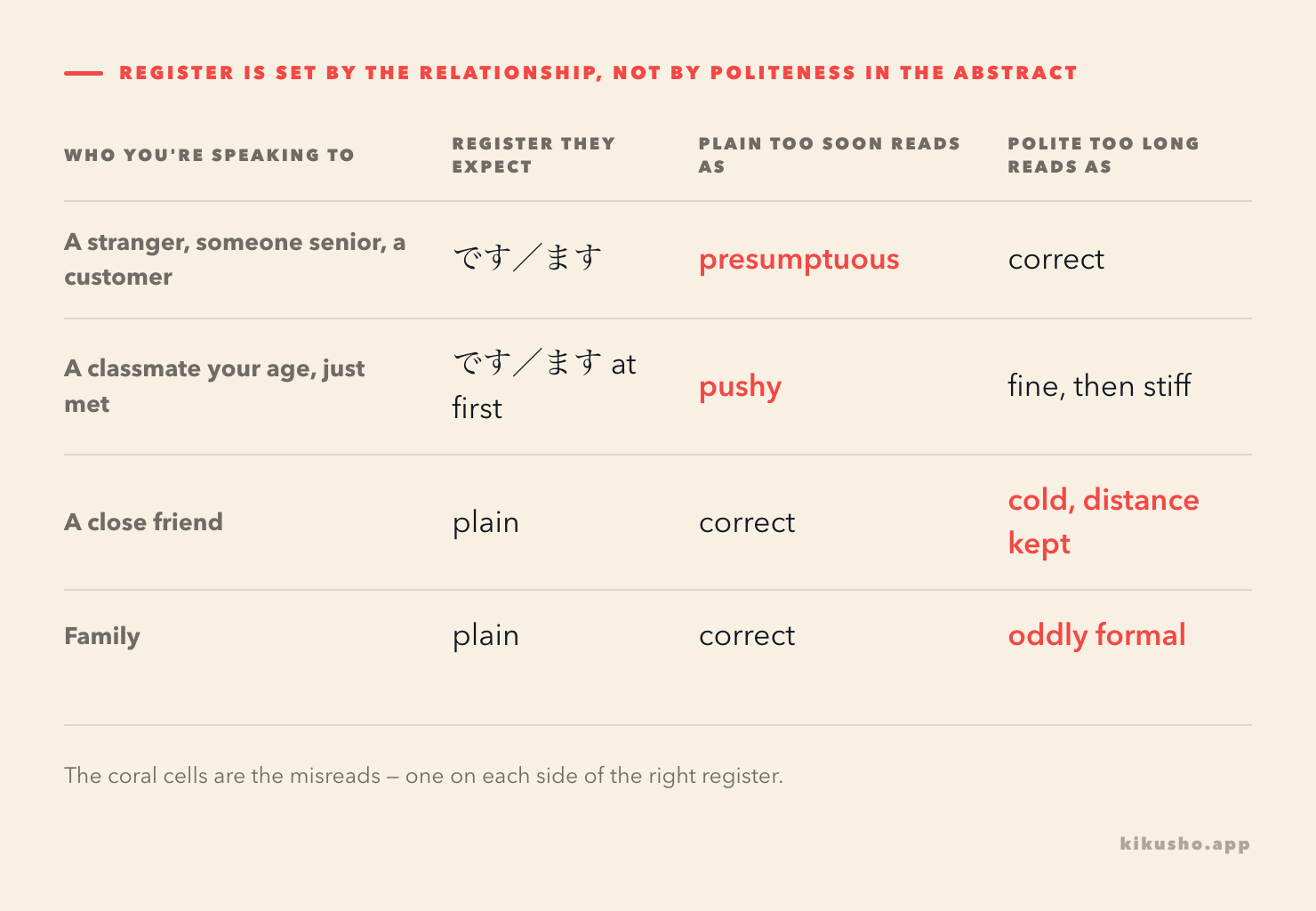
Read down the grid and the pattern is not "more polite is safer." It is that each relationship has a register it expects, and there are two ways to miss it, one on each side.
Not all plain form is equally casual
Here is where "is plain form rude" holds a grain of truth. Plain form is a region, not a single tone, and one corner of it is genuinely blunt even among friends.
A plain question with rising intonation, 来る?, is soft and ordinary. The plain imperative, 来い, is an order. The prohibition するな is sharp. Rough sentence-final particles like ぞ and ぜ push harder than よ and ね. So a specific slice of casual speech does read as rough, and a learner who met plain form through its imperatives could be forgiven for filing the whole register under "rude." The fix is to see that this is tone varying inside casual speech, not casual speech being rude by nature.
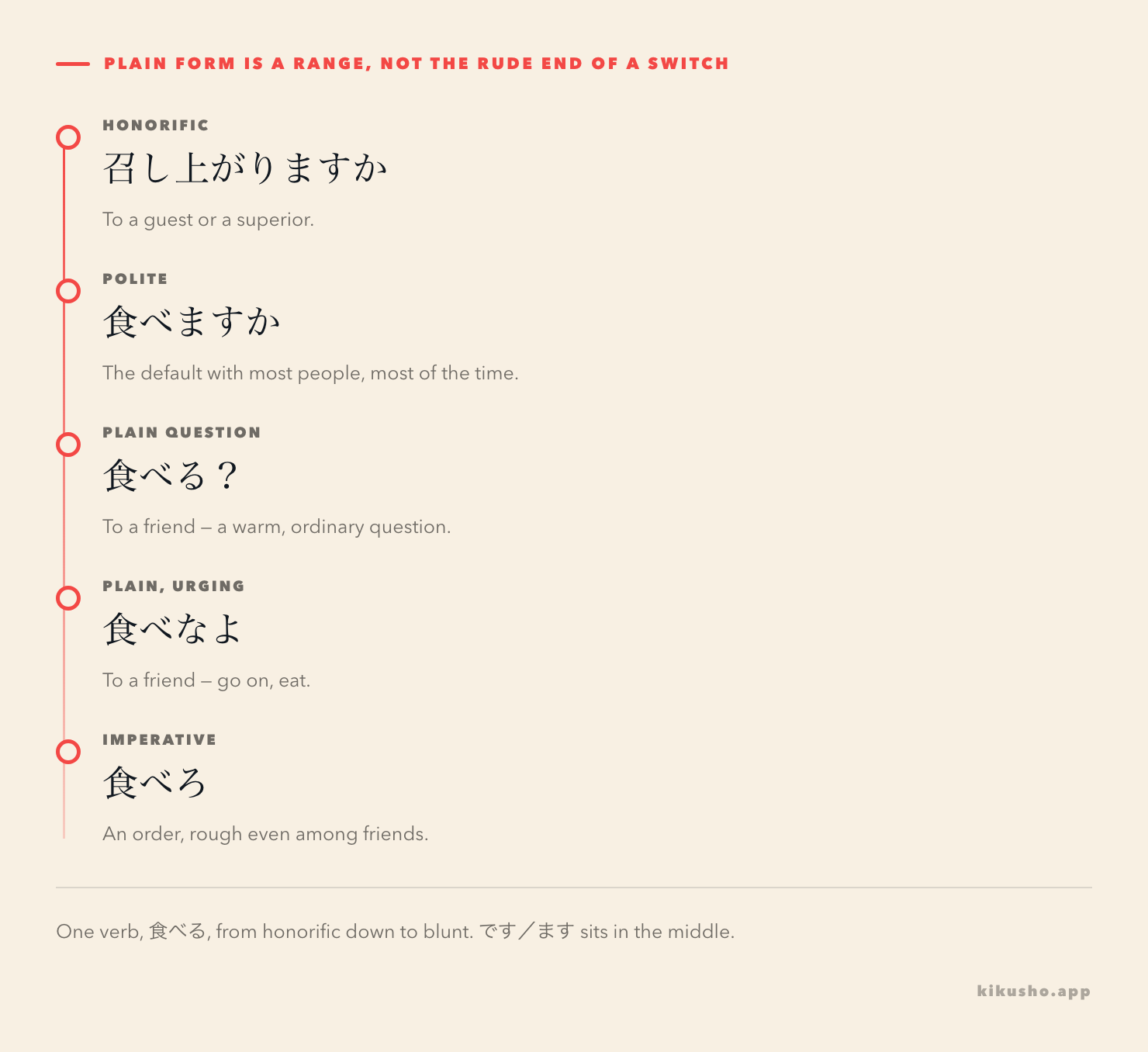
Notice where です/ます falls on that ladder. It is not the far safe end with rudeness at the other; it is the middle. Above it sits honorific language for guests and superiors, and below it sits a whole warm band of casual speech that only turns rough at the very bottom.
The test you can run without stopping the conversation
The pages that answer this question tend to stop at "it depends on the relationship," which is true and useless in the moment someone is waiting for you to reply. A rule you can apply mid-sentence is more like this.
Mirror the register the other person uses with you, and do not be the one who drops です/ます first with anyone senior. Let the older or higher-ranked person open the door to casual speech; they often do it in words, with something like ため口でいいよ. Weigh age and role before warmth, because a friendly feeling is not the same as an established relationship. And when you cannot tell, hold です/ます one beat longer than feels natural, since the two errors are not equally costly: being a touch too formal with a near-equal is mild and easily walked back, while being casual with a senior who did not invite it is not.
This is also why the useful thing to capture from real speech is not the phrase but the pairing: the words together with who said them to whom. A plain-form line you overhear is close to worthless a week later if all you kept was the verb, because the whole lesson lived in the relationship it belonged to. When you save a phrase in Kikusho, the card holds a register note next to the reading and the meaning, so what you review is the form and the social distance it assumes at once, rather than a gloss you will misplace onto the wrong person.
You don't lock one register and leave it there
A beginner often hears the choice as permanent: pick です/ます or pick plain, and stay there for the life of the relationship. Real speech does not work that way. People shift between registers inside a single conversation, softening a plain sentence with a ね, climbing to です/ます for the actual request and dropping back once it is made, slipping a casual aside into an otherwise polite exchange.
The baseline itself migrates over time. A relationship that starts at です/ます with a stranger can move, meeting by meeting, toward plain form as the two of you stop being strangers, and that drift is usually led by the older or more senior person. Nothing announces it; one day the polite endings have simply thinned out.
Because the register tracks the relationship this closely, a deliberate jump back to です/ます is loud. A couple who normally speak plainly can turn to です/ます in an argument, to put cold air between them. A manager who has gone suddenly very polite is often not being kind. The formality is doing the same work it always does, marking distance, only now the distance is the message.
Staying polite too long has its own cost
The advice a learner hears is almost always to be more polite, never less, so the second failure goes unmentioned. It is real. です/ます with someone who has moved into your inner circle reads as distance held on purpose.
Picture the moment a friend switches you to plain form and waits. If you keep answering in です/ます, you are not being safe. You are declining the closeness they just offered, and it can register as coldness, stiffness, a quiet "why are you being like this with me." The formality that protects you with a stranger becomes a small wall with a friend.
So the register is not a dial where turning it up is always the careful choice. It is a mirror of the relationship, and a mirror held rigid tells the other person something as clearly as one broken too early does. The learner who never leaves です/ます is not avoiding mistakes. They are keeping everyone at one fixed distance, including the people who already came closer and are wondering why you have not.
Common questions
Is it rude to use plain form with someone older than me?
Usually, until they invite it. Age and seniority set the default to です/ます, and the older person is the one who signals that casual speech is fine, often in so many words with ため口でいいよ. Following their lead is safe; being the first to drop the polite form is what reads as presumptuous.
Will I offend a close friend by using です/ます?
You will not offend them, but you may puzzle or slightly chill them. Among close friends です/ます can read as sudden distance or mock-formality, so if a friend speaks to you in plain form and you keep answering politely, it can feel like you are holding them at arm's length.
Is plain form the same as ため口?
They overlap heavily. Plain form is the grammar — だ and dictionary-form verbs instead of です and ます. ため口 is what that grammar sounds like socially: the casual register you speak with people you are level with.