
On this page
Textbook Japanese sounds stiff because it teaches the one register a textbook can safely teach: fully spelled out, maximally polite, every slot filled. Natural speech is defined by the opposite — by what it drops — so the gap you hear is not vocabulary you are missing. It is everything the textbook keeps in that a native takes out.
That is oddly good news. It means the distance between your careful, correct Japanese and the way people actually talk is not another thousand words. It is a short, learnable list of things that fall away, contract, or get added on the end. Once you know what to listen for, you stop hearing a wall and start hearing the same sentences you already know, worn smooth.
The textbook teaches the one register it can grade
A textbook has to teach a version of every sentence that is correct in front of your teacher, your future boss, and a stranger on the train. There is exactly one register that fits all three: polite, complete, and unambiguous. So that is what gets printed. 私は学生です. 明日、友達に会います. Every subject stated, every particle in place, every verb in ます.
None of that is wrong. You will never offend anyone speaking this way, and that safety is the whole point — it is why です and ます come first, and why they should. The problem is that "correct in every situation" and "what a person actually says to a friend" are almost never the same sentence, and a textbook can only afford to print the first one.
There is also a quieter reason. A textbook teaches what it can test, and it can only test what has a right answer. Whether you used を correctly has a right answer. Whether you should have dropped を because the meaning was obvious does not — it depends on the room. So the droppable, the softenable, the things that make speech sound human get left out of the book, not because they are advanced, but because there is nothing to mark them against.
Natural speech drops what the textbook keeps in
The single biggest source of textbook stiffness is that the textbook says everything, and a native says only what is not already obvious. Japanese lets you leave out anything the listener can already supply, and in conversation that turns out to be most of the sentence.
The subject goes first. A textbook writes 私は every time the sentence is about you, because grammatically it belongs there. Say 私は out loud in every sentence and you sound less like a learner than like a translation of English, where the subject is compulsory. In Japanese it is understood without being said, so stating it draws attention to it — the natural default is to leave it out entirely, which is a whole topic on its own in why Japanese has so many words for "I".
The particles go next. In relaxed speech は, を and が routinely drop when the sentence is short and the meaning is clear. ご飯食べた? is how you ask "did you eat?", not ご飯を食べましたか. The を is gone, the polite ending is gone, and nothing is lost. Watch what one ordinary sentence sheds on the way from the page to the mouth.
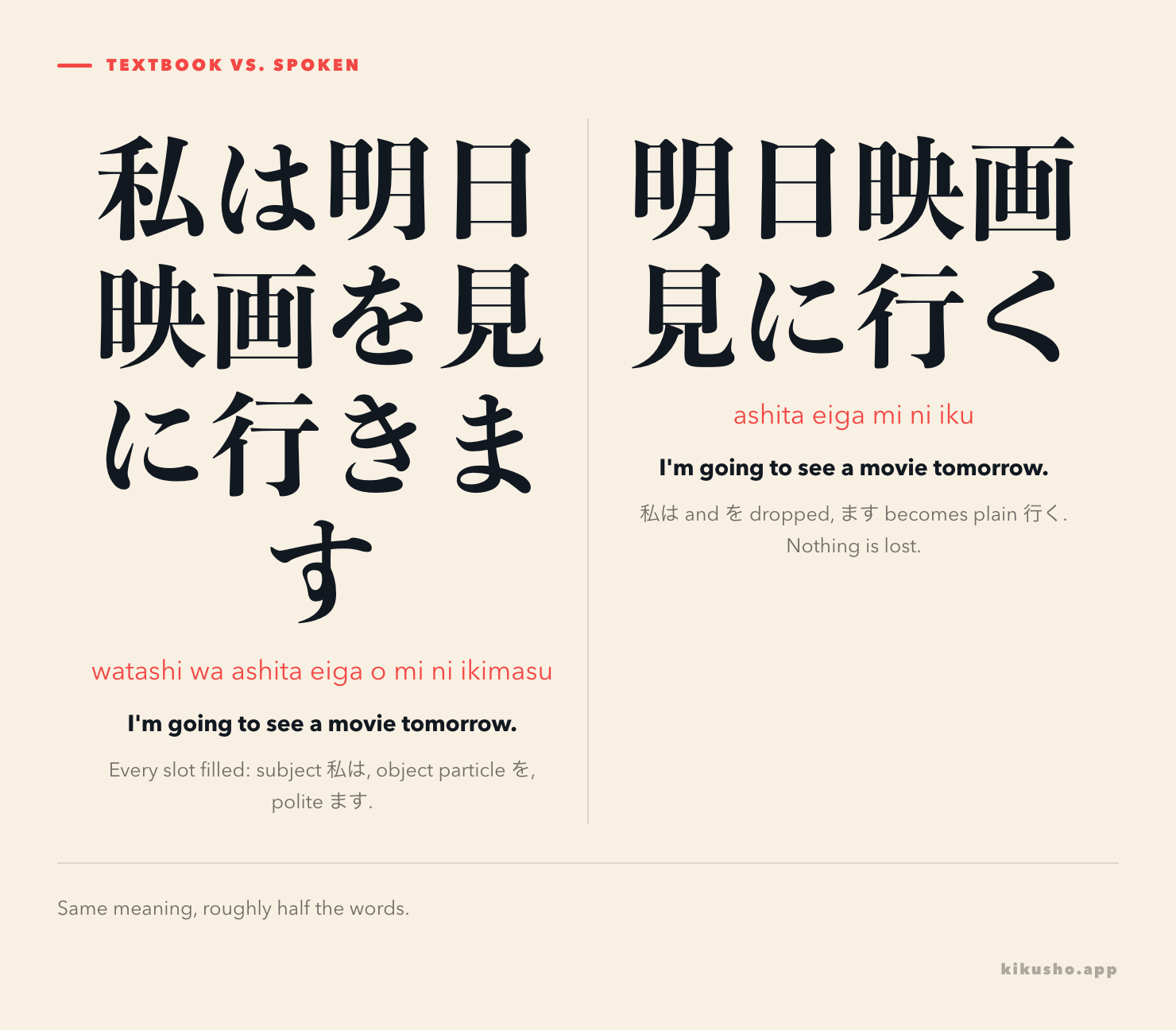
Both sentences mean exactly the same thing. The second is not sloppier or less educated — it is what a careful, fluent adult says to a friend. The first, said to that friend, would sound like you were addressing a committee.
The endings contract, and the contraction is regular
The second thing that happens between the book and the street is that long endings get shorter, and they do it by rule, not by whim. Once you see the pattern, a whole class of "words I've never heard" turns out to be forms you already know, squeezed.
ている loses its い and becomes てる: 食べてる, 見てる. なければ collapses to なきゃ. てしまう, the ending that marks an action as finished and past undoing, becomes ちゃう — 食べちゃった, "I went and ate it all". では becomes じゃ, which is why the textbook's ではない is everyone else's じゃない. ておく, doing something in advance, contracts to とく.
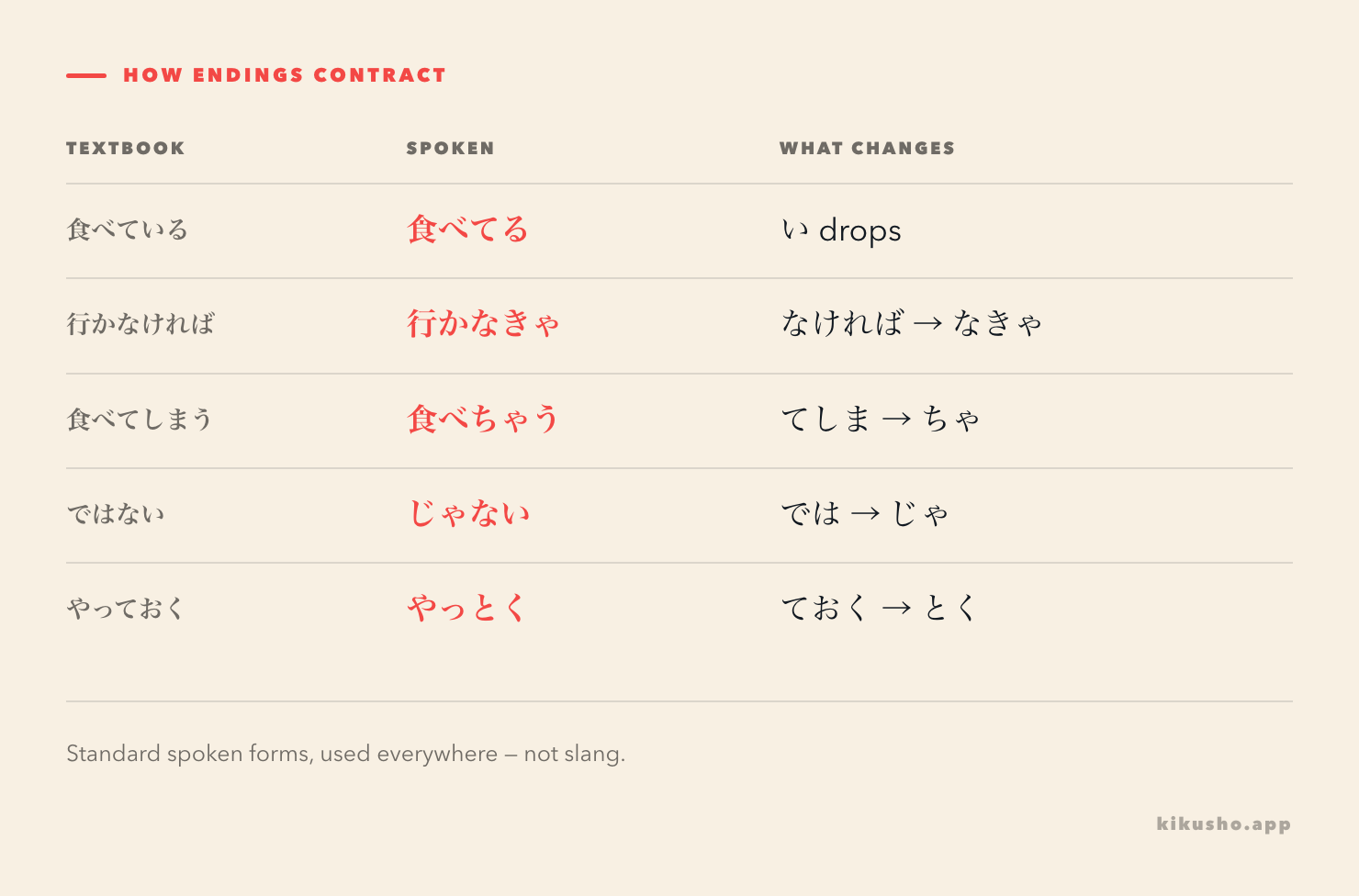
These are not slang and they are not regional — they are standard spoken Japanese, used by everyone, in every drama, constantly. A textbook prints the full forms because the full forms are the ones that decompose cleanly into grammar you can be taught. The contracted forms are what those same rules sound like at speed. Learning them is not learning new grammar; it is learning to recognise the grammar you have when it arrives compressed.
Final particles carry the tone です and ます can't
Strip a Japanese sentence down to just its information and something is missing that politeness alone cannot restore: the speaker's stance toward what they just said. That stance rides on the little particles at the very end — ね, よ, な, っけ, でしょ — and textbooks tend to omit them, because they carry attitude rather than facts, and attitude is not on the test.
The verb can frame that stance too: 思う, 考える and 気がする let you present a belief, a considered judgment or a hunch. Choosing between them changes how you put an idea to someone, even when all three sentences use polite endings.
But leaving them off is precisely what makes speech sound cold. 行く is a correct sentence and a slightly abrupt one. The particle is what turns a bare statement into something said to a person.
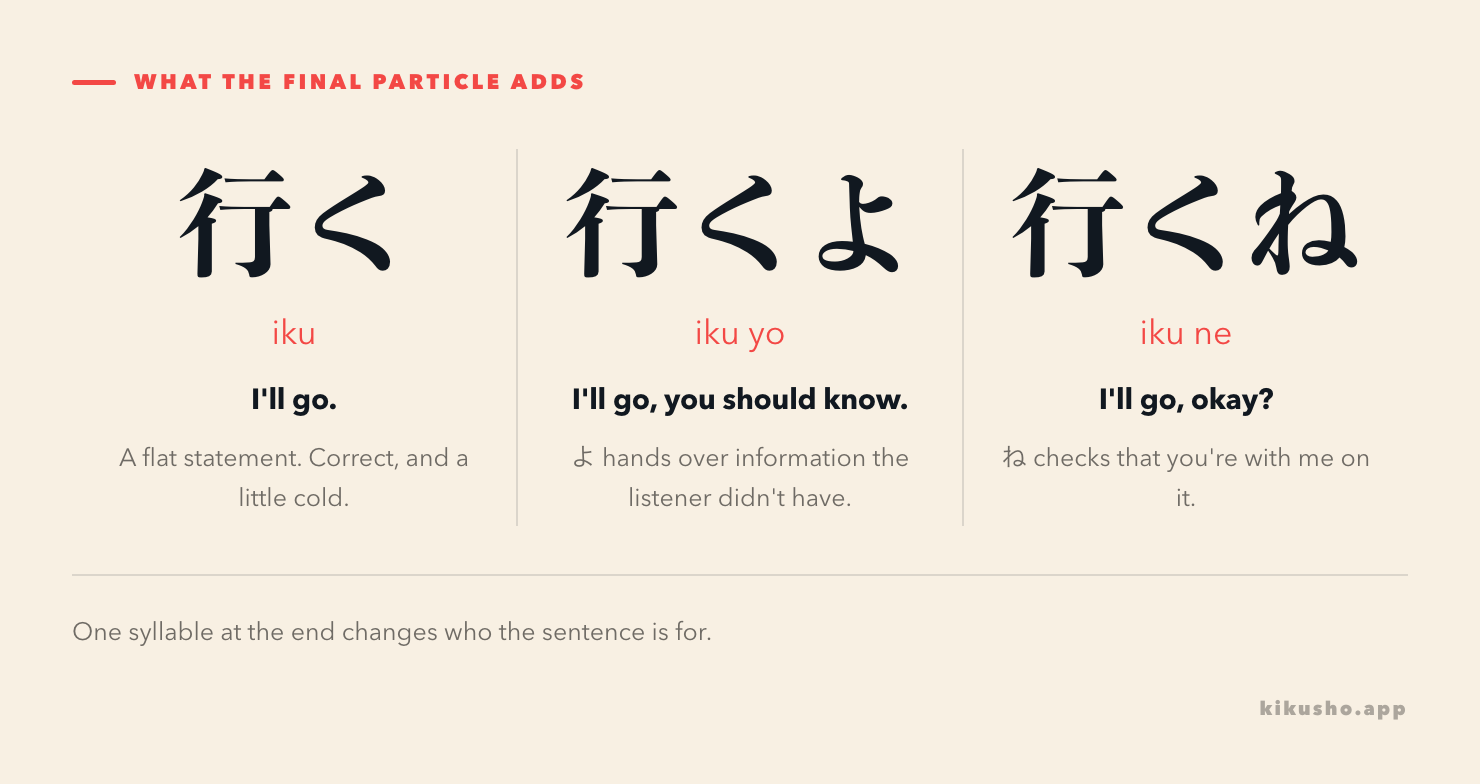
よ hands the listener a piece of information they did not have. ね reaches for agreement, checking that you and they are on the same page. Used together, よね does both at once. None of this changes the facts of the sentence, which is why a textbook can drop it — and why a native almost never does. If your Japanese sounds flat, missing final particles is often the reason, more than any grammar mistake.
Politeness is a dial the textbook leaves on one setting
Here is the part most learners feel but cannot name: textbook Japanese is not just polite, it is polite everywhere, at the same level, regardless of who is speaking to whom. Real politeness is a dial that moves constantly — up for a customer, down for a friend, and back up when the friend's boss walks in.
A native speaks plain form with people they are close to and shifts into です・ます with distance or respect, and the shifting itself is the fluency. Staying locked in ます with everyone is not more correct; it reads as keeping everyone at arm's length, which is its own kind of unnatural. This is far more manageable than it sounds, because keigo is not a second language bolted on top — it is a small set of levels and substitutions, laid out in how Japanese politeness works without memorising keigo. The skill textbooks under-teach is not the polite forms. It is knowing when to come down from them.
Notice that none of the four things in this article — dropped subjects, dropped particles, contracted endings, final particles — is vocabulary. They are all about what you do with words you already have. That is why looking up more words never fixes the stiffness.
What to do: collect the spoken form, not the citation form
The fix is not to unlearn the textbook. Its sentences are the skeleton, and you want the skeleton. The fix is to stop treating the citation form — the full, polite, dictionary version — as the only form worth keeping, and to collect the reduced form you actually heard alongside it.
This is the same skill as understanding fast speech, which breaks down in the same places: dropped sounds and fused phrases, not missing words. If that half of the problem is new to you, why you can't understand spoken Japanese even knowing the words is the companion to this one. Both come down to the gap between the written word and the spoken stream.
So when a line in a drama lands as 食べちゃった rather than 食べてしまいました, keep it the way it was said. A card that stores the contracted form, with a note on when it is used, teaches you the register at the same time as the meaning — and register is exactly what the textbook could not test. Kikusho drafts a card from a phrase you paste, say, or photograph in about three seconds, and each card carries a note on its politeness and register, so the way a line was said travels with what it meant. You can also pick a word out of an example sentence to make a card of its own. Collect enough of these and the stiffness resolves on its own: not because you studied harder, but because you finally started keeping the version people actually use.
Common questions
Is textbook Japanese wrong?
No. Everything a textbook teaches is correct and usable, and being understood is never the problem. It sounds stiff because it teaches the most explicit, most polite version of every sentence — the one that is safe in any situation — and natural speech is defined by what it leaves out of that version, not by different words.
Should I stop learning the polite forms first?
No. です and ます are the right place to start, because they are never rude and they let you build any sentence. The fix is not to skip them but to treat politeness as a dial you can turn down, and to collect the dropped particles and contracted endings as you meet them in real speech.
Why do textbooks leave out sentence-final particles like ね and よ?
Because they carry attitude rather than information, so there is nothing to test. A sentence is grammatical without them, which is exactly why a textbook can omit them and a native almost never does.