On this page
明日、東京に行く. Tomorrow, I go to Tokyo. The に your textbook drilled onto times, 3時に and 月曜日に, is simply gone here, and putting it back as 明日に is wrong. A whole family of time words behaves like this: 今日, 昨日, 明日 and everything else fixed to the moment you are speaking take no particle before the verb. They skip に because each one already carries its own position in time, so there is no separate point left for the particle to mark.
Learned one at a time, the group looks like a list of exceptions. Seen together, it is a closed set with a single rule, and the rule even tells you what the next unfamiliar time word will do.
They are all measured from the moment you speak
What the no-に words share is where their meaning comes from: the act of speaking. 今日 is not a date on the calendar. It is "the day this sentence is being said," which is why it points at a different date every morning. 明日 is the day after that one, 昨日 the day before, 先週 the week before this one, 来年 the year after this one. The reference point travels with the speaker, so the word always knows where it sits.
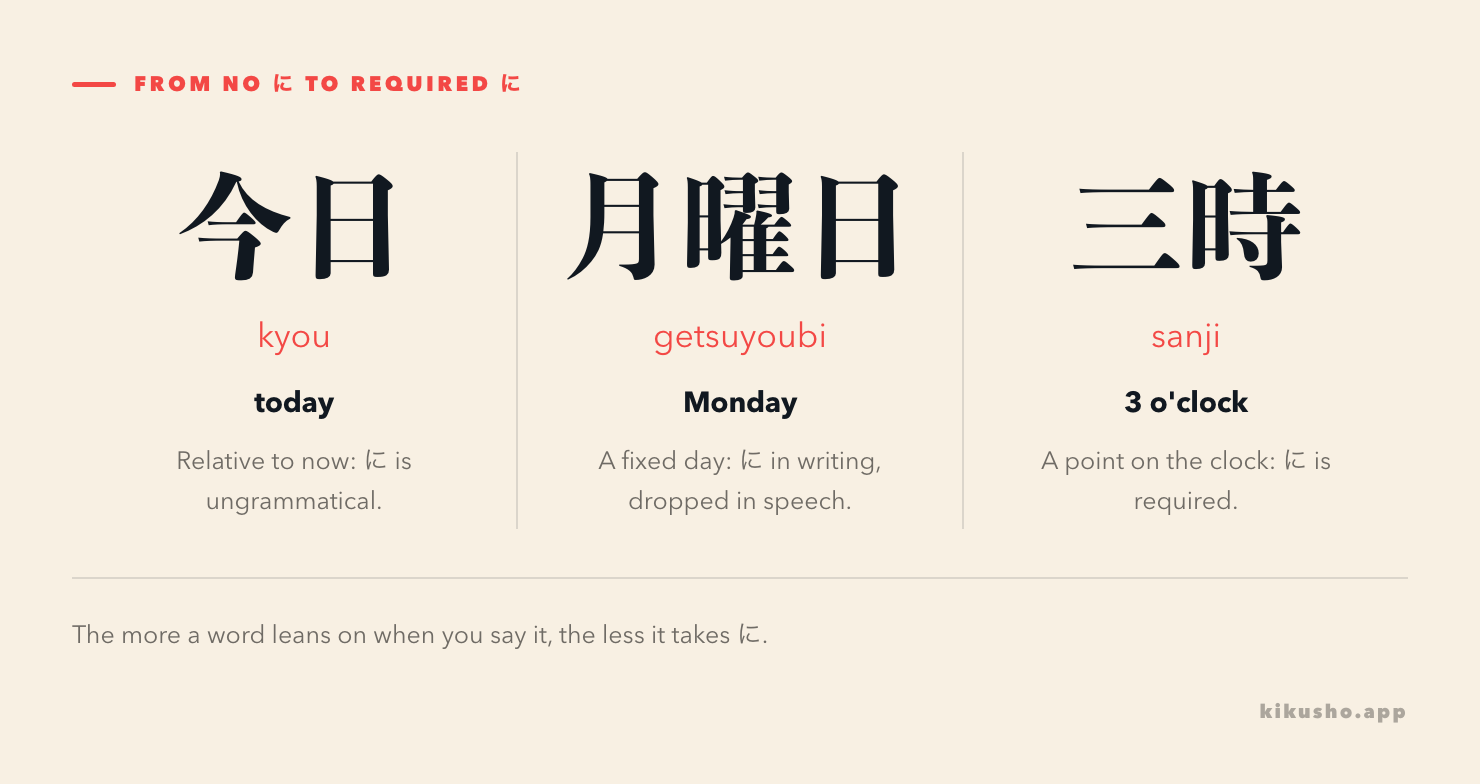
Set that against the times that do take に. 3時 is three o'clock whenever you say it. 月曜日 is Monday, 9月 is September, 2025年 is the year 2025, and not one of them shifts because you happened to speak on a Tuesday instead of a Sunday. These are fixed labels on the timeline, and に is what fastens a sentence to one of them.
That is why the no-に words form a closed set. You cannot invent a new one the way you can coin a noun; the language has only so many ways to say "the span around now." Because the group is finite and runs on one rule, it repays learning as a set rather than as a run of separate surprises.
The set, from last week to next year
Most of the group falls into a tidy grid: a span (day, week, month, year) crossed with one step back, now, and one step ahead.
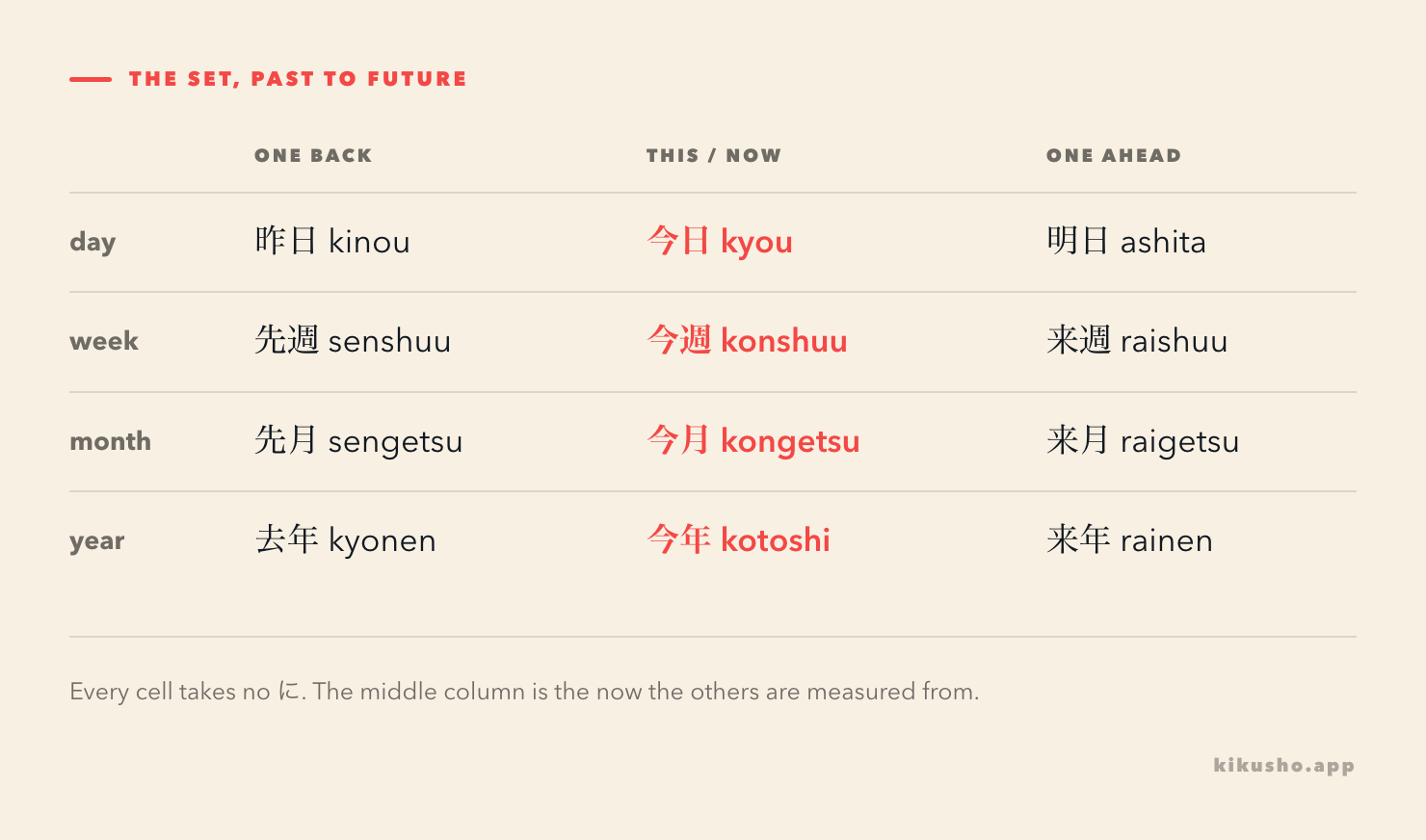
Around that core sit the finer-grained relatives that work the same way: 今朝 (this morning), 今晩 (tonight), おととい (the day before yesterday), あさって (the day after tomorrow), さっき (a moment ago), これから (from now on). None of them takes に. The handful you will reach for almost every day is smaller still: 今日, 明日, 昨日, 今 and 毎日. Get those five into your ear without a particle and most of your sentences about when something happens are already right.
One test tells you whether a new time word needs に
When you meet a time word you have not seen before, one question settles the particle: does its meaning change depending on when you say it? If the word means something different tomorrow than it does today, it is anchored to now, and it refuses に. If it names the same point forever, it takes に.
さっき (a moment ago) passes as relative, because the moment it points to keeps moving, so no に. 来週 shifts every week, so no に. 誕生日 (a birthday) is a fixed date on the calendar, so it behaves like a clock time: 誕生日に (on the birthday). The test sorts the tricky ones too. It is the same instinct behind why 住む takes に while 働く takes で: the particle answers to meaning, not to the word sitting in front of it. Here the meaning that decides is whether the word is already pinned to the present.
Meeting these words inside real sentences is what turns the test into a reflex instead of a rule you recite. Part of why they stay a list of exceptions for so long is that you tend to meet them one at a time, 明日空いてる? in a message or 来週まで on a sign, with no sight of the pattern behind them. Saving that line to Kikusho keeps the whole sentence on the card, so 明日 arrives with its missing particle in place rather than as a bare gloss, and the next relative time word slots into a rule you have already seen instead of opening a new exception.
The times that do take に
The other half of the rule is just as tidy: anything that names a fixed slot on the calendar or the clock takes に. Clock times, 3時に and 7時半に. Days of the month, 5日に and 20日に. Named months, 9月に. Years, 2025年に. Fixed occasions, 誕生日に (on the birthday) and クリスマスに (at Christmas). Each of these means the same thing no matter when you say it, so に does real work, fastening the sentence to that one point.
This also settles what happens when a relative word describes a fixed one. 来週 never takes に by itself, yet 来週の月曜日に (on next Monday) is fine: 来週 joins with の to say which Monday, and the fixed 月曜日 carries the particle. 今日の午後三時に works the same way, pinning the meeting to the clock while 今日 stays bare. The relative word does the pointing with の, and the fixed word takes the に.
Where the rule bends
Three groups sit on the edge, and they are worth knowing before they trip you.
The 毎 (every) words, 毎日, 毎週, 毎朝, 毎年, also skip に, but not because they are anchored to now. They say how often something happens, not when, and a frequency word is adverbial by itself. They belong with expressions like いつも and よく, covered in the adverbs of frequency, rather than with the calendar.
Weekdays and 週末 (the weekend) are fixed points, so the grammar gives them に: 月曜日に, 週末に. In conversation, though, that に is dropped so often that 月曜日、休む is as ordinary as the fuller form. These are the words you will hear both ways. 週末 leans hardest toward dropping the particle, since "this weekend" is already half-relative.
Finally, 今 hides a frozen exception. On its own it means "right now" and takes no particle: 今、行く, "I'm going now." But 今に is a set phrase meaning "before long," and 今のうちに means "while you still can." The に there is welded to the idiom; it is not 今 taking a time particle.
The particle they refuse is に, not は or から
The last thing to fix is the urge to overcorrect: these words drop に, and only に. Every other particle attaches normally. 今日は忙しい marks today as the topic, 今日から runs from today, 今日まで lasts until today, 今日の予定 is today's schedule. That first one leans on the same contrast as は versus が: 今日は sets today as what the sentence is about. The block is specific to the one particle whose whole job is to place an event in time, because the word has already done that placing itself.
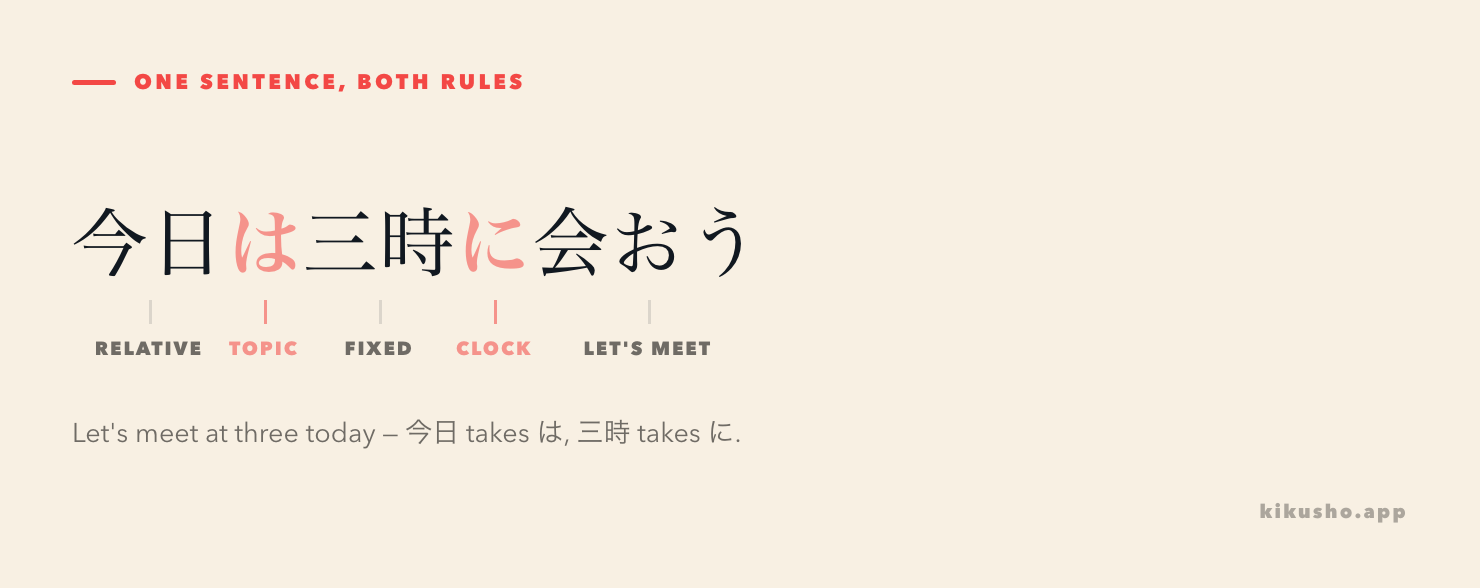
You can watch both rules run in a single breath. 今日は三時に会おう, "let's meet at three today," puts は on the relative 今日 and に on the fixed 三時, one clause apart. Nothing about 今日 is off-limits except the single particle it has no use for. Once you hold the group as what it is, a closed set fastened to the present, the particle stops being a decision and starts being obvious.
Common questions
Why does 3時 take に but 明日 doesn't?
3時 names a fixed point on the clock, the same point whenever you say it, so に fastens the event to it. 明日 means a different date each day you say it: it is defined by "now" and already carries its own place in time, leaving nothing for に to mark.
Can I put は or から after 今日?
Yes. These words refuse に specifically, not every particle. 今日は忙しい (today is busy), 今日から (from today) and 今日まで (until today) are all normal. に is the one that clashes, because the word has already located itself in time.
Do the days of the week take に?
In careful and written Japanese, yes: 月曜日に. In everyday speech the に is dropped constantly, so 月曜日、休む is common too. Weekdays name a fixed point, so unlike 今日 they can take the particle; they just lose it casually.
Does 毎日 take に?
No. 毎日, 毎週 and 毎年 skip に as well, but for a different reason: they state a frequency rather than a point in time, and a frequency word is adverbial on its own.